Best Crypto Exchanges for Corporate Treasury
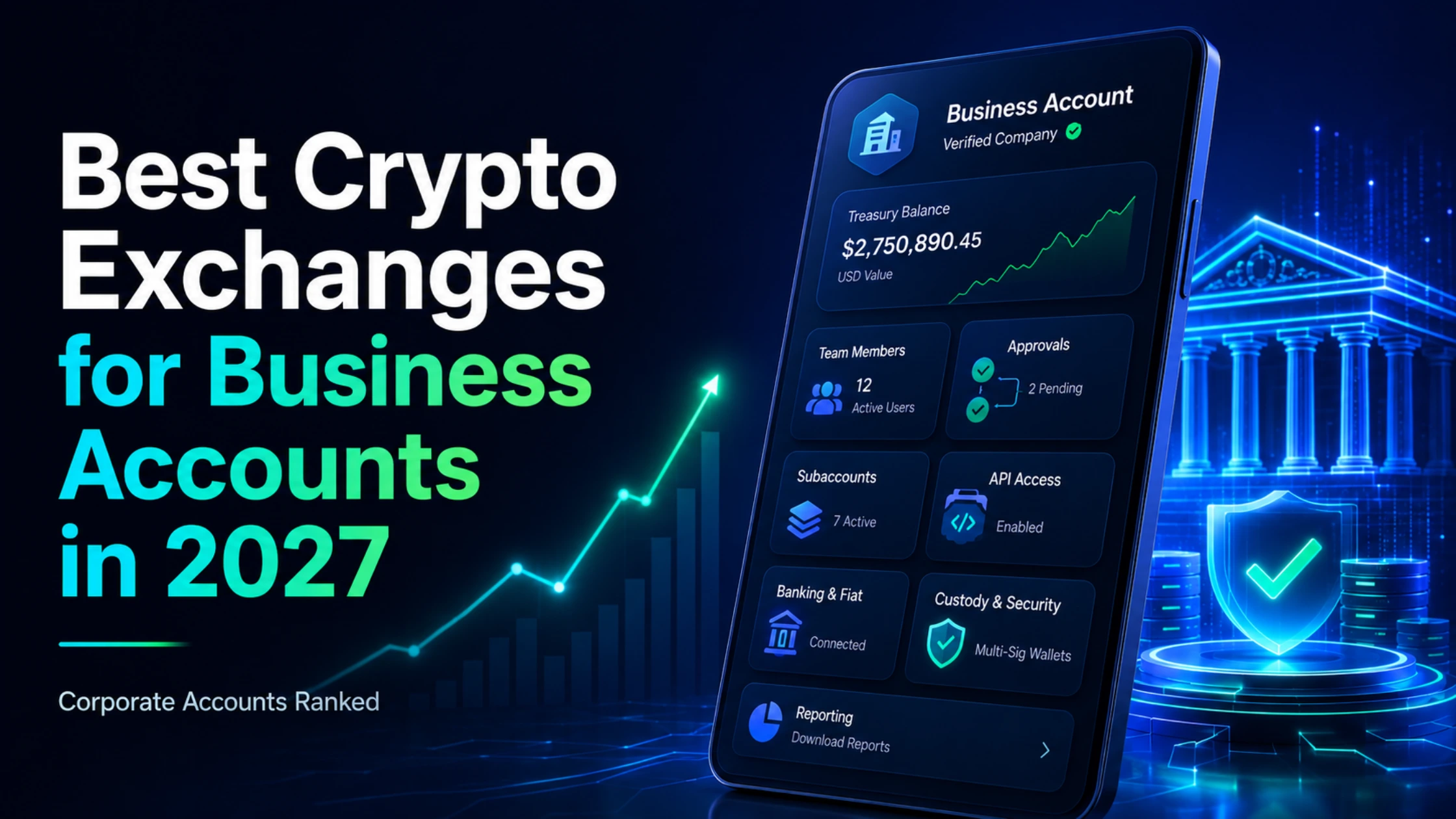
Compare the best crypto exchanges for business and corporate accounts in 2027. We rank Coinbase, Kraken, CEX.IO Prime, VALR, Binance, OKX, Bybit and Bitget for corporate KYC, UBO verification, multi-user permissions, subaccounts, APIs, OTC, reporting, fiat banking and institutional custody.
Data checked: 18 August 2026. Corporate eligibility, institutional products, regulatory permissions and banking services can change before and during 2027.
Summary
Opening a crypto exchange account for a company is fundamentally different from opening one as an individual.
A serious corporate platform may need to support:
- legal-entity onboarding
- directors and UBO verification
- company bank accounts
- multiple team members
- role-based access
- transaction approvals
- segregated subaccounts
- restricted API keys
- OTC execution
- institutional reporting
- audit-ready statements
- fiat settlement
- qualified or institutional custody
Decentralised News therefore developed the proprietary DN Corporate Exchange Readiness Score, which measures whether an exchange is genuinely capable of supporting a corporate treasury, fund, trading business, Web3 company or crypto-native SME.
Our current conclusions:
- Coinbase Prime: Best overall for institutional governance and qualified custody.
- Kraken: Best all-round business exchange for companies that need fiat, OTC, APIs and sophisticated governance.
- CEX.IO Prime: Best institutional alternative for multi-user trading, aggregated liquidity and post-trade settlement.
- VALR: Best business crypto exchange for South Africa and one of the strongest corporate-account architectures reviewed.
- Binance: Best for high-volume global trading infrastructure and extensive API functionality where available.
- OKX: Best for trading teams, managed accounts and sophisticated subaccount structures.
- Bybit: Best for derivatives-focused institutions and institutional reporting.
- Bitget: Strong institutional alternative with flexible subaccounts and independent API permissions.
The best platform depends much more on how the company intends to use crypto than on which exchange has the lowest headline trading fee.
Quick Verdict
For a company simply buying Bitcoin for its balance sheet, a full institutional prime-brokerage stack may be unnecessary.
For a fund managing several portfolios, however, allowing every trader to share the CEO’s exchange login would be unacceptable.
That distinction is why business exchange rankings need to go beyond:
Does this exchange accept corporate accounts?
The more important questions are:
Can different staff members have different permissions?
Can withdrawals require independent approval?
Can trading strategies be segregated into subaccounts?
Can auditors obtain reliable statements without receiving trading access?
Can API keys trade without having permission to withdraw funds?
Can large transactions move through an OTC desk rather than the public order book?
Can fiat move directly between the exchange and a bank account held in the company’s legal name?
These questions materially change the ranking.
For institutional governance, Coinbase Prime currently sets one of the highest standards.
For businesses that want a more conventional crypto exchange combined with strong fiat infrastructure, OTC, APIs and increasingly sophisticated team governance, Kraken is our strongest all-round choice.
CEX.IO Prime is compelling for professional firms requiring multi-user access, subaccounts, aggregated liquidity and post-trade settlement.
VALR deserves far more attention than most global comparisons give it. Its corporate platform combines subaccounts, multiple-user access, dual transaction authorisations and unusually granular API permissions.
Best Crypto Exchanges for Business Accounts in 2027
Rank | Platform | DN Corporate Readiness Score | Best For | Key Limitation |
1 | Coinbase Prime / Business | 95/100 | Institutional governance and custody | Business product availability remains geographically limited |
2 | 92/100 | Best all-round corporate exchange | Advanced Organizations governance remains in beta for some accounts | |
3 | 88/100 | Institutional execution and multi-user operations | Smaller trading ecosystem than the largest global exchanges | |
4 | 87/100 | South African and international corporate accounts | Strongest banking advantages remain ZAR-centric | |
5 | 84/100 | High-volume trading and API infrastructure | Corporate functionality varies by jurisdiction | |
6 | 83/100 | Managed trading teams and subaccounts | Institutional availability differs by region | |
7 | 81/100 | Derivatives institutions and reporting | Some retail products are unavailable to corporate users | |
8 | 79/100 | Subaccount and API flexibility | Institutional governance layer is less developed than the leaders |
Important: Scores reflect publicly documented corporate functionality as of the data-check date. They do not measure the financial solvency or investment risk of an exchange.
What Is the DN Corporate Exchange Readiness Score?
A corporate account should not receive a high score simply because an exchange accepts a certificate of incorporation.
The DN methodology assigns up to 100 points across nine categories.
DN Corporate Exchange Readiness Formula
Corporate Readiness = KYB + Governance + Subaccounts + API Controls + Institutional Execution + Reporting + Fiat Banking + Custody + Jurisdictional Fit
Weighting
Category | Maximum Score |
Corporate KYC and entity onboarding | 15 |
Multi-user governance and approvals | 20 |
Subaccounts and segregation | 10 |
API controls and permissions | 10 |
OTC and institutional execution | 10 |
Reporting and statements | 10 |
Fiat banking and settlement | 10 |
Custody architecture | 10 |
Jurisdictional clarity | 5 |
Total | 100 |
The methodology deliberately gives governance the largest individual weighting.
For a corporate treasury containing several million dollars, preventing one compromised employee account from authorising a withdrawal may matter more than saving five basis points on trading fees.
DN Corporate Exchange Readiness Calculator
Find the strongest crypto exchange for your company's operating model. Choose your business type and adjust the importance of governance, banking, APIs, custody, reporting and institutional execution.
Your Business
What Matters Most?
DN Best Fit
Your Ranked Shortlist
Companies can use the tool to adjust the weight given to:
- banking
- OTC
- subaccounts
- multiple users
- approval workflows
- APIs
- reporting
- custody
- jurisdiction
A two-person Web3 agency may therefore receive a different best-fit result from a regulated asset manager.
That is intentional.
There is no single “best corporate exchange” for every type of company.
Which Businesses Need Corporate Crypto Accounts?
Corporate crypto accounts can be useful for several very different types of organisation.
Corporate Treasuries
A company may hold:
- BTC
- ETH
- stablecoins
- tokenized assets
as treasury assets.
The priorities here are typically:
custody + governance + banking + reporting
rather than derivatives trading.
Crypto Funds and Asset Managers
Funds may need:
- institutional custody
- multiple portfolios
- trading APIs
- OTC
- financing
- sophisticated permissions
- audit records
- performance reporting
- segregated accounts
This moves platforms such as Coinbase Prime, Kraken and CEX.IO Prime higher in the ranking.
Web3 Businesses
Crypto-native companies may need to:
- receive stablecoin revenue
- pay contractors
- hold operational treasury
- hedge token exposure
- convert stablecoins to fiat
- automate transactions
- manage multiple wallets and accounts
API functionality and banking become particularly important.
Agencies and Professional-Service Firms
An agency receiving USDC from international clients may not need a prime broker.
It may instead require:
- corporate KYC
- stablecoin deposits
- fiat conversion
- bank withdrawal
- accountant access
- transaction exports
- simple treasury controls
Coinbase Business, Kraken and VALR can become considerably more relevant than a derivatives-focused venue.
Crypto-Native SMEs
These businesses often operate somewhere between a conventional business and an institutional trading company.
Their requirements may include:
payments + treasury + exchange + stablecoins + API automation + accounting
This is an increasingly important gap in the crypto market.
1. Coinbase Prime: Best Institutional Crypto Platform for Governance and Custody
Coinbase now has two different business propositions that should not be confused.
Coinbase Business
Coinbase Business is aimed more directly at operating companies.
Its current functionality includes:
- crypto trading
- stablecoin payments
- payment links
- invoicing
- payouts
- APIs
- bank connectivity
- accounting integrations
- tax-ready reporting
Businesses can move between crypto and bank money, automate payments and manage operations from a dedicated business account.
Current Coinbase Business availability is still limited compared with Coinbase’s broader retail footprint, with the product presently centred on eligible US and Singapore businesses.
Coinbase Prime
Coinbase Prime is the institutional platform.
This is where Coinbase becomes particularly difficult to beat on governance.
Prime distinguishes between:
- entities
- portfolios
- team members
- entity-level permissions
- portfolio-level permissions
Users can be assigned different roles depending on what they are allowed to do.
For example:
- Administrator
- Team Manager
- Initiator
- Approver
- auditor-style access
Permissions can differ across individual portfolios.
This is significantly more sophisticated than giving several employees access to one corporate login.
Coinbase Prime Approval Workflows
Coinbase Prime can separate the person who initiates an action from the person who approves it.
That architecture matters for:
- withdrawals
- transfers
- new users
- security changes
- high-value treasury movements
A business can therefore create governance that resembles conventional institutional treasury controls.
This is one of the most important criteria in the DN Corporate Exchange Readiness Score.
Coinbase Prime Custody
Prime Custody creates another major advantage.
Institutional clients can hold assets with Coinbase Custody Trust Company while accessing trading and financing functionality through the broader Prime infrastructure.
For organisations requiring qualified-custodian infrastructure, this can be substantially more important than choosing whichever exchange has the lowest spot commission.
Best for
- funds
- registered investment businesses
- sophisticated corporate treasuries
- family offices
- institutions
- businesses requiring strong internal controls
DN verdict
Best overall for institutional governance and custody.
Its primary weakness for smaller businesses is that the institutional stack may be far more sophisticated than they actually need.
2. Kraken: Best All-Round Crypto Exchange for Business Accounts
Kraken offers a dedicated Business Account rather than asking companies to operate through personal accounts.
Current corporate benefits include:
- personalised deposit and withdrawal limits
- Kraken Pro trading
- OTC access
- higher API limits
- eligible margin products
- eligible derivatives products
- corporate banking
- institutional API infrastructure
Corporate fiat transfers must generally move between Kraken and a bank account registered in the business’s name.
That separation between personal and company funds is exactly what a serious corporate account should require.
Kraken Corporate KYC
Kraken’s onboarding requirements illustrate why corporate KYC is considerably more involved than personal KYC.
Typical documentation can include:
- certificate of formation or equivalent
- articles of incorporation
- company share registry
- organisational chart
- proof of operating address
- business banking evidence
- director information
- beneficial-owner information
- authorised-account-user information
Additional due-diligence documents can be required depending on the company’s activities.
Businesses operating regulated crypto or financial services can face additional scrutiny.
Kraken Organizations
Kraken’s newer Organizations governance system materially changes its corporate proposition.
Where available, organisations can:
- invite team members
- assign trading permissions
- assign funding permissions
- assign administrative permissions
- create approval policies
- require multiple approvals
- protect address changes
- control access changes
- use service users for programmatic API access
- enforce stronger organisation-level security policies
This makes Kraken considerably more suitable for corporate treasuries.
Important limitation
Organizations remains a beta product and may not yet be enabled for every Business Account.
Its current beta architecture also has limitations compared with mature multi-portfolio institutional systems.
Kraken Reporting
Businesses can export:
- account statements
- balances
- trades
- ledger activity
through the platform, with API-based history export also available.
That is important for:
- accounting
- auditing
- tax preparation
- treasury reconciliation
DN verdict
Best overall conventional crypto exchange for corporate accounts.
Coinbase Prime has the more sophisticated institutional custody architecture, but Kraken provides an unusually strong combination of banking, trading, OTC, APIs, reporting and emerging corporate governance.
3. CEX.IO Prime: Best Institutional Alternative for Multi-User Operations
CEX.IO Prime is designed specifically for institutional and corporate customers.
It is not simply the standard exchange with a higher withdrawal limit.
Its institutional architecture includes:
- aggregated liquidity
- professional execution
- web trading
- REST API
- WebSocket API
- FIX connectivity
- institutional custody
- subaccounts
- multiple users
- configurable access rights
- reporting
- dedicated account management
CEX.IO Prime Subaccounts
Businesses can create separate subaccounts for:
- strategies
- assets
- departments
- clients
Each subaccount can maintain segregated crypto balances.
This is particularly useful for:
- asset managers
- proprietary trading firms
- fintech companies
- brokerages
- family offices
CEX.IO Prime Multi-User Access
Team members can receive different access rights.
That matters because:
trading permission
should not automatically mean:
withdrawal permission.
CEX.IO Prime’s institutional design makes it significantly more appropriate for professional trading operations than a retail account shared between several employees.
Institutional Execution
CEX.IO Prime aggregates liquidity across different venues and provides institutional execution infrastructure.
For a business executing large orders, this can reduce the need to manually divide orders across several exchanges.
The service also supports post-trade settlement and custody.
DN verdict
One of the strongest institutional alternatives to Coinbase Prime and Kraken.
Particularly attractive for companies that prioritise multi-user access, subaccounts, institutional execution and API connectivity.
4. VALR: Best Business Crypto Exchange for South Africa
Referral code: VAZP2TAW
VALR is particularly important because most international corporate-exchange comparisons dramatically underestimate it.
VALR explicitly welcomes corporate customers and provides dedicated business infrastructure.
Its current corporate platform includes:
- corporate accounts
- multi-user access
- dual transaction authorisations
- subaccounts
- institutional APIs
- fiat banking
- trading
- custody infrastructure
VALR Corporate KYC
Corporate onboarding can require documents such as:
- company registration
- director identification
- director proof of address
- proof of business address
- corporate bank-account evidence
- income-tax registration
- VAT information where applicable
- ownership information
- beneficial-owner information
- authorised trader details
- source-of-funds explanation
- business-purpose explanation
Companies providing financial services to third parties can face additional compliance requirements.
That is an important distinction.
A software company buying BTC for its own treasury is not the same compliance profile as an asset manager trading customer money.
VALR Multi-User and Dual Authorisation
This is one of VALR’s strongest corporate features.
VALR markets its business architecture around multiple user access and dual authorisations, reducing the need to share login credentials.
For treasury management, that is materially safer than a single-user exchange account.
VALR Subaccounts
Corporate customers can create subaccounts to segregate:
- treasury holdings
- client assets
- strategies
- departments
- trading operations
VALR currently allows up to 50 subaccounts through its standard API framework, with larger requirements handled through its business team.
Internal transfers can also be automated programmatically.
VALR API Permissions
VALR deserves particular credit for API permission granularity.
API keys can be configured with capabilities including:
- View
- Trade
- Withdraw
- Internal Transfer
- Link Bank Account
This allows a business to create, for example:
a trading bot that can execute orders but cannot withdraw funds.
That is precisely the kind of access separation corporate systems should provide.
DN verdict
Best business crypto exchange for South Africa and one of the strongest corporate-account architectures in this ranking.
VALR becomes particularly difficult to beat when the business also requires ZAR banking.
5. Binance: Best for High-Volume Trading and API Infrastructure
Referral code: CPA_00SXKU7IO9
Binance’s institutional strength is its enormous trading infrastructure.
Its current developer and institutional stack supports capabilities including:
- subaccounts
- portfolio margin
- institutional loans
- algorithmic trading
- block execution
- advanced APIs
- institutional trading systems
- VIP services
For sophisticated trading businesses, this infrastructure can be highly valuable.
Binance Subaccounts
Master accounts can create and manage subaccounts.
Corporate trading operations can use them to separate:
- strategies
- trading teams
- risk books
- market-making activity
- different asset exposures
API infrastructure also allows programmatic management of subaccounts and permissions.
Where Binance Scores Lower
The reason Binance does not automatically win this ranking is that trading infrastructure and corporate governance are not the same thing.
Binance is extraordinarily capable as a trading platform.
But companies requiring formal treasury approval policies, highly developed audit workflows or qualified-custody architecture should compare it directly with Coinbase Prime, Kraken and specialist institutional providers.
Availability also differs significantly between jurisdictions.
DN verdict
Best for companies whose primary requirement is high-volume crypto trading infrastructure.
Especially relevant for algorithmic trading firms, market makers and crypto-native companies operating in eligible jurisdictions.
6. OKX: Best for Managed Trading Teams and Subaccounts
Referral code: 2136301
OKX has developed a particularly interesting subaccount architecture.
Standard subaccounts can help organisations separate:
- trading strategies
- bots
- portfolios
- risk
VIP users can access larger numbers of subaccounts.
But the most interesting corporate feature is Managed Trading Subaccounts.
OKX Managed Trading Subaccounts
This architecture separates the party owning the capital from the trading team managing the strategy.
The investor maintains control over the assets while a trading team receives permission to operate the strategy.
Withdrawals remain controlled through the main account.
That creates an operational separation between:
capital ownership
and
trading execution.
This is highly relevant to:
- asset managers
- proprietary trading teams
- quantitative funds
- external trading managers
Trading teams need to meet institutional and VIP eligibility requirements.
OKX API Controls
OKX supports API connections and subaccount management for sophisticated trading operations.
The combination of:
- subaccounts
- managed accounts
- API access
- institutional liquidity
makes it one of the stronger exchanges for active trading businesses.
DN verdict
Best for firms that need structured delegation of trading activity.
It is particularly attractive when portfolio segregation and managed-trader relationships matter more than conventional corporate treasury workflows.
7. Bybit: Best for Derivatives-Focused Institutions and Reporting
Referral code: 46164
Bybit supports Business KYC for corporate entities.
Its current requirements can include:
- certificate of incorporation
- constitutional or formation documents
- register of members
- register of directors
- beneficial-owner information
- UBO identity verification
- director identification
- authorised operator information
- organisational chart
Bybit currently uses a 25% ownership threshold for identifying UBOs in its published standard corporate documentation, although additional persons and information can be requested.
Corporate Withdrawal Limits
Business verification substantially increases potential withdrawal capacity.
Published corporate limits scale further with VIP and PRO institutional status.
That is important for professional trading businesses with significantly larger capital flows than a conventional retail account.
Bybit Institutional Reporting
One of Bybit’s strongest features is its institutional reporting portal.
Institutional users can generate reports covering:
- account statements
- profit and loss
- transaction logs
- deposits and withdrawals
- loans
Reports can include both:
- main accounts
- subaccounts
and can be exported in formats including PDF and CSV depending on the report.
That is a meaningful advantage for finance and operations teams.
Bybit Corporate Limitations
Corporate users should not assume every retail feature remains available.
Some Bybit products specifically exclude corporate or institutional users.
Certain fiat purchase methods also have different identity-verification rules.
DN verdict
Best for derivatives-oriented institutional trading teams that value structured reporting.
The corporate proposition is strong, but product-level restrictions should be reviewed carefully before onboarding.
8. Bitget: Strong Subaccount and API Flexibility
Referral code: nqef
Bitget supports dedicated Business Verification / KYB.
Corporate-document requirements vary according to organisation type.
Like the other major venues, Bitget may require information relating to:
- the legal entity
- directors
- shareholders
- UBOs
- authorised representatives
- addresses
- business activities
Bitget Subaccount APIs
Bitget is particularly interesting from an API-management perspective.
Subaccounts can have independently managed API keys when the master account grants permission.
Depending on the account configuration, a subaccount can:
- create API keys
- view API keys
- edit API permissions
without requiring the master account to perform every API-management action.
For organisations running multiple trading systems, that can simplify operational separation.
DN verdict
Strong alternative for algorithmic trading teams and crypto-native companies requiring flexible subaccount API administration.
It currently ranks behind the leaders because the documented governance and institutional treasury layer is less comprehensive.
What Documents Are Required for a Corporate Crypto Account?
Every exchange has different requirements.
But a company should prepare for significantly more documentation than an individual investor.
A typical package can include:
Corporate documents
- certificate of incorporation
- articles of association
- memorandum of association
- partnership agreement
- trust agreement
- register of directors
- shareholder register
- business licence
- regulatory licence where relevant
Ownership information
- ownership percentages
- organisational chart
- parent entities
- subsidiaries
- intermediary holding companies
- UBOs
Individual documentation
For directors, controllers, authorised users and UBOs:
- passport or ID
- proof of address
- tax number
- contact information
- role within company
Financial information
Potential requests include:
- corporate bank statement
- financial statements
- source of funds
- source of wealth
- revenue information
- expected trading volume
- expected deposit size
The larger or more complex the organisation, the more likely additional due diligence becomes.
What Is a UBO?
UBO means Ultimate Beneficial Owner.
Suppose:
John owns 100% of Holding Company A
which owns:
60% of Trading Company B
which opens the exchange account.
John may still be considered an ultimate beneficial owner even though his name does not directly appear as the shareholder of Trading Company B.
Corporate exchanges therefore frequently require an ownership chart that follows the structure all the way through to the underlying natural persons.
UBO Thresholds Are Not Universal
Do not assume every exchange uses the same percentage.
Different platforms and jurisdictions can use thresholds such as:
- 25%
- 10%
- 5%
or request information about additional controlling persons regardless of ownership percentage.
VALR, for example, currently asks corporate applicants for information on individuals or entities owning more than 5% in its published onboarding guidance.
Bybit’s standard published Business KYC documentation identifies UBOs holding 25% or more.
Kraken’s threshold can depend on the applicable regulatory jurisdiction.
This is another reason generic “documents needed” lists can be misleading.
Multi-User Access Is Not the Same as Subaccounts
This distinction matters.
Multi-user access
Multiple people interact with the same corporate account.
For example:
- CFO
- trader
- accountant
- treasury manager
Each may have different permissions.
Subaccounts
The organisation creates additional segregated accounts beneath a main account.
For example:
Corporate Main Account
→ Treasury
→ Market Making
→ BTC Strategy
→ Client A
→ Client B
A strong institutional platform may support both.
Why Sharing One Login Is a Corporate Security Failure
Imagine a business with:
- CEO
- CFO
- two traders
- accountant
All five share one exchange login.
The exchange cannot easily determine:
- who executed a trade
- who changed security settings
- who created an API key
- who authorised a withdrawal
When one employee leaves, the company may need to replace shared credentials.
A proper multi-user system creates individual identities and logs.
That gives the company:
accountability + revocation + permissions + auditability
which is far more appropriate for corporate finance.
Approval Workflows Matter More Than Most Exchange Rankings Admit
Consider a treasury withdrawal of:
$2 million USDC.
The business may want:
- Treasury analyst initiates withdrawal
- CFO reviews
- Second director approves
- Transfer executes
That process creates segregation of duties.
A retail-style exchange account may instead allow one user to execute everything.
Coinbase Prime and Kraken’s newer organisation-level governance systems perform particularly strongly in this category.
VALR’s dual-authorisation architecture is also notable.
API Permissions: The Most Overlooked Corporate Risk
Businesses increasingly connect exchanges to:
- trading bots
- treasury software
- portfolio management
- accounting platforms
- market-making infrastructure
- internal dashboards
An API key should have only the permissions it actually needs.
Low-risk example
Portfolio reporting software receives:
View only
Trading bot
Receives:
View + Trade
but:
No withdrawal
Treasury automation
May require:
Transfer
with additional controls.
Giving every integration unrestricted withdrawal access creates unnecessary attack surface.
Granular API permissions therefore contribute directly to the DN Corporate Exchange Readiness Score.
Which Exchange Is Best for Corporate Treasury?
For a conventional company holding BTC or stablecoins as treasury assets, our starting shortlist is:
1. Coinbase Prime
Best institutional governance and custody architecture.
2. Kraken
Excellent banking, OTC, trading, APIs and corporate verification.
3. VALR
Particularly attractive for South African corporate treasuries.
4. CEX.IO Prime
Strong institutional custody and execution alternative.
A treasury’s priorities differ from a proprietary trading firm.
The ability to trade 300 altcoins is probably much less important than:
- custody
- approval policies
- banking
- statements
- account recovery
Which Exchange Is Best for Crypto Trading Companies?
Our shortlist shifts.
Binance
Extremely strong trading and API infrastructure.
OKX
Excellent subaccount and managed-trading architecture.
Bybit
Strong derivatives and institutional reporting.
Bitget
Flexible APIs and subaccount administration.
CEX.IO Prime
Particularly strong for institutional execution and aggregated liquidity.
Which Exchange Is Best for a Web3 Startup?
The needs are different again.
A Web3 startup may need:
- stablecoin payments
- contractor payouts
- treasury conversion
- fiat off-ramping
- APIs
- accounting
- banking
Coinbase Business is particularly interesting for eligible US and Singapore companies because the product combines trading, payments, banking and accounting integrations.
Kraken is another strong all-round option.
VALR becomes especially compelling for South African companies.
Which Exchange Is Best for a Crypto Fund?
Institutional funds should prioritise:
- custody
- governance
- execution
- reporting
- subaccounts
- regulatory fit
Our strongest starting points are:
Coinbase Prime
CEX.IO Prime
Kraken
with Binance, OKX and Bybit becoming particularly interesting for trading-intensive strategies.
Which Exchange Is Best for a South African Business?
VALR is our current first choice.
Its combination of:
- South African regulatory footprint
- ZAR banking
- corporate accounts
- multiple users
- dual authorisations
- subaccounts
- API permissions
creates a particularly strong local proposition.
Kraken is a strong international alternative where the required products and funding rails are available.
OTC Trading for Businesses
Large companies should not assume the public exchange order book is always the best place to execute.
OTC desks can help with:
- large BTC purchases
- treasury reallocations
- stablecoin conversions
- large asset disposals
- reduced market impact
- negotiated settlement
Platforms with institutional OTC infrastructure therefore receive additional credit under the DN methodology.
For a $500 purchase, OTC is irrelevant.
For a $5 million treasury transaction, it can be critical.
Corporate Fiat Banking
A business exchange should ideally allow funds to move directly between:
Company Bank Account ↔ Corporate Exchange Account
without routing money through an employee.
That is essential for:
- accounting
- auditing
- compliance
- ownership clarity
Kraken explicitly requires business-account fiat transfers to use accounts registered in the company’s name.
Coinbase Business similarly requires the linked bank account name to match the business.
VALR’s corporate onboarding requires evidence of the company’s bank account.
This is good practice, not inconvenience.
Reporting and Account Statements
Corporate accounting requires more than screenshots.
Finance teams can need:
- transaction history
- balances
- deposit history
- withdrawal history
- trading history
- fee records
- monthly statements
- P&L
- tax exports
- API access
Bybit’s institutional reporting infrastructure is particularly strong.
Kraken also offers formal statement and ledger exports.
Coinbase Business integrates with accounting platforms such as:
- QuickBooks
- Xero
- NetSuite
while Coinbase Prime provides institutional portfolio reporting.
CEX.IO Prime offers exportable institutional reporting.
Custody: Exchange Wallet or Institutional Custodian?
Not every company should hold its entire treasury in an exchange trading wallet.
Possible models include:
Exchange custody
Maximum trading convenience.
Institutional custody
Assets held under more restrictive institutional controls.
Qualified custody
Relevant to certain regulated investment businesses.
Self-custody
Company controls its own signing architecture.
Hybrid model
Trading capital remains on exchange while long-term treasury assets are moved to separate institutional or self-custody infrastructure.
For larger companies, the hybrid model can substantially reduce exchange exposure.
The Jurisdiction Problem
A platform may advertise:
corporate accounts globally
while specific products remain unavailable in certain jurisdictions.
Companies must separately confirm:
- whether the legal entity can onboard
- whether its directors and UBOs are permitted
- whether fiat banking is supported
- whether derivatives are allowed
- whether OTC is available
- whether institutional custody exists
- which legal entity provides each service
These questions become more important as the company grows.
Best Corporate Crypto Exchange by Business Type
Business Type | DN Starting Choice | Strong Alternative |
Corporate treasury | Coinbase Prime | Kraken |
Web3 startup | Coinbase Business | Kraken |
South African company | VALR | Kraken |
Crypto hedge fund | Coinbase Prime | CEX.IO Prime |
Proprietary trading firm | Binance | OKX |
Quantitative trading firm | Binance | Bitget |
Derivatives trading business | Bybit | OKX |
External trading manager | OKX | CEX.IO Prime |
Company needing qualified custody | Coinbase Prime | Specialist custodian |
High-volume OTC client | Kraken | Coinbase Prime / CEX.IO Prime |
Corporate Crypto Account Onboarding Checklist
Before applying, prepare:
Entity
- legal company name
- registration number
- incorporation date
- registered address
- operating address
- tax number
- business activities
Ownership
- shareholder register
- directors
- UBOs
- organisational chart
- parent entities
People
- directors’ identification
- authorised traders
- account administrators
- beneficial owners
- proof of residential addresses
Banking
- company bank statement
- bank-account confirmation
- expected fiat flows
Business Activity
- reason for opening account
- expected monthly volume
- expected assets
- intended products
- source of funds
- source of wealth where requested
Regulated Companies
- licences
- regulatory registrations
- AML programme
- compliance policies
- customer-fund structure
Preparing these before beginning the application can materially reduce onboarding delays.
How to Choose a Business Crypto Exchange
Do not begin with:
Which exchange has the lowest trading fees?
Instead ask:
1. Who owns the account?
The company or an employee?
It should normally be the company.
2. Who can access it?
Can everyone receive individual credentials?
3. Who can trade?
Can traders be separated from administrators?
4. Who can withdraw?
Can withdrawal permission be restricted?
5. Who approves withdrawals?
Can two people be required?
6. Can portfolios be segregated?
Look for subaccounts or portfolios.
7. Can software connect safely?
Evaluate API permissions.
8. Can finance teams reconcile the account?
Check statements, exports and APIs.
9. Can large trades move efficiently?
Evaluate OTC and liquidity.
10. Where are assets held?
Understand custody.
These questions provide far more useful answers than another generic comparison of maker and taker fees.
Frequently Asked Questions
Can a company open a crypto exchange account?
Yes.
Major exchanges including Coinbase, Kraken, Binance, OKX, Bybit, Bitget, VALR and CEX.IO provide corporate, business or institutional onboarding in eligible jurisdictions.
Availability and requirements vary.
Should I use my personal crypto account for company money?
Generally, a dedicated corporate account creates much cleaner separation between business and personal assets.
It also simplifies accounting, banking, compliance and ownership records.
What is corporate KYC?
Corporate KYC or KYB verifies:
- the legal entity
- ownership
- directors
- authorised users
- beneficial owners
- source of funds
- business activities
rather than verifying only one individual.
What is KYB?
Know Your Business.
It is the corporate equivalent of identity-verification procedures used for individual customers.
What is a UBO?
An Ultimate Beneficial Owner is a natural person who ultimately owns or controls an entity.
The percentage threshold used to identify a UBO can vary by exchange and jurisdiction.
Can multiple employees use one corporate exchange account?
Some institutional platforms support multiple users with individual permissions.
This is preferable to sharing one password.
Which crypto exchanges support approval workflows?
Coinbase Prime has sophisticated role and approval architecture.
Kraken’s Organizations system introduces similar governance capabilities for eligible Business Accounts.
VALR also provides dual-authorisation functionality for corporate users.
Which exchange is best for a business in South Africa?
VALR currently provides our strongest business-account proposition for South African companies due to its ZAR infrastructure, corporate accounts, subaccounts, multi-user capabilities and API controls.
What is the best exchange for institutional crypto custody?
Coinbase Prime is particularly strong because institutional clients can access qualified custody alongside trading and financing infrastructure.
Which exchange is best for a crypto trading firm?
Binance, OKX, Bybit, Bitget and CEX.IO Prime are particularly relevant for trading-intensive businesses.
The right choice depends on spot versus derivatives trading, jurisdictions, APIs and capital structure.
Can businesses use OTC desks?
Yes.
Many institutional exchanges provide OTC execution for eligible large clients.
Requirements and minimum transaction sizes vary.
Can businesses open subaccounts?
Yes.
Subaccounts are available on platforms including Binance, OKX, Bybit, Bitget, VALR and CEX.IO Prime.
The exact number and functionality differ.
Do corporate crypto accounts require source-of-funds evidence?
They can.
Companies should expect exchanges to request information explaining where capital originates, particularly for larger, unusual or regulated transactions.
Can an exchange reject a corporate account?
Yes.
Successful incorporation does not guarantee onboarding.
Platforms evaluate:
- jurisdiction
- industry
- ownership structure
- sanctions exposure
- regulatory status
- source of funds
- intended activity
and other risk factors.
Final Verdict
The corporate crypto market has moved well beyond simply allowing a company name on an exchange profile.
The strongest platforms are becoming digital-asset operating systems for businesses.
For institutions requiring sophisticated governance and custody, Coinbase Prime currently sets the benchmark.
For companies that want a powerful traditional exchange combined with fiat banking, OTC, APIs, reporting and increasingly sophisticated corporate permissions, Kraken is our strongest all-round recommendation.
CEX.IO Prime deserves consideration from institutions requiring multi-user access, subaccounts, aggregated liquidity and professional settlement infrastructure.
VALR is the standout corporate exchange for South Africa and one of the most technically interesting business-account platforms reviewed, particularly because of its dual authorisations, subaccounts and granular API permissions.
Binance remains exceptionally powerful for high-volume institutional trading.
OKX is particularly strong for managed trading teams and segregated strategies.
Bybit distinguishes itself through derivatives infrastructure and institutional reporting.
Bitget offers flexible KYB, subaccounts and independent API management.
The central lesson is that businesses should not choose an exchange using the same criteria as retail traders.
For companies, the real question is not simply:
Where can we trade crypto?
It is:
Where can we control who trades, who moves money, who approves transactions, how portfolios are segregated, how auditors obtain records and how assets are ultimately protected?
That is what the DN Corporate Exchange Readiness Score is designed to measure.
Affiliate Disclosure
Some links in this article are affiliate links. Decentralised News may receive compensation if an eligible business or user opens an account through one of these links. Affiliate relationships do not influence rankings, methodology, risk assessments or editorial conclusions.
Disclaimer
This article is for educational and informational purposes only and is intended for readers aged 18 and over. Crypto assets involve substantial financial, operational, custody and regulatory risks. Corporate eligibility, banking, custody, derivatives and institutional products vary by jurisdiction. Businesses should obtain appropriate legal, tax, accounting and compliance advice before opening or operating a corporate digital-asset account.
Recommended reading:
Best Crypto Exchanges for DCA in 2027: Recurring Buy Fees, Spreads and True Costs Compared
Crypto Liquidation Fairness Index 2026: Which Exchanges Liquidate Traders Most Fairly?
Best Crypto Exchange VIP Programs: Fees, Qualification and Benefits Compared
Best Crypto Exchanges for Cashing Out in 2027: Bank Withdrawal Fees, Speed and True Costs Compared