
Money Stories · Original fiction · 10 minute read
The metronome began ticking inside Naoko’s bag between stations. The woman beside her looked down, then moved her own bag a little farther away.
“It’s for music,” Naoko said.
“I hoped it was.”
Naoko caught the little red pendulum and fastened it. Mio, who was nine, had left it in the teaching room on Friday. There was a rabbit sticker on its base and a piece of tape holding the cover shut. Naoko had meant to leave it at home. Instead, she was taking it to inspect a flat ninety minutes farther from her work than the one she occupied now.
Her brother had sent her the listing with three exclamation marks. He reserved that many for weddings and appliances bought below their usual price.
Room for Dad’s piano!!!
There was room. She had enlarged the photograph until the advertised rectangle became almost the size of the room itself. The piano could stand against the inner wall. A lamp beside it. The stool at the proper distance. No laundry drying across the keyboard.
At forty-three, Naoko knew exactly how much space a person could claim by calling it necessary for something else.
Her father’s upright was in a specialist storage workshop, where it had been for eight months. The family house had been sold. She paid eight thousand yen a month for storage and put aside another two thousand for its care. It was insured under the storage agreement; it was not rotting in a garage, as her brother occasionally suggested without using those words.
Her present landlord did not permit an acoustic piano. She taught in a room leased by the month near her students and practised, when she practised at all, on a narrow electronic keyboard with headphones. She had become expert at hearing how a piece ought to sound while somebody else attempted it.
The train slowed beside a row of balconies. A towel lifted, fell, lifted again. Naoko had left her flat at nine. At a quarter to eleven she would reach the building. On an ordinary working day, her journey to the teaching room took fifteen minutes.
She noted both times. Then she shut the notebook. She had not come only to find reasons against it.
Takashi was waiting outside with two canned coffees. He had driven. He held one out as though it were a small contribution towards the purchase.
“You see? Quiet.”
A child on a balcony above them was explaining, at full volume, why he did not need a coat.
“Comparatively,” Takashi said.
The agent opened the flat. It smelled of an absent family: the faint sweetness of a cleaned cupboard, something dusty warming behind a curtain. The floor beside the window was lighter where a sofa had stood. Naoko went straight to the inner wall.
“One metre forty-eight,” she said.
Takashi pulled out the tape measure. He had remembered the width of their father’s piano. She had remembered the depth, the space for the stool and how far her elbows travelled in a passage she could still play from memory.
They worked round each other without speaking. This, for a minute, was how it had been when they cleared the house. He lifted; she decided where the thing could safely go.
The agent had sent the building’s written rules in advance. Daytime piano practice was permitted within stated hours and conditions. A specialist had estimated the isolation work Naoko wanted; nobody had promised it would make sound disappear. She would still have neighbours.
Takashi sat on the floor where the stool would be.
“He would have liked this.”
Their father had liked rooms with a view of other people’s washing. He said it reassured him that things were going on.
“He would have complained about the drive,” Naoko said.
“He complained about every drive.”
They laughed. Then Takashi said, “You could finally be settled.”
She looked at the agent’s shoe covers. They had small blue elastic rims.
“I’ve lived in my flat for twelve years.”
“You know what I mean.”
She did. That was why she could not answer without sounding unreasonable.
Her comparison assistant had put this property first when she asked it to rank the shortlisted homes by estimated monthly mortgage payment. Sixty-eight thousand yen. Her present rent, including the common charge, was ninety thousand. The difference looked like a door opening.
The lender’s figure was preliminary, subject to approval and the specified loan terms. She had read that sentence. She had also read it less often than she read sixty-eight thousand.
“Coffee somewhere?” Takashi asked.
“I want to take the train back.”
“I can drop you.”
“I know.”
He searched her face, then put the tape measure away.
At the station she missed a connection while buying lunch. Nobody had done anything wrong. The next train was exactly where the timetable said it would be, twenty minutes in the future.
She ate a rice ball on a bench. On a teaching afternoon, those twenty minutes would have belonged to somebody who was paying her to listen.
Before leaving home she had asked the assistant to compare the costs again, using the actual documents and her own figures. Now she opened its table and checked it against the pages in her folder. One management charge had initially been counted twice because it appeared in both the agent’s summary and the building statement. She removed the duplicate herself.
Sixty-eight thousand for the estimated loan payment. Ten thousand for management. Twelve thousand for the building’s repair fund. Thirteen thousand set aside for the quoted annual taxes and insurance, plus an allowance for repairs inside the flat. Twenty-four thousand for the journeys her teaching schedule would require. Two thousand still for the piano’s care.
One hundred and twenty-nine thousand a month.
At home, ninety thousand rent, three thousand reserved for her rental renewal and insurance, six thousand travel, eight thousand piano storage and two thousand care came to one hundred and nine thousand.
Moving the piano out of storage saved money. It did not save the whole difference.
She had set a ceiling of one hundred and twenty-five thousand for these parts of her life, after food, utilities, her teaching-room costs, tax reserves and other ordinary commitments. That ceiling assumed she kept her current lessons.
The journey would bring her home after nine on two evenings. If she kept her decision to be home by eight, she would have to give up the final weekly lesson on each of those evenings. Eight lessons in her four-week comparison, at four thousand each: thirty-two thousand in fees before tax. Her teaching-room rent and the supplies bought in monthly blocks would not fall with them. Neither pupil could move to another available slot; she had asked before giving the possible journey a chance to become an excuse.
She wrote the thirty-two thousand below the cash-cost comparison, not inside the mortgage figure. It was income she might choose to surrender. The train company would not collect it from her.
The metronome’s rabbit looked up from her bag. Mio hated being told to play more slowly. She usually obeyed for two bars, then made a private arrangement with time.
Naoko telephoned Takashi.
“I could keep the late lessons,” she said. “I could get used to getting home late.”
“Probably.”
He did not say she should. She had been preparing herself for an argument he had not agreed to have.
“I don’t want to.”
“That’s different from can’t afford it.”
“The ordinary monthly costs are higher than I allowed, too.”
“Some of the loan payment would be buying the flat, though.”
“Yes. I still need the monthly money while I’m buying it.”
“How much higher?”
She told him. He listened through the figures without offering to split anything. She was grateful. An offer would have given her another person’s kindness to price into the room.
“What about the money from the house?” he asked.
She had kept four and a half million yen for a possible purchase, apart from her emergency reserve. The proposed down payment was three million. The current estimates for buying fees and taxes, moving both household and piano, and the isolation work added another one million three hundred thousand. That left two hundred thousand in the purchase pot before any estimate changed.
“I have money to start something,” she said. “I still have to live on the other side of it.”
A train arrived on the opposite platform. She let its noise cover the silence.
“I wanted you to have a place that was yours,” Takashi said when it had gone.
“I know.”
“And I wanted us to finish dealing with his things.”
This was less generous, and more useful. She watched a man fold his umbrella though the rain had already dried from it.
“I haven’t finished,” she said.
“No. I haven’t either.”
She reached the teaching room before two. The journey back had taken longer than the journey out. Her Saturday experiment did not tell her what a wet weekday would be like. It told her enough to stop calling the distance a line on a map.
There was a rehearsal studio above a print shop ten minutes away. The assistant found it when she changed the question: an acoustic piano she could actually play, near the place she already worked, within twelve thousand yen a month.
She checked the studio’s own booking page, then called. The room was real; so was the upright. Four available Saturday hours cost three thousand each. The assistant had also suggested a school room that was unavailable to the public. She crossed that one off.
She did not book immediately. First she rang the storage workshop. Her father’s piano could stay on its present paid terms for another three months. She asked for the next condition report and an appointment to discuss its longer-term options. Storage was not a rehearsal service, and she would not pretend that visiting the instrument meant using it.
That expense remained in her budget. Nothing had been sold, donated or carried invisibly up a staircase to make the answer easier.
She messaged the agent to say she would not proceed. She had made no offer and paid no deposit. The agent thanked her for letting him know. It was strange how little the world required to bring a possible life to an end.
Then she paid for the four rehearsal hours. Her existing one hundred and nine thousand, plus twelve thousand, made one hundred and twenty-one thousand. She could do that while she kept teaching. The first hour was at four.
At half past three she walked past the print shop with her music under her arm. She had brought a piece she had not taught to anybody. Its corners were soft from being carried around for years without being opened.
The studio piano had a bright, slightly impertinent upper register. Her father’s had been rounder. This one owed her nothing.
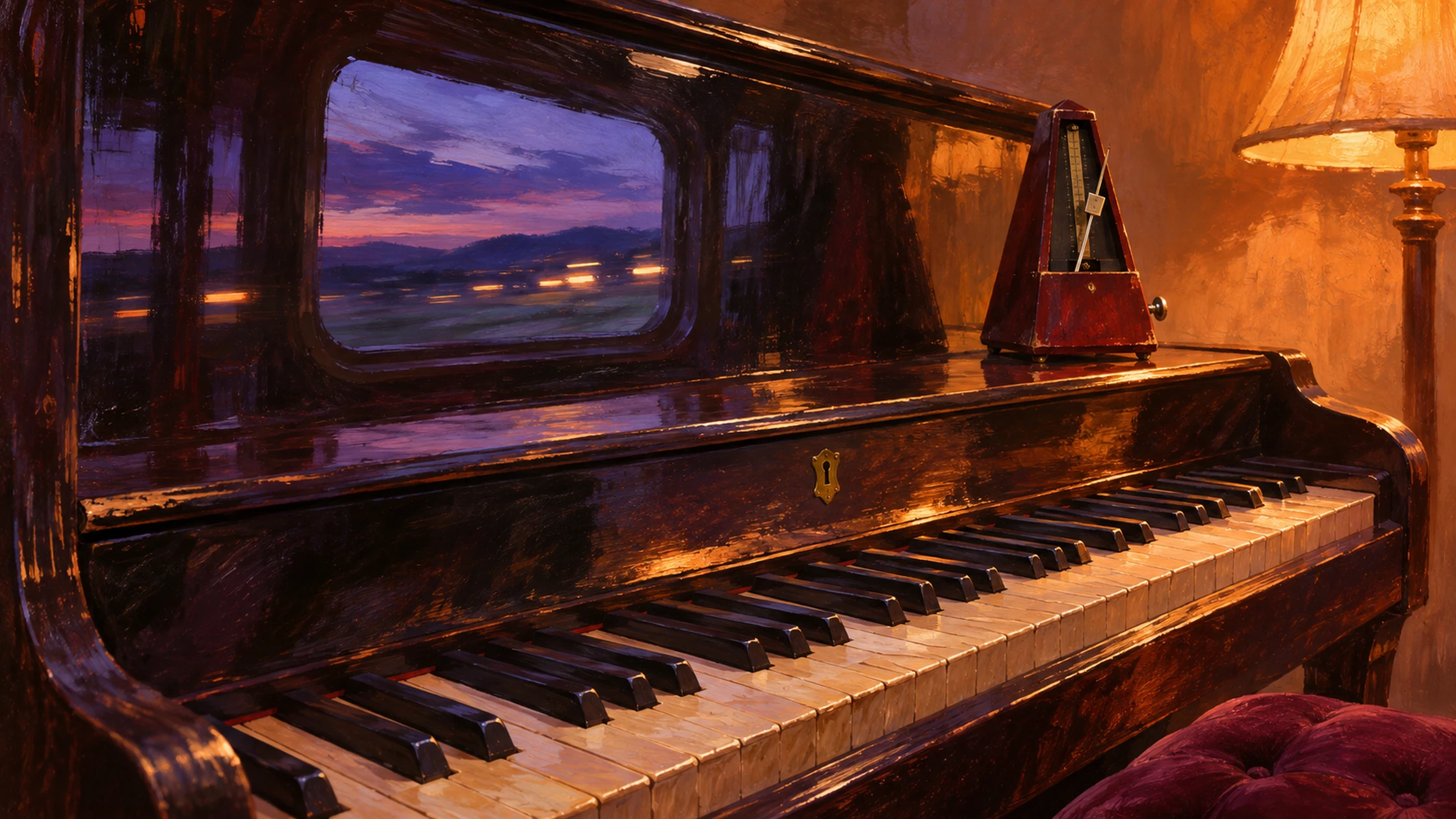
She put Mio’s metronome on top, then left its pendulum caught. Through the narrow window, a violet strip of afternoon lay across the polished wood. Somewhere below, the printer began another run.
Before playing, Naoko sent Takashi a picture of the room.
Is that Dad’s?
No.
He sent back a thumb, then, a moment later: What are you playing?
She set the phone face down. She could tell him afterwards. For now she lowered both hands to the unfamiliar keys and began with the part she had always skipped.
Money behind the story
Japan’s MLIT housing-literacy guide separates initial and continuing housing costs, including management charges, repair reserves, taxes and insurance. It supports checking those categories; it does not verify this story’s invented quotes.
Naoko’s current monthly allocation is JPY 109,000: rent 90,000, rental renewal/insurance 3,000, travel 6,000, piano storage 8,000 and care 2,000. The purchase scenario totals 129,000: loan 68,000, management 10,000, building reserve 12,000, tax/insurance/private-repair provision 13,000, travel 24,000 and piano care 2,000. Storage ends only in that unchosen purchase scenario. Staying and adding four 3,000-yen rehearsal hours gives 121,000, below her 125,000 allocation ceiling.
The separate four-week teaching comparison identifies eight potentially forgone 4,000-yen lessons, or 32,000 before tax, if she refuses the late return journeys. Already committed teaching-room and supply costs would remain. Those fees are neither a train charge nor a guaranteed unavoidable loss.
Her 4.5 million-yen purchase fund would cover the illustrated 3 million down payment, 850,000 buying costs, 200,000 moving and 250,000 isolation work, leaving 200,000; her emergency reserve is separate. Estimates and loan approval remain uncertain. Mortgage payments include principal, so this cash-capacity exercise does not establish whether renting or buying produces greater long-term wealth. Annual provisions are budget allocations, not monthly bills. All sums, permissions and arrangements are fictional.
Financial sources checked 25 November 2026. Story figures and outcomes are illustrative. General financial education, not individual financial advice.
Stay with the story: three questions
- Which costs would change if you chose the apparently cheaper option, and which would remain?
- What would you have to stop doing to make a new journey or commitment fit into your week?
- Is there a smaller way to use something you value while you decide what to do about owning or keeping it?



