
What Matters
The dangerous gap in AI trading is often not execution. It is the missing chain between the evidence that created an idea and the position that eventually gets opened. If an agent cannot show which claims supported the thesis, what would invalidate it and how those claims became a specific trade, the user has an execution record without a decision record.
DN Evidence Block
Last reviewed: 15 November 2026.
Directional source: the supplied agentic-trading transcript repeatedly distinguishes idea generation, thesis formation, policy-gated execution and post-trade memory, and argues that trading decisions need lineage rather than an ungrounded web-search narrative.
Primary verification: NIST guidance on provenance and documentation for generative AI; FINRA’s GenAI guidance on supervision, reliability and accuracy; FINRA’s 2026 oversight guidance on retaining and supervising AI-assisted communications.
Boundary: this is an editorial risk-control framework, not legal advice and not a claim that provenance makes a strategy profitable.
An Execution Log Is Not a Thesis Log
A conventional trading system can tell you the timestamp, order type, venue, fill and P&L. That is useful after the trade. But an AI-assisted system introduces an earlier layer: the model may have read research, market data, social posts, earnings releases or user prompts and converted them into a narrative about why the trade exists.
If that narrative is not preserved, the user cannot reconstruct whether the position came from robust evidence, stale context, a prompt-induced bias or a hallucinated synthesis.
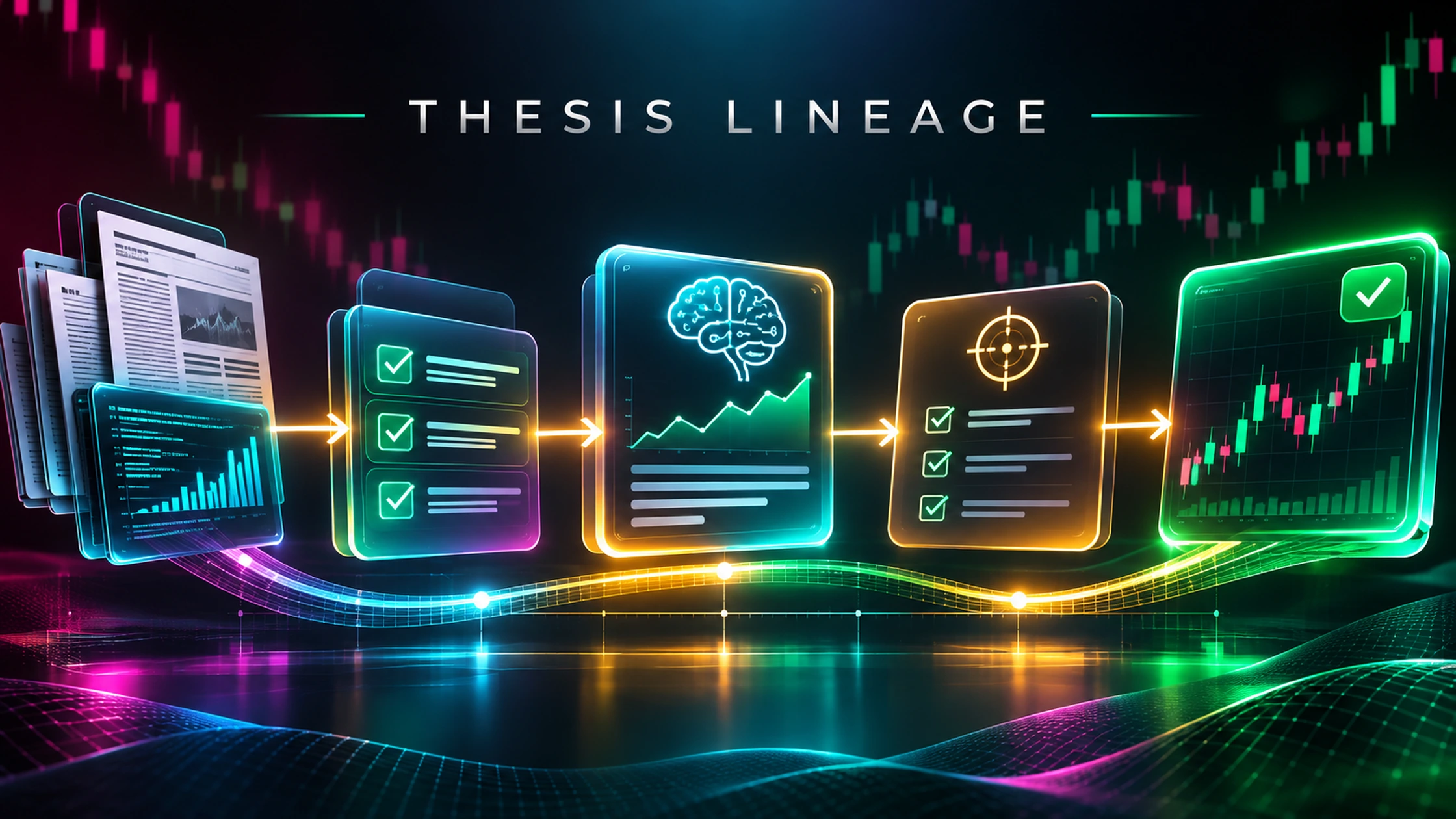
Lineage Means Preserving the Decision Chain
| Stage | Record to preserve | Why it matters |
|---|---|---|
| Source evidence | Documents, data timestamps, URLs, market snapshots | Shows what the agent actually relied on |
| Claim extraction | Specific factual claims derived from each source | Separates facts from narrative |
| Thesis | Why those claims imply an opportunity | Makes the inference explicit |
| Invalidation | What evidence would make the thesis wrong | Prevents one-way confirmation bias |
| Trade plan | Instrument, size, timing, hedge, risk limit | Connects thesis to capital allocation |
| Execution | Quote, venue, order, fill, fees, slippage | Separates thesis quality from execution quality |
| Review | Outcome and which assumptions held | Turns the trade into future evidence |
Why Provenance Matters for AI Systems
NIST’s Generative AI Profile identifies provenance tracking and documentation as useful controls for understanding the origin and history of data and synthetic content. In finance, the same logic can be applied to decision inputs: record where a claim came from, when it was observed and how it changed the downstream conclusion.
That does not make the conclusion correct. It makes the conclusion inspectable.
Why Finance Raises the Bar
FINRA’s Regulatory Notice 24-09 says existing obligations continue to apply when member firms use generative AI and specifically highlights model reliability, accuracy, governance and supervision. Its 2026 oversight report also emphasizes supervision and retention of AI-assisted communications in applicable regulated workflows.
Retail traders are not FINRA member firms, but the design lesson is broader: when an AI output influences money, evidence of what the system saw and did becomes more valuable, not less.
The Confirmation-Bias Problem
LLMs are conversational systems. If a user challenges an answer, the model may revise its conclusion because the user supplied new information, because the model found a genuine error, or simply because the prompt shifted the framing. A trade-thesis system should therefore preserve the original claims and explicitly record the reason for any revision.
Invalidation Is More Important Than Confidence
A confidence score can look scientific while hiding weak evidence. An invalidation condition is more operational: “If data-center capex guidance falls below X,” “if funding flips beyond Y,” or “if the issuer cuts the forecast.” The condition tells the agent what new evidence should change the position.
DN Trade Thesis Lineage Check
Score whether a proposed AI-assisted trade has enough decision provenance to be audited later.
10–12: strong audit trail; 7–9: usable but incomplete; 4–6: weak lineage; 0–3: execution is outrunning evidence.
What Good Lineage Changes
It lets a trader distinguish four very different failures:
- The source claim was wrong.
- The claim was right but the thesis inference was weak.
- The thesis was right but sizing or timing was poor.
- The trade plan was sound but execution failed.
Without lineage, all four collapse into “the AI made a bad trade.” That is useless for improvement.
DN Rule
Never let an agent convert a market narrative into capital without preserving the intermediate decision record. A position should be traceable backward from fill → plan → thesis → claims → sources.
Frequently Asked Questions
Is this just a trading journal?
No. A trading journal records what happened. Thesis lineage specifically preserves why the trade existed and what evidence created the plan.
Does provenance prove a source is true?
No. Provenance proves where information came from and how it moved through the decision process; source quality remains a separate question.
Should every source be stored forever?
Retention depends on the user, jurisdiction and workflow. At minimum, preserve enough metadata to reconstruct the decision responsibly.
Can an agent update a thesis?
Yes, but the update should preserve the previous state, the new evidence and the reason for the change.
Final Verdict
Agentic trading will not become trustworthy merely because execution becomes faster. Trust comes from a decision chain that can survive scrutiny after the outcome is known. The valuable artifact is not the model’s confidence. It is the lineage from evidence to action.
Primary Sources
- NIST — AI RMF Generative AI Profile
- FINRA Regulatory Notice 24-09
- FINRA 2026 Annual Regulatory Oversight Report



