
What Matters
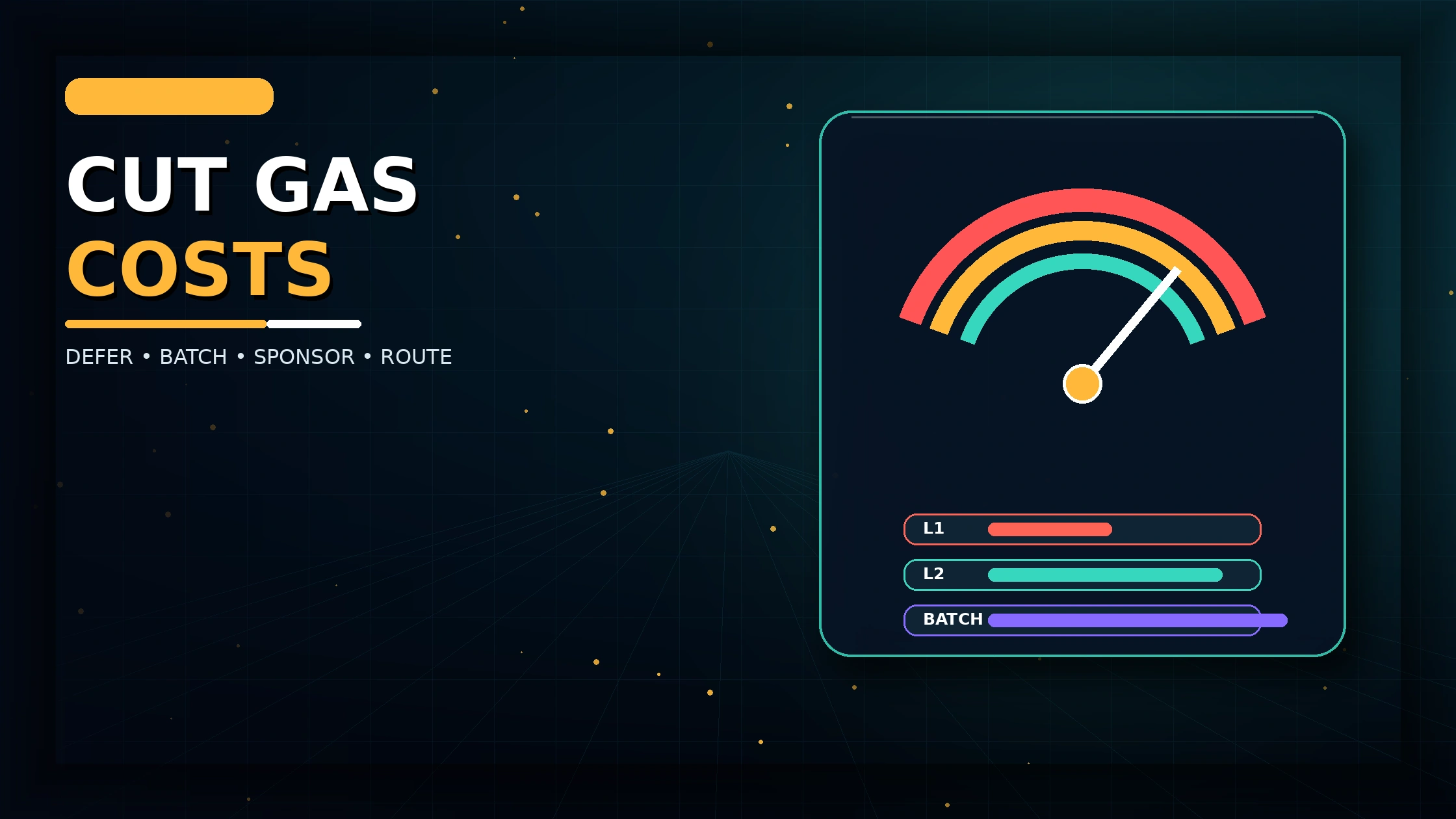
An AI agent cannot make Ethereum gas cheap by prediction alone. It can reduce unnecessary cost by deferring non-urgent actions, batching compatible calls, choosing an appropriate L2, using paymasters under strict policies, comparing total route cost and avoiding failed or duplicated transactions.
DN Evidence Block
Reviewed: 18 November 2026. Primary evidence: Ethereum gas and account-abstraction documentation, ERC-4337 paymaster guidance, EIP-7702 and current L2 fee architecture.
Boundary: fees are live market values. A strategy that saved money historically can fail during congestion, sequencer stress, bridge delays or volatile token prices. Always compare total execution cost, not a single quoted gas number.
Five Workflows That Actually Reduce Cost
| Workflow | Agent decision | Potential benefit | Main risk | Required control |
|---|---|---|---|---|
| 1. Defer low-urgency actions | Wait until fee conditions fall below a policy threshold | Avoids paying peak fees for housekeeping | Opportunity or deadline expires | Maximum delay and urgency class |
| 2. Batch compatible calls | Combine approvals, swaps, claims or transfers where supported | Reduces repeated signatures and fixed overhead | Larger batch increases blast radius | Full-call simulation and per-call visibility |
| 3. Use paymasters or sponsored gas | Select a sponsor path or fee-token policy | Removes native-gas balance friction | Subsidy denial, abuse limits or hidden pricing | Quota, fallback and sponsor policy |
| 4. Route by total cost | Compare L1, L2, bridge, solver and settlement paths | Finds cheaper end-to-end execution | Cheap route adds bridge or failure risk | Cost plus finality and security score |
| 5. Prevent failed and duplicate actions | Simulate, reconcile and retry only after checking outcome | Avoids paying for reverts or duplicate orders | Stale simulation or ambiguous receipt | State check, nonce policy and idempotency |
1. Defer Work That Has No Immediate Economic Value
Agents often perform maintenance tasks: claiming rewards, moving dust balances, updating allowances, consolidating funds or refreshing onchain records. The cheapest action may be to wait. A gas policy should classify each task by deadline and value at risk.
For example, an agent can postpone a $15 reward claim when the estimated cost is $8, but it should not delay a collateral repayment that prevents liquidation. The policy needs a maximum waiting time and a condition that overrides cost when safety is threatened.
Ethereum’s base fee changes according to block demand. The agent can monitor a percentile or rolling range, but it should avoid pretending it can perfectly forecast the next block. Use thresholds and deadlines, not false certainty.
2. Batch Only Calls That Belong Together
Smart accounts and multicall patterns can combine several actions into one signed operation. Batching may reduce wallet prompts and fixed overhead, especially for repeated approvals, swaps and deposits. EIP-7702 and ERC-4337 smart accounts make these patterns easier to expose to users and agents.
A batch is not automatically cheaper or safer. More calldata and contract execution still cost gas. One failed subcall may revert the whole batch, depending on implementation. The user must be able to inspect each target, function, token amount and approval.
Good batch candidates
- Claim several small rewards from the same protocol.
- Approve a capped amount, swap and deposit in one controlled flow.
- Execute multiple transfers to an approved payroll list.
- Revoke several stale allowances.
Bad batch candidates
- Unrelated high-value transactions.
- Calls to unverified contracts hidden behind a summary.
- Unlimited approvals combined with swaps.
- Actions that should have different human approval thresholds.
3. Paymasters Improve UX, Not Economics by Magic
ERC-4337 paymasters can sponsor gas under a policy. A business may cover fees for users, an agent may pay through an offchain billing account, or an application may accept another token. This reduces the need to maintain native gas on every smart account.
The cost still exists. Someone pays it, and the sponsor may add pricing, quotas, eligibility or strategic restrictions. A robust agent records the sponsor, quoted cost, fallback path and reason for rejection. If the paymaster fails, the agent should not repeatedly resubmit an operation and consume resources.
DN Rule
Gasless is a user-experience description, not an economic description. Record who pays, what conditions apply and how the subsidy changes after limits expire.
4. Compare End-to-End Route Cost
An L2 transaction may have low execution gas but still include L1 data cost, bridge fees, solver fees, spreads and withdrawal delay. The correct comparison is total value lost or paid from the starting asset to the final usable asset.
An agent should score:
- execution gas and L1 data fee;
- bridge or message fee;
- swap spread and price impact;
- solver or relayer fee;
- expected finality time;
- failure and recovery path;
- destination liquidity and token representation.
DN has affiliate relationships with deBridge and CoW Swap. Those services represent different routing models and should be evaluated by live quotes, destination outcome and current support.
5. Avoid Reverts, Duplicate Retries and Unnecessary Approvals
A failed transaction can still consume gas. Common causes include stale slippage limits, insufficient balances, expired deadlines, changed nonces, revoked permissions and contract state that moved after simulation.
The agent should simulate the exact calldata against recent state, include a deadline, cap slippage and reconcile the transaction receipt and resulting balances. If a request times out, check whether it landed before retrying. Idempotency is as important onchain as in ordinary payment systems.
Token approvals are another cost and security issue. Reusing a bounded allowance can avoid repeated approvals, but an unlimited allowance increases exposure. The agent should choose an amount and expiry appropriate to the workflow and revoke unused permissions.
How to Choose Between L1 and L2
Mainnet may be appropriate for high-value settlement, deep liquidity or contracts not available elsewhere. L2s can lower execution cost and make frequent agent actions feasible. The best choice depends on asset availability, bridge risk, finality, sequencer reliability, data cost and exit requirements.
Do not move a position to an L2 solely because one transaction is cheaper. Calculate the cost and risk of entering, operating and exiting the environment.
The Difference From a Gas-Budget Policy
DN’s existing Agent Gas Deferral Policy focuses on decisions an agent should not improvise: urgency, budget, abandonment and approval. This article focuses on the operational methods that implement those decisions: deferral, batching, sponsorship, routing and failure prevention.
DN Agent Gas Route Planner
Compare one proposed route. Enter estimated costs in the same currency.
The model excludes tax, opportunity cost and unknown smart-contract loss.
Worked Example
An agent wants to claim and sell rewards worth $25. The L2 transaction costs $1.50, L1 data adds $0.50, the route fee is $1, expected slippage is $2 and the estimated failure cost adds $0.20. Total expected cost is $5.20, leaving $19.80 before tax and other risk.
If the same rewards can be batched next week for $2.50 total and there is no expiry or safety deadline, deferral is rational. If the token is rapidly deteriorating, waiting may cost more than gas. The agent must compare economic value, not gas alone.
Who Should Use These Workflows
- Agent operators running repeated onchain maintenance.
- Wallet and smart-account teams designing fee policies.
- Treasuries comparing L1, L2 and cross-chain routes.
- Developers reducing failed transactions and redundant approvals.
Methodology and Limitations
DN evaluated methods by fee reduction, timing risk, external dependencies, failure recovery and security impact. We did not benchmark every L2, bundler, paymaster or solver. Live fees and routes change by block, transaction size and market conditions.
Frequently Asked Questions
Can an AI agent predict the cheapest block?
It can estimate and use historical patterns, but demand is uncertain. Use thresholds and deadlines rather than a guaranteed prediction.
Does batching always save gas?
No. It can reduce fixed overhead, but the batch may execute more calldata and create a larger failure domain.
Who pays in a gasless transaction?
A paymaster, application, sponsor or separate billing arrangement pays or recovers the cost.
Is an L2 always cheaper?
Often for execution, but total cost may include bridge, data, spread, finality and withdrawal costs.
What is the biggest avoidable gas loss?
Failed or duplicate transactions caused by stale state, ambiguous timeouts or missing reconciliation.
Primary Sources
Commercial disclosure: DN may earn compensation from deBridge and CoW Swap links. No route provider paid for the framework.



