
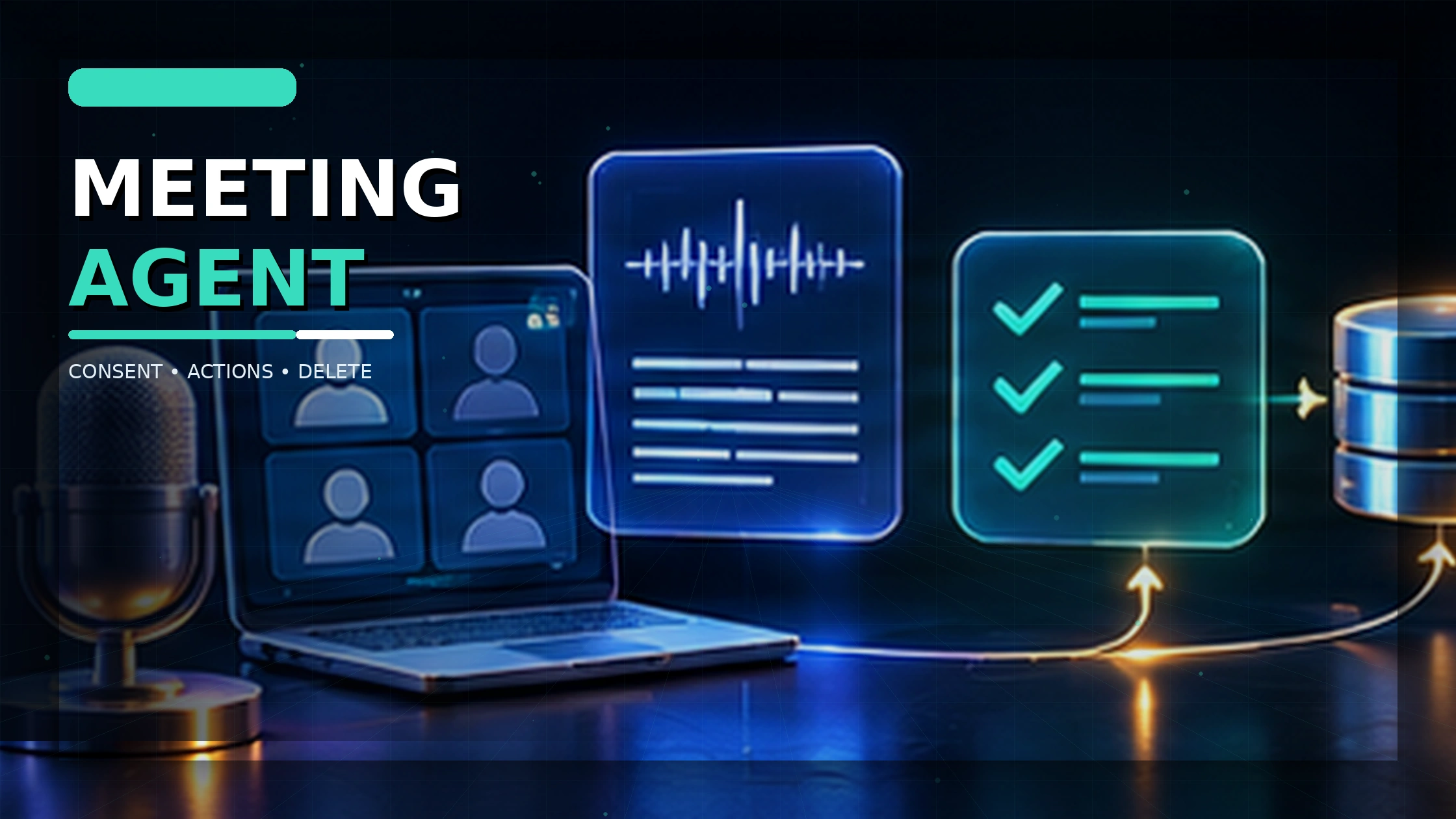
What Matters
A meeting-note agent is a records system, not a harmless convenience. It can capture voices, names, commercial plans, health information, employment discussions and legal advice. A defensible B2B service obtains appropriate notice or consent, minimizes the recording, separates transcript from action items, restricts access and deletes data on a defined schedule. The commercial value comes from reliable follow-through, not storing every conversation forever.
DN Evidence Block
Reviewed: 21 November 2026. Evidence base: NIST Privacy Framework, GDPR and POPIA principles, NIST AI RMF and standard records-management controls.
Boundary: recording and consent requirements vary by jurisdiction and context. Employment, medical, legal and regulated meetings need specialist review.
The Meeting Workflow
| Stage | Agent task | Control | Evidence | Failure to prevent |
|---|---|---|---|---|
| Before meeting | Agenda, attendees and approved context | Notice, consent and recording policy | Invitation, purpose and participant choice | Hidden recording |
| Capture | Audio or live transcript | Minimum channel, encryption and access | Start/stop time and source | Recording unrelated conversation |
| Summarize | Decisions, actions and open questions | Source-linked transcript segments | Model/version and reviewer | Invented agreement or attribution |
| Follow-up | Draft email, tasks and CRM updates | Human approval and recipient scope | Final sent record and task owner | Sending confidential notes to wrong party |
| Retention | Archive or delete | Purpose-based schedule and legal hold | Deletion log and exception owner | Permanent shadow archive |
Step 1: Define the Record Before the Meeting
Decide whether the business needs audio, full transcript, summary, decisions or only action items. Many teams do not need a permanent audio file. The less data collected, the lower the security and privacy burden.
State the purpose and who will receive the record. Let participants know how to opt out or use a non-recorded alternative. Do not invite a recording bot into a sensitive call by default.
Step 2: Separate Transcript, Summary and Official Minutes
A transcript is an imperfect representation of speech. A summary is a model-generated interpretation. Official minutes are an approved organizational record. Label each layer and preserve approval where the distinction matters.
Names, decisions and commitments require review. The agent should quote or link the source segment for high-impact actions and flag uncertain speakers.
Step 3: Extract Actions With Owners and Dates
Every action item should have an owner, due date, source and status. The agent can draft tasks, but it should not assign a commitment that the participant did not accept. Send a review window before syncing material actions into project or CRM systems.
Use deterministic rules for recurring follow-ups. For example, no external email is sent without human approval, and no task involving money, legal documents or personnel changes is auto-created.
Step 4: Control Access
Meeting records should inherit the sensitivity of the discussion. Use workspace permissions, client separation and role-based access. Do not place every transcript into a global agent memory.
Redact secrets, account numbers and special-category data before sending content to downstream models or observability tools. Review the complete path using DN’s Agent Privacy framework.
DN Rule
The fact that every participant could hear the meeting does not mean every employee or model provider may access the transcript later.
Step 5: Set Retention and Deletion
Choose a default period by meeting type. Routine internal notes may be retained briefly, while approved minutes or contracts follow formal records schedules. Delete temporary audio after review when it is no longer necessary.
Deletion should propagate to exports, search indexes and backups where feasible. Keep a legal-hold process for records that must be preserved.
Step 6: Price the B2B Service
A meeting workflow can be sold per seat, per recorded hour or as a managed team service. A managed offer includes configuration, retention, templates, CRM integration, quality review and incident support. Price must include transcription, model use, storage, review and support.
A strong sales claim is “action items reach the right owner within one business day with a review record,” not “never take notes again.”
DN Meeting Agent Privacy and Value Test
Score one proposed deployment.
Worked Example
A consulting team records client implementation calls with notice. The service retains audio for seven days, keeps the approved summary for one year, drafts tasks and requires the project manager to approve external follow-ups. Sensitive finance discussions use a no-recording template. The value is faster execution with a defensible record, not maximum transcription.
Methodology and Limitations
DN evaluated meeting agents by notice, minimization, accuracy, access, authority and retention. The framework does not determine lawful recording in a specific jurisdiction and does not replace employment, privacy, legal or records-management advice.
Frequently Asked Questions
Do participants need to know an AI agent is taking notes?
Use clear notice and obtain the consent or lawful basis required by the jurisdiction and context. Provide an alternative when appropriate.
Is a transcript the official record?
Not automatically. It may contain speaker and transcription errors. Official minutes should be reviewed and approved.
How long should meeting audio be kept?
Only as long as necessary for the defined purpose, subject to legal and organizational retention requirements.
Can the agent send follow-up emails automatically?
Start with drafts and human approval, especially for external, confidential or consequential messages.
What data is most sensitive?
Identity, employment, health, legal, financial, security and confidential commercial information.
Primary Sources
- NIST Privacy Framework
- NIST AI Risk Management Framework
- European Commission: Data Protection
- South Africa Information Regulator: POPIA
Editorial disclosure: no meeting-assistant vendor paid for this framework.



