
What Matters
Options agents do not trade direction alone. They trade volatility, time, convexity, liquidity and margin. A model can forecast the underlying correctly and still lose because implied volatility falls, theta accumulates or the order crosses a wide spread.
DN Evidence Block
Reviewed: 20 November 2026. Primary evidence: Deribit product and API documentation, Options Industry Council education and CFTC virtual-currency derivatives warnings.
Boundary: options are complex and can create rapid losses. This framework is educational and does not recommend a strategy or venue.
Eight Workflows for an Options Agent
| Workflow | Agent output | Main risk | External control |
|---|---|---|---|
| 1. Surface ingestion | Expiry/strike prices and implied volatility | Stale or crossed markets | Freshness and spread threshold |
| 2. Greeks aggregation | Portfolio delta, gamma, theta and vega | Model assumptions and sign errors | Independent risk engine |
| 3. Scenario analysis | P&L across price, volatility and time | Missing jumps and liquidity | Stress grid and tail scenarios |
| 4. Strategy proposal | Spread or hedge with rationale | Overfit volatility forecast | Approved structures and max loss |
| 5. Quote selection | Limit price and size | Wide spread and partial fill | Price and participation caps |
| 6. Margin monitoring | Collateral and liquidation alerts | Nonlinear risk during jumps | Independent buffer and kill switch |
| 7. Hedge execution | Underlying or futures adjustment | Over-hedging and churn | Frequency and cost budget |
| 8. Expiry/settlement | Exercise, settlement and close plan | Wrong instrument or currency | Calendar and instrument master |
1. Build an Instrument Master
Record underlying, option type, strike, expiry, settlement style, quote currency, contract size, minimum amount and margin treatment. Deribit inverse options, for example, are European-style and settle in the base currency, which changes P&L and accounting compared with a USD-settled product.
Do not parse instruments from display names alone. Use the venue’s official instrument endpoint and preserve the version.
2. Volatility Surface, Not One IV Number
Implied volatility varies by strike and expiry. Skew reflects asymmetric demand, while term structure reflects expected risk over different horizons. An agent should fit or interpolate a surface only after filtering stale, illiquid and arbitrage-inconsistent quotes.
Model confidence should decline where spreads are wide or open interest is low. A smooth fitted surface can hide a lack of executable liquidity.
3. Greeks Are Local Estimates
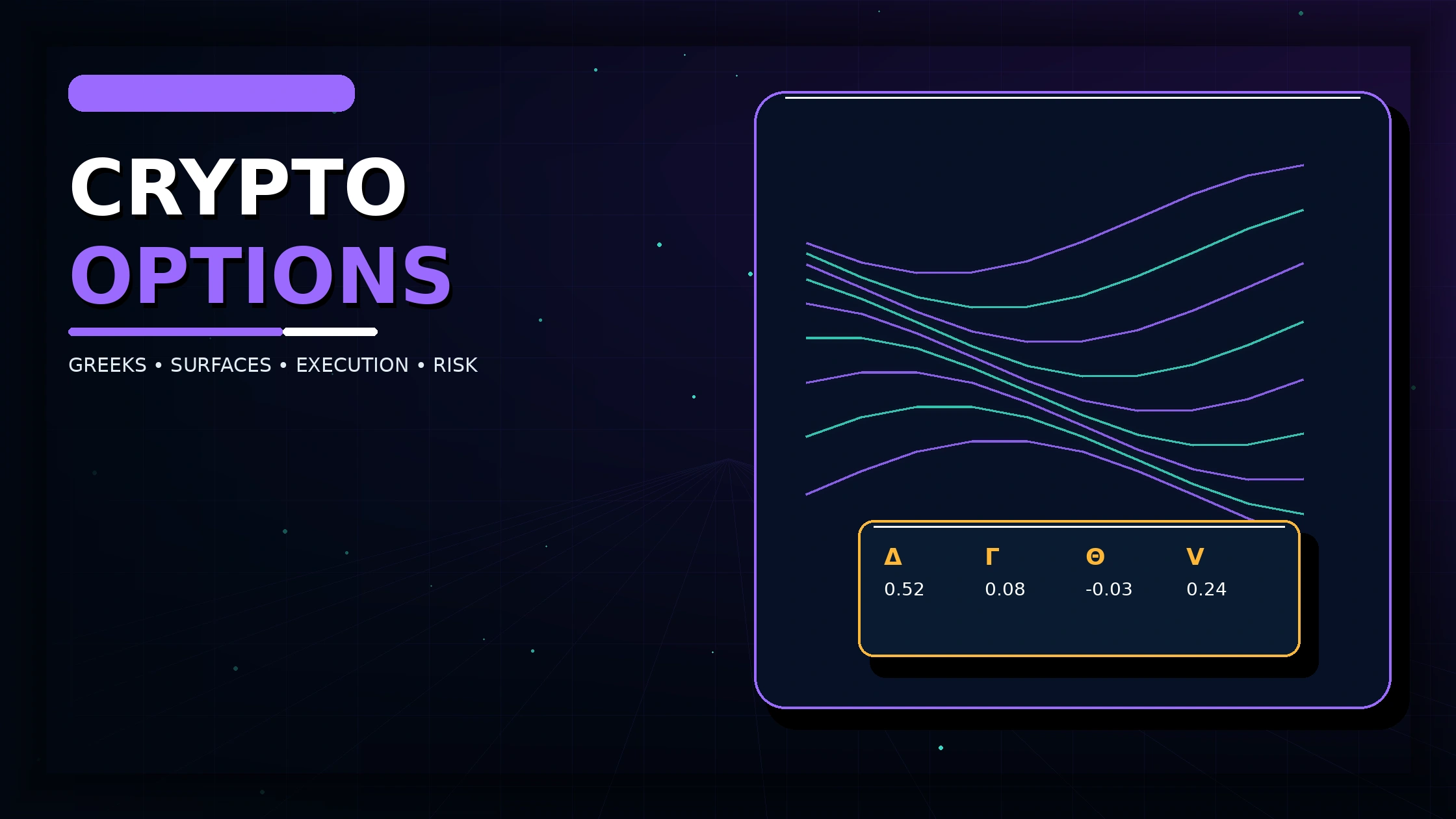
Delta, gamma, theta and vega estimate how option value changes around current inputs. The Options Industry Council describes Greeks as theoretical guideposts, not guarantees. Large jumps, volatility changes and time passage can make linear approximations inaccurate.
Aggregate Greeks across the portfolio and stress them under nonlinear scenarios. Verify sign conventions and units for inverse contracts.
4. Direction Is Only One Component
A call buyer can be right that Bitcoin rises and still lose if the move is too small, too late or accompanied by an implied-volatility collapse. A short-volatility strategy can earn frequent small gains and then suffer a large jump loss.
Every proposal should state the required price, volatility and time path, maximum premium or loss, break-even and invalidation.
5. Liquidity and Execution
Options books can be fragmented across strikes and expiries. Use limit orders, maximum spread and minimum depth. Multi-leg strategies need legging-risk controls or a supported combination/block workflow.
Mark price supports risk and margin calculations but is not necessarily an executable exit. Compare mark, best bid/offer and size-adjusted price.
6. Margin Is Dynamic
Short options and portfolio margin can change rapidly as price and volatility move. An agent should monitor available margin, stressed margin and concentration by expiry and strike. It should not assume current margin is the maximum possible requirement.
Hold a buffer outside the model. The risk service should reduce or block positions before venue liquidation thresholds.
7. Delta Hedging Can Create Cost and Feedback
Frequent hedging reduces directional exposure but pays spread, fees and slippage. Gamma determines how quickly delta changes. In volatile markets, many hedgers can trade in the same direction and amplify movement.
Set hedge bands and cost budgets rather than rebalancing every small change.
8. Expiry and Settlement Are Operational Events
Confirm final settlement index, time, currency and whether positions expire automatically. Close or fund positions early when operational uncertainty, holidays or low liquidity make settlement risky.
DN Rule
The language model may explain an options trade; it may not define the portfolio’s maximum gamma, vega or margin exposure.
DN Crypto Options Agent Risk Gate
Score one proposed options workflow.
Worked Example
An agent expects a volatility increase before an event and proposes a long straddle. It verifies the expiry and contract size, compares implied volatility with its forecast and calculates premium loss, gamma and vega. The risk service caps premium at 0.5% of portfolio value.
The spread is wider than policy, so execution is deferred. The signal may be valid, but the available trade is not.
Methodology and Limitations
DN mapped options-agent controls across instruments, volatility, Greeks, execution, margin and settlement. We did not value a specific contract or test every venue’s portfolio-margin methodology.
Frequently Asked Questions
Can an AI agent predict implied volatility?
It can estimate and forecast volatility, but the forecast is uncertain and option prices also reflect supply, demand, skew, term structure and liquidity.
What are the most important Greeks for an agent?
Delta, gamma, theta and vega are core exposures, but portfolio behavior also depends on cross-Greeks, jumps, liquidity, margin and settlement.
Are short options more dangerous than long options?
Short options can create large or theoretically unlimited losses and margin calls. Long options cap premium loss but can lose 100% of the premium.
Why can an options agent be right on direction and still lose?
Implied volatility, time decay, strike, timing, spread and execution can outweigh the directional move.
What should remain outside the model?
Position, gamma, vega, margin, concentration and loss limits, plus approved instruments and settlement controls.
Primary Sources
- Deribit API Documentation
- Deribit Inverse Options
- Options Industry Council: Understanding Greeks
- CFTC Virtual Currency Risk Advisory
Editorial disclosure: no options venue, broker or data provider paid for inclusion.



