
What Matters
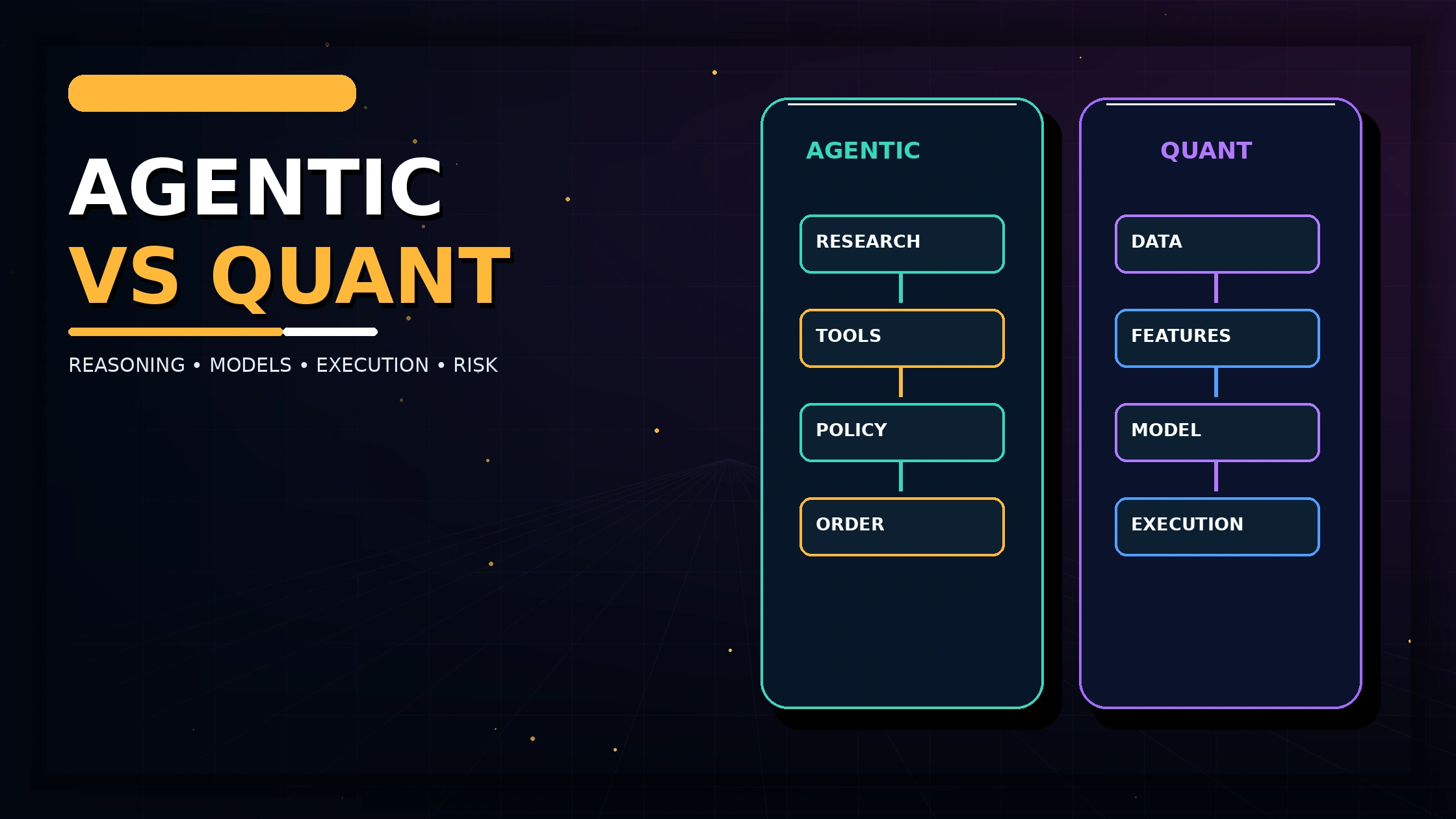
Agentic finance and traditional quant trading are not competing model brands. They solve different parts of the workflow. Quant systems turn defined data and rules into reproducible signals and orders. Agentic systems can gather evidence, plan, use tools and handle exceptions. The strongest production architecture combines them without letting an opaque model own the risk boundary.
DN Evidence Block
Reviewed: 20 November 2026. Primary evidence: NIST AI Risk Management Framework, SEC market-access control principles, MiFID II algorithmic-trading requirements and current agent-orchestration documentation.
Boundary: neither architecture guarantees profit. The comparison concerns system design, evidence and failure modes.
Architecture Comparison
| Dimension | Traditional quant system | Agentic-finance system | Strong hybrid |
|---|---|---|---|
| Inputs | Structured market and alternative data | Structured data plus text, documents and tools | Agent prepares evidence; typed pipeline validates it |
| Decision | Model or deterministic rule | Planning, reasoning and tool calls | Agent proposes; policy and quant model score |
| Reproducibility | Higher when versions and data are fixed | Lower with non-deterministic models | Store outputs and deterministic final checks |
| Latency | Can operate at microsecond to daily horizons | Typically slower and variable | Keep agent off critical execution path |
| Explainability | Clear rules or statistical features, sometimes opaque ML | Natural-language rationale can be persuasive but unfaithful | Evidence-linked structured decision record |
| Failure | Overfit, bad data, coding and market-regime failure | Hallucination, tool misuse, prompt injection and state drift | Independent controls for both classes |
| Cost | Data, research, infrastructure and execution | Adds model calls, orchestration and review | Use agents only where they reduce total error or labor |
Traditional Quant: Defined Inputs, Defined Outputs
A quant strategy specifies data, features, model, portfolio construction, execution and risk. This structure supports backtesting and comparison, but it can still fail through leakage, overfitting, stale assumptions and live execution differences.
The strength is that a reviewer can usually identify the exact code and data that generated an order. The weakness is brittleness when the workflow encounters an unexpected document, counterparty or operational exception.
Agentic Finance: Flexible Tools and Open-Ended Tasks
An agent can read filings, compare protocol documentation, query data, prepare a trade thesis, request approval and call an execution tool. This expands the task surface beyond numeric prediction.
The same flexibility creates new risk. The model can select the wrong tool, misread evidence, accept malicious instructions, lose state or produce a convincing explanation that does not match its actual decision process.
Where Agents Add Real Value
- Research across unstructured and frequently changing sources.
- Entity resolution and document comparison.
- Operational exception triage.
- Preparing structured proposals and evidence packs.
- Coordinating slower workflows across systems.
- Explaining deterministic risk results to humans.
Where Conventional Systems Should Remain in Control
- Position and leverage limits.
- Price, size and counterparty checks.
- Order construction, precision and nonce handling.
- Latency-critical routing.
- Accounting and balance reconciliation.
- Kill switches and credential revocation.
Natural-Language Explanations Are Not Audit Evidence
An LLM can generate a reason after the fact. A reliable system stores the sources, features, tool calls, model and prompt versions, proposal, policy checks, order and outcome. The explanation should point to that record rather than replace it.
Cost: Does the Agent Reduce Total Error?
Agent calls add latency and variable cost. More importantly, they create review and incident work. Measure whether the agent reduces analyst time, captures better evidence, improves rejection quality or handles exceptions that a fixed pipeline could not.
If the agent produces the same trade as a deterministic model with more cost and uncertainty, it is not an improvement.
The Hybrid Reference Architecture
- Versioned data and document ingestion.
- Agent research with source and freshness requirements.
- Structured thesis schema rather than free text.
- Quant model or deterministic score.
- External risk and compliance gate.
- Bounded execution service.
- Independent outcome reconciliation.
- Evaluation store linking evidence to result.
DN Rule
Use agents for uncertainty in information; use deterministic controls for certainty in authority.
DN Agentic-vs-Quant Architecture Selector
Choose the nearest workflow. The result indicates where agentic behavior adds value and where a quant core should remain.
Worked Example
A portfolio process reviews tokenized-credit products once a week. An agent extracts issuer terms and redemption changes, while a quantitative model scores duration, liquidity and concentration. An external policy caps exposure and rejects ineligible products.
The agent improves evidence collection. The quant model preserves consistent comparison. The policy service keeps financial authority outside both.
Methodology and Limitations
DN compared architecture, inputs, reproducibility, latency, governance, cost and failure modes. The categories overlap: a quant system can use AI, and an agent can call quantitative models.
Frequently Asked Questions
Is agentic finance the same as algorithmic trading?
No. Algorithmic trading can be entirely deterministic. Agentic systems add model-driven planning, tool use, memory or multi-step autonomy.
Are traditional quant systems safer?
Not automatically. They can be overfit, unstable or poorly controlled, but their inputs and execution paths are often easier to specify and test.
Where are language models most useful?
Research synthesis, document extraction, exception triage, tool orchestration and explanations—especially at slower decision horizons.
Should an LLM decide order size?
It may propose size, but hard capital, leverage, concentration and loss limits should be enforced by deterministic code outside the model.
What is the best architecture?
Often a hybrid: agentic research and workflow coordination around a conventional data, risk and execution core.
Primary Sources
- NIST AI Risk Management Framework Core
- SEC Market Access Risk Controls
- MiFID II Article 17
- LangGraph Documentation
Editorial disclosure: no framework, exchange or model provider paid for inclusion.



