
What Matters
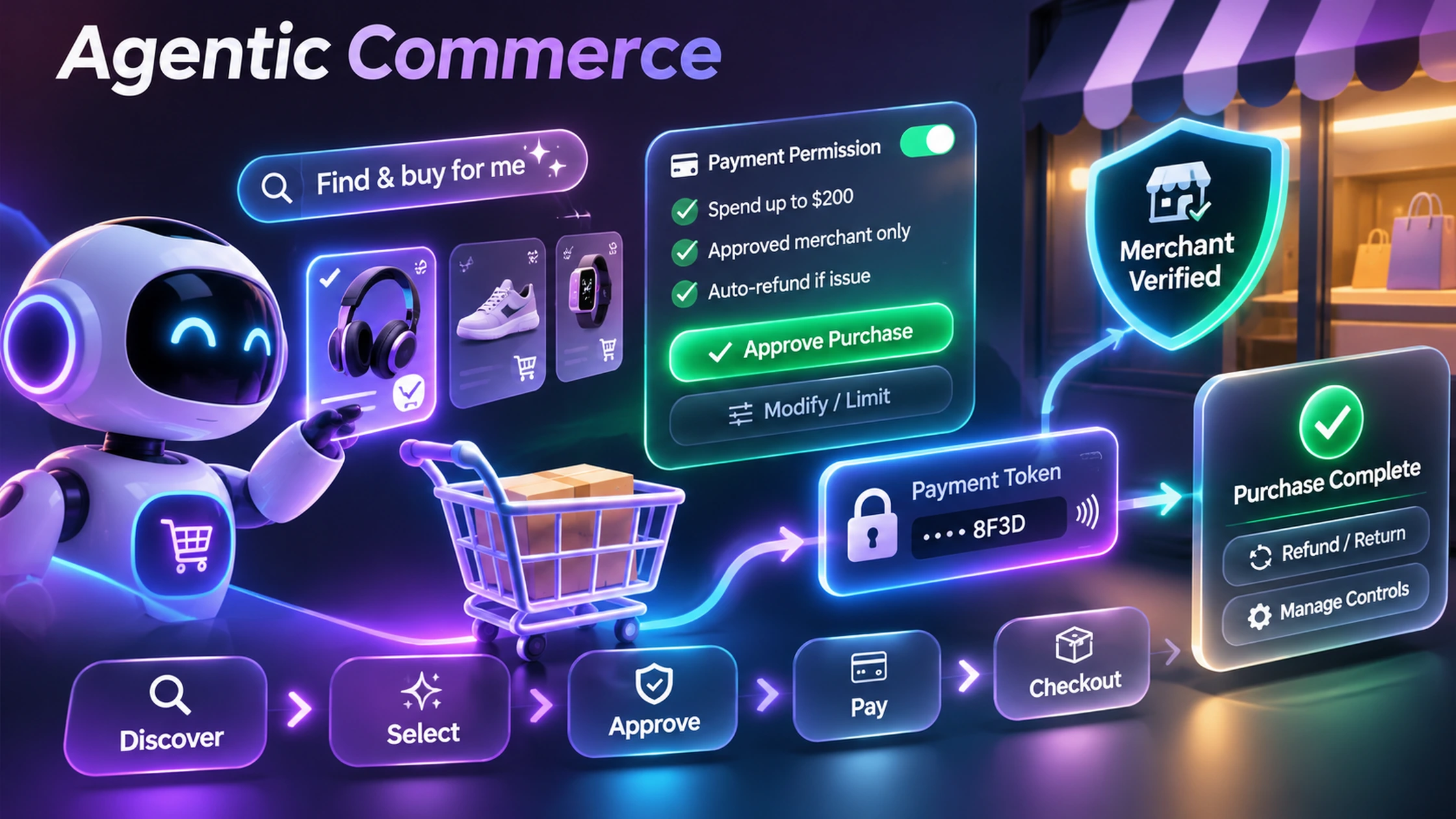
Agentic commerce is no longer just a checkout demo. The ecosystem now includes product discovery, merchant feeds, agent verification, payment tokens, machine-to-machine payment protocols and approval controls. But “an agent can pay” does not mean “an agent should have unlimited spending authority.”
DN Evidence Block
Last reviewed: 16 November 2026.
Primary sources: OpenAI commerce documentation, Visa Trusted Agent Protocol and Intelligent Commerce materials, Visa’s 2026 agentic-payments analysis, and Mastercard Agent Pay for Machines.
Boundary: availability varies by market, merchant, payment rail and implementation.
1. What is agentic commerce?
Commerce where software agents help discover, compare, select or purchase goods and services on behalf of a person or business.
2. Is it the same as a chatbot?
No. A chatbot can recommend. An agentic system may also call tools, pass structured order data or initiate a supported transaction.
3. Can agents buy things today?
Yes, in supported environments. OpenAI’s current commerce documentation covers discovery, bookings and supported purchase flows; Visa and Mastercard are building infrastructure for agent-driven payments.
4. How does a merchant know an agent is legitimate?
That is one reason Visa introduced Trusted Agent Protocol: to help merchants distinguish recognized agents from malicious bots during commerce flows.
5. Does the agent need my card number?
Not necessarily. Modern designs increasingly rely on tokens and controlled payment credentials rather than exposing raw card data.
6. Can I set limits?
Good implementations should support budget, merchant, category or approval boundaries at the harness or payment layer.
7. What should require human approval?
Large, unusual, ambiguous, irreversible or policy-sensitive purchases are strong candidates for explicit approval.
8. Can an agent compare products?
Yes. Structured feeds improve price, availability and seller-context accuracy, but comparison quality still depends on data freshness and coverage.
9. What is the biggest merchant risk?
Misidentifying malicious automation as a legitimate buyer agent, or accepting stale/incorrect order context.
10. What is the biggest consumer risk?
Over-broad authority combined with weak confirmation and refund evidence.
11. Do normal refund rules disappear?
No. The payment method, merchant terms and network rules still matter.
12. Can agents pay other agents?
Yes in emerging machine-payment frameworks, especially for APIs, compute and digital services.
13. Is crypto required?
No. Card rails, bank rails and onchain rails are all being adapted for agentic use.
14. Why are product feeds important?
They give agents current structured data rather than forcing them to scrape ambiguous pages.
15. What should an agent remember?
Preferences and budget rules are useful; raw secrets and unrestricted credentials are not.
16. Can merchants block agents?
Yes. Merchant and anti-bot controls still apply unless the integration recognizes and permits the agent.
17. Does agentic commerce reduce fraud?
Not automatically. It changes the fraud surface and increases the need for agent identity, provenance and transaction controls.
18. What is still immature?
Cross-merchant identity, consistent permissions, regional support, dispute semantics and interoperability remain uneven.
19. What should beginners try first?
Low-value, reversible purchases with explicit approval and a spending cap.
20. What should nobody delegate first?
Large financial commitments, unusual merchants or purchases where return/refund rights are unclear.
DN Agentic Commerce Control Check
DN Rule
Let agents compress shopping effort before you let them expand spending authority.
The Agentic-Commerce Stack
Agentic commerce is not one product. It is a stack of components that can fail independently: discovery, product data, merchant identity, preference memory, decision policy, payment credentials, approval, fulfilment, returns and dispute evidence. Treating the agent as a single black box hides which component actually made the decision.
| Layer | What it should preserve | Typical failure |
|---|---|---|
| Discovery | Query, candidate set and excluded offers | The agent never saw a better merchant or region-specific option |
| Product data | Price, stock, seller, variant, timestamp and delivery promise | Stale inventory or the wrong size/plan |
| Decision policy | Budget, quality floor, prohibited categories and preference weights | Cheapest offer wins despite poor warranty or delivery terms |
| Payment | Token or credential used, amount cap and approval event | Authority is broader than the purchase required |
| Order record | Merchant, item, taxes, terms, confirmation and receipt | The later dispute cannot reconstruct what the agent approved |
| Post-purchase | Delivery, return window, cancellation and refund status | The agent optimises checkout but ignores the lifecycle |
Three Levels of Shopping Autonomy
Level 1: Research only
The agent searches, compares and prepares a shortlist. The human chooses the merchant and completes checkout. This is the right default for unfamiliar merchants, high-value items and purchases with complex return conditions.
Level 2: Prepared checkout
The agent selects a product, fills a cart and prepares the payment request, but a human confirms the final seller, amount and delivery terms. This removes repetitive work while keeping commitment authority with the buyer.
Level 3: Bounded autonomous purchase
The agent may buy without per-transaction approval only inside a policy that is enforced outside the prompt: a capped credential, merchant allowlist, category rules, quantity limits and a clear revocation path. Routine office supplies or low-value digital services may fit this level. Travel, subscriptions with renewal, financial products and non-refundable purchases usually do not.
Worked Example: An Agent Buying a Laptop
A user asks for a 14-inch laptop under $1,500, delivered within five days. A weak agent sorts by price and buys the first matching listing. A stronger workflow records the seller’s legal identity, warranty region, keyboard layout, return window, stock timestamp, delivery estimate and whether the price includes tax. It then asks for approval because the amount exceeds the user’s $300 autonomous-purchase threshold. If the laptop arrives damaged, the order record links the approved offer to the receipt, merchant terms and return deadline.
Merchant-Side Controls
Merchants also need policy. A recognised agent should still be rate-limited, authenticated where appropriate and bound to the same inventory, price and consumer-rights data shown to humans. Merchants should log whether a transaction came from an agent, which product feed or page supplied the offer, and what terms were presented at commitment time. That evidence helps distinguish a bad recommendation from a fulfilment or pricing dispute.
DN Deployment Checklist
- Start with a dedicated, low-balance payment method.
- Set numeric per-purchase and daily caps.
- Allowlist trusted merchants and block unfamiliar marketplaces by default.
- Require approval for subscriptions, travel, financial products and non-refundable items.
- Preserve product, merchant, price, tax, shipping and return terms at checkout.
- Test cancellation and credential revocation before relying on the agent.
- Review the purchase log monthly and remove permissions that are no longer needed.
What This Article Does Not Establish
It does not establish that every current agentic checkout supports these controls, that a payment network guarantees the quality of the merchant, or that tokenised credentials eliminate fraud. The control model is a decision framework. Availability and dispute rights still depend on the implementation, merchant, country and payment method.
Commercial disclosure: DN may earn from selected payment, wallet or commerce services discussed elsewhere. Commercial relationships do not change the control criteria used here.



