
Money Stories · Original fiction · 9 minute read
On the eleventh morning, Inês found her good shoes in a box marked KITCHEN.
Her son had packed it. Beneath the shoes were two cake tins, a radio and the little wooden bird that had lived on top of the television. She took out the bird and stood it on the empty windowsill.
There were twenty-three boxes. She had counted them every evening, as though one might leave by itself.
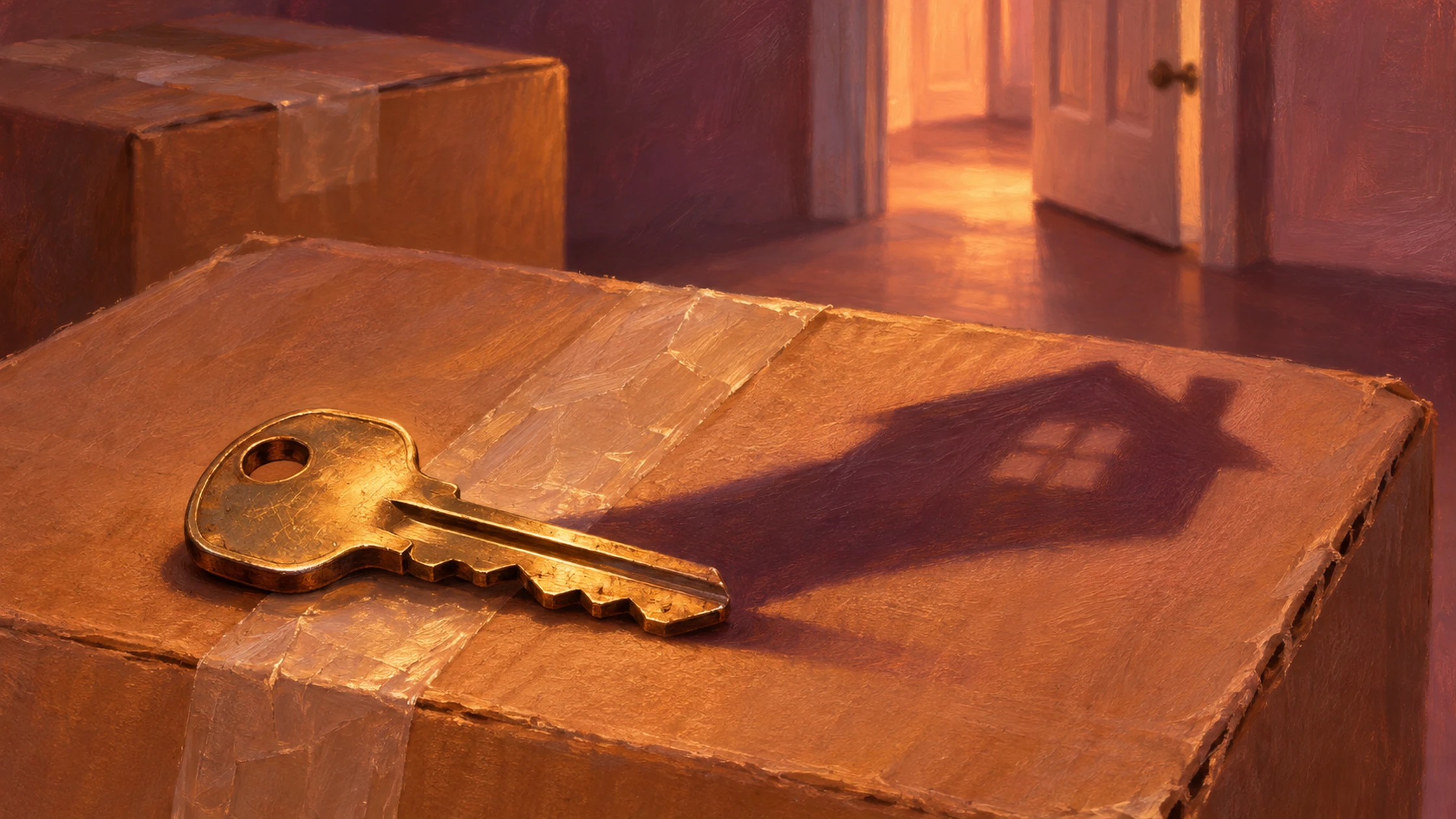
The brass key to the new flat lay beside her cup. She had carried it for eleven days. Its teeth were sharper than those of the key she was leaving behind; twice it had caught the lining of her bag.
At fifty-seven, Inês was about to live alone for the first time. She knew where she would put the radio. She had known since she first saw the new kitchen, with its deep window and a patch of wall that belonged to no cupboard. She could imagine the sound in that room. She could not get the radio, the boxes and her narrow bookcase across Porto on a bus.
The removal firm had quoted two hundred and forty euros. It wanted payment before loading. She had not confirmed the booking or paid a deposit.
She had a hundred and ten euros she could use.
When she collected the new key, she had paid six hundred euros for the first month's rent and six hundred as the new deposit. The flat came with a bed, cooker and refrigerator. She was taking her own small table, the bookcase and the boxes. Both homes' agreed rent for the overlap was already paid.
The figures she had checked last night were two hundred and sixty euros in the account, after paying for the intervening days. A hundred and fifty still had to cover food, travel to work and bills before her next salary. She had written those amounts in the notebook she kept beside the telephone.
The old deposit was six hundred and fifty.
She had been counting on some of it becoming available for the move. At an earlier visit, the landlord had said he expected there would be little to deduct. Then he had looked up at the bedroom ceiling.
The stain was shaped like a country nobody wanted to govern. It had been there before Inês and Luís separated. She had photographs of it and messages about the upstairs leak. The landlord said he needed to establish what work was necessary before agreeing any refund. She disputed his suggestion that the damage was theirs.
Every few days another message arrived, asking for something she had already sent.
The six hundred and fifty remained outside her account.
She had not promised it to the removal firm. She could not yet see another plan.
At work, she could solve small impasses all day. She was a hospital receptionist. She knew how to find the person who had an answer, how to ask someone to repeat a surname without making them feel that the surname was the problem. She carried a spare pen because pens vanished when people were anxious.
At home she stepped over a box to reach the kettle and waited for a reply about the ceiling.
On the fourth evening, Tomás came with bread and stood in the doorway looking at the boxes.
“I thought these were going.”
“They are.”
“You said Wednesday.”
“I know what I said.”
He put the bread on the one clear patch of table. He had his father's habit of pushing a paper bag flat before putting it down. Inês noticed it without wanting either man back in the room.
Luís had moved to his brother's place. The ending of their marriage had required more patience than shouting. Her son seemed to think that because there had been no terrible final scene, there might still be a missing conversation that would put things right.
“You don't have to rush,” Tomás said.
Inês opened the bread bag. “This is not rushing.”
“I mean, if you need more time.”
“For what?”
He looked away. There were things he could say on the phone more easily than he could say them in a room where both his parents had once sat.
“Dad asked whether you liked the new place.”
“Tell him I do.”
“You could tell him.”
She cut the bread too firmly and scattered crumbs into a box of towels.
“He knows.”
Tomás helped her pick them out. He did not ask about the van. She did not tell him.
Later, after he had gone, she took the new key from her bag and put it into the lock of her old front door. For a moment she blamed the lock. Then she saw the brighter brass. She was tired enough to make the mistake and awake enough to be furious with it.
By the eighth day she was unsealing boxes she needed to carry downstairs. A saucepan. Her work shoes. The folder with the photographs of the ceiling.
Dulce from the floor below found her sitting on the landing with the folder across her knees. Inês had gone there because the flat's internet connection was better near the door, and she wanted to send the photographs before she lost patience with them.
“Have you locked yourself out?” Dulce asked.
“I'm trying to leave.”
Dulce set down a bag of lemons. She sold flowers and plants from a small shop and sometimes brought home things nobody had bought. Inês had acquired several plants that way, including one neither woman could identify.
“I thought you'd gone.”
“So did everyone.”
She showed Dulce the messages. Then, because she was tired of discussing a stain, she explained the hundred and ten euros and the removal quote.
“You could have said,” Dulce told her.
Inês had expected that sentence to sound reproachful. Dulce said it while examining a lemon for a soft place.
“I've got the van on Sunday morning. Nine until twelve. I need it for deliveries after that.”
“You have work.”
“At twelve. That's why I said twelve.”
She would drive her own van. Inês could cover the fuel they used. The little trolley would have to be hired, and they would need someone else to help carry. Dulce's shoulder was troublesome; she would not lift the bookcase.
“And I want to see the load first,” she said. “People tell you a few things and then show you a piano.”
Inês stood up and opened her door.
“No piano.”
“Disappointing. I've always wanted one.”
They measured the bookcase and the van, then looked at the route and the two entrances. There would be two loads. The table's legs could come off. The old wardrobe belonged to the landlord and would stay. Inês could take the plant on her lap.
For the first time that week, the next action was something she could do with a screwdriver.
She called Tomás from the kitchen.
“I need you on Sunday at nine.”
“For the move?”
“For the move.”
He said he could stay until half past eleven. He was collecting his daughter afterwards. Inês wrote the time down. She had begun to understand that asking for help involved finding the edges of somebody else's morning.
“Mum,” he said. “What happened with the other van?”
She told him the quote. She told him what remained after the new rent and deposit, and the money she needed to keep for the days before payday. She told him about the old deposit.
“Why didn't you tell me?”
“You were asking about your father.”
There was a pause.
“I thought you were putting it off.”
“I was. Because I didn't know how to do it.”
She could hear him shifting the phone. She wondered if he was about to offer money. She did not want to rehearse refusing or accepting it before he spoke.
“I'll bring the socket set,” he said.
“I have screwdrivers.”
“For the table. We need the sockets.”
She looked at the bolts under the tabletop.
“All right.”
Now it was Sunday, the eleventh morning, and the shoes were out of the kitchen box.
Tomás arrived at ten to nine. Dulce was already outside taking empty flower buckets from the van. Inês brought down the notebook with the agreed costs and the key. The folder about the deposit went into her own bag. She would not risk having to search twenty-three boxes for it.
They carried the first load downstairs. Tomás took one end of the bookcase; Inês took the other. On the first turn they stopped and tried the angle again. Dulce directed them from below, then held the building door.
Nobody pretended it was a small favour. By the second load, Inês's shirt was damp at the back and Tomás had a grey mark across his trousers. The trolley saved them several journeys with the heavier boxes. They still made plenty of journeys.
At the new flat, the bookcase fitted through the door with less room than their measurements had suggested. They left a little of its varnish on the frame. Inês touched the pale mark on the wood and decided it could wait.
At eleven twenty, the last box was inside. Tomás reattached the table legs and looked at the time.
“Go,” she said. “I'll make it level.”
“It is level.”
They both put a hand on it to check.
He kissed her, hesitated, then asked if she wanted him to call that evening.
“After seven.”
“All right.”
Dulce returned the trolley with her. The hire cost twelve euros. Replacing the fuel used cost eighteen. Inês bought bread, cheese and fruit for ten and packed portions for both helpers to take away. Forty euros altogether. Of the two hundred and sixty, two hundred and twenty remained: the protected hundred and fifty and seventy she had not yet committed.
The old deposit was still six hundred and fifty in a disputed claim. She sent the requested photographs again, with the earlier messages attached, and kept the correspondence. There was no answer before she put the phone down.
She arranged the return of the old key for that afternoon. It was in the folder now, separate from the new one.
When she came back, the flat had cooled a little. She opened a box, found a mug and washed it. The radio was still in KITCHEN, beneath the cake tins. She put it in the space she had chosen beside the window.
The station was playing something she disliked. She turned the dial, found a woman reading the weather and stayed there, eating her bread over the sink so she would not put crumbs on her own clean table.
Money behind the story
This story concerns liquidity: money that may be recoverable is not necessarily money available for a move. Banco de Portugal’s household-budget guidance distinguishes reliable from uncertain receipts, lists planned expenses and calculates the balance after them. The Todos Contam financial-education programme also recommends keeping supporting documents, recording payment dates and revising a budget when circumstances change. These sources support budgeting practices, not a judgment about this fictional tenancy dispute.
The new home requires: €600 first rent + €600 new deposit = €1,200 already paid. Both homes’ agreed overlap rent is paid. The moving-day cash snapshot, after intervening ordinary spending, is €260. Reserving €150 for living and work commitments leaves €110. The €240 removal quote exceeds that available amount by €130; no booking deposit was paid.
The alternative move costs €18 fuel + €12 trolley hire + €10 food = €40. It leaves €220 in the account, of which €150 remains reserved and €70 uncommitted. The helpers give their time within agreed limits; those hours are not described as costless merely because no fee is charged.
The old €650 deposit remains disputed and is excluded throughout. No recovery date, legal entitlement, deposit-protection arrangement or future refund is assumed. The costs and housing terms are invented, not representative Porto prices.
Financial sources checked 24 November 2026. Story figures and outcomes are illustrative. General financial education, not individual financial advice.
Stay with the story: three questions
- Which amounts you expect to recover are still unavailable for the next payment you need to make?
- What limits on time, lifting, equipment or money would make an offer of help clear for everyone involved?
- What might someone close to you misunderstand if they can see a delayed decision but not its financial constraints?



