
Money Stories · Original fiction · 10 minute read
The shutter made three sounds on its way up: a scrape, a bang, then the small resentful squeal that Daniel had been promising to fix since July. His aunt had heard it once over the phone and offered to bring oil. She had worked in a school kitchen for thirty-six years. She did not consider the fact that a man repaired motorcycles sufficient evidence that he could look after a shutter.
Her retirement lunch began at one.
At seven, Daniel told her he could not come.
“On a Saturday I can take four hundred and eighty thousand,” he said.
He used the number from his best recent Saturday. He had been using it all week, polishing it in conversation until it sounded like what the day itself was worth.
“I have a workshop to keep.”
There was a clatter at her end. Someone was moving chairs.
“Yes,” Aunt Esther said. “I know where you are.”
She said nothing about what he owed her. That would have been easier to refuse.
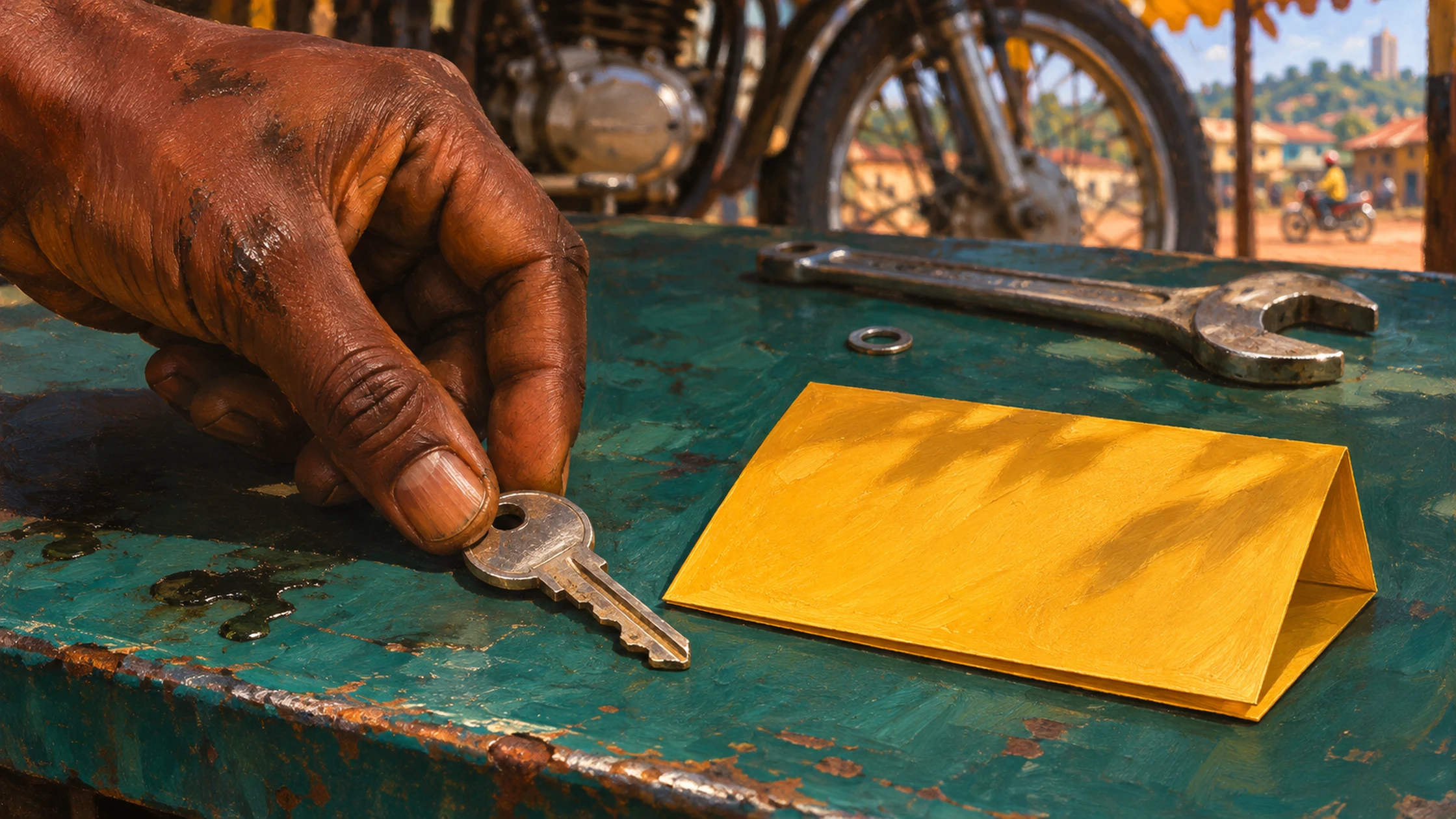
He put the yellow invitation face down beside a tray of washers. At the bottom she had written his name herself. Daniel knew the pen: blue, thick, always losing its cap.
The first motorcycle came with a metallic ticking that its owner imitated more loudly than the engine. Daniel listened, waited for the imitation to stop, and listened again. Isaac, his apprentice, crouched at the other side with the notebook he had started carrying in his back pocket.
“Which side?” Daniel asked him.
Isaac pointed. He was right.
He was nineteen and had become careful in a way Daniel did not remember being at nineteen. He counted the clean rags before using one. When a part came from the supplier, he wrote its cost beside the job instead of trusting himself to remember it later.
Daniel had teased him about the notebook. Now, when a customer questioned a bill, he asked Isaac to fetch it.
By nine the first job was done and paid: sixty-five thousand shillings. The second motorcycle already stood on its support, awaiting parts. That repair would bring a hundred and forty-five thousand.
Two hundred and ten by lunchtime, Daniel thought. He could hear the rest of the day arriving in the road: engines slowing, a horn answered by another horn, a customer calling his name before coming into view.
His cousin sent a message. Could he at least come for the speeches?
Daniel typed the same large Saturday number. He had begun to resent having to explain that work was work. He sent it without reading it back.
Isaac was entering the first payment.
“What?” Daniel said.
“I didn’t say anything.”
“You looked.”
Isaac flattened the notebook against the bench. “Are you counting the pads as yours?”
Daniel laughed once. “Whose money came into this shop?”
“And whose pads went out?”
It was an impertinent way to ask a reasonable question. Daniel occupied himself with a socket that did not need cleaning.
The supplier’s rider arrived with the second job’s parts. His motorcycle rattled with plastic packets. While Daniel checked the contents, Isaac put down the morning’s figures: a hundred and twenty-five thousand for parts across the two jobs, ten thousand for the oil and other consumables they used.
They would collect two hundred and ten. A hundred and thirty-five belonged against what they had bought to do the work. Seventy-five remained before Isaac’s pay or the workshop’s other costs.
The rider held out his hand for the money.
Daniel paid him from the first receipt and the workshop’s existing parts float, settling the morning’s materials. The notes looked smaller on the journey out.
“I know what parts cost,” he said after the rider left.
“Yes.”
“I buy them.”
“Yes.”
Isaac did not smile. That helped, eventually.
Daniel checked the two entries himself. There was no ingenious answer hiding between them. A customer could give him a thick fold of notes and still leave most of it owing to someone else. He knew this in the evening, when he counted. Apparently he could forget it on the telephone.
From the school lunch came a photograph of Aunt Esther beside a stack of plates. She was wearing a green dress Daniel had never seen, with a ribbon tied at her waist. He enlarged the photograph. A second woman was taking the plates from her hands.
His aunt looked offended by the assistance.
He laughed before he could stop himself.
At eleven, a loose panel in the workshop roof began its dry tapping. The second engine was quiet now, which let Daniel hear it. He ran the engine once more, checked what needed checking, and called the owner to collect it.
Three people had asked about afternoon work. None had yet booked; Daniel had given prices and said he would confirm. A chain job and two oil changes would bring a hundred and eighty thousand if all three came and paid. The materials would cost a hundred and twenty thousand. He would buy them only after accepting the work.
He started to say “one hundred and eighty” to Isaac and stopped.
“Sixty,” he said.
Isaac looked up.
“After the materials. For that afternoon.”
“If all three come.”
“Yes, if they come.”
It was still a substantial amount. Sixty thousand could replace things, mend things, wait in an account until a quiet day. Daniel did not feel released by discovering the right number. He felt deprived of the wrong one, which had done a much better job of defending him.
“What happens to your pay if we close?” he asked.
Isaac looked at the yellow card.
“You said thirty for the day.”
“I did.”
The boy did not look up. “I told my mother.”
Daniel felt ashamed that he had made the question sound uncertain.
“You’ll have thirty.”
The pay was due whether Daniel stayed or left. So were the rent and the other fixed bills. They had to be covered across the month; closing for an afternoon would not persuade them to disappear.
The morning’s seventy-five thousand would leave forty-five after Isaac. Daniel set aside another fifteen towards those standing costs. Thirty remained before his own pay, tax and whatever next broke. He wrote that beneath the other numbers, using Isaac’s pen.
He could spend eight thousand on the return journey to the lunch. That would leave twenty-two from the morning, unclaimed by the costs he had just listed. It was not a wage he could promise himself. It was what he had today, with the week’s immediate bills already provided for elsewhere.
There was no way to make the afternoon’s possible sixty thousand stop mattering.
He put the pen down.
When Daniel was twelve, Aunt Esther had come to watch him run in a school race. She had arrived late, in shoes dusted with flour. He had been angry because he had already lost by the time she reached the field. She made him show her where he had started, and then where he had finished, and stood at the finish while he ran it again.
He had not thought of that in years. He disliked the memory arriving now, as if his mind were trying to win an argument by bringing out an old photograph.
Esther had also shouted at him unfairly, once, about a missing kitchen knife that later turned up in a sack of onions. She had never apologised in words. She had given him the largest piece of fish at supper. She was not becoming a saint because she was leaving her job.
He wanted to see what she would do when somebody else served her lunch.
Daniel called the three afternoon customers. One agreed to ask again next week. Another said he needed the oil changed today. Daniel gave him the number of a mechanic two roads away. The third did not answer, so Daniel sent a message that he could not take the job that afternoon and had made no booking.
There were no deposits to return. There was also no promise that any of the work would come back to him.
Isaac began putting tools away.
“Not yet,” Daniel said. “We finish this handover properly.”
They waited for the second customer, explained the work, and received the payment. Daniel counted Isaac’s thirty thousand into his hand. Isaac folded it carefully before asking whether he could leave as soon as they locked up.
“You have somewhere?”
“My brother’s match.”
“Football?”
Isaac looked at the sockets, the tyres, the dismantled engine. “Yes.”
Daniel deserved that look. He told him to go.
Closing made the sounds unfamiliar. The bench stopped ringing with tools. The roof panel went on tapping to itself. Daniel swept once, then found himself arranging the loose washers by size. He was buying minutes in which he would still be a man necessarily at work.
He turned the invitation over. There was a small drawing of a spoon beneath his name, probably added by one of his aunt’s younger colleagues. He put the workshop key on it while he washed his hands. Oil remained around his cuffs and in the lines beside his nails.
For a moment he considered going home to change.
Then he lowered the shutter.
It scraped. It banged. It squealed.
He locked it anyway.
At the lunch he arrived during a story about a pot that had burnt through its bottom. Someone was imitating the head teacher, badly. Aunt Esther saw Daniel from the other end of the room. She did not wave. She moved her handbag from the empty chair beside her.
He sat. There was no question about the workshop. No family tribunal assessing whether he had given enough. His cousin slid a plate towards him and continued arguing with someone about the correct year of the burnt pot.
Daniel tried to hide his cuffs beneath the table.
Esther caught his wrist. For a second he thought she was inspecting the oil. Instead she was turning his watch towards her.
“Is that right?” she asked.
“Nearly two.”
She looked towards the kitchen door. Until yesterday, at nearly two, she would have been counting how many children still needed to eat. Her hand shifted on the table, ready to rise with the rest of her.
The young colleague with the spoon drawing came out carrying a dish. “Sit down, Esther.”
His aunt sat.
A little later someone set off a spoon against a glass, asking for quiet. Daniel had heard metal striking metal all morning. This time he did not reach for anything.
Money behind the story
Money received from a job is not automatically the owner’s income. Daniel’s morning revenue is UGX 210,000. Parts and consumables cost UGX 135,000, leaving UGX 75,000 before labour and other costs. Paying Isaac the agreed UGX 30,000 and reserving UGX 15,000 towards standing costs leaves UGX 30,000 before Daniel’s drawings, tax and other needs. His UGX 8,000 return journey leaves UGX 22,000 within that limited calculation. This is not a complete profit-and-loss account.
The afternoon decision concerns three unaccepted requests: potential revenue of UGX 180,000 less UGX 120,000 of materials that would only be bought if the work proceeded. The possible additional contribution is UGX 60,000. Neither those customers nor their eventual payment is guaranteed. There are no accepted bookings, bought afternoon materials or customer deposits in this scenario.
ACCA’s relevant-cost guidance explains that a decision should identify the future cash flows it changes. Costs payable in either alternative do not become savings merely because work stops. Here, Isaac’s agreed pay and existing fixed commitments remain; staying open could add contribution, but the old UGX 480,000 sales figure cannot measure this afternoon’s sacrifice.
The calculation makes the trade-off clearer. It cannot price Esther’s company or establish that time off is always affordable. Prices, wages and workshop arrangements are invented, not Ugandan benchmarks or employment-law conclusions.
Financial sources checked 25 November 2026. Story figures and outcomes are illustrative. General financial education, not individual financial advice.
Stay with the story: three questions
- When money passes through your hands, which part already belongs against the costs of earning it?
- Which costs would actually change if you accepted or declined the next piece of work?
- What would you decide differently if the financial sacrifice had a clearer amount, even though it still mattered?



