The Volatility Arbitrage Engine: Capturing the Delta Between Implied and Realized Volatility
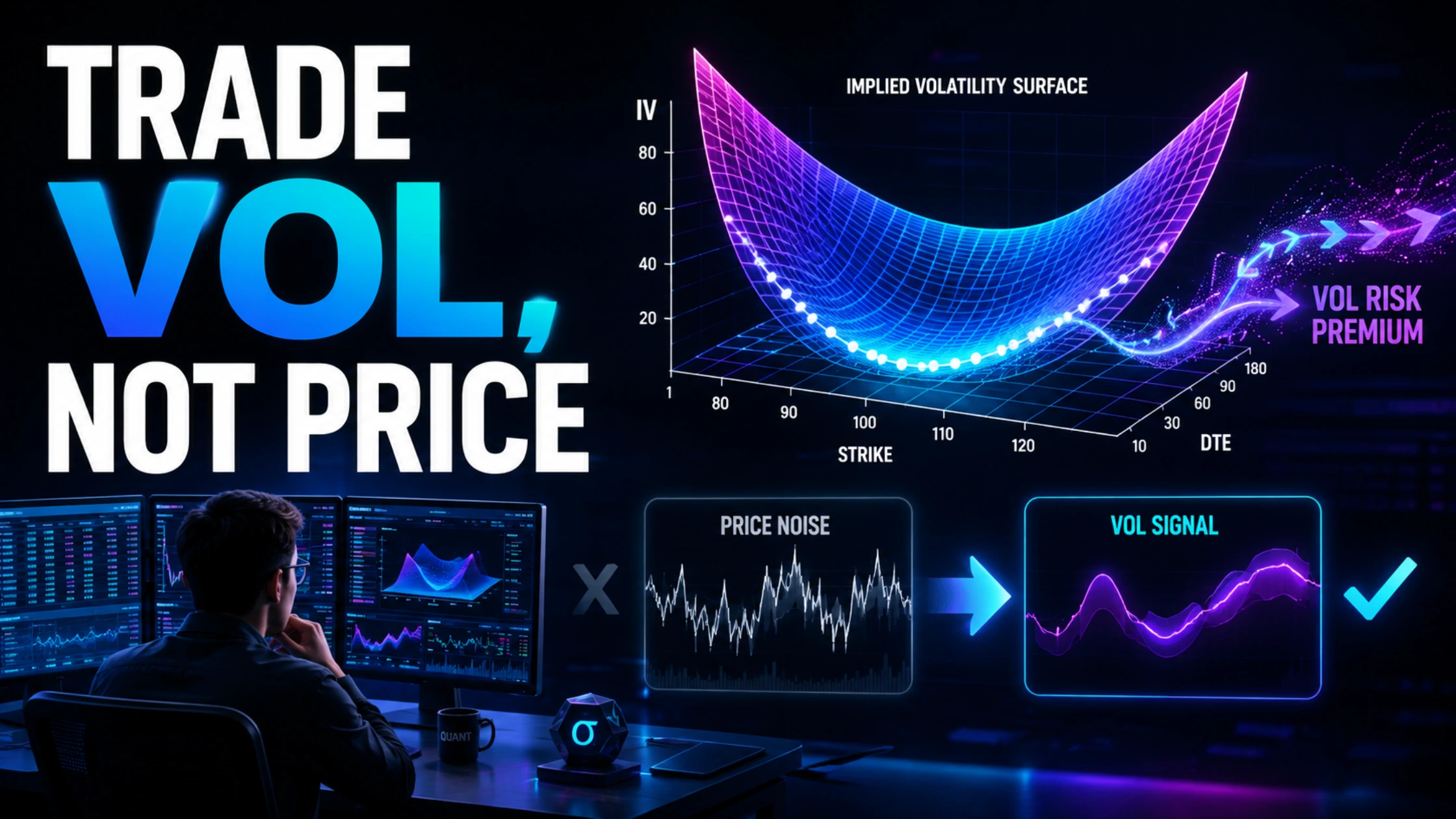
In traditional financial markets, novice traders spend their careers attempting to predict where price is going next. Institutional options desks and quantitative hedge funds, however, do not care whether Bitcoin trades at $50,000 or $150,000 next month. Instead, they trade a far more predictable variable: The Volatility Risk Premium (VRP).
In digital asset derivatives, market panic and speculative hype routinely force **Implied Volatility (IV)**—the expected price fluctuation priced into option contracts—far above **Realized Volatility (RV)**—the actual physical movement of the underlying asset over time. This systematic mispricing allows quantitative desks to execute Volatility Arbitrage: selling overpriced options options premium while continuously dynamic delta-hedging the spot or perpetual position to remain completely directionally neutral.
1. Deconstructing the Volatility Risk Premium (VRP)
To understand why option buyers routinely overpay, you must deconstruct how option pricing models (such as Black-Scholes and jump-diffusion models) translate market fear into option premiums.
Because retail participants treat options as lottery tickets, the implied volatility ($IV$) priced into derivatives is almost structurally higher than the realized volatility ($RV$) measured at settlement. By shorting high-IV options and dynamically rebalancing the underlying delta via high-speed perpetual swap markets, market makers harvest the **Volatility Delta** risk-free.
The Golden Law of Volatility Arbitrage
$$PnL = \int_{0}^{T} \frac{1}{2} S_t^2 \cdot \Gamma_t \cdot \left( \sigma_{\text{implied}}^2 - \sigma_{\text{realized}}^2 \right) dt$$
If Implied Volatility exceeds Realized Volatility ($\sigma_{\text{implied}} > \sigma_{\text{realized}}$) over the life of a delta-hedged position, the net cumulative PnL of the strategy is mathematically guaranteed to be positive, regardless of directional price movement.
2. Interactive Volatility Arbitrage & Delta-Hedging Simulator
Use our interactive quantitative engine below to model a delta-hedged options strategy. Adjust Implied Volatility, expected Realized Volatility, Days to Expiration (DTE), and rebalancing frequency to see your projected Net Volatility Yield and Gamma Hedging Decay.
3. The Institutional Execution Blueprint
Executing a delta-neutral volatility arbitrage strategy requires coordinating options write platforms with high-speed hedging venues. Follow this 4-step execution strategy:
Monitor BTC, ETH, and SOL options term structures on premier crypto options venues like Deribit (Code: 5969.4030) or decentralized options protocol Aevo. Look for options contracts with IV percentile rankings above 80% relative to the 30-day historical realized volatility.
Sell an Out-of-The-Money (OTM) Call and Put simultaneously (Short Strangle) on platforms such as Drift or Paradex. This establishes a net-zero initial delta while selling peak implied volatility premium.
As underlying spot prices move, your options position will develop non-zero Delta ($\Delta$). Connect high-liquidity perpetual swap accounts like Bybit (Code: 46164), OKX (Code: 2136301), MEXC (Code: 16yJL), or Bitget to buy or short perps whenever net delta drifts outside safe parameters.
When running automated hedging bots, isolate master withdrawal permissions using cold storage hardware vaults like Ledger or OneKey (Code: 46Z9TD). Ensure API keys assigned to automated trading platforms do not have withdrawal rights enabled.
4. Volatility Analytics & Quantitative Tooling
To track real-time volatility surfaces, options gamma exposures, and institutional flow alerts, integrate these professional quantitative tools into your trading workflow:
- Options Analytics & Flow Tracking: Monitor options order flow, unusual call/put sweeps, and gamma exposure maps with Unusual Whales.
- Charting & Volatility Surface Mapping: Plot historical vs. implied volatility curves across crypto assets using TradingView or Coinigy.
- Automated Delta-Hedging Bots: Program custom API rebalancing triggers using Coinrule, Cryptohopper, or 3Commas.
- On-Chain Arbitrage Detection: Identify volatility and cross-exchange pricing anomalies using ArbitrageScanner or ASCN AI.