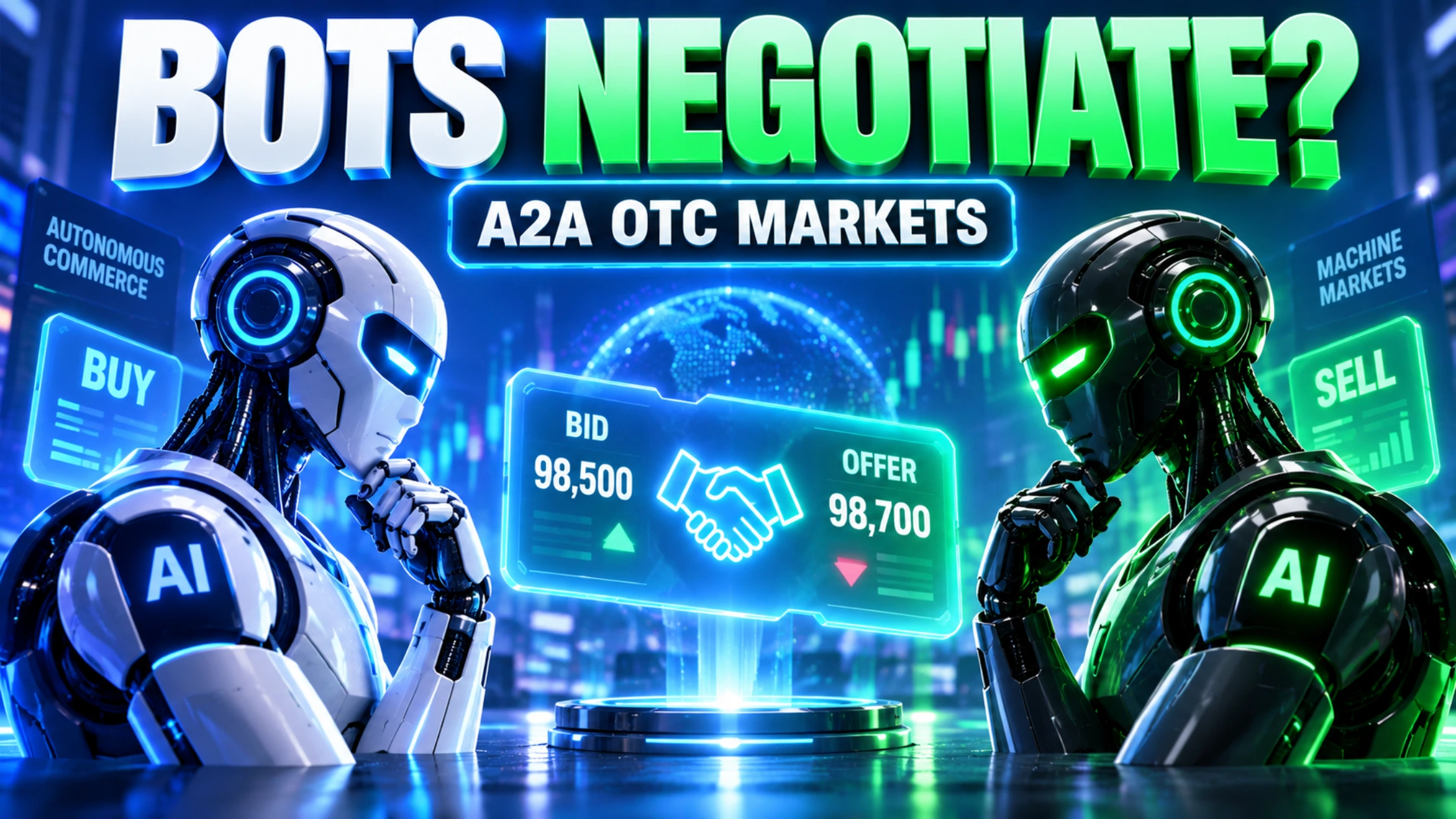
When Bots Negotiate: Inside the First Agent-to-Agent OTC Markets
AI agents are moving beyond buying fixed-price services. Buyer agents can increasingly discover seller agents, exchange requirements, negotiate price and terms, establish authority and settle transactions without a human approving every step. That begins to look less like ecommerce and more like a machine-native OTC market.
What Matters
The first real agent-to-agent markets are unlikely to begin with billion-dollar bond trades.
They are beginning with things machines naturally consume:
- API calls;
- data;
- compute;
- model inference;
- software services;
- digital resources;
- procurement;
- small merchant transactions.
The technological pieces are increasingly visible.
A2A gives independently built agents a common communication and task-coordination layer.
x402 and other machine-payment systems allow software to settle small transactions programmatically.
AP2 provides cryptographic evidence of delegated payment authority.
ERC-8004 is developing portable identity, reputation and validation registries for agents interacting outside pre-existing trust relationships.
Commerce standards such as UCP, ACP and newer agent-to-agent specifications provide ways to represent offers, checkout state and transaction terms.
The interesting transition occurs when those components are assembled into a bilateral market where:
one agent asks, another agent quotes, both negotiate, policy engines authorize, money moves and a machine-readable receipt records the outcome.
Why We Call It an Agent-to-Agent OTC Market
OTC traditionally means an agreement negotiated bilaterally rather than executed against a centralized public order book.
That economic structure maps surprisingly well onto emerging agent commerce.
A buyer agent may say:
“I need 100,000 verified market-data observations in the next hour. Maximum budget $40. Reliability must exceed my policy threshold. Quote me.”
A seller agent can respond:
“Standard price is $50. I can provide 100,000 calls for $36 if settlement occurs now.”
The buyer evaluates competing quotes, verifies the counterparty, checks its delegated budget and accepts the best admissible offer.
No conventional order book is necessary.
No human sales representative needs to enter the negotiation.
That is economically OTC even when the underlying product is an API rather than a bond.
The Agent-to-Agent Market Stack
Communication
A2A lets autonomous systems advertise capabilities, communicate and coordinate tasks across vendor boundaries.
Discovery
Agent Cards, DNS-based discovery, registries and marketplaces help buyer agents locate potential sellers.
Identity & Trust
Agent identity, reputation, validation and attestation systems help establish whether a counterparty should be trusted.
Negotiation
Buyer and seller agents exchange requirements, quantities, price, service levels, timing and other bilateral terms.
Mandate
Wallet policies and payment mandates define what each agent is actually authorized to agree to.
Settlement & Evidence
Payment rails settle value while receipts, task outputs and reputation records provide evidence of what happened.
A2A Gives Agents a Language for Negotiation
The Agent2Agent protocol has become a significant interoperability layer.
A2A v1.0 is designed so independently built agents can:
- advertise their capabilities;
- discover how another agent can be reached;
- exchange messages;
- delegate tasks;
- maintain task state;
- stream results;
- work across different agent frameworks.
By April 2026, the Linux Foundation reported support from more than 150 organizations and production use across multiple industries.
A2A later joined the Agentic AI Foundation as a Growth Stage project.
That matters for commerce because negotiation requires more than a payment API.
Agents must exchange information over time.
A buyer may ask for a quote.
A seller may ask for quantity.
The buyer may counter.
The seller may return an amended proposal.
The buyer may request validation.
Only then does settlement occur.
Stripe Has Already Demonstrated the Pattern
A particularly useful example came from Stripe Sessions 2026.
Stripe and AWS demonstrated a buyer agent searching for a service across different seller configurations.
One seller could not even recognize the agent.
Another could expose product information but still required conventional account registration.
A third exposed an agent-compatible seller experience and payment rail.
The demonstrated machine transaction completed in roughly three seconds for approximately $0.12.
More important than the payment itself was the architecture surrounding it.
Stripe described seller agents capable of quoting dynamic prices and negotiating quantity discounts.
For example, an item priced at $12 individually might be offered at $8 when an agent requests 1,000 units.
That is not simply checkout automation.
It is automated bilateral price formation.
The DN Agent-to-Agent Market Maturity Ladder
The model recommends products or prepares a transaction, but a human remains the effective buyer and approves the economic decision.
A buyer agent autonomously pays a fixed price for an API, dataset or digital resource. x402-style machine payments fit naturally here.
An agent interacts with a merchant's structured checkout or seller API but commercial terms remain mostly fixed.
The buyer agent discovers and communicates directly with another agent representing the seller or service provider.
Both agents can alter material terms such as price, volume, delivery time or service level inside delegated policy boundaries.
Agents autonomously discover counterparties, establish trust, negotiate terms, authorize settlement, verify delivery and update reputation without synchronous human approval.
What Is Actually Being Negotiated?
Machine negotiation can extend far beyond headline price.
| Market | Potential Negotiated Terms | Why Agents May Be Better Suited Than Humans |
|---|---|---|
| APIs | Price per call, volume, speed, priority, retry guarantee | Millions of tiny purchasing decisions can occur dynamically. |
| Compute | GPU time, latency, region, availability, duration | Workloads can route to the best real-time quote. |
| AI inference | Model, tokens, latency, quality, context size | The buying agent can optimize cost against task value. |
| Data | Freshness, coverage, exclusivity, query volume | Agents can purchase exactly the information needed. |
| Advertising | Audience, placement, impression count, price | Inventory and demand can clear continuously. |
| Procurement | Quantity, unit price, lead time, delivery, warranties | Structured repetitive negotiation is highly automatable. |
| Financial liquidity | Size, price, spread, collateral, settlement timing | Bilateral RFQ workflows are inherently machine compatible. |
The First Big Market May Be API Liquidity
APIs already look surprisingly similar to financial liquidity.
A service has:
- capacity;
- a marginal cost;
- a service quality;
- variable demand;
- an acceptable minimum price;
- inventory that can disappear under load.
A buyer agent has:
- a maximum willingness to pay;
- a latency tolerance;
- a quality requirement;
- a deadline;
- alternative counterparties.
Today most APIs publish one static pricing schedule.
In an A2A market, price could become dynamic.
An inference provider with idle GPUs could discount spare capacity.
A research agent facing a deadline could pay a premium for immediate delivery.
The market clears without either company employing a salesperson to negotiate a three-cent transaction.
x402 Solves the Settlement Problem, Not the Entire Market
x402 is increasingly important because it lets software pay software without a conventional checkout.
Its 2026 batch-settlement architecture goes further by allowing agents to exchange cryptographic payment vouchers quickly and settle many interactions together.
That can make fractions-of-a-cent interactions more economical.
But x402 does not by itself answer:
- Which seller should the agent choose?
- Is the seller trustworthy?
- What should the price be?
- Should the buyer negotiate?
- Was the service delivered correctly?
- Should the counterparty receive a positive reputation score?
Those are market-structure problems.
ERC-8004 Adds a Trust Layer
An open A2A economy creates a problem that enterprise agents inside one company do not face.
The buyer may never have encountered the seller before.
ERC-8004 is an emerging Ethereum standard designed around this problem.
Its architecture includes:
- Identity Registry: portable agent identities;
- Reputation Registry: standardized feedback signals;
- Validation Registry: independent verification of agent work.
Agents can advertise endpoints such as A2A, MCP, wallets or other identifiers.
Reputation can then be associated with the agent across interactions.
The standard is particularly interesting because payment is deliberately orthogonal to the identity system.
That makes it possible for an agent to establish trust through one layer and settle through another.
Identity Will Become Financial Infrastructure
The need to distinguish legitimate agents from malicious or impersonating software is already moving into mainstream payments.
In September 2026, Visa, Mastercard and Ant International announced work on a shared framework for identifying and verifying purchasing agents.
India is separately developing registry concepts around AI agents transacting over UPI.
That points toward an important future distinction.
A wallet identifies where money comes from.
An agent identity system identifies which autonomous actor was authorized to decide that the money should move.
AP2 Handles the Mandate Problem
Even if two agents trust one another, they still need to prove that they were allowed to make the deal.
AP2 introduces signed mandate structures designed to record user or organizational authority.
In an A2A negotiation this can create a useful separation:
The agent negotiates.
The mandate defines the negotiating envelope.
A procurement agent might therefore receive authority to:
- buy up to 10,000 units;
- spend no more than $80,000;
- use approved suppliers;
- accept delivery within 14 days;
- reject payment terms longer than 30 days.
The agent can negotiate creatively inside those constraints.
It cannot legally or technically enlarge them itself.
The Agent Negotiation Envelope
This may become one of the most important concepts in autonomous commerce.
The goal is not unrestricted negotiation.
The goal is constrained economic discretion.
Why Agents Could Make Prices More Dynamic
Human negotiation has high fixed costs.
Nobody negotiates the price of a $0.03 API call because the conversation costs more than the transaction.
Agents change that equation.
If negotiation costs approach zero, bilateral price discovery can occur at much smaller transaction values.
This could transform static SaaS pricing.
Instead of:
$99 per month
a service could expose:
“Ask my seller agent for a quote.”
The resulting price might depend on:
- current capacity;
- customer reputation;
- volume;
- urgency;
- service level;
- payment method;
- historical relationship;
- market competition.
This Could Create Machine-Native RFQ Markets
Request-for-quote markets already dominate many institutional financial workflows.
A participant asks several counterparties for prices and executes against the best acceptable quote.
That model is almost perfectly suited to agents.
A buyer agent could:
- discover ten qualified sellers;
- send an identical structured request;
- receive ten quotes;
- verify reputation and delivery guarantees;
- counter the top three;
- compare total economic cost;
- settle with the winner;
- score performance afterward.
The resulting market has no visible public order book.
Yet it can still produce intense competition.
The Hidden Risk: Agents Can Collude Too
Automated negotiation does not guarantee competitive markets.
Agents may learn that aggressive competition reduces profits.
Pricing systems could converge on mutually beneficial high prices without explicitly being programmed to collude.
Other risks include:
- coordinated bidding;
- fake counterparties;
- Sybil reputation attacks;
- quote stuffing;
- discriminatory pricing;
- self-dealing between related agents;
- manipulation of reference prices;
- agents leaking confidential negotiating parameters.
Machine-speed negotiation therefore increases the importance of monitoring and market conduct controls.
A Seller Agent Should Never Know the Buyer's True Maximum
Suppose the buyer agent has authority to pay up to $100.
That does not mean the seller agent should learn:
“My user is willing to pay $100.”
A properly designed negotiating agent should protect private reservation values.
Otherwise, every transaction will conveniently settle at the buyer's maximum.
Likewise, the seller agent should not reveal its true minimum acceptable price unless its strategy specifically requires it.
Agentic commerce therefore creates a new field of machine negotiation security:
how do we give agents economic objectives without leaking those objectives to their counterparties?
The DN A2A Commerce Classification Standard
One of the biggest measurement mistakes will be counting every machine payment as agent-to-agent commerce.
DN proposes four categories.
| Tier | Classification | Evidence |
|---|---|---|
| A | Verified autonomous A2A negotiation | Identifiable buyer agent + identifiable seller agent + material negotiated term + delegated authority + settlement evidence. |
| B | Verified A2A transaction | Buyer and seller agents interact and settle, but commercial terms are fixed or not demonstrably negotiated. |
| C | Agent-to-service transaction | An agent autonomously purchases from an API, merchant or service with no identifiable seller agent negotiation. |
| D | Machine-compatible payment | Payment format is compatible with agents but autonomous agent participation is not independently established. |
DN A2A Volume Tracker
Use this framework to separate headline machine-payment activity from evidence-backed agent-to-agent commerce.
The default values below are illustrative only. Replace them with your own dataset or verified research observations. DN does not infer that a payment is A2A simply because it used an agent-compatible rail.
What x402 Volume Does and Does Not Tell Us
Machine-payment rails are growing rapidly.
That is important.
But a payment made by an AI agent to a fixed-price API is not the same thing as two agents negotiating with each other.
The distinction matters because three separate markets can exist:
- machine payments;
- agent-mediated commerce;
- agent-to-agent negotiated commerce.
The third is the smallest today.
It may ultimately be the most economically interesting.
The Future A2A Market Maker May Be a Seller Agent
Imagine a cloud provider with excess GPU capacity.
Its seller agent continuously observes:
- available capacity;
- electricity cost;
- expected future demand;
- customer quality;
- competitor quotes.
It then publishes individualized quotes.
The seller agent is effectively making a market in compute.
A similar structure could emerge for:
- data feeds;
- API capacity;
- delivery slots;
- advertising;
- cloud storage;
- AI inference;
- liquidity;
- credit;
- insurance capacity.
When Does This Become Agentic Finance?
The boundary between commerce and finance becomes blurry when the negotiated object itself is financial.
Consider an agent seeking:
- a stablecoin conversion;
- a collateralized loan;
- a hedge;
- an RFQ for tokenized assets;
- cross-border liquidity;
- insurance;
- yield-bearing cash management.
The same A2A architecture still applies:
discover → authenticate → negotiate → mandate → risk-check → settle → verify
But the regulatory burden becomes much greater.
The Most Dangerous Future Is Machine-Speed Credit
Payments are comparatively simple because the obligation often ends immediately after settlement.
Credit persists through time.
An autonomous lending market would require agents to negotiate:
- principal;
- interest;
- collateral;
- maturity;
- covenants;
- liquidation;
- counterparty risk.
A mispriced API call may cost cents.
A mispriced autonomous credit agreement can create leverage and systemic exposure.
DN therefore expects agent identity, reputation and risk infrastructure to matter much more as A2A markets migrate from digital services into financial obligations.
Reputation May Become Machine Credit History
ERC-8004's reputation model hints at a potentially important future.
If agents accumulate verifiable histories of:
- successful completion;
- timely payment;
- delivery quality;
- dispute frequency;
- validation results;
those histories could eventually influence economic terms.
A highly reliable seller agent could command a premium.
A buyer agent with strong payment history could receive better terms.
Reputation then becomes economically valuable.
But Reputation Creates a Sybil Problem
Software identities can be created cheaply.
An operator could create hundreds of agents that transact with one another and leave positive feedback.
The result looks like reputation.
It may simply be manufactured history.
This is why ERC-8004 explicitly acknowledges Sybil risk and allows more sophisticated reputation aggregation to occur outside the basic registry.
In high-value markets, reputation will probably need to combine:
- identity;
- economic stake;
- transaction history;
- independent validation;
- counterparty quality;
- possibly regulated credentials.
The Negotiation Model Must Be Auditable
If an agent buys an API for $0.03, nobody may care why it selected that provider.
If an enterprise procurement agent signs a $5 million supply agreement, somebody will.
Organizations will need records of:
- the mandate given to the agent;
- counterparties considered;
- quotes received;
- terms proposed;
- terms rejected;
- final economic rationale;
- who or what authorized settlement;
- what was delivered.
Autonomy does not eliminate governance.
It increases the amount of governance that must become machine-readable.
The DN Agent-to-Agent OTC Market Map
| Layer | Emerging Infrastructure | Function | Major Unsolved Problem |
|---|---|---|---|
| Communication | A2A | Agent discovery, messaging, delegation and task coordination | Trusting unknown counterparties |
| Tool Access | MCP | Agents discover and invoke tools | Authorization and tool integrity |
| Commerce State | UCP, ACP, AGTP-Commerce | Offers, checkout, transaction structures | Interoperability between competing standards |
| Mandates | AP2, wallet policy | Prove delegated authority | Cross-platform legal recognition |
| Identity & Trust | ERC-8004, agent registries, attestations | Identity, reputation and validation | Sybil resistance and liability |
| Machine Settlement | x402, MPP, Agent Pay for Machines | Programmatic value transfer | Scale, compliance and reconciliation |
| Market Intelligence | Emerging | Quote comparison, reputation and price discovery | No universal A2A market-data layer yet |
What DN Wants to Measure Next
The agent economy needs better data than transaction counts.
A future DN A2A Observatory should track:
- verified buyer agents;
- verified seller agents;
- bilateral transactions;
- negotiated transactions;
- average negotiated discount;
- quote-response time;
- number of counterparties considered;
- settlement success;
- delivery success;
- dispute rate;
- repeat counterparty rate;
- reputation dispersion;
- autonomous volume;
- human intervention rate.
DN Agent Negotiation Spread
Traditional markets measure bid-ask spreads.
Agent markets need another concept.
This could reveal how much economic value agents create through negotiation rather than mere execution.
If a buyer agent consistently reduces all-in acquisition cost by 7%, the agent is not just a user interface.
It is economically productive capital.
The Real Business Opportunity
A world of autonomous buyers changes the economics of distribution.
Today a business optimizes for:
- Google;
- social media;
- human sales teams;
- marketplaces;
- affiliate distribution.
Tomorrow it may also need to optimize for:
- agent discovery;
- machine-readable inventory;
- agent reputation;
- automated price quotation;
- programmatic settlement;
- machine-readable service guarantees.
A seller invisible to buyer agents may lose the transaction before a human ever knows a buyer existed.
Why This Matters for Decentralised News
This creates a new information layer.
Agents will need trusted external data to answer:
- Which platform is operational?
- Which counterparty has strong reputation?
- Which wallet architecture limits risk?
- Which payment rail is cheapest?
- Which API is most reliable?
- Which market offers the best execution?
- Which claims have been independently tested?
That is exactly the type of machine-readable research DN's benchmark programme is being built to supply.
From Negotiation to Real Execution
The agent-to-agent economy still needs secure wallets, payment rails and trading infrastructure. Continue through the related DN benchmarks.
Best Wallets for AI Agents x402 Cost & Reliability Benchmark Agent Checkout Reliability Index Best Crypto Platforms for AI AgentsSome related DN decision pages contain separately disclosed commercial relationships. No referral relationship determines the conclusions in this research article.
DN Methodology
DN distinguishes between machine-compatible transactions and genuine agent-to-agent markets.
A transaction should not be classified as verified negotiated A2A commerce unless there is evidence of:
- an identifiable buyer agent;
- an identifiable seller agent or autonomous seller representative;
- a bilateral interaction between them;
- at least one material economic term capable of negotiation;
- delegated authority permitting the agents to act;
- settlement or transaction evidence;
- a sufficiently clear resulting state.
Machine-payment volume that lacks these attributes should remain classified as agent-to-service or machine-compatible activity rather than being promoted as agent-to-agent OTC volume.
What Would Prove This Thesis Wrong?
There are credible reasons agent negotiation may remain niche.
Static posted prices may prove efficient enough for most digital services.
Large platforms may internalize buyer and seller agents inside closed marketplaces rather than allowing open bilateral discovery.
Businesses may refuse to let AI systems modify pricing because of competition, compliance or brand risk.
Humans may also insist on approving material negotiations.
And for financial products, regulatory obligations may sharply limit unconstrained software-to-software dealing.
If those forces dominate, agents may become highly capable executors without becoming independent market negotiators.
But the economic incentive remains strong.
When the cost of negotiation approaches zero, more things become negotiable.
Frequently Asked Questions
What is agent-to-agent commerce?
Agent-to-agent commerce occurs when autonomous software agents representing different economic parties communicate directly to discover services, exchange requirements, agree transaction terms or settle purchases without a human manually conducting each step.
What is an agent-to-agent OTC market?
DN uses agent-to-agent OTC market to describe bilateral machine commerce where buyer and seller agents can negotiate transaction terms directly rather than relying on a centralized public order book. The term does not imply that the market is a regulated securities OTC venue.
Can AI agents negotiate prices with each other?
Yes. Seller-agent architectures can expose dynamic quotation and negotiation logic while buyer agents operate within spending and policy constraints. Stripe demonstrated buyer and seller agent architectures involving dynamic price negotiation during its 2026 agent-to-agent commerce work.
What does A2A do?
The Agent2Agent protocol provides an open standard for agents to advertise capabilities, discover compatible interfaces, communicate, delegate tasks and coordinate work across different frameworks and organizations.
What role does x402 play in agent-to-agent commerce?
x402 provides internet-native machine payment infrastructure. It can settle purchases between software participants, but additional layers are needed for counterparty discovery, trust, negotiation, authorization and reputation.
What is ERC-8004?
ERC-8004 is an emerging Ethereum standard for trustless agents that defines identity, reputation and validation registries intended to help autonomous agents discover and evaluate counterparties across organizational boundaries.
What is the Agent Negotiation Envelope?
DN defines the Agent Negotiation Envelope as the bounded range of economic terms an agent is authorized to change without obtaining additional approval. It can include maximum price, quantity, counterparties, delivery conditions and settlement rules.
What is A2A Volume Purity?
DN defines A2A Volume Purity as the proportion of reported machine-commerce volume that can be attributed to evidenced bilateral agent transactions rather than merely payments made through infrastructure that is compatible with AI agents.
Will AI agents trade financial assets directly with each other?
Technically, the same discovery, negotiation, authorization and settlement architecture can be applied to financial transactions. Regulated assets introduce significantly greater requirements involving identity, licensing, market conduct, counterparty risk, KYC, AML and transaction reporting.
Primary Evidence Base
- A2A Protocol v1.0: production-ready open Agent2Agent communication standard, A2A Protocol project.
- Linux Foundation A2A one-year milestone: more than 150 supporting organizations and reported production deployments.
- Stripe Sessions 2026, Preparing for Agent-to-Agent Commerce: buyer-agent and seller-agent architecture, machine transaction demonstration and dynamic-pricing discussion.
- ERC-8004, Trustless Agents: identity, reputation and validation registries for open agent economies.
- Ethereum AI Agents documentation: current ERC-8004 ecosystem and agent-wallet context.
- x402 Foundation and x402 V2: open machine-payment protocol and agentic payment infrastructure.
- x402 Batch Settlement: high-velocity voucher-based machine payments and bulk settlement architecture.
- Google Universal Commerce Protocol: agentic commerce interoperability and A2A integration.
- Google Agent Payments Protocol: mandates and verifiable delegated payment authority.
- Mastercard Agent Pay for Machines: machine-to-machine and high-frequency agent payment infrastructure.
- AGTP-Commerce Internet-Draft: emerging structured commerce messaging for agent-to-agent transactions.
- Visa, Mastercard and Ant International: September 2026 joint work on interoperable agent identity and trust standards.
Commercial Disclosure: This article is protocol-led research rather than an affiliate ranking. Commercial relationships do not determine the protocols, standards or infrastructure discussed. Related DN platform and wallet decision pages may contain separately disclosed partner links.
Research Standard: DN distinguishes documented architecture, demonstrations and deployed infrastructure from independently measured autonomous economic activity. The existence of an agent-compatible payment transaction does not prove that two autonomous agents negotiated the transaction.
Regulatory Disclaimer: The use of “OTC market” in this article is an economic analogy for bilateral negotiated machine commerce. It does not imply that the referenced protocols operate regulated securities, derivatives, banking, lending or foreign-exchange venues.
Risk Disclaimer: Autonomous transactions introduce financial, cybersecurity, software, model, identity, counterparty and operational risks. Nothing on this page constitutes financial, investment, legal, cybersecurity or tax advice.
Related reading:
Best Agentic Checkout Systems 2027: ACP vs UCP vs Visa vs Mastercard
Fastest Crypto Trading APIs 2027: Latency, Rejections & Reliability Ranked
Best Crypto Platforms for AI Agents 2027 | Agentic Finance Rankings
Agentic Wallet Security Index 2027: The Safest Wallets for AI Agents
Best Wallets for AI Agents 2027: Security, Payments & Autonomous Finance