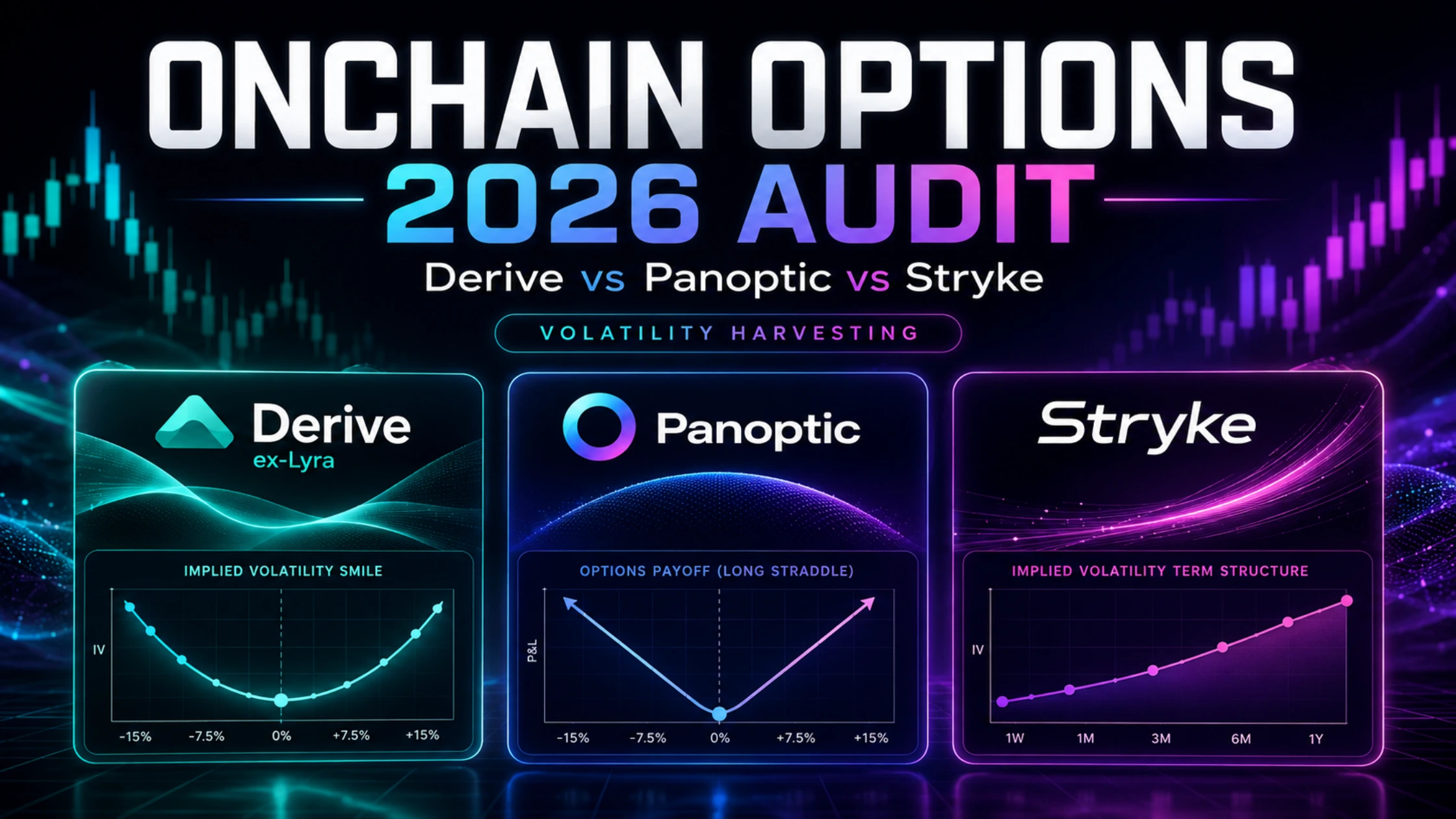
Onchain Crypto Options & Volatility Harvesting: Derive (ex-Lyra) vs. Panoptic vs. Stryke (2026 Audit)
Key Takeaways (DN Volatility & Options Summary)
- The Onchain Options Shift: While perpetual futures account for the majority of crypto derivatives volume, decentralized options protocol volume is expanding rapidly as institutional market makers and retail quants seek programmable volatility, covered call yields, and non-directional hedging.
- Derive (formerly Lyra) leads decentralized institutional options volume on its custom OP Stack app-chain, using off-chain Rust order book matching, portfolio-aware cross-margining, and institutional RFQ block trading with FalconX integration.
- Panoptic V2 introduces oracle-free perpetual options ("panoptions") built directly on top of Uniswap v3/v4 liquidity pools, offering no expiration dates, automated volatility vaults, and up to 10x leverage without oracle manipulation risks.
- Stryke (formerly Dopex) provides structured option liquidity pools (CLAMM), enabling automated yield harvesting through covered calls, cash-secured puts, and tail-risk protection.
Featured Volatility Outlets & VIP Discount Portals
Access low-latency options order books, fee rebates, and priority developer SDKs using our verified partner portals:
- 🔹 Derive Desk (Institutional Options L2): Launch Derive Volatility Desk — Referral Code:
decentralised - 🔹 Panoptic V2 Vault Suite: Access Panoptic Perpetual Options — Referral Code:
decentralised - 🔹 deBridge (Cross-Chain Capital Router): Bridge Options Collateral via deBridge — Partner Link:
20473 - 🔹 Evedex (Low-Latency Execution Engine): Claim Evedex VIP API Key — Promo Code:
9e3mk2nx
1. The Evolution of Onchain Volatility Trading
For years, centralized platforms (primarily Deribit) held a virtual monopoly on crypto options trading due to the immense computational requirements of calculating real-time option Greeks (Delta, Gamma, Vega, Theta) and risk-margin requirements onchain. Early DeFi options protocols relied on fully collateralized, automated market maker (AMM) pools that suffered from high capital inefficiency, slippage, and impermanent loss.
In 2026, the decentralized options landscape has transformed through two breakthrough primitives:
- App-Chain Order Books with Portfolio Margining (Derive): Moving matching logic to dedicated Layer-2 rollups allows protocols to process millions of transactions per second off-chain while calculating portfolio-aware cross-margin onchain.
- Oracle-Free Perpetual Options (Panoptic): Eliminating fixed expiration dates entirely, perpetual options allow traders to buy or sell calls and puts on any Uniswap v3/v4 liquidity pool without relying on external oracle price feeds.
To evaluate which platform delivers the best execution depth and capital efficiency for volatility strategies, Decentralised News audited Derive, Panoptic V2, and Stryke.
2. DN Volatility Protocol Index (DN-VOPI) Framework
Our quantitative research team evaluates options and volatility platforms using five specialized criteria:
- Capital Efficiency & Portfolio Margining: The protocol's ability to net long and short positions across calls, puts, and perpetuals to lower margin lockup.
- Oracle Independence & Security: Dependence on external price oracles versus native AMM liquidity pool pricing.
- Expiry Flexibility: Support for standard European/American expirations versus perpetual, non-expiring options contracts.
- Institutional RFQ & Block Depth: Request-for-Quote (RFQ) infrastructure supporting large-block multi-leg option structures (e.g., straddles, iron condors).
- Yield-Vault Automation: Automated vaults that execute structured options strategies (covered calls, cash-secured puts) on behalf of passive LPs.
3. Onchain Options Protocol Comparison Matrix
Below are the empirical benchmarks from our 30-day options protocol testing:
| Platform | Core Architecture | Option Style | Oracle Dependency | Capital Efficiency Model | Verified Partner Portal |
|---|---|---|---|---|---|
| Derive (ex-Lyra) | OP Stack L2 App-Chain + Rust Order Book | European Dated Options & Perps | Custom High-Frequency Feeds | Portfolio & Cross-Margining | Derive Desk (decentralised) |
| Panoptic V2 | Uniswap v3/v4 Pool Layer | Perpetual Options (No Expiry) | Oracle-Free (Pure AMM) | Up to 10x Portfolio-Aware Leverage | Panoptic V2 (decentralised) |
| Stryke (ex-Dopex) | Concentrated Liquidity AMM (CLAMM) | Short-Dated / Range Options | Chainlink Oracles | Vault-Backed Collateral Pools | deBridge Router (20473) |
4. Platform Deep Dives: Top Volatility Venues
1. Derive (formerly Lyra) — Institutional Order Book & RFQ Block Engine
Derive has established itself as the leading decentralized venue for institutional crypto options and perpetuals. Operating on a custom L2 rollup built on the OP Stack, Derive combines off-chain Rust matching engines with onchain Ethereum settlement.
Key Highlights: Request-for-Quote (RFQ) engine for zero-slippage multi-million dollar block trades with FalconX integration, paired with unified portfolio cross-margining.
💡 Trader Pro Tip: Register on the Derive Volatility Desk (Code decentralised) to unlock VIP fee tier discounts and priority API rate limits.
2. Panoptic V2 — Oracle-Free Perpetual Options on Any Token
Panoptic V2 redefines options trading by introducing non-expiring perpetual options ("panoptions") built natively on Uniswap liquidity pools.
Key Highlights: 100% oracle-free pricing derived from Uniswap v3/v4 liquidity concentration, permissionless option market creation for any ERC-20 token, and automated market-neutral volatility vaults.
💡 Trader Pro Tip: Access perpetual options and automated yield vaults on the Panoptic V2 Platform (Code decentralised).
3. Stryke (formerly Dopex) — Concentrated Option Liquidity Pools
Stryke utilizes Concentrated Liquidity Automated Market Maker (CLAMM) architecture to democratize option writing for DeFi users.
Key Highlights: Single-asset collateral deposits into targeted price ranges allow traders to buy short-dated options while generating high fee yields for vault LPs.
💡 Trader Pro Tip: Bridge USDC or ETH collateral across chains into options vaults in under 25 seconds via the deBridge Intent Router (Code 20473).
Frequently Asked Questions (FAQ)
What is a perpetual option ("panoption")?
A perpetual option is an options contract that never expires. Unlike traditional options that decay toward a fixed settlement date, perpetual options can be held indefinitely. Instead of paying upfront decay premiums, buyers pay continuous streaming premiums ("streamia") to liquidity providers based on active pool utilization.
Why is portfolio margining important for options trading?
Options strategies often involve multiple positions (e.g., buying a call while selling a higher-strike call to create a vertical spread). Portfolio margining calculates the maximum potential loss of the combined strategy rather than requiring full collateral for each position independently, increasing capital efficiency by up to 80%.
How do I bridge funds to Layer-2 options app-chains like Derive?
You can use intent-based cross-chain bridges like deBridge to transfer native USDC, ETH, or staked assets directly into your Derive L2 account in under 30 seconds with zero MEV sandwich risk.