
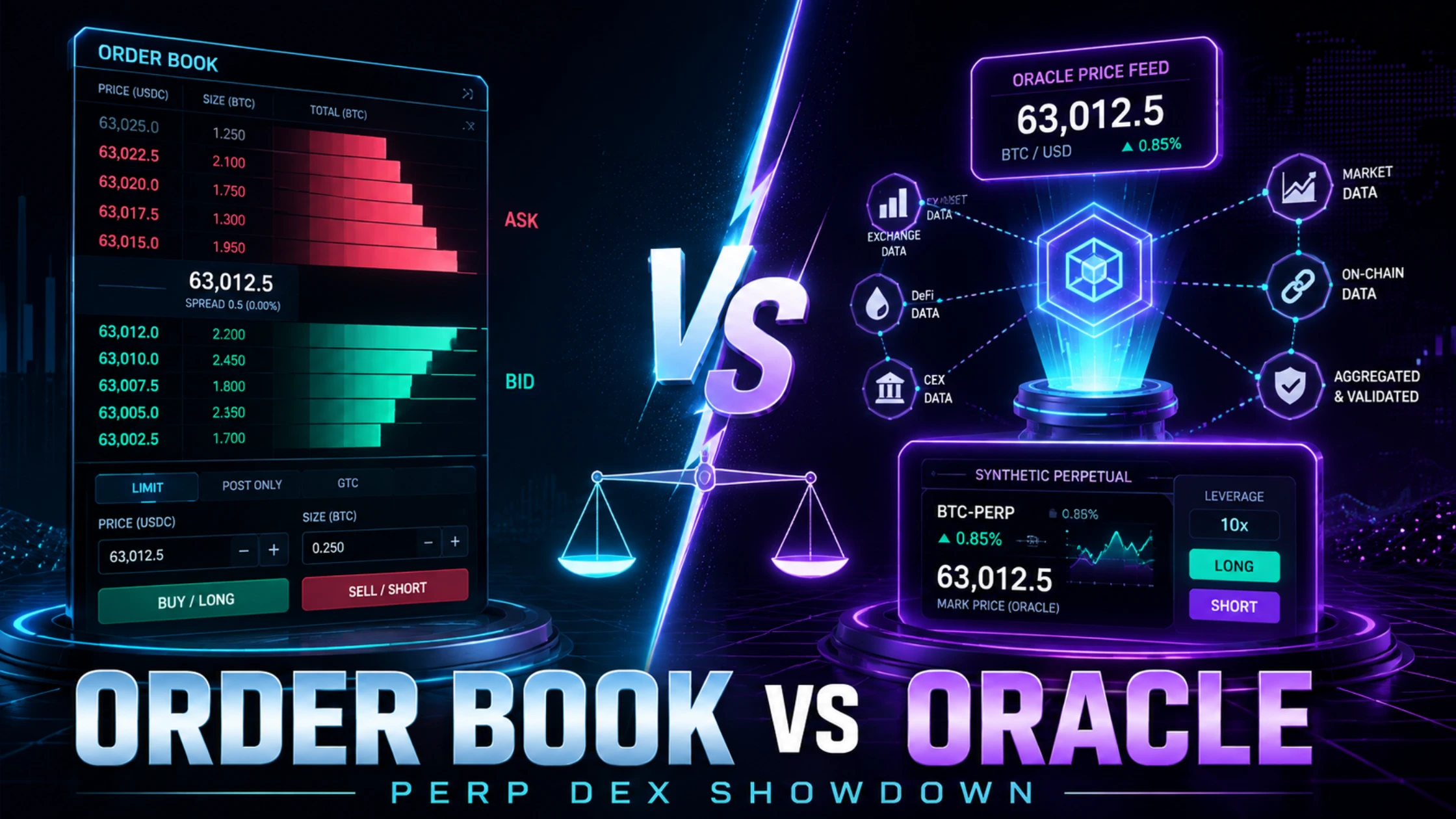
Order Book vs. Oracle Perpetual DEX: Which Matching Architecture Wins in 2026?
Key Takeaways (DN Architecture Benchmarks)
- Order Book DEXs (CLOBs) like edgeX and Paradex deliver true onchain price discovery, negative maker fees for liquidity providers, and deterministic limit order execution.
- Oracle & Pool-Based DEXs like Jupiter Perps and gTrade excel at high-leverage synthetic trading across crypto, forex, and commodities with zero price impact on trade entry—filling orders directly against liquidity pools and oracle feeds.
- MEV & Latency Protection: Central Limit Order Books are more vulnerable to toxic latency arbitrage, while Oracle-based platforms face unique risks from oracle latency lag and flash crash liquidations.
Featured Architecture Outlets & VIP Execution Portals
Experience zero-slippage execution or low-latency CLOB order book trading using our official partner portals:
- 🔹 Jupiter Perps (Solana JLP Pool): Trade Jupiter Perps on Solana — Referral Code:
whj8az405rdo - 🔹 edgeX (High-Speed CLOB): Launch edgeX Order Book Perps — Referral Code:
DECENTRALISED - 🔹 gTrade (Oracle Synthetic Engine): Trade Forex, Stocks & Crypto on gTrade — Referral Code:
decentralised - 🔹 Paradex (Starknet ZK CLOB): Launch Paradex Zero-Knowledge Perps — Referral Code:
decentralised
1. The Central Limit Order Book (CLOB) vs. Synthetic Oracle Divide
As decentralized derivatives volume scales toward multi-billion dollar daily averages, the underlying matching engine architecture dictates everything: execution slippage, liquidation cascade mechanics, fee tiers, and trader profitability.
The decentralized perpetual market has consolidated around two dominant execution models:
- Central Limit Order Book (CLOB / Order Book DEXs): Buyers and sellers submit bid/ask quotes into an active order book (either onchain or off-chain matched with ZK-settlement). Prices are formed organically via real-time supply and demand.
- Oracle-Based Synthetic Engines (Oracle & Pool DEXs): Trades are executed synthetically against a unified liquidity vault or virtual pool (like Jupiter's JLP pool or gTrade's gDAI vault) using real-time price feeds. Orders are filled at the exact oracle index price, regardless of local order size.
Understanding which matching engine fits your trading style—whether you are an algorithmic market maker, a high-leverage swing trader, or a macro forex speculator—is critical to preserving trading margin.
2. DN Slippage & Oracle Lag Index (DN-SOLI) Framework
To audit matching engine efficiency, Decentralised News subjects order book and oracle platforms to continuous automated stress tests using five quantitative pillars:
- Price Impact at $100k Order Size: Measuring fill price deviation from the global spot index on initial position entry.
- Oracle Delay Delta (ODD): The millisecond timestamp gap between off-chain spot market price updates and onchain oracle price updates.
- Maker Fee Rebate Potential: Availability of negative fees for market-making liquidity providers.
- MEV & Front-Running Resistance: Susceptibility to sandwich attacks, order re-ordering, or toxic latency arbitrage.
- Liquidation Cascade Buffer: Protocol mechanism performance during market-wide >15% flash crashes.
3. Architecture Feature & Risk Matrix
Below are the empirical benchmarks comparing Order Book and Oracle DEX execution models:
| Performance Metric | Order Book DEX (e.g., edgeX / Paradex) | Oracle & Pool DEX (e.g., Jupiter / gTrade) |
|---|---|---|
| Price Discovery Mode | Native Organic (Bid / Ask Spreads) | External Oracle Index Benchmark |
| Price Impact on Large Trades | Variable (Depends on Order Book Depth) | Zero Price Impact |
| Supported Asset Types | High-Volume Crypto Assets | Crypto, Stocks, Commodities & Forex |
| Maker / Taker Fee Dynamic | Negative Maker Fees (-0.005%) / Low Taker Fees | Flat Pool Swap Fees + Borrowing Spreads |
| Primary Execution Risk | Order Book Thinning during Volatility | Oracle Latency Lag & Spread Spikes |
| Best Persona Match | Quant Market Makers & Scalpers | Position Traders, Swing Traders & Macro |
4. Protocol Deep Dive: CLOB vs. Oracle Leaders
1. Jupiter Perps — Solana's Liquidity Engine Powered by JLP
Jupiter Perps is the dominant decentralized futures platform on Solana. Built around the multi-asset JLP (Jupiter Liquidity Pool) token, Jupiter enables traders to open high-leverage positions on Solana with zero price impact and minimal slippage.
Execution Engine: Trades execute directly against the JLP pool using Pyth and Switchboard oracle price feeds, allowing $500k+ position sizes on SOL, BTC, and ETH without moving order book depth.
💡 Trader Pro Tip: Trade on Jupiter Perps via Code whj8az405rdo to optimize swap routing fees and earn LP yield multipliers.
2. edgeX — Ultra-High-Speed Central Limit Order Book
edgeX delivers institutional-grade matching engine speeds for quantitative and high-frequency traders. Built as a dedicated derivatives app-chain, edgeX processes thousands of order cancellations and replacements per second.
Execution Engine: Off-chain order matching paired with transparent on-chain settlement, providing sub-30ms order confirmation speeds without gas fees on unfilled order edits.
💡 Trader Pro Tip: Register on edgeX via Code DECENTRALISED for exclusive maker fee discounts.
3. gTrade (Gains Network) — Zero-Slippage Synthetic Trading
gTrade is the premier oracle-based synthetic derivatives platform operating across Arbitrum and Polygon. Instead of relying on an order book, all trades are collateralized by the gDAI vault. Orders are filled directly at the exact Chainlink oracle price.
Execution Engine: Guaranteed zero price impact for large market entries across 150+ crypto pairs, global stock indices, gold, oil, and major forex pairs (e.g., EUR/USD).
💡 Trader Pro Tip: Start trading on gTrade via Partner Link decentralised to access institutional-grade synthetic execution.
Frequently Asked Questions (FAQ)
Is an order book DEX better than an oracle DEX for day trading?
It depends on your strategy. Order book DEXs (like edgeX and Paradex) are better for high-frequency scalping, algorithmic grid trading, and limit order execution. Oracle DEXs (like Jupiter Perps and gTrade) are superior for swing trading large positions with zero price impact.
How do oracle-based DEXs like Jupiter Perps offer zero price impact?
Oracle DEXs do not rely on an order book of buyers and sellers. Instead, trades are collateralized against a central liquidity pool (e.g., JLP or gDAI) and priced according to real-time aggregate oracle feeds, filling orders at the index price regardless of size.
What is the main advantage of L2/L3 order books like edgeX and Paradex?
High-speed app-chain order books match orders off-chain at sub-50ms speeds while settling batches onchain securely. This eliminates gas fees on order edits and prevents MEV bots from front-running or sandwiching pending limit orders.





