Regulatory Forensics | European Crypto Policy | June 2026
The MiCA Effect: How Europe’s New Crypto Regulation Is Creating Winners and Losers — and Pushing Capital Toward Dubai and Singapore
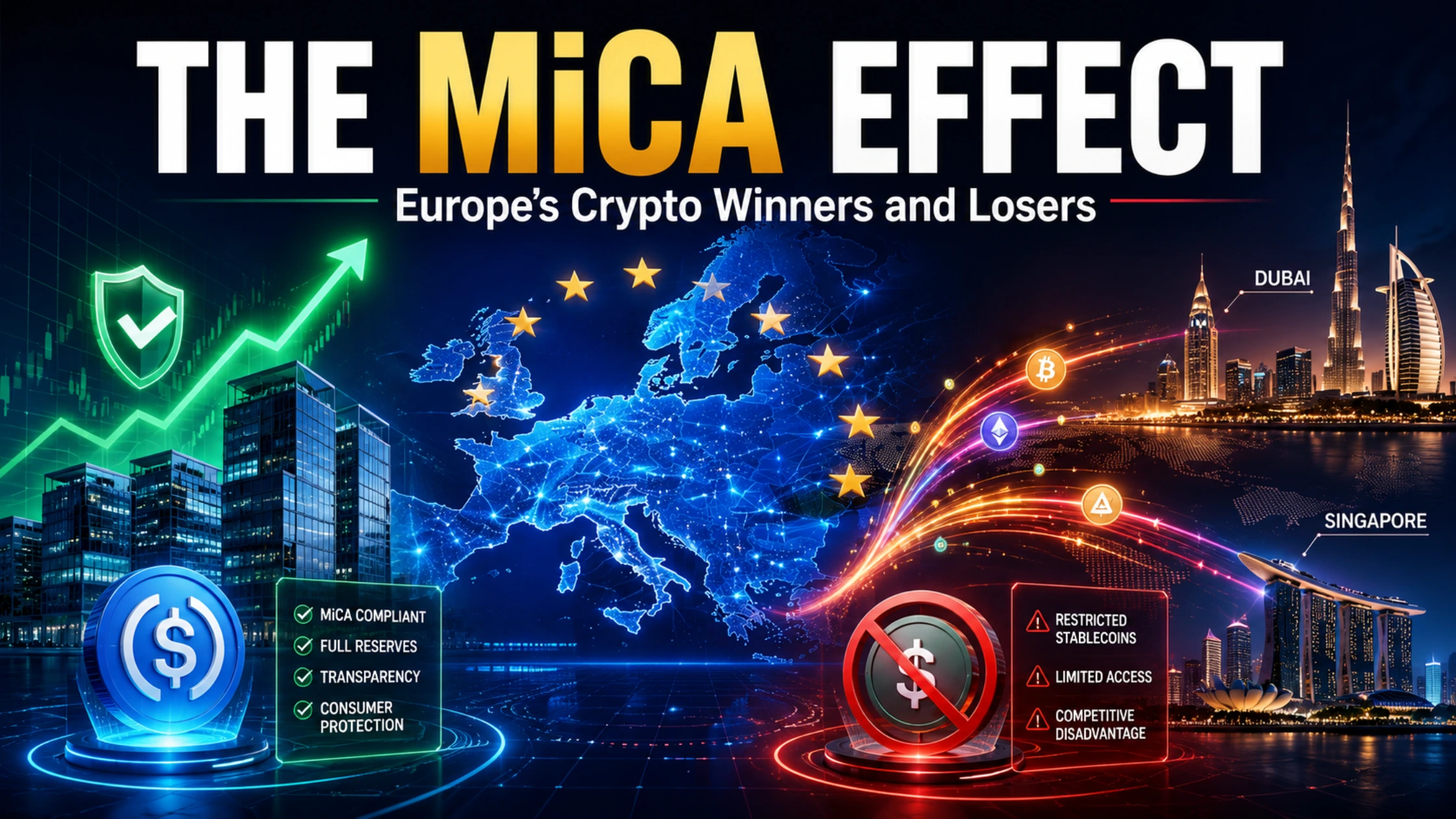
The European Union's Markets in Crypto-Assets Regulation (MiCA) became fully applicable for crypto-asset service providers (CASPs) on December 30, 2024, after stablecoin-specific rules took effect on June 30, 2024. The regulation has produced clear winners and losers within eighteen months of full implementation. Crypto.com became the first exchange globally to obtain a MiCA license on January 17, 2025, followed by OKX on February 18, 2025, alongside Coinbase Europe (Ireland-licensed), Bitstamp (Luxembourg-licensed), and Kraken, all of which can now passport their services across all 27 EU member states under a single authorization. The clearest loser is Tether: USDT, the world's largest stablecoin by market capitalization, has not pursued MiCA authorization, and as a structural consequence has been delisted from every major MiCA-regulated exchange operating in the EU, including Coinbase (December 2024), Crypto.com (January 2025), and Binance (March 2025 for EEA users). Kaiko market data shows USDT trading volume on EU venues fell more than 70% between Q4 2024 and Q2 2025, while USDC volume on the same venues nearly doubled. Fewer than 15 stablecoins hold active MiCA authorization as of late 2025, all structured as e-money tokens, with Circle's USDC and EURC the clear category leaders. Simultaneously, the compliance burden has pushed firms toward alternative jurisdictions: Dubai's Virtual Assets Regulatory Authority (VARA) now hosts more than 40 licensed virtual asset service providers, offering a faster, lower-cost regulatory pathway for firms whose primary market is the UAE, MENA region, or global operations rather than EU retail. The final MiCA transitional deadline for full CASP compliance arrives July 1, 2026, after which any unlicensed crypto-asset service provision to EU customers becomes illegal under EU law.
On December 30, 2024, something happened in European crypto markets that had never happened before in any major jurisdiction: a single, harmonised legal framework came into force that determined, with binary clarity, which crypto businesses could legally serve European Union customers and which could not. Markets in Crypto-Assets, MiCA, is now the most consequential piece of crypto regulation on earth, not because it is the strictest, but because it is the first to apply uniformly across an entire continental market of 450 million consumers.
Eighteen months later, the effects are no longer theoretical. They are visible in exchange registries, in stablecoin trading volumes, and in the licensing applications now flowing toward Dubai and Singapore from firms that have concluded the EU compliance bar is either unattainable or commercially not worth the cost. This article maps exactly who won, who lost, and where the capital and infrastructure that MiCA pushed out of Europe actually went.
"MiCA is the only one of the three [major regulatory frameworks] that provides direct access to a unified retail market of continental scale through a single authorization." For any crypto-asset service provider whose primary business involves EU retail clients, MiCA is not optional. It is the framework that determines whether that business can operate legally in the EU at all.
How MiCA Actually Works: The Mechanism Behind the Headlines
MiCA was adopted as Regulation (EU) 2023/1114 on May 31, 2023, and entered into force on June 29, 2023. Its rollout was deliberately sequenced into two phases. The first phase, covering stablecoin issuers under Titles III and IV, became applicable on June 30, 2024, establishing strict reserve, transparency, and authorisation requirements for any entity issuing an "e-money token" (EMT, pegged to a single currency) or "asset-referenced token" (ART, backed by a basket of assets). The second phase, covering crypto-asset service providers under Title V, became applicable on December 30, 2024, requiring any exchange, custodian, broker, or other crypto service provider to obtain authorisation from a national competent authority before serving EU customers.
The single most commercially significant feature of MiCA is passporting. Once a CASP obtains authorisation in any one EU member state, typically chosen for favourable regulatory responsiveness or lower costs (Malta, Ireland, and Luxembourg have emerged as the most popular licensing jurisdictions), that authorisation grants the right to provide services across all 27 member states without separate national licensing in each. This is structurally different from the UAE's VARA regime or Singapore's MAS framework, both of which govern only their own jurisdiction with no passporting mechanism into other markets.
Member states were granted different transitional windows for existing operators to come into full compliance: an 18-month window running to July 1, 2026 for France, Malta, Luxembourg, and Estonia; a 12-month window ending in late 2025 for Germany, Austria, and Ireland; and shortened windows in mid-2025 for the Netherlands and Poland. July 1, 2026, just two weeks from the publication of this article, marks the final, EU-wide compliance cliff. After that date, any entity providing crypto-asset services in the EU without full MiCA authorisation is operating in breach of EU law.
The Winners: Who Got Licensed First and Why It Matters
Speed to licensure has translated directly into competitive advantage, because early movers captured market share and regulatory goodwill during the period when competitors were still navigating the application process.
Crypto.com: the first mover
Crypto.com became the first cryptocurrency exchange in the world to obtain a MiCA license, securing authorisation on January 17, 2025, through its Malta and Cyprus licensed entities. This first-mover position has been commercially valuable: Crypto.com has positioned itself prominently in EU marketing materials around its compliance status, a meaningful differentiator at a moment when EU retail customers are increasingly aware that not all platforms can legally continue serving them.
OKX: the fast follower
OKX secured its MiCA license on February 18, 2025, through a Malta-based entity, granting it passporting rights across all EEA countries. OKX's licensing came at a critical moment, allowing it to continue onboarding EU retail customers without interruption while several competitors faced delisting pressure on their stablecoin offerings.
Coinbase Europe: licensed and proactive on stablecoin compliance
Coinbase, operating its EU business through an Ireland-licensed entity, was notable not only for early MiCA authorisation but for being the first major exchange to proactively announce the delisting of non-compliant stablecoins, including USDT, in early December 2024, ahead of the Title V application date. This proactive positioning allowed Coinbase to present its compliance as a brand differentiator rather than a reactive scramble.
Bitstamp: the Luxembourg anchor
Bitstamp, one of the longest-operating cryptocurrency exchanges globally, secured its MiCA authorisation through Luxembourg, a jurisdiction that has positioned itself as a financial-services-friendly licensing base within the EU, leveraging its existing reputation as a fund domiciliation centre to attract crypto licensing applications.
Kraken: adaptation through asset restriction
Kraken adapted its EU offering by restricting the availability of stablecoins that do not comply with MiCA requirements, limiting USDT trading for EEA customers while maintaining its broader EU market presence through compliant asset offerings.
The MiCA Licensing Scoreboard: Who Got There First
| Platform | License Date | Jurisdiction | Passporting | Notable Status |
|---|---|---|---|---|
| Crypto.com | 17 Jan 2025 | Malta / Cyprus | Yes — 27 states | First globally to obtain MiCA license |
| OKX | 18 Feb 2025 | Malta | Yes — 27 states | Fast follower, full EEA access |
| Coinbase Europe | Pre-Dec 2024 | Ireland | Yes — 27 states | First to proactively delist non-compliant stablecoins |
| Bitstamp | 2024-2025 | Luxembourg | Yes — 27 states | Leveraged Luxembourg's fund-domiciliation reputation |
| Kraken | 2024-2025 | Ireland | Yes — 27 states | Adapted via asset restriction rather than full relicensing delay |
| Binance | 2025, phased | Poland + multi | Partial / multi-entity | Delisted 9 stablecoins for EEA users, 31 Mar 2025 |
| Circle (USDC issuer) | 2024 | France | Yes — EMI passport | USDC/EURC the clear stablecoin-category winner |
The Losers: Tether, DeFi, and the Compliance Cost Casualties
Tether: the largest stablecoin issuer, locked out of the EU
Tether's USDT, the largest stablecoin globally by market capitalisation with a circulating supply above $175 billion as of late 2025, has not pursued MiCA authorisation. The mechanism that produced its effective EU ban is structural rather than punitive: MiCA Title V prohibits authorised CASPs from offering services in non-authorised EMTs to public customers in the EEA, meaning EU-licensed exchanges face a binary choice between delisting USDT or risking their own MiCA authorisation. Tether's stated position is that the EU framework, which requires 60% of a stablecoin's reserves to be held in cash deposits at European banks, is structurally incompatible with its existing reserve composition and risk philosophy. Tether CEO Paolo Ardoino has publicly characterised the EU's approach as creating dangerous over-reliance on traditional banking infrastructure, and has separately criticised the European Central Bank's digital euro initiative as a tool for financial surveillance.
The delisting wave proceeded in phases through 2024 and early 2025: Coinbase announced removal of non-compliant stablecoins in early December 2024, Crypto.com followed by ceasing USDT offerings by January 31, 2025, and Binance delisted USDT spot pairs for EEA users on March 31, 2025. Kaiko market research shows USDT trading volume on EU venues fell more than 70% between Q4 2024 and Q2 2025, while USDC volume on the same venues nearly doubled over the same period, with order book depth for USDT/EUR pairs collapsing as USDC/EUR depth on Coinbase, Kraken, and Bitstamp expanded materially.
It is important to be precise about what this restriction does and does not cover. MiCA Title V restricts the venue, not the asset. EU users can still hold USDT in self-custody wallets, transact on decentralised exchanges, and use it within DeFi protocols, all of which sit outside MiCA's regulatory perimeter. What they cannot do is buy, sell, or hold USDT through a MiCA-authorised centralised service provider. Tether has instead pivoted toward a US-centric strategy following the GENIUS Act, announcing a USAT-branded, US-domiciled stablecoin issued through Anchorage Digital Bank to serve the US market under federal stablecoin licensing, effectively conceding the regulated European retail market rather than restructuring its reserves to comply.
DeFi protocols: regulatory limbo without a clear answer
MiCA's Recital 22 explicitly excludes "fully decentralised" services from the regulation's scope, but provides no precise legal test for what qualifies as sufficiently decentralised. The European Securities and Markets Authority is expected to issue Level 3 guidance during 2026 to clarify this boundary, but in the interim, the practical effect has been a chilling one: frontends with identifiable operating entities, governance tokens with managed treasuries, and DAOs with identifiable founding teams generally fall within MiCA's scope as a practical compliance matter, even where the underlying protocol logic is genuinely permissionless. Several DeFi protocols with EU-based founding teams or corporate wrappers have restructured governance and frontend operations specifically to strengthen their claim to decentralisation exemption, an unintended consequence of regulatory ambiguity rather than a deliberate policy outcome.
Smaller exchanges priced out of compliance
Industry estimates put full MiCA-compliant operational costs, including licensing, governance infrastructure, detailed reporting systems, and white paper preparation, at a level that early 2025 industry data suggested only approximately 18% of crypto exchanges operating in the EU had fully met MiCA's anti-money laundering and transparency standards. This compliance bar, while intended to protect consumers, has had the structural side effect of concentrating European crypto infrastructure into a smaller number of well-capitalised institutions capable of absorbing the licensing cost, precisely the regulatory-arbitrage dynamic that critics of heavy-handed financial regulation predict and that MiCA's own design appears to have produced.
Where the Capital Went: Dubai, Singapore, and the Regulatory Arbitrage
For firms whose compliance calculus concluded that the EU retail market was not worth the licensing cost, or whose business model (high leverage derivatives, certain token issuance structures, or rapid product iteration cycles) sits uncomfortably within MiCA's prudential framework, the practical alternative has been Dubai's VARA regime, Singapore's MAS framework, or simply declining to actively solicit EU customers while continuing to serve them through reverse solicitation, a narrow exemption that MiCA still permits.
Dubai's VARA: the specialist alternative
The Virtual Assets Regulatory Authority, established in March 2022 as the world's first regulator dedicated solely to virtual assets, now hosts more than 40 licensed virtual asset service providers in Dubai (excluding the separately regulated DIFC financial free zone), with its full Full Market Product rulebook becoming effective in mid-2025. Major firms including Binance, OKX, and Crypto.com have all expanded operations into the UAE over the past several years, treating a VARA license not as a substitute for MiCA but as a complementary base for Gulf and MENA market access, proprietary trading operations, or simply a jurisdiction offering faster licensing timelines and a 0% corporate tax environment.
Critically, a VARA license does not provide EU market access. It is, as one comparative regulatory analysis put it, "not an EU passport, and it does not solve European market access on its own." What it offers instead is a credible, internationally recognised home for virtual asset operations specifically in Dubai, attractive to firms targeting Gulf high-net-worth clients, proprietary trading desks seeking a lower-friction operating base, or groups wanting to establish a regional headquarters while keeping the option of separate EU licensing open for later. VARA's own capital requirements are, in absolute terms, higher than MiCA's, and its marketing regulations and technology-risk documentation requirements (covering logging, cybersecurity, and business continuity management) are among the most detailed of any global virtual asset framework, meaning the "regulatory arbitrage" framing understates the genuine substance VARA demands; it is a different compliance profile, not simply a lighter one.
Singapore's MAS: the institutional alternative
Singapore's Payment Services Act framework, in force since January 2020 with digital payment token regulation since 2022 and a finalised stablecoin framework from August 2023, offers a different value proposition: a Major Payment Institution license for exchange and transfer services above defined volume thresholds, with a notably rigorous requirement that the firm's CEO and compliance officer be able to personally explain the business model and risk controls to MAS in an interview, without relying on outside advisors. This requirement has made MAS licensing a credibility signal for institutional counterparties, even though, like VARA, it provides no passporting beyond Singapore's own borders (a narrow exemption allows a Singapore-licensed firm to serve up to five foreign companies under limited conditions).
The honest comparison: arbitrage, but not the lazy kind
The popular narrative that MiCA is driving a simple flight to "lighter touch" jurisdictions understates what is actually happening. VARA's capital and governance requirements are not lower than MiCA's; in several respects they are higher and more operationally detailed. What Dubai and Singapore offer is not regulatory laxity but regulatory specificity and speed: a clearer, faster path to a license that serves a different addressable market than MiCA's EU-wide retail passport. For a firm whose strategic priority is the Gulf, MENA, or broader global institutional business rather than EU retail, VARA or MAS licensing represents a more efficient capital allocation than pursuing MiCA authorisation for a market the firm may never meaningfully serve. This is regulatory rationalisation, not regulatory evasion, though the practical effect, capital and operational headcount flowing toward Dubai and Singapore rather than into EU-based compliance infrastructure, is the same either way.
The Limits of the Winners-and-Losers Framing
The "DeFi loses" framing oversimplifies an unresolved legal question: MiCA's decentralisation exemption under Recital 22 has no precise operative test yet, with ESMA Level 3 guidance not expected until sometime in 2026. Protocols currently operating in a compliance grey zone may find their position clarified favourably once that guidance arrives, meaning the "loser" classification for DeFi is provisional rather than settled.
VARA and MAS are not simply "easier": Framing Dubai and Singapore as low-compliance escape valves understates the genuine governance, capital adequacy, and technology-risk substance both regimes require. Firms that treat a VARA license as a shortcut rather than a genuine regulatory commitment have faced license suspensions and fines reaching as high as AED 50 million (approximately $13.6 million) for serious violations.
The Bottom Line: Concentration Was the Point, Even If It Wasn't the Stated Goal
MiCA was designed to bring legal clarity, consumer protection, and market integrity to a previously fragmented European crypto landscape, and on those stated goals it has substantively succeeded: EU retail customers now have a clear, harmonised framework distinguishing licensed from unlicensed operators, with passporting rights that make a single authorisation meaningfully more valuable than the patchwork of national registrations that preceded it. The unstated but entirely predictable side effect is concentration: a compliance bar high enough to require sophisticated legal, governance, and capital infrastructure inevitably advantages well-capitalised incumbents over smaller, more experimental operators, and inevitably pushes business models that don't fit neatly into MiCA's prudential categories, including the largest stablecoin issuer in the world, toward jurisdictions willing to accommodate them.
For EU-based crypto users, the practical decision point is immediate: confirm your platform's MiCA status before the July 1, 2026 deadline, since unlicensed providers become illegal to use through regulated channels after that date. OKX, fully MiCA-licensed since February 2025, offers continued EU passport access alongside deep derivatives liquidity. For users or institutions whose strategy extends beyond the EU into Gulf or global markets, Bybit, operating under UAE licensing, represents the VARA-aligned alternative this article has mapped, appropriate for non-EU-retail-focused activity. MEXC rounds out broader market access for users navigating the post-MiCA landscape across multiple jurisdictions. See the DN Stablecoin Trust Score for how USDC, USDT, and EU-compliant euro stablecoins compare on reserve transparency, and the full global licensing landscape beyond MiCA, VARA, and MAS.
Frequently Asked Questions
MiCA (Markets in Crypto-Assets Regulation, EU 2023/1114) is the European Union's comprehensive legal framework for crypto-assets. Adopted on May 31, 2023, and entering into force June 29, 2023, it was rolled out in two phases: stablecoin issuer rules (Titles III and IV) became applicable June 30, 2024, and crypto-asset service provider rules (Title V) became applicable December 30, 2024. A transitional period for existing operators to achieve full compliance runs through July 1, 2026, after which unlicensed crypto-asset service provision to EU customers becomes illegal under EU law.
Tether has not pursued MiCA authorisation for USDT. Under MiCA Title V, EU-licensed crypto-asset service providers cannot offer non-authorised e-money tokens to public customers in the EEA without risking their own MiCA authorisation. This created a binary choice for exchanges: delist USDT or face regulatory consequences. The delisting proceeded in phases: Coinbase announced removal of non-compliant stablecoins in early December 2024, Crypto.com ceased USDT offerings by January 31, 2025, and Binance delisted USDT spot pairs for EEA users on March 31, 2025. Tether's stated objection centers on MiCA's requirement that 60% of stablecoin reserves be held as cash deposits at European banks, which Tether's CEO has characterised as creating dangerous banking-sector concentration risk.
Yes, with an important distinction. MiCA Title V restricts the venue offering the asset to EU public customers, not the asset itself or self-custody activity. EU users can still hold USDT in self-custody wallets, transact with it on decentralised exchanges, and use it within DeFi protocols, all of which sit outside MiCA's regulated perimeter. What is prohibited is buying, selling, or holding USDT through a MiCA-authorised centralised service provider such as a licensed EU exchange. Users seeking centralised exchange access to USD-pegged stablecoins in the EU are generally directed toward USDC, which holds MiCA authorisation through Circle's French-licensed entity.
Crypto.com became the first cryptocurrency exchange globally to obtain a MiCA license, securing authorisation on January 17, 2025 through Malta and Cyprus entities. OKX followed on February 18, 2025 through a Malta-licensed entity. Coinbase Europe (Ireland-licensed), Bitstamp (Luxembourg-licensed), and Kraken also achieved MiCA compliance during this period, while Binance pursued a phased, multi-entity approach including Polish licensing, completing its stablecoin delisting for EEA users by March 31, 2025 as part of its compliance process.
VARA (Virtual Assets Regulatory Authority), established in Dubai in March 2022, is a jurisdiction-specific license covering only virtual asset activity in or from Dubai, with no passporting into other markets, unlike MiCA's EU-wide passport. VARA's capital requirements are, in absolute terms, higher than MiCA's, and its technology-risk and marketing-regulation documentation is among the most detailed of any global framework. VARA is best suited for firms targeting Gulf and MENA markets, seeking a 0% corporate tax operating base, or wanting faster licensing timelines than the EU process typically offers. Dubai now hosts more than 40 licensed virtual asset service providers. A VARA license does not provide EU market access; firms wanting both must obtain separate MiCA authorisation.
MiCA's Recital 22 excludes "fully decentralised" services from the regulation's scope but provides no precise legal test for what qualifies as sufficiently decentralised. The European Securities and Markets Authority (ESMA) is expected to issue Level 3 guidance clarifying this boundary sometime during 2026. In practice, frontends with identifiable operating entities, governance tokens with managed treasuries, and DAOs with identifiable founding teams generally fall within MiCA's practical compliance scope, even where underlying protocol logic is genuinely permissionless. This regulatory ambiguity has led several EU-connected DeFi projects to restructure governance and frontend operations specifically to strengthen their decentralisation exemption claims.
As of late 2025, fewer than 15 stablecoins hold active MiCA authorisation, all structured as e-money tokens (EMTs) rather than the more restrictive asset-referenced token (ART) category. The authorised list includes USDC, EURC, EURI, EURCV, EUROe, EURQ, EURS, and a handful of smaller regional euro-denominated tokens. Circle's USDC and EURC, authorised through a French e-money institution license carrying an EU-wide passport, are the clear category leaders. No algorithmic stablecoins without tangible 1:1 reserve backing have been authorised, as MiCA effectively prohibits this structure for any token seeking EU authorisation.
July 1, 2026 marks the end of MiCA's EU-wide transitional period for crypto-asset service providers, the final date by which firms operating under earlier national registrations or transitional grandfathering provisions must achieve full MiCA authorisation. After this date, any entity providing crypto-asset services to EU customers without full MiCA authorisation is in breach of EU law and must cease offering those services. ESMA has been explicit that this deadline is firm, with maximum fines for non-compliant CASPs and issuers reaching €5 million or 10% of annual turnover, whichever is higher.
The evidence supports a more nuanced picture than wholesale exodus. Major exchanges including Coinbase, Crypto.com, OKX, Bitstamp, and Kraken have all successfully obtained MiCA licenses and continue operating in the EU. What has occurred is a bifurcation: firms whose core strategy depends on EU retail access have pursued MiCA compliance, while firms whose business model doesn't fit MiCA's prudential categories (notably Tether) or whose strategic priority lies outside the EU (Gulf-focused or globally diversified operators) have directed licensing investment toward VARA, MAS, or other frameworks instead. Industry data from early 2025 suggested only approximately 18% of EU-operating exchanges had fully met MiCA's AML and transparency standards at that point, indicating the compliance bar has been a genuine filter, concentrating European crypto infrastructure among better-capitalised incumbents rather than causing uniform departure.
Embed grant: The DN MiCA Compliance Tracker may be reproduced with attribution to decentralised.news.
DN-INTERNAL links to resolve: DN Stablecoin Trust Score, DN Regulatory Arbitrage Map, DN Sovereign Accumulation Tracker.
Sources: Vaultody MiCA/Tether analysis (Apr 2025), Eco.com MiCA regulatory cluster (2026), CCN USDT delisting report (Mar 2025), Scorechain stablecoin regulation analysis (May 2026), NewsBTC stablecoin shakedown report (Jun 2026), CoinCub MiCA/VARA/MAS comparison (May 2026), LegalBison MiCA vs VARA guide (Mar 2026), CertiK VARA analysis (Feb 2026), VARA public register.
As of: June 16, 2026. Not financial or legal advice. Regulatory status changes frequently; confirm current licensing directly with ESMA's CASP register or the relevant national competent authority before relying on this tracker for compliance decisions.