
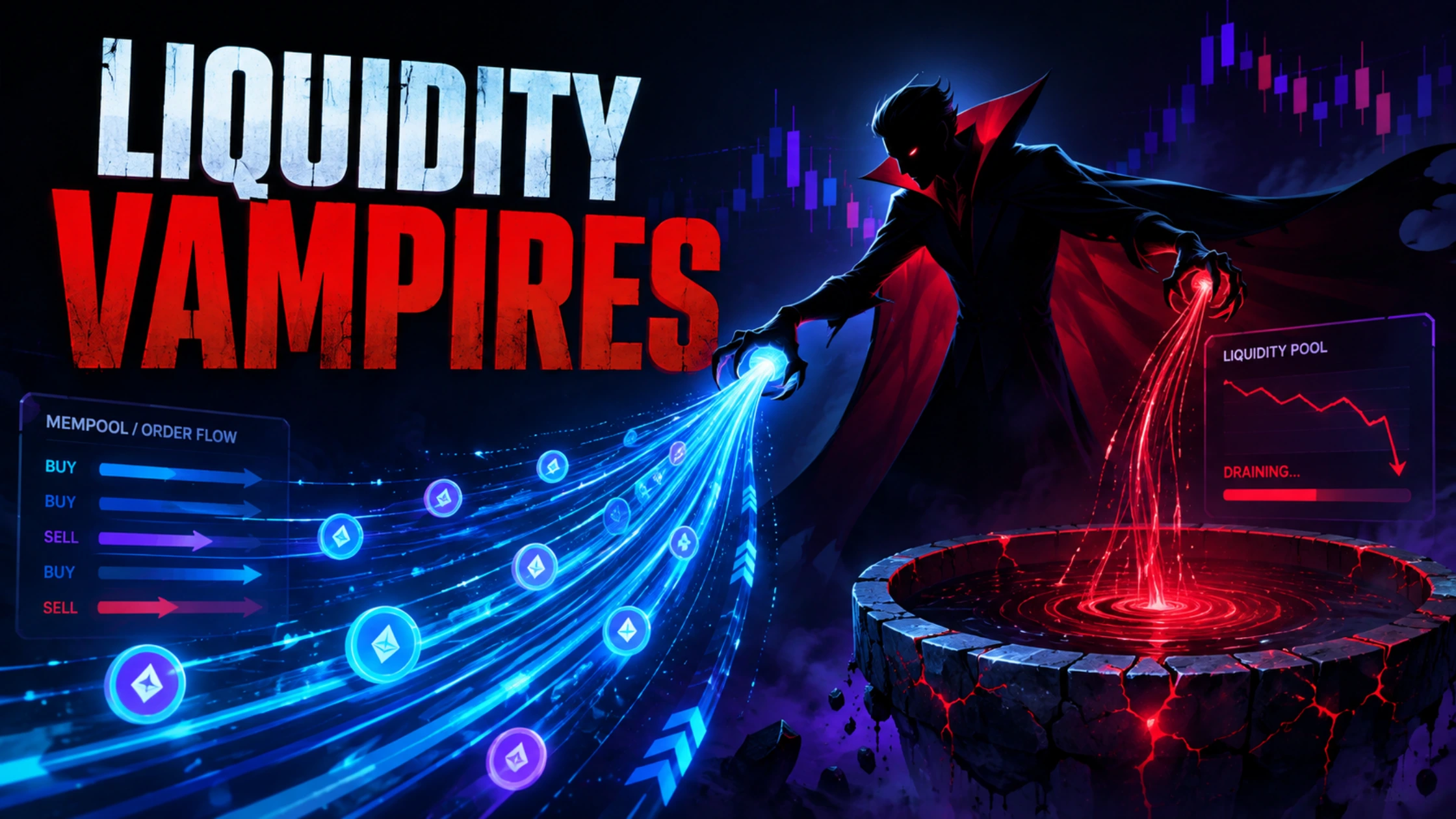
The Liquidity Vampires: Exploiting MEV & Order-Flow Toxicity in Crypto Ecosystems
Every time you click "Swap" on a decentralized exchange, your transaction enters a public staging environment known as the mempool. Before your trade settles on-chain, invisible automated software agents—known as MEV searchers—scan your order, compute your slippage tolerance, and reorder block space to extract profit directly from your wallet balance.
This predatory mechanism is known as Maximal Extractable Value (MEV). It represents a multi-billion dollar hidden tax on decentralized liquidity. In this deep dive, we deconstruct how MEV bots execute sandwich attacks, analyze order-flow toxicity, and reveal how sophisticated market operators shield their capital using private execution routes and specialized cross-chain infrastructure.
1. The Mechanics of Order-Flow Toxicity
To understand how MEV searchers drain retail value, you must first understand how transactions are packed into blocks under Proposer-Builder Separation (PBS) architecture.
In a typical sandwich attack, the searcher bids high priority gas fees to ensure their front-run buy transaction is placed immediately before yours. Your transaction then executes at the absolute highest price allowed by your slippage setting. Finally, the searcher's back-run sell order executes in the very next slot, leaving you with fewer tokens while the bot captures a risk-free arbitrage profit.
The Golden Rule of MEV Protection
If your slippage setting exceeds the natural market impact of your trade size relative to pool depth, your transaction is an immediate mathematical target for public mempool bots.
2. Interactive MEV Slippage & Gas Optimization Calculator
Use our interactive model below to evaluate your trade vulnerability. Test how trade size, DEX pool liquidity, slippage thresholds, and execution routes dictate your net MEV loss score.
3. The Sovereign Defensive Blueprint
Eliminating MEV extraction requires insulating your order flow from predatory searchers. Follow this 4-step execution strategy to lock down your trading operations:
Instead of submitting raw transactions to public RPC nodes, utilize zero-MEV intent engines and cross-chain liquid routers like deBridge. For instant, non-custodial swaps without mempool exposure, route capital through specialized private swap portals like SideShift or ChangeNOW.
For large-cap trades where DEX pool depth creates excessive price impact, route execution through tier-1 order books. Platforms such as Bybit (Code: 46164), OKX (Code: 2136301), MEXC (Code: 16yJL), and Bitget absorb multi-million dollar flows without sandwich vulnerabilities.
If you need to hedge spot portfolios without triggering DEX slippage, open short hedges using high-performance perpetual platforms like Deribit (Code: 5969.4030), GMX, Drift, or Aevo.
Never sign unverified RPC approval signatures on unfamiliar dApps. Store master key pairs on isolated hardware vaults such as Ledger or OneKey (Code: 46Z9TD) to enforce hardware-level authorization for all transaction payloads.
4. Advanced Analytics & Arbitrage Tooling
To monitor real-time DEX liquidity shifts, order-flow imbalances, and institutional tracking indicators, integrate professional quantitative software tools into your daily workflow:
- On-Chain Arbitrage Detection: Track cross-DEX spreads in real time using ArbitrageScanner or ASCN AI.
- Charting & Order-Flow Analysis: Map liquidity clusters and volume profiles using TradingView or Coinigy.
- Algorithmic Execution Bots: Automate protected grid trading strategies via Coinrule, Cryptohopper, or 3Commas.





