
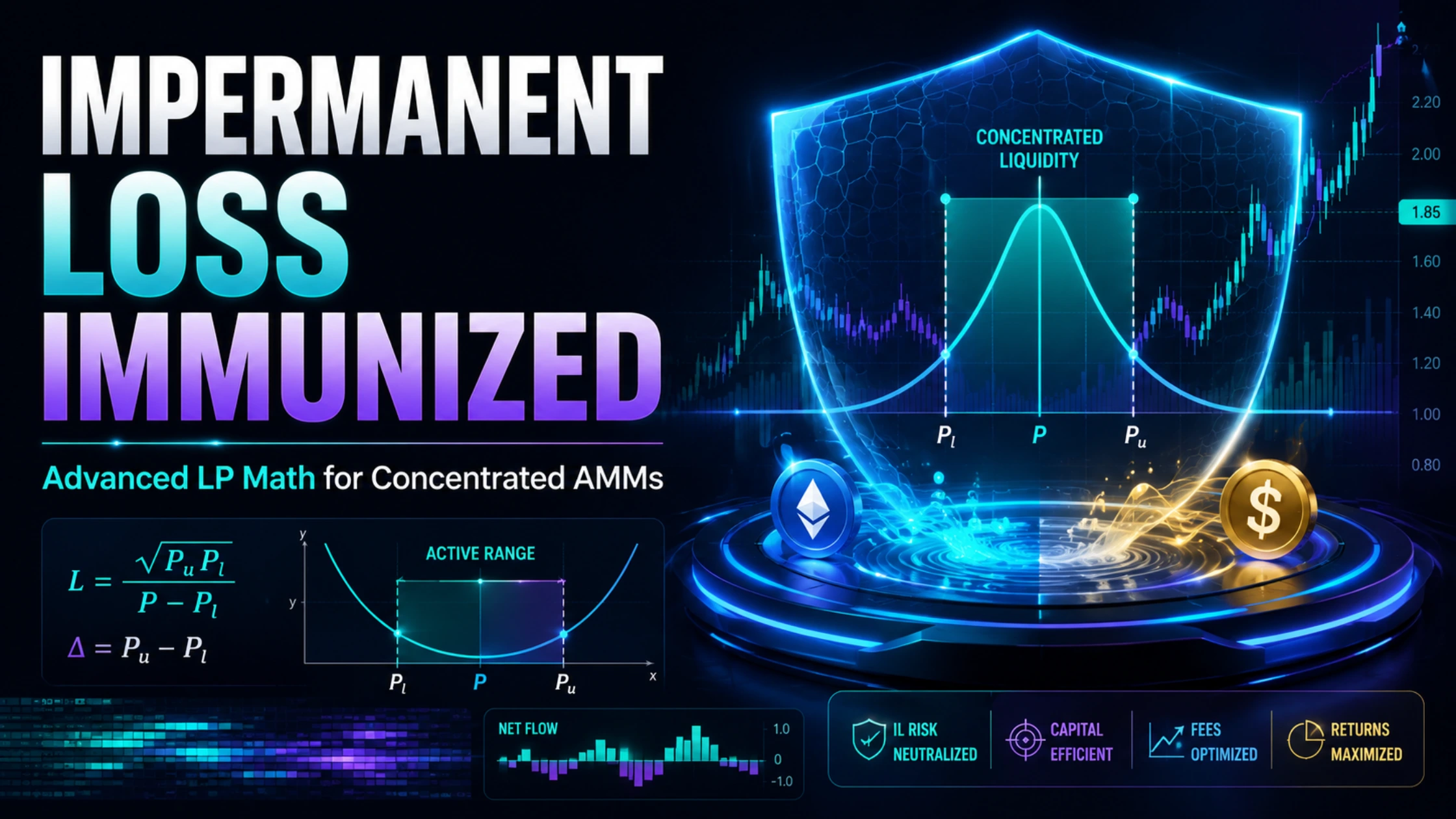
The Impermanent Loss Immunization Protocol: Advanced LP Math for Concentrated AMMs
Yield farming on Automated Market Makers (AMMs) like Uniswap v3/v4, Curve, or Raydium appears highly lucrative on paper, with high advertised Annual Percentage Yields (APYs). However, most retail Liquidity Providers (LPs) experience net negative returns over time due to an unhedged structural exposure: Impermanent Loss (IL).
When the price ratio of assets in a liquidity pool diverges from its deposit baseline, the AMM's underlying rebalancing formula ($x \cdot y = k$) automatically sells the outperforming asset and forces the LP to acquire more of the depreciating asset. In concentrated liquidity pools, this effect is amplified exponentially. Institutional market makers solve this by deploying Dynamic Delta-Hedged Liquidity Provisioning—using short perpetual swap positions or option options overlays to insulate capital from market divergence while capturing pure swap fee yield.
1. Deconstructing the Calculus of Concentrated Impermanent Loss
In a standard full-range AMM, Impermanent Loss follows a known non-linear formula based on price ratio divergence ($k = P_{\text{new}} / P_{\text{entry}}$):
The Equation of Standard AMM Impermanent Loss
$$\text{IL}(k) = \frac{2 \sqrt{k}}{1 + k} - 1$$
In concentrated liquidity environments where capital is bounded within a custom range $[P_a, P_b]$, the local gamma exposure accelerates. If price leaves the custom boundary, the position converts 100% into the losing asset, turning "impermanent" loss into permanent structural drawdown unless dynamically hedged.
2. Interactive Concentrated Liquidity & IL Hedging Optimizer
Use our quantitative AMM calculator below to model your LP position performance. Adjust deposit capital, price range concentration bounds, expected price movements, and hedging short ratios to calculate net fee yields against impermanent loss.
3. The LP Immunization Blueprint
Deploying a delta-hedged concentrated liquidity position requires coordinating AMM pool provisioning with high-speed hedging venues. Follow this 4-step framework:
Select high-throughput trading pools on concentrated DEX frameworks like SynFutures, Drift, or Astros (Code: 88SHOV). Set custom price range bounds to capture high fee volume multiples relative to full-range pools.
Open a short perpetual position corresponding to your LP position's net delta. Execute short hedges on high-liquidity derivative hubs like Bybit (Code: 46164), OKX (Code: 2136301), MEXC (Code: 16yJL), or Bitget to insulate your LP deposit against market downturns.
As spot price drifts, your position's delta changes. Program rebalancing triggers using automated execution tools like Coinrule, Cryptohopper, or 3Commas to adjust short hedge sizes automatically when prices approach range bounds.
When signing smart contract approvals for automated vaults or liquidity pools, store core private keys on hardware security devices like Ledger or OneKey (Code: 46Z9TD) to protect against malicious approval drains.
4. Analytics & AMM Tooling Software Stack
To monitor real-time pool volume, impermanent loss bounds, and cross-chain yield spreads, integrate these quantitative software platforms into your trading stack:
- Cross-Exchange & DEX Spread Scanners: Track live LP yield discrepancies with ArbitrageScanner or ASCN AI.
- Advanced Technical & Pool Charting Terminals: Map price range volatility and support bands using TradingView or Coinigy.
- Multi-Chain Portfolio & LP Tax Trackers: Monitor LP performance and automated yield harvests using CoinStats or Koinly.