
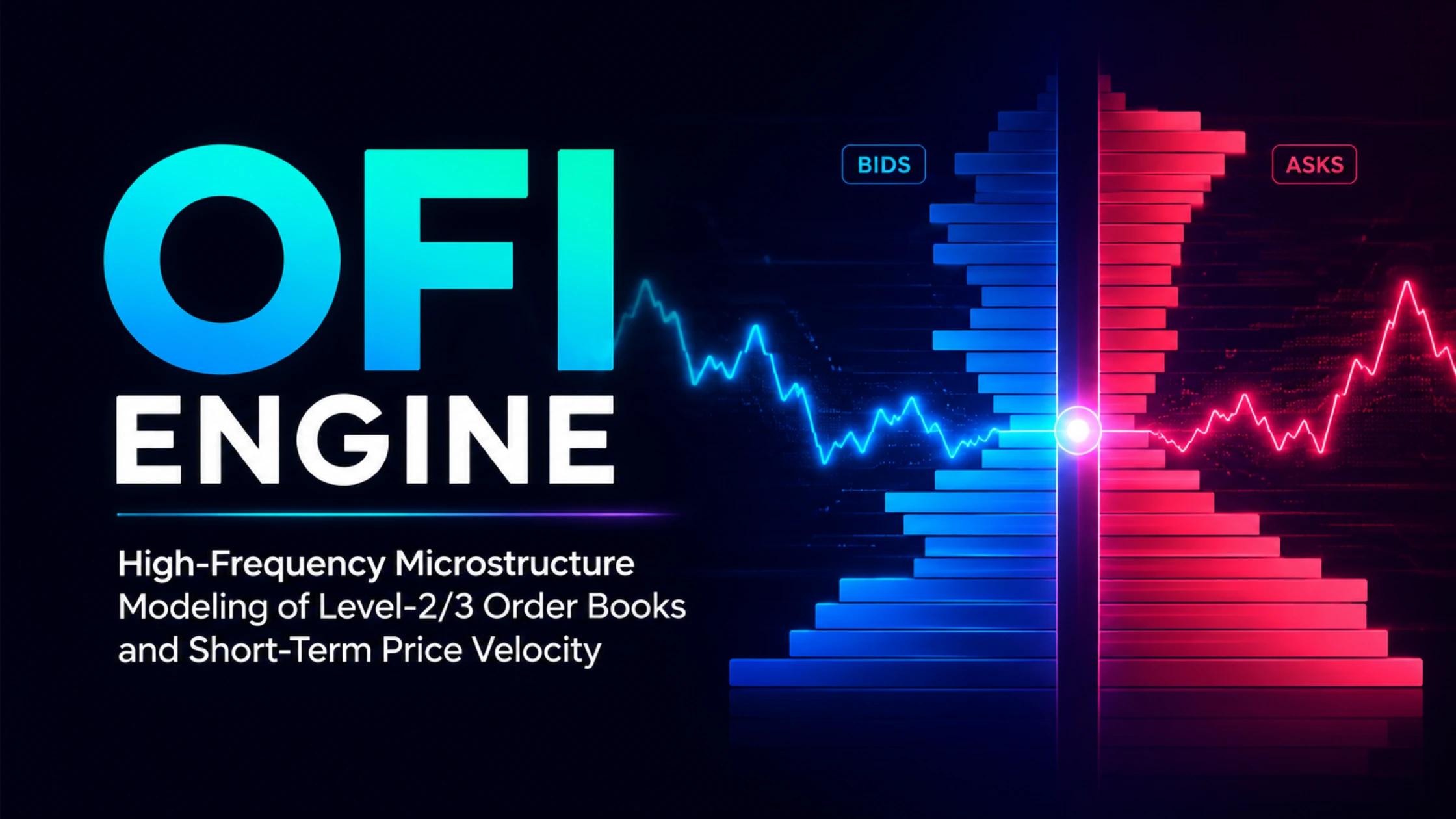
The Order Flow Imbalance (OFI) Engine: High-Frequency Microstructure Modeling of Level-2/3 Order Books and Short-Term Price Velocity
In cryptocurrency markets, retail day traders frequently analyze historical candlestick charts, RSI momentum lines, and moving average crossovers. High-frequency quantitative desks and market-making algorithms, however, view price action at a fundamentally faster temporal layer: Order Flow Imbalance (OFI) and Micro-Price Dynamics.
Price does not move because of past chart patterns; price moves when the net balance of limit order additions, cancellations, and aggressive market order executions exhausts the immediate depth of the order book. By continuously tracking tick-level changes across Level-2 and Level-3 order books, quantitative algorithms compute real-time **Order Flow Imbalance ($\text{OFI}$)** to anticipate directional price changes seconds—or even milliseconds—before they register on public OHLC charts.
1. Deconstructing Level-2/3 Order Book Dynamics & Micro-Price
To profit from market microstructure signals, you must isolate the three distinct events that alter the state of an exchange Limit Order Book (LOB) at every time step $t$:
The standard **Order Flow Imbalance ($\text{OFI}_t$)** metric aggregates bid and ask queue changes across adjacent discrete timestamps. It isolates net supply and demand pressure at the best bid ($P_{\text{bid}}$) and best ask ($P_{\text{ask}}$) levels:
The Mathematical Formula for Order Flow Imbalance (OFI)
$$\text{OFI}_t = e_{t, \text{bid}} - e_{t, \text{ask}}$$
$$\text{Where } e_{t, \text{bid}} = \begin{cases} v_{t, \text{bid}} & \text{if } P_{t, \text{bid}} > P_{t-1, \text{bid}} \\ v_{t, \text{bid}} - v_{t-1, \text{bid}} & \text{if } P_{t, \text{bid}} = P_{t-1, \text{bid}} \\ -v_{t-1, \text{bid}} & \text{if } P_{t, \text{bid}} < P_{t-1, \text{bid}} \end{cases}$$
When $\text{OFI}_t > 0$, net buying pressure is accumulating at the bid or asks are being cancelled/swept, forcing the Micro-Price—the volume-weighted fair value between best bid and best ask—to shift upwards ahead of market orders.
2. Interactive Order Flow Imbalance (OFI) & Micro-Price Predictor
Use our high-frequency microstructure simulator below to model OFI metrics. Adjust current bid/ask depths, net limit order additions, cancellation rates, and market taker volume to calculate instant OFI scores, Micro-Price divergence, and short-term price velocity.
3. The Order Flow Execution Blueprint
Exploiting Order Flow Imbalance requires accessing low-latency WebSocket L2/L3 order book feeds and executing limit orders ahead of queue exhaustion. Follow this 4-step framework:
Establish high-frequency WebSocket data connections to premier global derivatives exchanges like Bybit (Code: 46164), OKX (Code: 2136301), Binance (Code: CPA_00SXKU7IO9), or Kraken. Stream raw order updates to monitor bid/ask queue replenishment and cancellation rates.
Calculate rolling 50-tick OFI Z-scores and Micro-Price deltas using advanced charting terminals and volume profile analyzers such as TradingView or Coinigy. Trigger entry signals when OFI spikes while mid-price remains static.
When positive OFI confirms queue exhaustion on the ask side, submit post-only limit orders at the bid to capture incoming spread expansion. Deploy automated execution bots across liquid venues including KuCoin (Code: CX8QMK4M), MEXC (Code: 16yJL), Bitget, or Gate.io (Code: UgUVAVoJ).
Automate your order flow strategies using high-frequency execution bots via Coinrule, Cryptohopper, or 3Commas. Protect accumulated trading profits by transferring spot reserves into air-gapped hardware cold storage provided by Ledger or OneKey (Code: 46Z9TD).
4. Microstructure Analytics & Quantitative Tooling Stack
To monitor real-time order flow imbalances, options delta exposures, and multi-exchange order book depth, integrate these professional software platforms into your trading stack:
- Cross-Exchange Arbitrage & Order Book Scanners: Scan live order book imbalances across global venues with ArbitrageScanner or ASCN AI.
- Institutional Options Flow & GEX Heatmaps: Cross-reference spot OFI metrics with options order flow using Unusual Whales or Deribit (Code: 5969.4030).
- Portfolio & Multi-Account Tax Accounting: Track cost-basis movements and realized high-frequency gains using CoinStats or Koinly.





