This article discusses legal, financial and macroeconomic topics for informational purposes only. It is not financial, legal or investment advice. Digital assets are volatile and can lose value rapidly; consult a licensed advisor before making decisions about custody or asset allocation.
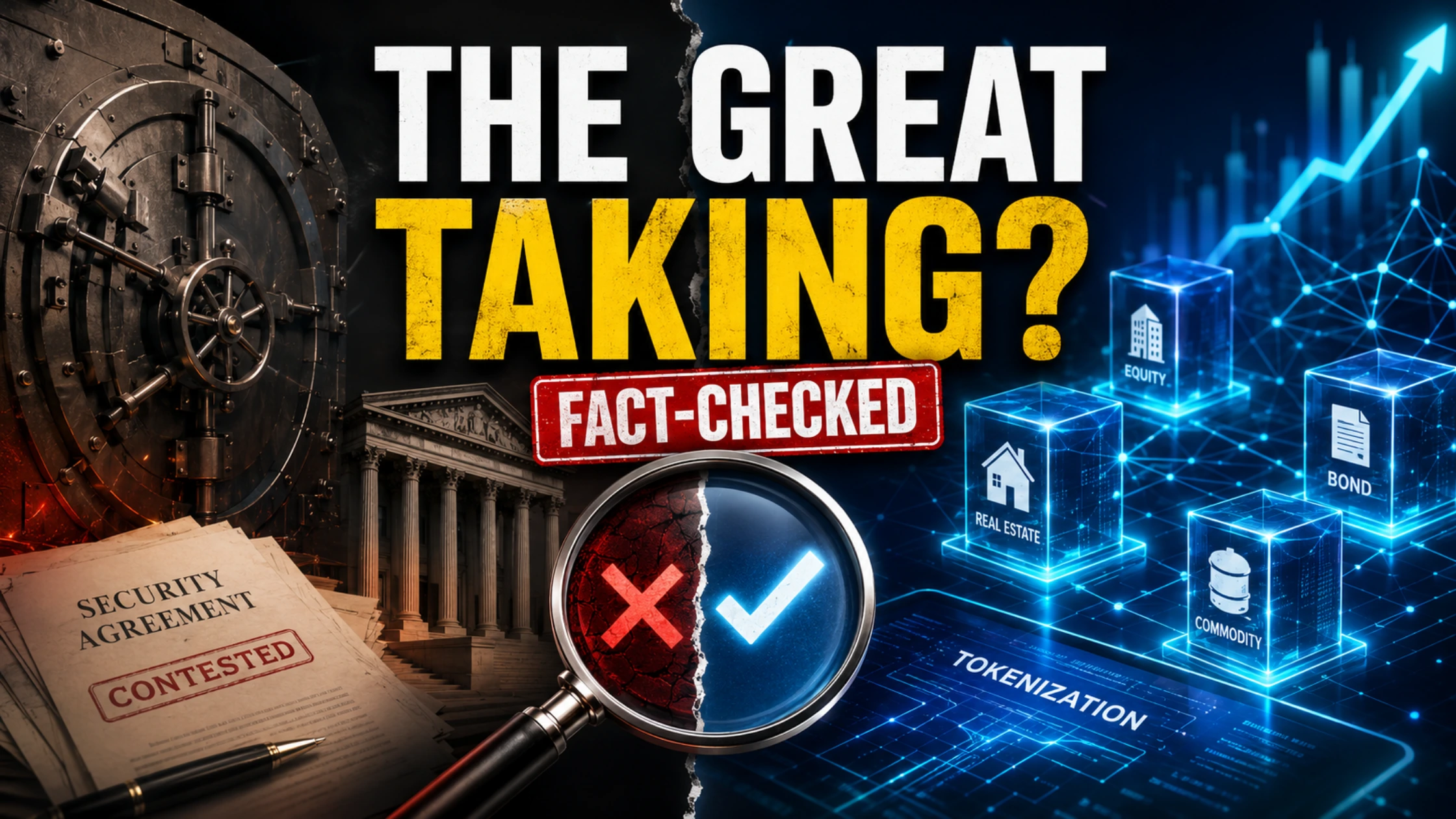
Summary: David Rogers Webb’s The Great Taking argues that decades of quiet legal reform have replaced direct securities ownership with a layered system of nominees, pooled accounts and pledgeable collateral, engineered so that in a severe crisis, secured creditors legally outrank ordinary investors. The underlying legal mechanics Webb describes, nominee registration, omnibus pooling, rehypothecation, and bankruptcy safe harbors, are real and independently verifiable. His claim that this system was deliberately engineered by intelligence-linked architects for that purpose is not independently corroborated and is disputed even by sympathetic reviewers. What makes the distinction matter right now is not conspiracy, it is convergence: the same custody-chain pattern that concerns Webb is being rebuilt, faster and at greater scale, through the tokenization of stocks, funds and real estate, run by many of the same institutions that already sit atop the traditional custodial chain, at the exact moment global sovereign bond markets are under the kind of synchronized stress DN has covered extensively this month.
What Webb actually documents, and what independent sources confirm
The book’s mechanical claim runs in four steps DN readers may already recognize from the source podcast: your shares are registered not in your name but a nominee’s, they sit in a pooled omnibus account rather than a specific certificate, they can legally be lent or pledged as collateral if your account agreement permits it, and in a severe insolvency, secured creditors holding that collateral can legally take priority over ordinary account holders through bankruptcy “safe harbor” provisions.
Each individual component checks out against primary sources. Nominee and indirect holding is the dominant global system; SEC rules require broker-dealers to maintain sufficient shares for customer accounts, and UCC Article 8, revised in 1994, defines an investor’s stake as a “security entitlement,” a property interest in the pool rather than in specific certificates. Rehypothecation is real and legal where a customer has consented, in the US chiefly through margin account agreements, and in the UK through the Financial Conduct Authority’s client asset rules and the Financial Collateral Arrangements Regulations 2003. Bankruptcy safe harbors for securities contracts, repurchase agreements and derivatives were substantially strengthened by the Bankruptcy Abuse Prevention and Consumer Protection Act of 2005, and Lehman Brothers’ 2008 collapse is the standard real-world example: J.P. Morgan, as custodian, successfully invoked safe harbor protection to defend asset transfers a court found would otherwise have looked preferential. A researcher who spent two weeks independently tracing Webb’s citations back to primary UCC drafting records, Federal Reserve correspondence and Hague Convention documents in 2024 reported that the sourcing “all checked out.”
Where the picture gets more contested is intent and outcome. The Uniform Law Commission, the body that actually drafts the UCC, published a formal rebuttal in March 2024 stating flatly that Webb’s “doomsday scenario,” an investor’s account balance vanishing to zero because of Article 8’s exceptions, is false. Their argument rests on three points worth taking seriously: retirement accounts cannot legally be pledged as collateral under the Internal Revenue Code, non-margin brokerage securities cannot legally be used for a firm’s own benefit under federal law and SEC regulation, and no individual investor has ever lost assets to Article 8’s exceptions, including in the Lehman Brothers failure, where retail customer accounts were transferred intact to a solvent firm within days. The Securities Investor Protection Corporation additionally insures customer accounts up to $500,000, a backstop separate from, and in addition to, UCC property protections. Several book reviewers who otherwise found Webb’s documentary evidence compelling reached a similar conclusion on the intent question: the legal mechanics are real and function as described, but Webb’s central claim of coordinated design by a small group of architects, anchored substantially in his characterization of former Depository Trust Company chairman William Dentzer’s CIA background, is not independently corroborated as a plan, and Webb himself, as multiple reviewers note, is unable to name the principals he alleges directed it.
The honest synthesis, and the one worth carrying forward, is this: you do not need to believe in a coordinated 1970s intelligence operation to conclude that the ordinary, well-documented interaction of leverage, interconnection, thin collateral, and legal creditor-priority rules could produce something that looks, from an individual investor’s chair, exactly like what Webb describes, in a crisis severe enough to overwhelm the safeguards that have held so far. That is a structural risk claim, not a conspiracy claim, and it survives the ULC’s rebuttal largely intact, because the rebuttal’s own defense rests on the safeguards holding, not on the underlying legal architecture being different from what Webb describes.
Why this connects to the WEF’s “Great Narrative,” carefully stated
Webb’s book is frequently discussed alongside Klaus Schwab and Thierry Malleret’s 2022 book The Great Narrative, the sequel to their 2020 COVID-19: The Great Reset, and the wider “you’ll own nothing and be happy” discourse. Precision matters here. The phrase itself originates from a 2016 essay published on the World Economic Forum’s platform by Danish MP Ida Auken, not a literal WEF policy proposal, and the Forum has publicly disclaimed it as prescriptive doctrine. What Schwab has been transparent about for five decades, since his original 1971 Davos Manifesto, is an ideological preference for “stakeholder capitalism,” a model in which large corporations, governments, and organized civil-society groups jointly steer economic outcomes toward sustainability and equity goals, explicitly positioned as an alternative to pure shareholder-return capitalism. Critics across the political spectrum argue this vision, whatever its stated intentions, necessarily concentrates decision-making power in a smaller set of large, coordinated institutional actors, banks, asset managers, multinational corporations and governments acting in concert, at the expense of dispersed individual ownership and choice. Supporters argue it is simply a framework for corporate responsibility with no enforcement mechanism and no ability to compel outcomes. Both things can be true at once: the WEF has no legal power to seize anyone’s assets, and the broader trend it champions, larger pools of capital under fewer, larger, more interconnected institutional hands, is the same structural precondition that makes Webb’s collateral-cascade scenario more plausible, regardless of whether anyone at Davos intended that specific outcome.
The part nobody is asking about: tokenization is rebuilding the exact same chain
Here is the genuinely underappreciated angle. In the 1960s, a real paperwork crisis on Wall Street, physical certificates piling up faster than clerks could process them, became the justification for replacing direct paper ownership with the nominee, pooled, book-entry system Webb spends his book critiquing. The justification was efficiency and settlement speed. The result was a longer chain of intermediaries between investor and asset.
In 2026, the same justification, efficiency, faster settlement, 24-hour markets, is being used for the next iteration: tokenizing stocks, bonds, money-market funds and real estate onto blockchain rails. And it is scaling fast. Total tokenized real-world-asset value on public blockchains, excluding stablecoins, reached roughly $31 to $32 billion by mid-2026, up from around $8 billion at the start of 2024, a nearly 300% increase in under two and a half years. Tokenized US Treasuries alone account for $13 billion to $15 billion of that, led by BlackRock’s BUIDL fund, which has scaled past $2.5 billion in assets, expanded across nine blockchain networks, and in February 2026 began trading on Uniswap, putting a regulated institutional fund directly onto decentralized-exchange infrastructure for the first time. The Nasdaq has received SEC approval to trade and settle certain tokenized stocks, the DTCC is piloting tokenized securities settlement with a possible commercial launch in late 2026, and Morgan Stanley has stated it intends to let institutional clients trade tokenized blue-chip US equities by year-end. Conservative industry estimates put the tokenized market above $100 billion by the end of 2026, with longer-range projections in the trillions against a global pool of real estate, bonds and private credit worth roughly $450 trillion.
The critical, underreported point is who is building this. It is not a decentralized, disintermediated alternative to the custodial system Webb describes. It is being built, overwhelmingly, by the same institutions, BlackRock, JPMorgan, Franklin Templeton, the DTCC itself, that already sit at the top of the traditional custody chain, using tokenization to extend that chain onto new rails rather than to shorten it. A tokenized share of a BlackRock fund still has BlackRock as issuer, still depends on a redemption mechanism controlled by BlackRock, and still sits, in most current implementations, inside a permissioned or semi-permissioned system where the platform operator can freeze, restrict or reverse transfers under stated conditions. This is efficient, and it may well be a genuine improvement in settlement speed and market access. It is also, mechanically, a fifth link added to Webb’s four-step chain, not a removal of any of the first four.
Where the mispricing is already visible: paper claims outrunning physical supply
Webb’s argument is ultimately about a mismatch between how many claims exist on an asset and how much of that asset can actually be delivered on demand. That mismatch is not hypothetical right now, it is a live, quantifiable market condition in precious metals. The COMEX silver coverage ratio, the share of outstanding paper futures contracts that could actually be met with metal sitting in exchange vaults, has held below its 15% stress threshold for six consecutive months through mid-2026, translating to roughly seven paper ounces in circulation for every one ounce actually deliverable. A single week in January 2026 saw 26% of the entire deliverable COMEX silver pool disappear, and the World Silver Survey’s 2026 update puts cumulative drawdown in exchange inventories at 762 million ounces since 2021, spanning five consecutive annual production deficits. Silver spiked above $90 an ounce in early 2026 partly on exactly this dynamic, institutional buyers increasingly demanding physical delivery rather than accepting cash settlement or continued rollover of paper claims, colliding with genuinely thinning vault inventories.
This is precisely Webb’s pooled-claim mechanism, playing out in real time, independent of any question about who designed the underlying legal system decades ago. An unallocated LBMA gold or silver account is, by the market’s own plain description, a claim against the institution’s general pool, not a specific bar with your name on it, and the institution is legally free to lend, lease or pledge that metal for its own commercial purposes. Only allocated, segregated, or directly held physical metal sits meaningfully outside that system.
The systemic backdrop makes this more relevant, not less
DN’s coverage this month has traced a genuinely synchronized set of pressures across global sovereign bond markets: US, Japanese, German, French and UK long-term yields all sitting at multi-decade highs simultaneously, a structural unwind of Japan’s historic role as the marginal buyer of foreign duration, US federal debt past $40 trillion, and a Treasury secretary intervening directly in bond markets because the Federal Reserve, under new leadership explicitly uninterested in balance-sheet expansion, has not. None of that is proof that a Webb-style cascading collateral crisis is imminent. It is, however, precisely the kind of environment, leveraged, interconnected, collateral-thin, multiple major institutions under simultaneous stress, in which the legal mechanics Webb documents would actually matter rather than sitting dormant, and it is a meaningfully more stressed backdrop than the one the ULC’s 2024 rebuttal was written against.
The predictive picture and the honest hedge
None of the primary sources reviewed here support a specific date or trigger for a Webb-style event, and treating this as an imminent, certain outcome would be its own form of overconfidence. What the evidence supports is a probabilistic reframing: the legal infrastructure for a rapid, legal, creditor-priority transfer of pooled securities exists and is confirmed by both critics and defenders of Webb’s thesis; the precondition, thin collateral coverage colliding with simultaneous institutional stress, is demonstrably present today in at least one major market (COMEX silver) and plausible in a broader sovereign-debt sense given the yield dynamics DN has documented; and the newest expansion of custodial infrastructure, tokenization, is currently being built to extend rather than shorten the custody chain for the vast majority of retail-accessible products.
The coherent hedge, consistent with what Webb himself states he does personally, is reducing the number of legal links between you and an asset, not simply diversifying across more custodians. Directly held physical gold or silver, land, and operating businesses reduce that chain to close to zero. Self-custodied Bitcoin and similar bearer-instrument digital assets, where the holder alone controls the private key, are structurally the same category, arguably the first genuinely new bearer-asset class created in decades, precisely because there is no issuer, no redemption gate, and no nominee standing between the holder and the asset. Crucially, this does not describe most people’s actual crypto exposure: Bitcoin held on an exchange, in an ETF wrapper, or in a custodial account reintroduces nominee ownership, pooling and, in many jurisdictions, explicit rehypothecation rights through the exchange’s own terms of service, recreating Webb’s chain in digital form rather than escaping it.
DN Custody Chain Depth Scanner
Apply David Rogers Webb's four-step framework to any holding, traditional or digital, and see exactly how many legal links stand between you and the asset.
No existing tool applies Webb’s own four-step framework consistently across both traditional and digital assets to score exactly how many legal links stand between a holder and what they believe they own. The DN Custody Chain Depth Scanner does that. Answer how a given holding is registered, whether it sits in a pooled or segregated account, whether pledging or lending has been consented to, whether it falls under bankruptcy safe harbor categories, and, for digital assets, who actually controls the private key, and the tool produces a transparent custody-depth score and plain-language tier, from bearer-level direct ownership through to fully pooled, pledgeable, safe-harbored exposure, so the discernment Webb asks readers to apply can actually be applied, asset by asset, rather than left as an abstract worry.
Where to position around this thesis
Readers looking to reduce custody-chain depth on digital assets specifically can do so through self-custody solutions such as a Ledger hardware wallet, which removes exchange and nominee counterparty risk entirely by keeping private keys under the holder’s direct control. Those who want continued market access while remaining aware of the custody trade-offs involved can trade through venues such as Bybit or OKX, understanding that exchange-held balances sit inside a custodial chain structurally similar to the one this article describes.
Frequently asked questions
Is The Great Taking’s core claim true? The legal mechanics Webb describes, nominee ownership, pooled custody, rehypothecation with consent, and bankruptcy safe harbors for secured creditors, are real and independently confirmed by primary legal sources, including by the Uniform Law Commission itself. Webb’s further claim that this system was deliberately engineered by a coordinated group of architects for the specific purpose of eventual mass asset seizure is not independently corroborated and is disputed even by reviewers sympathetic to his documentary evidence.
Has anyone actually lost assets this way? According to the Uniform Law Commission’s own 2024 statement, no individual investor has ever lost assets specifically because of UCC Article 8’s exceptions, including during the 2008 Lehman Brothers collapse, where retail customer accounts were transferred intact to a solvent firm. Federal law separately prohibits pledging retirement account assets as collateral, and SIPC insurance covers customer accounts up to $500,000 as an additional backstop.
What does the World Economic Forum actually advocate? The Forum has not published a formal policy program requiring people to own nothing; the phrase originated in a 2016 essay by a Danish politician published on the WEF’s platform, not as official WEF doctrine. What WEF founder Klaus Schwab has consistently advocated since 1971 is “stakeholder capitalism,” a model favoring coordinated decision-making among large corporations, governments and civil-society organizations, which critics argue concentrates power even without any formal seizure mechanism.
How does tokenization relate to The Great Taking? Tokenization of stocks, funds and real estate is being justified using the same efficiency and settlement-speed arguments used to justify the 1994 shift to indirect securities holding that Webb critiques. Most current tokenized products are issued and controlled by the same large institutions that already sit atop the traditional custody chain, meaning they typically add a layer to that chain rather than removing one, with the notable exception of genuinely self-custodied, issuer-free digital bearer assets.
What is the COMEX silver coverage ratio and why does it matter here? It measures how much physical silver is immediately deliverable against outstanding paper futures contracts, and it has held below a 15% stress threshold for six consecutive months through mid-2026, meaning roughly seven paper claims exist for every one deliverable ounce. It is a live, present-day example of the pooled-claim mismatch Webb’s broader thesis describes, independent of any question about deliberate design.
Does holding crypto protect against a Great Taking-style event? Only if held in genuine self-custody, where the holder alone controls the private key, which removes issuer, nominee and rehypothecation risk entirely. Crypto held on an exchange, through an ETF, or in a custodial account reintroduces the same nominee, pooling and lending risks Webb describes for traditional securities, and does not function as the same category of hedge.
Should I sell my brokerage account and move to physical assets? This is not investment advice. Most individual investors have never lost assets to the specific legal mechanisms described here, and diversification across custody types, rather than an all-or-nothing move, is what most financial professionals would recommend. Anyone considering a significant change to how they hold assets should assess their own risk tolerance and consult a licensed financial advisor.
Decentralised News maintains E-E-A-T standards through primary-source verification of all legal, regulatory and market data cited above, sourced from the Uniform Law Commission, SEC regulations, the Uniform Commercial Code, the World Silver Survey, rwa.xyz, and reporting current as of August 2026. This article presents Webb’s documented legal mechanics alongside independent verification and formal rebuttal where available, and distinguishes clearly between confirmed legal fact and contested claims of intent.
Start Here — Build Your Crypto Infrastructure Safely
You don’t need to use everything at once.
Professionals reduce risk by having access to multiple rails so they are never dependent on a single platform.
Below is a simple, practical setup used by many experienced traders and investors.
1) Your Fiat Gateway (Primary Access)
Best starting point for deposits & withdrawals
Binance — reliable onboarding, deep liquidity, global coverage
👉 sign up
Why open this:
- Move from bank → crypto easily
- Convert large amounts efficiently
- Emergency exit capability
2) Your Trading Execution Venue (Fast & Flexible)
Best for active trading and broad market access
MEXC — huge altcoin selection & low trading friction
👉 sign up
Why open this:
- Trade markets not listed elsewhere
- Better execution during volatility
- Lower dependence on a single exchange
3) Your Advanced Tools & Derivatives Platform
Best for leverage, hedging and professional execution
Bybit — strong order controls & derivatives infrastructure
👉 sign up
Why open this:
- Proper stop loss tools
- Hedging capability
- Strategy flexibility
4) Your Yield & Passive Income Layer
Best for structured products and capital efficiency
Gate.com — structured yield & automated earning tools
👉 sign up
Why open this:
- Earn on idle capital
- Diversify platform risk
- Access structured strategies
5) Your Altcoin & Ecosystem Expansion Layer
Best for early market access and wide listings
KuCoin — broad token ecosystem
👉 sign up
Why open this:
- Access emerging markets
- Portfolio diversification
- Redundancy if one platform restricts access
Why This Structure Matters
Using one exchange creates a single point of failure.
Using multiple rails creates:
- Liquidity redundancy
- Faster reaction ability
- Lower operational risk
- Greater opportunity access
You don’t need large capital to start — you just need prepared infrastructure.
Practical Next Step
Open accounts gradually and verify them before you need them.
Most people only prepare during stress —
professionals prepare before it.
(Decentralised News provides infrastructure education, not financial advice. Always use proper security practices.)