Most beginners enter crypto backwards.
They start with the exciting part. They ask which coin could explode, which exchange has the biggest bonus, or whether they should buy Bitcoin, Solana, or some obscure token they saw on social media. But that is not how you build a safe start.
The right first question is simpler:
What should I open first so I can enter crypto safely without doing something stupid?
That is what this guide is for.
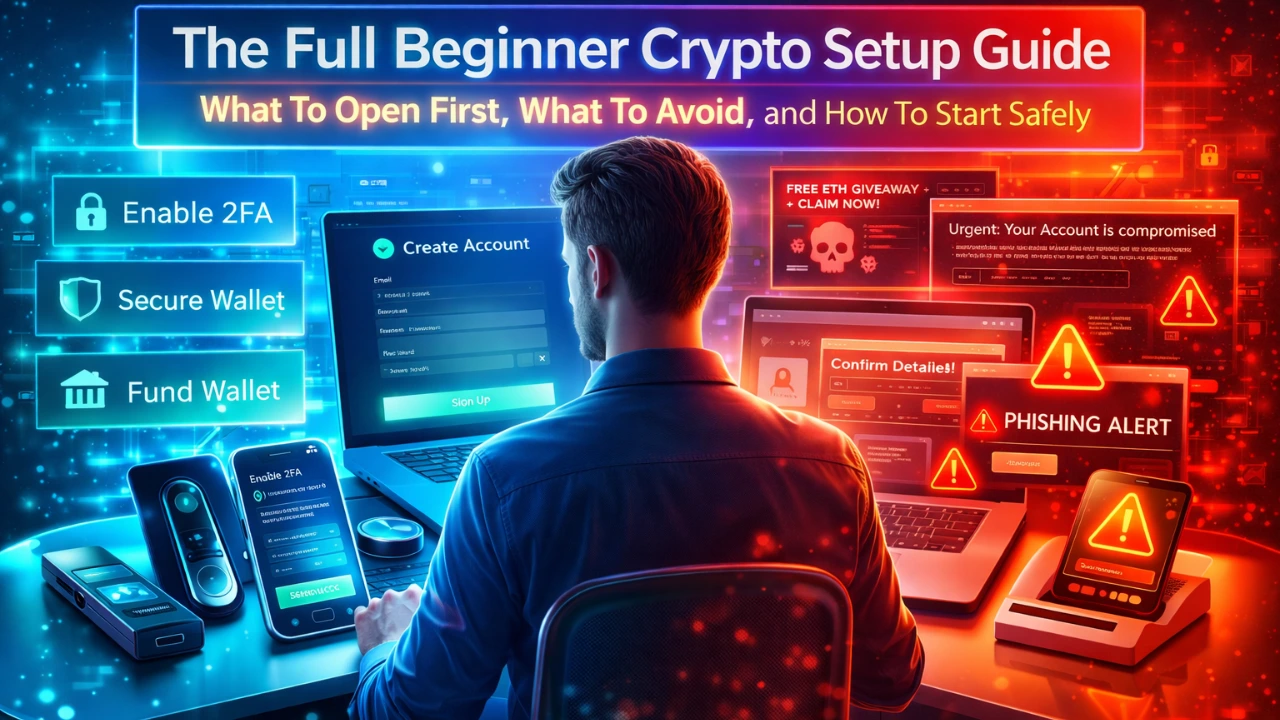
Not hype. Not jargon. Not “be your own bank” chest-thumping. Just a clean beginner setup for 2026: what accounts to open first, what order to do it in, what mistakes to avoid, and how to build a crypto system that is useful before it is clever.
Because in 2026, crypto is not only about speculation. For many people, it is becoming part of a broader money stack: stablecoins for flexibility, Bitcoin for long-term exposure, exchanges for access, wallets for control, and learning enough to avoid expensive errors. Major platforms now explicitly position themselves around this broader utility. Binance describes a path from registration to verification, deposit, and trading across spot, margin, futures, and options. Bybit’s onboarding materials walk new users through registration, verification, deposit, and buy flows, while OKX continues to push a separate self-custody wallet alongside its exchange ecosystem. Kraken emphasizes security, simpler buying, and education as part of its beginner experience.

What this feels like right now
It feels like there are too many doors and no clear entrance. Every platform says it is the best. Every influencer makes it sound easy. Every app promises opportunity. Meanwhile, you are trying to figure out something much more basic: how not to lose money before you even begin.
That feeling is normal.
The best beginner setup is not the one with the most features. It is the one that gives you access, flexibility, and security without forcing you into complexity before you are ready.
The cautious beginner
You are curious about crypto, but you do not want to get wrecked, scammed, or overwhelmed. You want the safest clean entry point.
The practical earner
You care less about speculation and more about utility. You want to buy stablecoins, maybe some Bitcoin, and understand how crypto can fit into savings, transfers, or financial optionality.
The ambitious learner
You know you may want more later: copy trading, deeper markets, maybe even self-custody and DeFi. But you want to earn that complexity in the right order.
The correct beginner sequence
A proper beginner crypto setup usually has five parts:
- A primary exchange account
- A backup exchange account
- A simple funding method
- A basic stablecoin and Bitcoin plan
- A wallet plan for later
That is it.
You do not need ten apps. You do not need to start with DeFi. You do not need leverage. You do not need trading bots. You do not need to memorize every chain. You need a usable structure.

Step 1: Open one primary exchange first
Your first account should be a mainstream exchange with strong liquidity, a clean interface, and an obvious beginner path.
For most beginners, the strongest starting options are:
- Binance for broad all-round functionality and room to grow. Binance’s own beginner materials walk users through sign-up, security, funding, and trading, and its main platform continues to support a wide product range.
- Kraken for a lower-drama, security-forward, education-friendly starting point. Kraken emphasizes secure buying, learning resources, and platform security practices.
- Luno for a simpler beginner path in supported regions, especially for users who want a less cluttered onboarding experience.
- Bybit for users who want a stronger growth path into more active features later. Bybit’s current onboarding flow explicitly guides new users through account creation, verification, deposit, and buy steps.

A good rule is this: your primary exchange should help you do three things easily:
- buy crypto
- buy stablecoins
- withdraw later if needed
For readers who want the broadest general-purpose setup, Binance is still one of the strongest first accounts. For readers who want a cleaner, more security-centric feel, Kraken is excellent. For users in supported markets who value simplicity, Luno remains a smart starting point.
Step 2: Open one backup exchange
This is where most beginners are already ahead of the crowd if they listen.
Do not rely on only one platform.
A backup exchange gives you redundancy. That matters if:
- one platform is temporarily unavailable
- certain assets or features are not supported
- you want a second fiat or stablecoin rail
- you later need different fees, products, or withdrawal options
For many beginners, a simple pairing works well:
OKX is especially useful as a second-layer platform because it combines exchange access with a broader wallet and Web3 ecosystem. Its current wallet materials emphasize self-custody, multichain management, and direct asset control, which makes it a strong “later-stage beginner” bridge once you grow beyond pure exchange use.

Step 3: Set up your security before you buy anything
This is the least glamorous part of crypto and one of the most important.
Before your first deposit:
- create a strong password
- enable two-factor authentication
- save recovery details securely
- do not reuse passwords
- do not keep everything in screenshots and random notes
Kraken explicitly highlights its security stack, including proof of reserves, compliance standards, and broader security protections. That does not mean any platform is risk-free, but it does reinforce the point that security is not an afterthought.
A beginner who sets up security properly is already behaving more intelligently than many people who have been in crypto for years.
Step 4: Fund the account simply
Do not overcomplicate your first deposit.
Your goal is not to optimize every fee on day one. Your goal is to make a clean, successful first transaction and understand how the platform works.
That means:
- connect your preferred funding method if available
- deposit a small amount first
- buy a small amount of stablecoins or Bitcoin
- understand where your balances sit
- learn what deposit, withdraw, and convert actually mean inside the interface
Kraken’s buy flow, Binance’s beginner guides, and Bybit’s current getting-started materials all reinforce the same basic logic: register, verify, fund, then buy.

Step 5: Buy stablecoins before you buy “interesting” things
This is one of the smartest beginner habits.
Stablecoins are often the best first crypto purchase because they teach you the mechanics of crypto without immediately exposing you to full market volatility. They help you learn:
- how balances work
- how conversions work
- how transfers work
- how exchanges price digital assets
- how crypto feels operationally before it feels speculative
A beginner who starts with stablecoins usually learns faster and makes fewer emotional mistakes than a beginner who starts by chasing altcoins.
After that, a small Bitcoin position often makes more sense than random token shopping.
Step 6: Keep your first portfolio embarrassingly simple
Your first beginner portfolio does not need creativity. It needs survivability.
A sensible early setup for many people is:
- mostly stablecoins if you are still learning
- a modest Bitcoin allocation if you want long-term exposure
- zero leverage
- zero obscure tokens
- zero urgency
That is not boring. That is intelligent.
What to open first as a crypto beginner
Order | What to open | Why it matters | Beginner-friendly examples |
1 | Primary exchange | Main buying and stablecoin access | Binance, Kraken, Luno |
2 | Backup exchange | Redundancy and optionality | Bybit, OKX |
3 | Security tools | Account protection | 2FA, strong password, secure recovery |
4 | Funding method | Easy first deposit | Bank transfer or supported card method |
5 | Basic wallet plan | Future self-custody readiness | OKX Wallet, Ledger later on |
Step 7: Do not open a wallet too early unless you know why
This is where a lot of beginners get conflicting advice.
Some people will tell you to move immediately into self-custody. Others will tell you to keep everything on a centralized exchange forever. Both extremes miss the point.
For a true beginner, it is usually fine to start on a reputable exchange while you learn. What matters is that you understand the tradeoff:
- exchanges give convenience
- self-custody gives control
OKX’s wallet materials are useful here because they frame self-custody clearly: your keys, your assets, multichain access, and direct control. That is valuable later. But later is the key word.
A good beginner path is:
- learn on exchange
- get comfortable with deposits and withdrawals
- understand wallet basics
- then consider self-custody for strategic holdings

Step 8: Know what not to open first
Here is what beginners should usually avoid opening or using on day one:
- futures accounts
- leverage products
- copy trading with real money
- random DeFi apps
- browser wallets you do not understand
- automation bots
- niche exchanges you found through social media
- new coins just because they are “trending”
Bybit and BingX both currently support copy-trading features, and those can become useful later. But “later” is doing important work here. Bybit’s documentation makes clear that copy trading is a structured portfolio-management tool, not magic. Beginners should earn the right to use it by first understanding risk, position sizing, and basic exchange behavior.

Decision matrix: what kind of beginner are you?
If your main goal is safety and simplicity
Start with Kraken or Luno, buy a small amount of stablecoins or Bitcoin, and stop there for now.
If your main goal is broad long-term utility
Start with Binance, then add OKX or Bybit as your backup later.
If your main goal is eventually becoming more active
Start with Bybit or Binance, but use only spot and stablecoins at first.
If your main goal is learning self-custody later
Start with a mainstream exchange, then explore OKX Wallet once you understand basic transfers.
Fastest path to action
Do this and you will already be ahead of most new users:
- Open one primary account: Binance, Kraken, or Luno.
- Enable strong security immediately.
- Open one backup account: Bybit or OKX.
- Deposit a small test amount.
- Buy a small amount of stablecoins.
- Learn where the withdraw button is before you need it.
- Do nothing else until you understand what you just did.
That is the beginner setup.
Not glamorous. Very effective.
The biggest beginner mistake in crypto is not choosing the wrong coin. It is building the wrong setup.
Your first goal is not to get rich. Your first goal is to become hard to break.
The best beginner strategy is not speed. It is clean infrastructure, small mistakes, and slow confidence.
Mistakes that cost beginners money
The first mistake is opening a futures account before understanding spot.
The second is buying five different tokens before understanding one exchange dashboard.
The third is sending money before learning networks, fees, and withdrawal basics.
The fourth is confusing platform convenience with permanent safety.
The fifth is assuming a referral bonus is more important than liquidity, security, and usability.
The sixth is thinking “I’ll learn security later.”
The seventh is trying to look advanced too early.
Nothing destroys beginner capital faster than premature sophistication.

Who this guide is for and who it is not for
This guide is for:
- first-time buyers
- cautious professionals
- people who want stablecoins or Bitcoin without chaos
- beginners building a financial resilience stack
- users who want a setup before they want a strategy
This guide is not for:
- gamblers looking for quick wins
- users who want leverage immediately
- people who refuse to learn basic security
- anyone trying to turn crypto into an adrenaline sport
Beginner
Open Binance, Kraken, or Luno first. Buy a small amount of stablecoins. Learn the interface. Keep it simple.
Intermediate
Add Bybit or OKX as a backup platform. Start understanding how different exchanges serve different purposes. Do not confuse more options with better judgment.
Advanced future path
Once you are confident with transfers and security, explore self-custody through OKX Wallet or a hardware wallet like Ledger for long-term holdings. But only once the basics feel boring.
What to actually open first
For most readers, the cleanest beginner setup in 2026 looks like this:
Primary exchange: Binance or Kraken
Backup exchange: Bybit or OKX
First asset: stablecoins
Second asset: Bitcoin
First security step: two-factor authentication
First thing to avoid: leverage
First thing to learn: deposits, withdrawals, and wallet basics
That is enough to start safely.
Final word
Crypto overwhelms beginners because the industry often tries to sell complexity before it earns trust.
But the best start is simple.
Open one strong exchange.
Open one backup.
Secure both properly.
Fund slowly.
Start with stablecoins.
Add Bitcoin only if it fits your plan.
Ignore everything that tries to make you feel late.
Because the real edge for beginners is not speed. It is structure.
And once your structure is right, everything else becomes easier.
Further reading:
Your First AI-Powered Crypto Trade: A Walkthrough for Absolute Beginners
How to Start Crypto Trading with $100 (2026 Beginner Master Guide)
How to Trade, Invest, and Survive Crypto Markets From Beginner to Professional
Start Here — Build Your Crypto Infrastructure Safely
You don’t need to use everything at once.
Professionals reduce risk by having access to multiple rails so they are never dependent on a single platform.
Below is a simple, practical setup used by many experienced traders and investors.
1) Your Fiat Gateway (Primary Access)
Best starting point for deposits & withdrawals
Binance — reliable onboarding, deep liquidity, global coverage
👉 sign up
Why open this:
- Move from bank → crypto easily
- Convert large amounts efficiently
- Emergency exit capability
2) Your Trading Execution Venue (Fast & Flexible)
Best for active trading and broad market access
MEXC — huge altcoin selection & low trading friction
👉 sign up
Why open this:
- Trade markets not listed elsewhere
- Better execution during volatility
- Lower dependence on a single exchange
3) Your Advanced Tools & Derivatives Platform
Best for leverage, hedging and professional execution
Bybit — strong order controls & derivatives infrastructure
👉 sign up
Why open this:
- Proper stop loss tools
- Hedging capability
- Strategy flexibility
4) Your Yield & Passive Income Layer
Best for structured products and capital efficiency
Gate.com — structured yield & automated earning tools
👉 sign up
Why open this:
- Earn on idle capital
- Diversify platform risk
- Access structured strategies
5) Your Altcoin & Ecosystem Expansion Layer
Best for early market access and wide listings
KuCoin — broad token ecosystem
👉 sign up
Why open this:
- Access emerging markets
- Portfolio diversification
- Redundancy if one platform restricts access
Why This Structure Matters
Using one exchange creates a single point of failure.
Using multiple rails creates:
- Liquidity redundancy
- Faster reaction ability
- Lower operational risk
- Greater opportunity access
You don’t need large capital to start — you just need prepared infrastructure.
Practical Next Step
Open accounts gradually and verify them before you need them.
Most people only prepare during stress —
professionals prepare before it.
(Decentralised News provides infrastructure education, not financial advice. Always use proper security practices.)