The 190-day chain: how Terra's collapse broke Three Arrows, broke Alameda, and broke FTX, and why two market makers survived the same contagion, 2026 edition
- Terra's algorithmic stablecoin UST lost its dollar peg on May 7, 2022, triggering a self-reinforcing mint-and-dump mechanism that erased roughly $40 billion in combined UST and LUNA value within days, a collapse Do Kwon was sentenced to 15 years in US federal prison for on December 11, 2025 after admitting the peg's prior 2021 recovery had been secretly propped up by a trading firm rather than the algorithm itself.
- Three Arrows Capital, a Singapore-based fund that had grown to roughly $18 billion in assets, held large, leveraged exposure to Luna and staked ether and was ordered into liquidation on June 27, 2022 after Terra's collapse triggered margin calls it could not meet, leaving creditors owed roughly $3.3 billion and its founders' whereabouts unknown for years afterward.
- Three Arrows's collapse directly damaged Alameda Research, FTX's affiliated trading firm, which used FTX customer deposits to cover lending losses connected to the same mid-2022 contagion, according to former Alameda CEO Caroline Ellison's own trial testimony describing the period as one where the firm was "concerned if anyone found out it would all come crashing down."
- That vulnerability surfaced publicly on November 2, 2022, when CoinDesk reported that more than half of Alameda's disclosed balance sheet consisted of FTT, a token FTX itself had created and controlled the price of, triggering Binance's decision to liquidate its FTT holdings and the bank run that forced FTX into bankruptcy nine days later.
- Two major crypto market makers sat inside the same contagion window and survived it through different disciplines: Wintermute lost $160 million to a hack in September 2022 but remained solvent because its DeFi operations were structurally isolated from its centralized and OTC business, while GSR disclosed zero exposure to Alameda and only single-digit exposure to FTX, a direct result of deliberately diversifying counterparty risk rather than concentrating it with one exchange.
- The DN Liquidation Cascade Simulator, embedded below, models the exact mechanic that connects all three collapses: when a forced sale triggers a contained, one-time price decline, and when it triggers a self-reinforcing cascade with no natural stopping point.
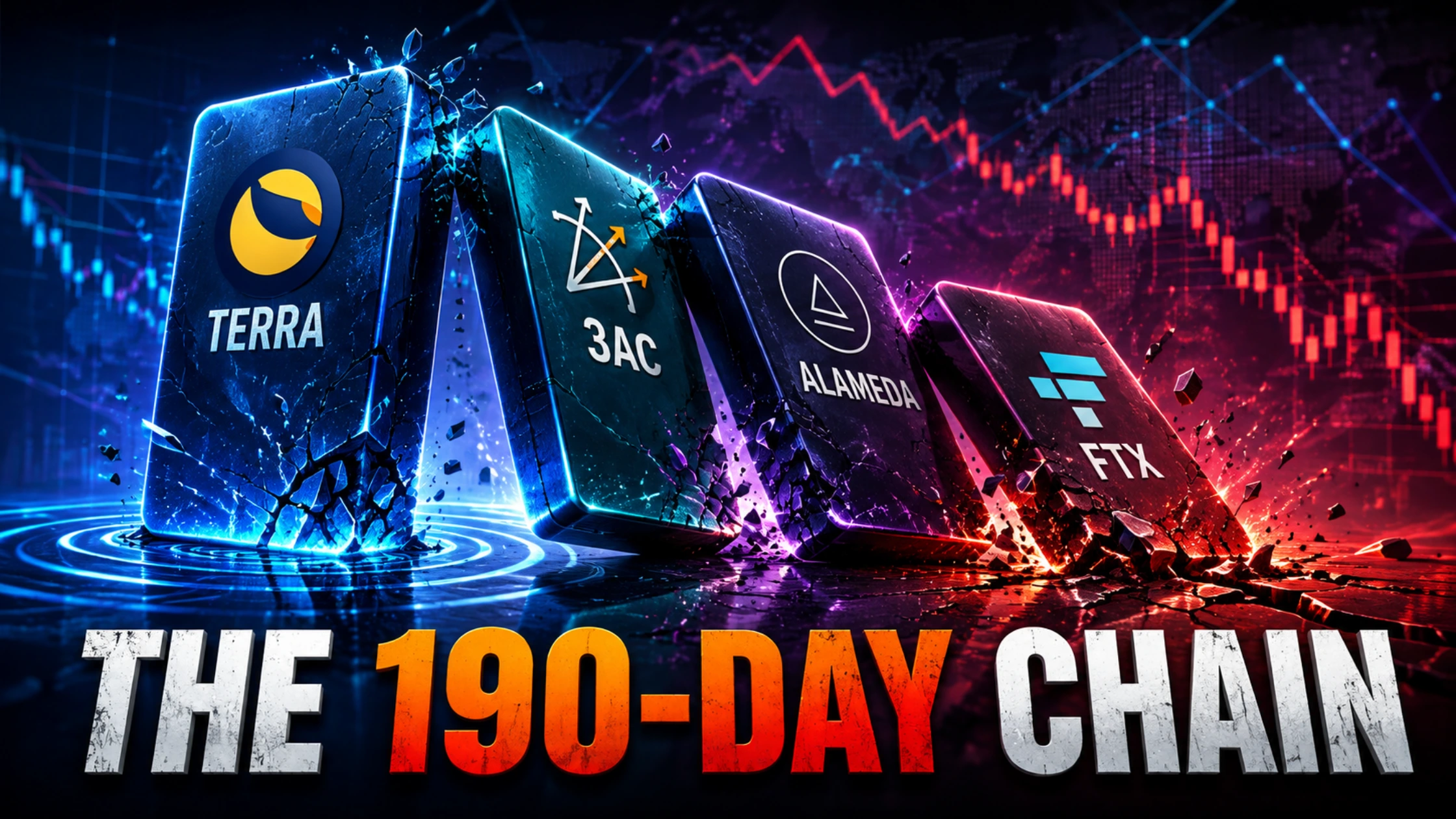
Most retrospectives on 2022's crypto collapse treat Terra, Three Arrows Capital and FTX as three separate stories that happened to occur in the same bad year. They were not separate. They were one continuous chain of forced selling, each link damaging the next through shared counterparties and correlated collateral, over a span of almost exactly 190 days from Terra's first depeg to FTX's bankruptcy filing. Understanding that chain as a single mechanism, rather than three unrelated failures, is the only way to actually answer the question every crypto-native investor eventually has to ask: when does a forced liquidation stay contained, and when does it become the next link in a chain reaction.
Link one: a stablecoin designed to require infinite confidence
TerraUSD was engineered to hold its dollar peg through an arbitrage mechanism with its sister token, LUNA: if UST traded below $1, arbitrageurs could burn UST for $1 worth of newly minted LUNA and profit from the difference, in theory pushing UST's price back toward the peg. Do Kwon's own design documents acknowledged the mechanism's fatal dependency: the entire system relied on confidence never breaking, because if UST holders sold in enough volume, the resulting flood of newly minted LUNA would crash LUNA's price, which would further erode confidence in UST, which would trigger more selling and more LUNA minting, a feedback loop Kwon himself had described internally as a possible death spiral.
That death spiral had already nearly happened once before, in May 2021, when UST first slipped to 92 cents. According to Kwon's own December 2025 sentencing proceedings, the peg was restored not by the protocol's design working as advertised, but because Kwon secretly arranged for the trading firm Jump Crypto to spend more than $20 million buying UST on the open market, while publicly claiming the algorithm alone had fixed the problem. That concealment became one of the two federal fraud counts Kwon pleaded guilty to. When the same dynamic returned for real on May 7, 2022, no undisclosed rescue arrived in time. UST fell through 98 cents, then 95, then 90, and the arbitrage mechanism that was supposed to restore the peg instead flooded the market with newly minted LUNA, crashing its price from above $116 in April to a small fraction of a cent within days. The combined collapse erased roughly $40 billion in value, and Kwon, who had fled South Korea and was ultimately arrested in Montenegro in March 2023 attempting to travel on a forged Costa Rican passport, was sentenced to 15 years in US federal prison in December 2025, on top of an earlier $4.5 billion civil settlement with the SEC.
Link two: a fund that had already bet the house
Three Arrows Capital, the Singapore-based hedge fund co-founded by Su Zhu and Kyle Davies, had grown to a peak of roughly $18 billion in assets by aggressively leveraging bets across the crypto market, including a large position in Luna and a heavily leveraged bet on staked ether trading at a discount to spot ether. When Terra collapsed, both positions moved against the fund simultaneously, and lenders who had extended credit against thin collateral, in some cases requiring what court filings later described as very little collateral at all, began issuing margin calls the fund could not meet. Zhu and Davies later admitted, in a Fortune interview conducted weeks after the fund's collapse, that they had positioned for a market environment that never arrived, and that once contagion started, the wider industry began actively hunting similarly leveraged positions, aware that funds like theirs would be forced to sell into an already falling market. A British Virgin Islands court ordered Three Arrows into liquidation on June 27, 2022, leaving roughly $3.3 billion owed to creditors. Zhu and Davies's whereabouts remained unknown to liquidators for years; Zhu was ultimately arrested attempting to leave Singapore in September 2023 and served a four-month sentence for failing to cooperate with the liquidation, and as of March 2026 liquidators were still pursuing an insolvent trading claim of roughly $1.1 billion against both founders.
Link three: the balance sheet nobody was supposed to see
This is the connection most accounts of FTX's collapse skip, and it is the one that actually explains the timing. Alameda Research, the trading firm Sam Bankman-Fried founded alongside FTX, had significant lending exposure across the same mid-2022 contagion that consumed Three Arrows, through crypto lenders including Genesis. Caroline Ellison, who ran Alameda as CEO, testified at Bankman-Fried's criminal trial that in the period between May and June 2022, immediately following Terra's collapse, Alameda was in what she called "a bad situation" and was "concerned if anyone found out it would all come crashing down." According to her testimony, Alameda used FTX customer deposits to repay lenders like Genesis during this window, and when those lenders requested updated balance sheets in mid-June 2022, the documents Alameda provided were altered specifically to conceal how bad the firm's position actually was.
That concealment held for roughly four more months, until CoinDesk reporter Ian Allison published a story on November 2, 2022 based on a leaked internal Alameda balance sheet. The document showed $14.6 billion in total assets, of which $3.66 billion was "unlocked FTT" and a further $2.16 billion was FTT used as loan collateral, meaning more than a third, and by some accountings over half, of Alameda's disclosed assets consisted of a token FTX itself had created, minted, and effectively controlled the market price of. Caroline Ellison publicly dismissed the report as incomplete four days later, but on the same day, Binance CEO Changpeng Zhao announced Binance would liquidate its own FTT holdings, a decision that triggered a bank run on FTX as customers, alarmed by the implied insolvency risk, rushed to withdraw funds the exchange had secretly lent to Alameda. FTX filed for bankruptcy on November 11, 2022, nine days after the CoinDesk report and 188 days after Terra's initial depeg. Ellison pleaded guilty to seven counts of fraud in December 2022 and, after extensive cooperation with prosecutors, was sentenced to two years in federal prison in September 2024, a fraction of the sentence Kwon or Bankman-Fried, sentenced separately to 25 years, ultimately received.
The two firms that sat inside the same contagion and did not break
The chain above makes the counterexamples more interesting, not less. Wintermute, a major algorithmic market maker, lost $160 million to a hacker who exploited a known vulnerability in a vanity wallet address generator on September 20, 2022, in the same contagion window between Three Arrows's collapse and FTX's. The hack was, in dollar terms, a serious loss. But Wintermute's founder Evgeny Gaevoy was able to state within hours that the firm remained solvent with more than twice the stolen amount left in equity, because the breach was confined entirely to Wintermute's DeFi operations, structurally separated from its centralized exchange and over-the-counter trading businesses. The firm's core business continued operating without interruption, a direct consequence of segregating risk by business line rather than running one commingled balance sheet the way Alameda and FTX did.
GSR, another major market maker, avoided the FTX contagion specifically through counterparty diversification. GSR's CEO Jakob Palmstierna stated publicly in December 2022, weeks after FTX's collapse, that the firm's exposure to Alameda was zero and its exposure to FTX itself was in the single-digit percentage of the firm's total cash balance, a direct result of GSR maintaining trading relationships and collateral across many exchanges rather than concentrating activity with one counterparty the way so many funds and lenders had concentrated with FTX. Both firms still felt the broader crypto winter that followed, GSR cut staff later that year alongside much of the industry, but neither faced a Three Arrows or Alameda-style forced liquidation, because neither had built a structure where one counterparty's failure could cascade through the rest of the business.
The DN synthesis: the difference between a bad quarter and a chain reaction
Read as one mechanism rather than three headlines, this chain demonstrates a distinction worth making precise: a leveraged position that loses value is a bad trade. A leveraged position whose forced liquidation itself moves the price of the collateral it is denominated in, the way LUNA's price collapsed because of the very minting mechanism meant to defend UST, or the way FTT's value was inseparable from FTX's own solvency, is something structurally different, a reflexive collateral design where the act of selling to cover a loss actively deepens the loss. Three Arrows's leveraged Luna and staked ether positions, and Alameda's FTT-heavy balance sheet, both shared this property. Wintermute's segregated business lines and GSR's diversified counterparty exposure did not, which is precisely why a comparable shock produced a contained loss in one case and an uncontrollable cascade in the other.
The tool below lets you model that exact distinction directly: given an initial forced sale, how much of its own price impact feeds into a further round of forced selling elsewhere, and at what point does that feedback loop die out versus become self-sustaining.
DN Liquidation Cascade Simulator
A forced sale is not the end of the story. It is the first round. Model whether the cascade dies out or runs away.
What this means for DN's readers
The single most transferable lesson from this chain, for anyone holding leveraged positions or providing liquidity in crypto markets today, is to ask a question most participants never ask about their own collateral: if this position had to be liquidated right now, would the act of selling it move the price of the thing backing it. A position collateralized in a deep, liquid, unrelated asset behaves like Wintermute's segregated business lines. A position collateralized in a thin, self-referential, or issuer-controlled token behaves like Terra's LUNA or Alameda's FTT, regardless of how healthy the balance sheet looks on the day before the test arrives.
For readers looking to build exposure to crypto markets with this discipline in mind, spot and derivatives access across diversified, established venues is available through most major exchanges, including Bybit, OKX and MEXC. As always, this is not financial advice. The chain from Terra to Three Arrows to Alameda to FTX took 190 days to fully unwind. Understanding the mechanism connecting each link is the difference between recognizing the next one early and reading about it afterward.
Frequently asked questions
How did Terra's UST stablecoin lose its peg in May 2022?
UST relied on an arbitrage mechanism with its sister token LUNA to maintain its dollar peg. When large-scale selling pushed UST below $1 on May 7, 2022, the mechanism designed to restore the peg instead flooded the market with newly minted LUNA, crashing LUNA's price and further eroding confidence in UST in a self-reinforcing feedback loop that erased roughly $40 billion in combined value within days.
What sentence did Do Kwon receive for the Terra collapse?
Do Kwon was sentenced to 15 years in US federal prison on December 11, 2025, after pleading guilty to wire fraud and conspiracy charges, including admitting that a 2021 UST peg recovery had been secretly achieved through a trading firm's market purchases rather than the algorithm working as publicly claimed. He also faced an earlier $4.5 billion civil settlement with the SEC.
How did Terra's collapse cause Three Arrows Capital to fail?
Three Arrows Capital held large, leveraged positions connected to Luna and staked ether. When Terra collapsed in May 2022, both positions moved sharply against the fund, triggering margin calls from lenders that Three Arrows could not meet, leading a British Virgin Islands court to order the fund into liquidation on June 27, 2022 with roughly $3.3 billion owed to creditors.
How is Alameda Research connected to the Three Arrows Capital collapse?
Former Alameda CEO Caroline Ellison testified that Alameda faced significant lending-related losses in the same May to June 2022 contagion window that destroyed Three Arrows, and that Alameda used FTX customer deposits to repay lenders during this period while providing altered balance sheets to conceal the firm's actual financial condition.
What did the CoinDesk report about Alameda's balance sheet reveal?
Published November 2, 2022, the report revealed that a large share of Alameda's disclosed assets, over a third by one measure and over half by another, consisted of FTT, a token issued and effectively price-controlled by FTX itself, raising concerns about Alameda's actual liquidity and its close financial ties to FTX.
Why did FTX collapse just nine days after the CoinDesk report?
Binance CEO Changpeng Zhao announced Binance would liquidate its FTT holdings shortly after the CoinDesk report, triggering a loss of confidence and a rapid bank run as FTX customers rushed to withdraw funds. FTX could not meet withdrawal demands because customer deposits had been lent to Alameda, and the exchange filed for bankruptcy on November 11, 2022.
How did Wintermute survive its $160 million hack in September 2022?
Wintermute's hack was confined entirely to its DeFi operations, which were structurally separated from its centralized exchange and over-the-counter trading businesses. The firm's founder stated it remained solvent with more than twice the stolen amount left in equity, and its core trading business continued operating without interruption.
How did GSR avoid exposure to the FTX and Alameda collapse?
GSR's CEO stated publicly that the firm had zero exposure to Alameda and only single-digit percentage exposure to FTX relative to its total cash balance, a result of the firm deliberately diversifying trading relationships and collateral across many exchanges rather than concentrating activity with a single counterparty.
What determines whether a forced liquidation stays contained or becomes a cascade?
A key factor is whether the collateral or asset being force-sold is deep and liquid, in which case the price impact of selling is limited and contained, or thin and self-referential, such as a token whose value depends on the same entity or mechanism being liquidated, in which case the forced sale itself can trigger further price declines and additional rounds of liquidation.