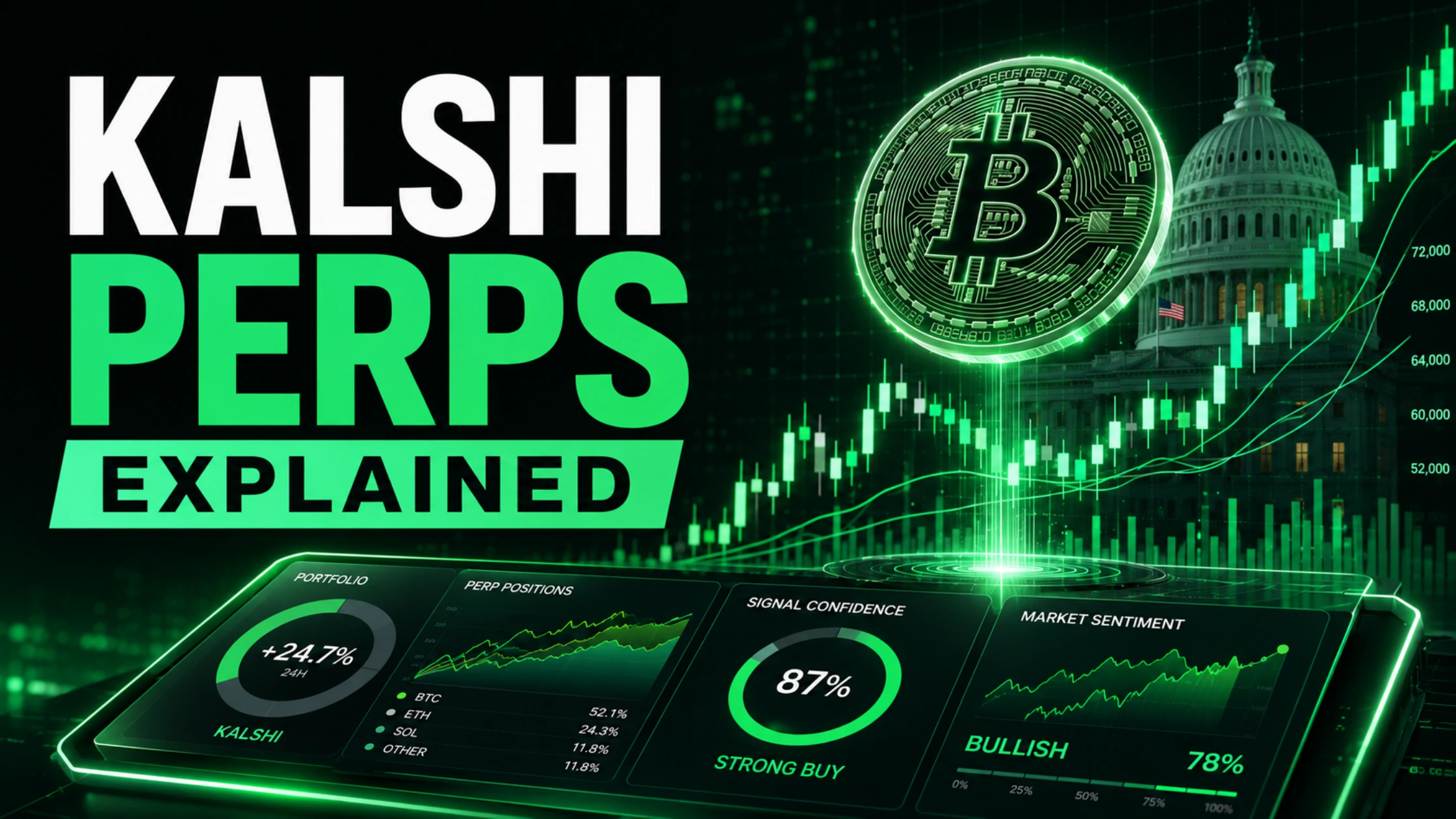
The definitive guide to Kalshi perpetual futures in 2027. Compare regulation, leverage, fees, funding, margin, liquidation, supported crypto contracts, APIs and risk controls.
Edition: 2027 Early Edition
Last reviewed: 3 August 2026
Summary
Kalshi has introduced crypto perpetual futures through a US derivatives-market structure rather than the conventional offshore crypto-exchange model.
Feature | Kalshi structure |
Exchange | KalshiEX, CFTC-regulated designated contract market |
Clearing | Kalshi Klear, registered derivatives clearing organization |
Retail intermediary | Kinetics, registered futures commission merchant |
Settlement | Cash |
Collateral denomination | US dollar margin |
Expiry | None |
Retail margin mode | Isolated |
Portfolio margin | Available through qualifying API access |
Price reference | CF Benchmarks real-time crypto indices |
Funding | Every eight hours |
Trading | 24/7, excluding maintenance and halts |
Maximum leverage | Asset-specific, up to approximately 6x |
Retail access | Approved US users after KYC, application and education |
Underlying ownership | None |
Kalshi’s Bitcoin perpetual received CFTC approval in May 2026. The exchange subsequently listed additional crypto perpetual contracts within its regulated DCM framework.
Eligible US users can register through the Decentralised News Kalshi referral route.
The Central Thesis
Kalshi is not simply adding another leveraged cryptocurrency interface.
It is attempting to translate the crypto perpetual into the institutional grammar of the US futures market:
- Exchange regulation
- Futures commission merchant intermediation
- Central clearing
- Segregated customer funds
- Risk-based margin
- Contract filings
- Trade surveillance
- Market-integrity rules
That structure can reduce several forms of offshore-platform risk.
It cannot remove:
- Market risk
- Funding risk
- Liquidation risk
- Slippage
- Negative balances
- Operational outages
- Poor position sizing
The product is more formally regulated.
It is not economically forgiving.
The DN Kalshi Perpetuals Quality Score
Category | Weight | DN assessment | Key reason |
Regulatory architecture | 20% | 9.6/10 | DCM, DCO and FCM structure |
Customer-fund treatment | 15% | 9.2/10 | Segregated margin account |
Margin discipline | 15% | 8.9/10 | Application, education and lower leverage |
Contract transparency | 10% | 9.3/10 | Published terms, index and funding rules |
Fee competitiveness | 10% | 6.8/10 | Higher entry rates than many crypto-native venues |
Liquidity maturity | 10% | 7.0/10 | Newer order books require pair-level testing |
Product breadth | 10% | 7.8/10 | Expanding but narrower than major global exchanges |
API and institutional access | 5% | 8.8/10 | REST, WebSocket and FIX support |
Geographic usefulness | 5% | 5.5/10 | Retail access currently concentrated in the US |
Overall DN score: 8.5/10
The score measures market structure and product suitability, not expected profitability.
The Four-Layer Kalshi Structure
Layer | Entity | Function |
Trading venue | KalshiEX | Matches orders and operates the DCM |
Retail intermediary | Kinetics | Onboards retail users and administers margin |
Clearinghouse | Kalshi Klear | Clears trades and manages settlement and defaults |
Reference index | CF Benchmarks | Supplies spot-price benchmarks |
Most offshore crypto exchanges combine several of these roles inside one corporate group and account system.
Kalshi separates them more explicitly.
Most retail users trade through Kinetics, while institutions meeting higher financial and operational standards may seek self-clearing access through Kalshi Klear.
What the Trader Actually Owns
A Kalshi perpetual position is not:
- Bitcoin
- A tokenized Bitcoin claim
- A Bitcoin ETF
- A deposit at a crypto exchange
- An option to acquire Bitcoin
It is a cash-settled futures obligation tied to the price movement of the referenced asset.
Economic event | Long position | Short position |
Underlying price rises | Profits | Loses |
Underlying price falls | Loses | Profits |
Positive funding | Pays | Receives |
Negative funding | Receives | Pays |
Position reaches maintenance threshold | May be liquidated | May be liquidated |
No physical cryptocurrency changes hands.
Kalshi Perpetuals vs Competing Instruments
Feature | Kalshi perp | Kalshi prediction | Spot crypto | Dated future | Crypto option |
Direct asset ownership | No | No | Yes | No | No |
Long exposure | Yes | Outcome dependent | Yes | Yes | Yes |
Short exposure | Yes | Outcome dependent | Requires borrowing or derivative | Yes | Yes |
Expiration | None | Fixed | None | Fixed | Fixed |
Funding | Yes | No | No | No recurring perp funding | No perp funding |
Margin | Yes | Fully funded contract cost | Usually no | Yes | Buyer pays premium |
Liquidation | Yes | No conventional margin liquidation | No if unleveraged | Yes | Seller may face margin |
P&L | Linear | Binary or bounded | Linear | Linear | Nonlinear |
Underlying delivery | No | No | Yes | Product dependent | Product dependent |
Contract Architecture
The Bitcoin perpetual specification currently provides:
Specification | BTC perpetual |
Underlying | BTC spot price in US dollars |
Index | CF Benchmarks BRTI |
Update frequency | One second |
Contract format | Linear and US dollar-margined |
Contract size | 0.0001 BTC per minimum contract unit |
Trading hours | 24/7, excluding maintenance and halts |
Clearinghouse | Kalshi Klear |
Funding times | 12:00 AM, 8:00 AM and 4:00 PM ET |
Settlement cycles | 12:00 PM and 4:00 PM ET |
Funding cap | Positive or negative 2% per interval |
Retail margin | Isolated |
Portfolio margin | API access for qualifying users |
Supported Crypto Markets
The original launch collection included nine assets.
Asset | Ticker | Published launch trading unit | Minimum unit |
Bitcoin | BTC | 1 BTC | 0.0001 BTC |
Ethereum | ETH | 10 ETH | 0.001 ETH |
Solana | SOL | 1,000 SOL | 0.10 SOL |
XRP | XRP | 10,000 XRP | 1 XRP |
Dogecoin | DOGE | 1,000,000 DOGE | 100 DOGE |
Chainlink | LINK | 10,000 LINK | 1 LINK |
Polkadot | DOT | 100,000 DOT | 10 DOT |
Litecoin | LTC | 1,000 LTC | 0.10 LTC |
Bitcoin Cash | BCH | 100 BCH | 0.01 BCH |
The listed trading unit describes the full contract convention, while fractional minimum units allow much smaller positions.
Kalshi’s live marketplace has expanded beyond this original set, and the current product page should be treated as the source of truth for active markets.
Current Asset-Specific Leverage Examples
Asset | Displayed maximum at review |
Bitcoin | 5.8x |
Ethereum | 4.4x |
Chainlink | 3.4x |
XRP | 2.7x |
Solana | 2.6x |
Hyperliquid | 2.1x |
Leverage limits are dynamic and can change according to risk parameters and market conditions.
Why the Leverage Cap Is Not a Recommendation
Maximum leverage describes the outer product limit.
It does not account for:
- The trader’s account size
- Stop distance
- Volatility
- Liquidity
- Funding
- Other positions
- Income
- Risk tolerance
A trader should calculate acceptable loss before selecting leverage.
The DN Position-Sizing Sequence
Step | Decision |
1 | Define total perps account equity |
2 | Define maximum acceptable account loss |
3 | Select a technically valid stop |
4 | Estimate fees, funding and slippage |
5 | Calculate position notional |
6 | Select leverage to determine required margin |
7 | Compare stop with displayed liquidation |
8 | Reduce size if the buffer is inadequate |
Leverage comes sixth, not first.
Worked Position-Sizing Example
Assume:
Variable | Amount |
Perps account equity | $10,000 |
Maximum account risk | 0.5% |
Maximum planned loss | $50 |
Stop distance | 2.5% |
Position size before costs:
$50 ÷ 2.5% = $2,000
Required margin at different leverage:
Leverage | Approximate initial margin |
1x | $2,000 |
2x | $1,000 |
4x | $500 |
5x | $400 |
The account risk should remain approximately $50 only if the stop executes near its trigger.
Fees and slippage require a smaller final position.
Isolated Margin vs Portfolio Margin
Feature | Isolated margin | Portfolio margin |
Collateral scope | One position | Portfolio-level |
Retail application | Current default | Not standard retail-app mode |
Main benefit | Ring-fenced position risk | Offset recognition |
Main danger | Faster position liquidation | Cross-position complexity |
Best use | Defined-risk directional trades | Hedged institutional portfolios |
Access | Retail application | Qualifying API users |
Kalshi says isolated margin lowers the likelihood that one position will trigger liquidation of unrelated positions.
Its risk documentation also notes that extreme black-swan losses can exceed posted margin, which is why the clearing system maintains a default-management waterfall.
How Funding Really Works
The simple explanation is:
- Perp above spot: longs pay shorts
- Perp below spot: shorts pay longs
The detailed contract methodology is more sophisticated.
Funding architecture
Component | Kalshi methodology |
Frequency | Every eight hours |
Observation frequency | Per-second under contract rules |
Price comparison | Perp impact bid and ask against underlying index |
Impact notional | $1,000 in the reviewed filing |
Weighting | Weighted average premium index |
Deadband | Below 0.01% becomes zero |
Cap | Positive or negative 2% per interval |
Index outage | Funding paused or set under contract rules |
Recipient | Opposite side of the market |
Kalshi revenue | Funding is not an exchange fee |
Why the Public Explanation and Contract Rules Differ
Kalshi’s consumer help article describes an eight-hour average based on one-minute premium candles.
The detailed exchange filing defines a weighted average of per-second premium-index observations and explicitly states that it is not a conventional equally weighted TWAP.
The practical lesson is not that one explanation is unusable.
It is that traders should distinguish:
- Educational summaries
- Help-center explanations
- Binding contract terms
When precision matters, the contract rules control.
Funding Scenarios
Assume a $20,000 notional position.
Funding rate per event | One event | Three events | 30 events |
0.005% | $1 | $3 | $30 |
0.01% | $2 | $6 | $60 |
0.03% | $6 | $18 | $180 |
0.10% | $20 | $60 | $600 |
These figures represent payments by the paying side. The receiving side obtains the corresponding funding transfer before other effects.
A position can be directionally profitable but net unprofitable after persistent funding.
Kalshi Perpetual Fee Tiers
The July 7, 2026 fee schedule uses combined 30-day perpetual and prediction-market volume.
Taker fees
Tier | 30-day volume | Taker fee |
0 | $0 | 12.0 bps |
1 | At least $100,000 | 10.0 bps |
2 | At least $300,000 | 8.0 bps |
3 | At least $1 million | 6.0 bps |
4 | At least $3 million | 5.0 bps |
5 | At least $10 million | 4.0 bps |
6 | At least $30 million | 3.5 bps |
7 | At least $100 million | 3.2 bps |
8 | At least $300 million | 3.0 bps |
9 | At least $1 billion | 2.8 bps |
10 | At least $3 billion | 2.6 bps |
Maker fees
Tier | Volume or maker-share qualification | Maker fee |
0 | $0 | 5.0 bps |
1 | At least $100,000 | 4.0 bps |
2 | At least $300,000 | 3.2 bps |
3 | At least $1 million | 2.4 bps |
4 | At least $3 million | 2.0 bps |
5 | At least $10 million | 1.6 bps |
6 | At least $30 million or 0.1% maker share | 1.4 bps |
7 | At least $100 million or 0.3% maker share | 1.2 bps |
8 | At least $300 million or 1% maker share | 1.0 bps |
9 | At least $1 billion or 3% maker share | 0.8 bps |
10 | At least $3 billion or 10% maker share | 0.6 bps |
The Notional Fee Trap
A trader deposits $100 and selects 5x leverage.
The position notional is $500.
The fee is calculated on $500, not $100.
Order | Tier 0 rate | Estimated fee on $500 |
Maker open | 0.05% | $0.25 |
Taker open | 0.12% | $0.60 |
Maker round trip | 0.10% combined | $0.50 |
Taker round trip | 0.24% combined | $1.20 |
The closing notional can differ if the underlying price moves, so the actual closing fee may be slightly higher or lower.
Kalshi vs Offshore Crypto Perpetual Exchanges
Factor | Kalshi | Typical offshore CEX |
US regulatory route | CFTC-regulated structure | Frequently unavailable to US users |
Central clearing | Kalshi Klear | Often internal exchange clearing |
Retail intermediary | Registered FCM | Exchange account |
Customer margin | Segregated account structure | Platform-specific |
Leverage | Approximately up to 6x | Frequently much higher |
Entry fees | 5 bps maker, 12 bps taker at Tier 0 | Often lower |
Crypto collateral | Primarily USD-margin framework | Often stablecoin or coin margin |
Product breadth | Expanding | Often hundreds of contracts |
Liquidity history | Newer | Mature on leading venues |
KYC | Required | Usually required on major CEXs |
Negative-balance risk | Possible in extremes | Platform-specific |
International reach | Limited | Often broader |
API | REST, WebSocket and FIX | Usually REST and WebSocket |
Kalshi’s central advantage is regulatory and clearing architecture.
Its current disadvantages include fee levels, geographic reach and the relative youth of its order books.
Kalshi vs Decentralized Perpetual Exchanges
Factor | Kalshi | Perpetual DEX |
Custody | FCM and clearing structure | Wallet or protocol custody |
KYC | Required | Often permissionless |
Regulator | CFTC framework | Jurisdiction and protocol dependent |
Settlement asset | Cash margin | Usually stablecoins or crypto |
Smart-contract risk | Limited at user layer | Material |
Oracle risk | Regulated benchmark structure | Protocol-specific |
Central clearing | Yes | Protocol clearing or liquidity pools |
Geographic access | Restricted | Frontend and legal restrictions vary |
Governance | Corporate and regulatory | Token or protocol governance |
Recovery process | Legal and institutional processes | Code and governance processes |
Liquidation Architecture
A liquidation follows a broad sequence:
- The position loses value.
- Equity approaches maintenance margin.
- The risk engine identifies the deficiency.
- Kalshi Klear submits opposing market orders.
- The position closes at available prices.
- Remaining margin is returned, where available.
- A shortfall enters the clearinghouse risk waterfall.
- The customer can remain liable if extreme execution creates a negative balance.
The DN Liquidation Defence Ladder
Defence | Purpose | Limitation |
Lower leverage | Increases price buffer | Does not prevent loss |
Smaller notional | Reduces account impact | Profit potential also falls |
Isolated margin | Ring-fences the position | Allocated margin can still be lost |
Stop loss | Attempts voluntary exit | Fill price is not guaranteed |
Limit exit | Controls minimum price | May not execute |
External alerts | Improves response time | Alerts can fail or arrive late |
Additional cash reserve | Supports emergency margin | Transfer may be delayed |
No overnight position | Avoids unattended exposure | Misses longer moves |
Diversified venues | Reduces operational dependence | Adds complexity |
Stop Loss vs Liquidation
Feature | Stop loss | Liquidation |
Selected by | Trader | Clearing risk engine |
Objective | Limit planned loss | Protect clearing system |
Trigger | User-defined price | Maintenance-margin deficiency |
Expected timing | Before liquidation | After margin threshold is breached |
Price guaranteed | No | No |
Emotional control | Supports discipline | Forced process |
Remaining margin | Usually greater | Can be little or none |
A stop beyond the liquidation price is not a meaningful risk control.
Settlement Price Methodology
The detailed contract filing uses a hierarchy.
Tier | Method |
1 | Trade VWAP during the final 60 seconds before settlement |
2 | Average of sampled order-book midpoints when no eligible trade occurs |
3 | Previous settlement price adjusted by the underlying index change |
Fallback | Exchange determination under applicable rules |
The methodology aims to maintain settlement even when market activity is thin, while allowing outlier or manipulative transactions to be excluded.
Market Integrity Controls
Kalshi’s filings allow the exchange to use:
- Price bands
- Order-size limits
- Position-exposure limits
- Trading halts
- Adjusted margin
- Emergency controls
- Market-outcome review procedures
- Prospective funding-methodology changes
These powers are intended to preserve orderly markets.
They also mean contract parameters are not permanently fixed.
Scheduled Maintenance Risk
Maintenance condition | Effect |
Current schedule | Thursday, approximately 3:00 AM to 5:00 AM ET |
New orders | Unavailable |
Order changes | Unavailable |
Open positions | Remain open |
Mark price | Frozen in platform display |
Funding | Processed after reopening |
Underlying crypto market | Continues trading externally |
This creates basis and operational risk.
The cryptocurrency market can move while the trader cannot actively modify the Kalshi position.
Access and Suitability Process
Stage | Requirement |
1 | US-based eligible Kalshi user |
2 | Completed KYC |
3 | Margin-account application |
4 | Experience and financial questionnaire |
5 | Approval |
6 | Mandatory education |
7 | Separate margin funding |
8 | Perpetual trading access |
Kalshi can reject applications based on responses, regulatory requirements or other eligibility criteria.
Funding the Margin Account
Users can currently fund the perps account through supported routes such as:
- ACH
- Wire
- Other available methods
- Transfer from the prediction-market balance
The balances remain operationally separate.
Only margin not committed to open positions is available for transfer or withdrawal.
API and Professional Trading
Kalshi’s perps API supports:
Interface | Typical use |
REST | Orders, positions, account and market requests |
WebSocket | Live market and account updates |
FIX | Institutional order and market-data connectivity |
Demo | Development and testing |
Production | Approved member trading |
The API mirrors parts of Kalshi’s event-contract conventions but uses a separate margin namespace and dedicated hosts.
API Risk Checklist
Before enabling programmatic trading:
- Use the demo environment.
- Restrict API permissions.
- Avoid withdrawal permissions where applicable.
- Use IP allowlisting.
- Implement maximum position limits.
- Implement maximum daily loss.
- Monitor funding.
- Reconcile fills.
- Handle partial fills.
- Handle exchange maintenance.
- Build WebSocket reconnection logic.
- Add a manual kill switch.
- Test liquidation alerts.
- Log every order request and response.
The DN Kalshi Perpetuals Readiness Test
A trader should answer yes to every question before opening a live position.
Question | Required answer |
Do I understand the underlying index? | Yes |
Do I understand notional fee calculation? | Yes |
Have I checked the current funding rate? | Yes |
Have I defined a stop? | Yes |
Is the stop before liquidation? | Yes |
Is planned loss acceptable? | Yes |
Have I included slippage? | Yes |
Can I tolerate a worse-than-stop fill? | Yes |
Have I checked maintenance times? | Yes |
Is sufficient account equity unallocated? | Yes |
Am I legally eligible? | Yes |
Am I using non-essential capital? | Yes |
One no is enough to delay the trade.
Trade Scenario: Long BTC With 3x Leverage
Assume:
Variable | Amount |
Account equity | $5,000 |
Allocated margin | $500 |
Leverage | 3x |
Position notional | $1,500 |
Entry BTC price | $100,000 |
BTC quantity represented | 0.015 BTC |
Target | $106,000 |
Stop | $98,000 |
Opening order | Taker |
Closing order | Taker |
Fee tier | Tier 0 |
Slippage | 3 bps each side |
Funding | 0.01% across three events |
Gross target profit
BTC rises 6%.
$1,500 × 6% = $90
Gross stop loss
BTC falls 2%.
$1,500 × 2% = $30
Estimated trading fees
Opening taker fee:
$1,500 × 0.12% = $1.80
The closing fee is calculated using the closing notional and would be approximately similar.
Estimated funding
$1,500 × 0.01% × 3 = $0.45
Slippage
At 3 basis points on entry and exit, modeled slippage is approximately $0.90 before adjusting for the changed exit notional.
The final target and stop outcomes should include all costs.
This is the function of the accompanying DN calculator.
Decentralised News Proprietary Tool
DN Kalshi Perpetual Futures Cost & Risk Calculator
Estimate leveraged notional, maker and taker fees, funding, slippage, planned stop risk, target return and the distance between your stop and Kalshi’s displayed liquidation price.
Enter the proposed trade
Fee defaults reflect Kalshi’s July 7, 2026 Tier 0 schedule: 5 bps maker and 12 bps taker. Confirm the live fee tier and liquidation price inside your account.
DN Kalshi Perpetual Futures Calculator
The proprietary tool calculates:
- Leveraged notional
- Underlying quantity
- Maker or taker fees by tier
- Opening and closing costs
- Funding payments or receipts
- Slippage
- Target profit
- Planned stop loss
- Account risk percentage
- Return on margin
- Break-even price
- Net reward-to-risk
- Stop distance
- Liquidation distance
- Stop-to-liquidation buffer
It deliberately does not attempt to reconstruct Kalshi Klear’s exact risk-based margin engine.
The trader enters the liquidation estimate shown by Kalshi and tests the proposed stop against it.
Frequently Asked Questions
Is Kalshi a prediction market or futures exchange?
Kalshi operates event markets and has expanded into perpetual futures. The products use separate account and regulatory structures.
Are Kalshi perpetuals CFTC regulated?
KalshiEX is a CFTC-regulated designated contract market. Kalshi Klear is the registered clearinghouse, and the BTC perpetual received formal CFTC approval.
Are Kalshi perps available to everyone in America?
No. Users must complete KYC, apply for a margin account, receive approval and complete product education.
Can international traders use Kalshi perps?
Current retail eligibility focuses on US users. International expansion may occur later.
Does Kalshi offer 100x leverage?
No. Kalshi currently uses materially lower, asset-specific leverage limits of up to approximately 6x.
Are Kalshi fees low?
The rates become competitive at high volume, but the Tier 0 rates are higher than those charged by many offshore crypto exchanges.
Does a limit order always receive the maker fee?
No. A limit order that executes immediately can be a taker order.
Is funding charged every eight hours?
Funding is calculated at three scheduled times per day. Only positions open through the relevant event are affected.
Can funding be positive income?
Yes. The position on the receiving side obtains the funding payment.
Is the 2% funding cap normal?
No. It is a maximum per-interval boundary under the contract rules, not a normal expected rate.
Is the liquidation price exactly equal to a simple 1 divided by leverage formula?
No. Actual liquidation uses risk-based initial and maintenance-margin calculations.
Can a stop loss prevent liquidation?
It can reduce risk when placed before liquidation, but execution is not guaranteed.
Can I owe Kalshi money after liquidation?
Extreme gaps or illiquidity can create a negative perps balance. Kalshi’s risk disclosure states that the customer can remain liable.
Does customer segregation guarantee there is no loss?
No. Segregation separates customer margin from operating funds. It does not protect the trader against market losses.
Can I hold a Kalshi perpetual indefinitely?
There is no formal expiry, but funding, margin, liquidation, rule changes and market availability affect how long the position can remain practical.
Final 2027 Verdict
Kalshi has created one of the most consequential regulated crypto-market products in the United States.
Its strongest features are structural:
- CFTC-regulated exchange
- Registered clearinghouse
- FCM-based retail access
- Segregated customer margin
- Published contract terms
- Regulated benchmark indices
- Suitability screening
- Mandatory education
- Conservative leverage relative to offshore competitors
- Institutional API and FIX connectivity
Its weaknesses are equally clear:
- Entry-level fees are relatively high.
- Liquidity is newer and must be tested.
- Product breadth is still expanding.
- Retail availability is geographically narrow.
- Scheduled maintenance creates operational exposure.
- Liquidation and negative-balance risk remain.
Kalshi is not automatically the cheapest perpetual exchange.
It may be one of the clearest regulatory routes for eligible US traders who value market structure more than maximum leverage.
The best use case is not speculative overextension.
It is disciplined:
- Hedging
- Defined-risk directional exposure
- Moderate leverage
- Transparent position sizing
- Cost-aware execution
- Carefully controlled automation
Eligible users can join Kalshi through Decentralised News and then apply for margin access.
Regulation improves the framework.
Only position sizing improves the odds of surviving the trade.
Affiliate Disclosure
The Kalshi link included in this publication is a referral link. Decentralised News may receive compensation when eligible readers register or complete qualifying activity.
The commercial relationship does not guarantee a positive assessment and does not change the risks described in this guide.
Risk Disclaimer
This publication is for educational and informational purposes only. It does not constitute financial, investment, legal, accounting or tax advice.
Perpetual futures involve leverage, funding, liquidation, slippage and operational risk. Users can lose all funds placed in their margin account and may owe additional funds after extreme market events.
Product availability, leverage, fees, margin rules and regulations can change without notice. Readers must confirm current terms and legal eligibility directly with Kalshi before trading.