Best P2P Crypto Exchanges and Marketplaces in 2027: The Definitive Safety and Access Rankings
Compare the best P2P crypto exchanges in 2027 using the DN P2P Safety Score. Analyse Binance, Bybit, OKX and CoinCola across escrow, merchant ratings, payment methods, premiums, chargeback risk and dispute handling.
Edition: 2027 Early Edition
Last reviewed: July 2026
Summary
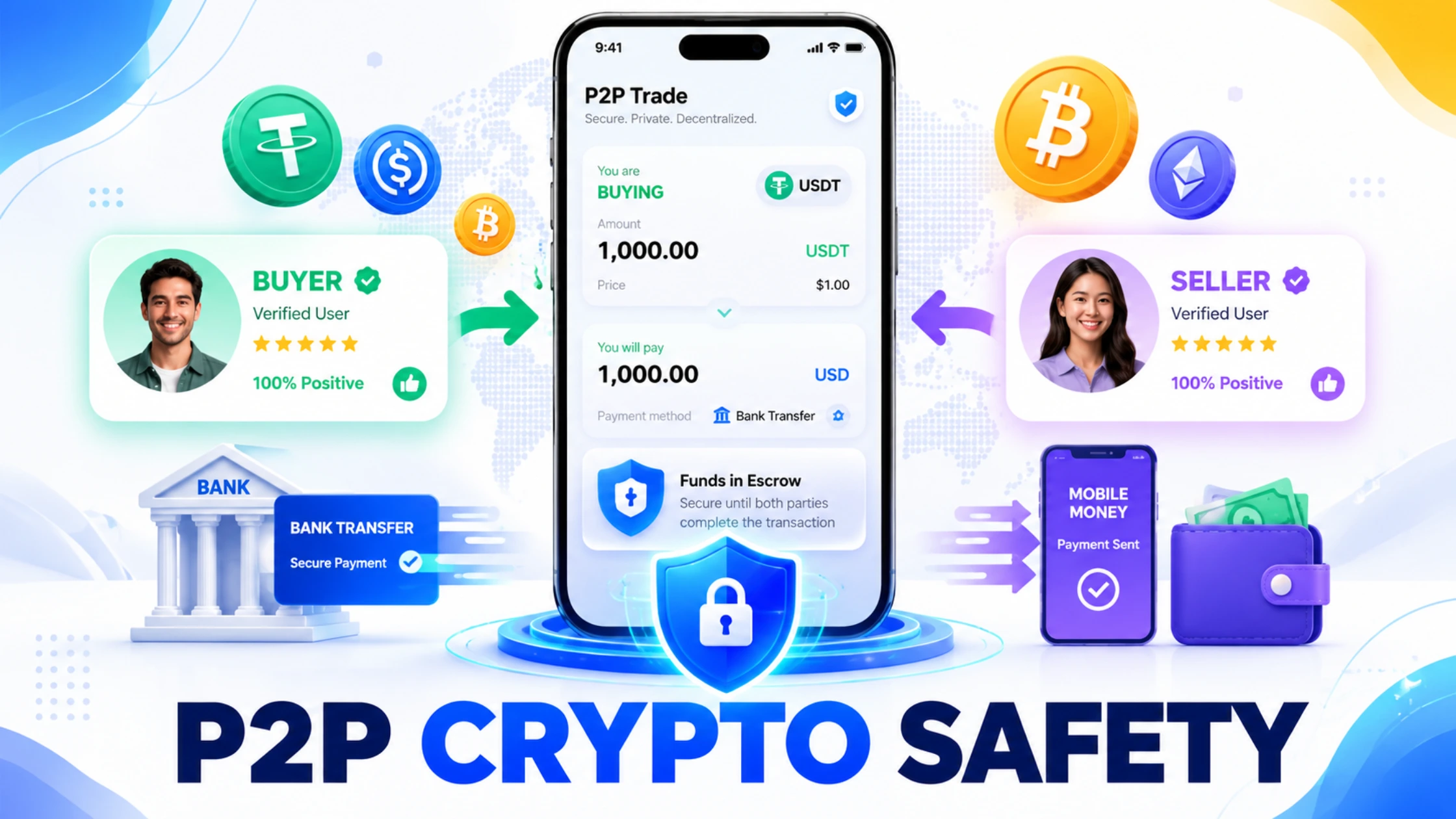
Peer-to-peer crypto markets connect buyers and sellers who agree on a price and external payment method.
The platform normally places the seller’s cryptocurrency in escrow, but it does not control the external fiat transfer.
That distinction creates the central P2P risk:
Escrow can protect the crypto while the order is open, but payment finality still depends on banks, mobile-money providers, digital wallets and the honesty of both counterparties.
2027 category leaders
Category | Leading platform | Primary advantage |
Best overall P2P marketplace | Broad merchant network, fiat coverage and integrated exchange markets | |
Best for payment-method variety | Large selection of supported payment methods in eligible markets | |
Best integrated exchange and Web3 route | P2P access connected to spot trading, automation and wallets | |
Best specialist regional marketplace | Localised bank and mobile-money markets in supported regions | |
Best direct rand-deposit alternative | Direct South African banking access | |
Best simple South African alternative | Beginner-friendly rand deposits |
Overall verdict
Binance is the strongest overall P2P marketplace.
Bybit is particularly competitive for payment-method flexibility.
OKX provides the best connected route from P2P purchasing into trading and Web3.
CoinCola remains relevant as a specialist regional P2P platform where it has active local markets.
The final decision must be based on local availability, merchant quality, payment finality and the complete price, not the platform name alone.
Why P2P Markets Still Matter
The conventional route into digital assets is straightforward in theory:
- Open an exchange account.
- Deposit money from a bank.
- Buy cryptocurrency.
That route does not work equally well everywhere.
In some markets:
- Local currencies are unsupported.
- Banks decline crypto-related payments.
- International cards carry large charges.
- Foreign-exchange access is limited.
- Bank transfers take several days.
- Mobile money is more widely used than bank accounts.
- Users receive income through payment applications.
- Stablecoins trade as an informal digital-dollar market.
P2P marketplaces fill the gap between formal financial infrastructure and digital-asset demand.
They can improve access.
They can also move part of the risk from the exchange to the user.
How P2P Crypto Trading Works
Stage | Buyer action | Seller action | Platform role |
Advertisement | Reviews price and terms | Publishes price, limits and payment method | Displays the marketplace |
Order creation | Accepts the offer | Commits the specified crypto | Locks crypto in escrow |
Fiat payment | Sends money externally | Waits for payment | Provides chat and order timer |
Payment confirmation | Marks the order paid | Checks own bank or wallet | Keeps crypto locked |
Release | Receives crypto | Confirms settled payment | Releases escrow |
Dispute | Provides payment evidence | Provides account evidence | Reviews platform records |
Completion | Receives asset | Retains fiat | Records transaction and feedback |
Binance, Bybit, OKX and CoinCola use escrow for eligible P2P orders, but the fiat payment is handled through an external provider. ore
The DN P2P Safety Score assesses the infrastructure available to a careful user.
Category | Weight | What is assessed |
Escrow and dispute infrastructure | 20% | Crypto locking, appeals and evidence review |
Merchant transparency | 20% | Verification, ratings, order history and completion data |
Payment-method controls | 15% | Name matching, supported methods and third-party-payment rules |
Marketplace liquidity | 15% | Number of active offers, order limits and rate competition |
Fraud controls | 10% | Risk screening, account restrictions and suspicious-order handling |
User experience | 10% | Search filters, chat, timers and mobile usability |
Price competitiveness | 5% | Premiums and merchant competition |
Geographic usefulness | 5% | Fiat and payment availability across supported regions |
The score does not guarantee transaction safety.
A strong platform cannot prevent a user from releasing crypto after seeing a fake screenshot or accepting a third-party payment.
Best P2P Crypto Exchanges Compared
Platform | Best for | DN P2P Safety Score | Key protection | Main limitation |
Overall global P2P access | 9.3/10 | Escrow, verified merchants and broad transaction history | Availability and local pairs change | |
Payment-method variety | 9.0/10 | Name matching, escrow, reviews and appeals | Fees can vary by fiat and merchant category | |
Integrated P2P and Web3 access | 9.0/10 | Escrow, merchant controls and third-party-payment prohibition | External payment remains outside OKX control | |
Regional P2P markets | 8.4/10 | Escrow, ratings and local payment filters | Market depth can be uneven | |
Direct South African deposit | Not a P2P ranking | Direct rand account funding | Does not replace P2P in unsupported markets | |
Simple direct rand purchase | Not a P2P ranking | Straightforward local deposit route | More limited trading and payment flexibility |
Scores are Decentralised News editorial assessments and not safety guarantees.
1. Binance: Best Overall P2P Crypto Exchange
Join Binance using referral code CPA_00SXKU7IO9
Binance ranks first because a P2P marketplace becomes more useful as the number of legitimate counterparties, payment methods and competing advertisements increases.
Key strengths
- Broad fiat and payment coverage
- Escrow for eligible orders
- Verified merchant programme
- Merchant transaction history
- Completion-rate data
- Search filters
- P2P and exchange markets in one account
- Platform chat
- Appeals
- Mobile and web access
Binance requires applicable identity verification before P2P trading and allows users to filter advertisements by fiat currency, cryptocurrency, amount and payment method. uying USDT through a local bank
- Selling stablecoins into local currency
- Comparing several merchants
- Using a payment method not supported by direct deposits
- Moving acquired crypto into spot markets
- Users who require flexible order sizes
Primary danger
The scale that creates choice also attracts fraud attempts.
Users must distinguish between:
- The real Binance website and an impersonation page
- A verified merchant and a fake profile screenshot
- Platform chat and off-platform messaging
- A settled bank payment and a fabricated notification
Binance verdict
Binance is the strongest overall marketplace for users who have confirmed that P2P service and the required fiat pair are available in their jurisdiction.
2. Bybit: Best for Payment-Method Flexibility
Join Bybit with referral code 46164
Bybit’s P2P platform supports a wide variety of payment methods in eligible markets.
The platform’s current materials refer to more than 80 possible payment methods, including bank transfers, cards, payment applications and selected cash-in-person transactions. Actual availability depends on country and advertiser.
crow
- Website and mobile access
- P2P Express
- Merchant reviews
- Payment-method filters
- Appeal specialists
- Name-matching requirements
- Integrated spot and derivatives accounts
- Risk-based withdrawal restrictions
Bybit states that risky P2P activity may trigger a temporary withdrawal restriction while the transaction is reviewed.
Bybit’s P2P fee structure is no longer accurately described as universally free.
Fees can differ according to:
- Fiat currency
- Maker or taker status
- Merchant level
- Verification category
- Advertisement type
- Payment-provider charges
Users must inspect the live quote.
rule
The payment-account holder name should match the verified Bybit identity.
Third-party payments are prohibited unless specifically approved within the platform’s rules.
t is the strongest option for users who need broad payment-method flexibility and want P2P integrated with a trading-focused exchange.
3. OKX: Best Integrated P2P, Exchange and Web3 Route
Join OKX with referral code 2136301
OKX connects three stages of digital-asset activity:
- Local-currency P2P access.
- Centralized spot and derivatives markets.
- Self-custodial wallet and Web3 services.
Key strengths
- Automated crypto escrow
- Verified merchant framework
- Payment filters
- Platform chat
- Dispute process
- Strict payment-name matching
- Spot and trading-bot access
- Web3 wallet integration
- Mobile application
OKX describes itself as a neutral facilitator for P2P transactions. The fiat payment occurs externally, while the cryptocurrency is secured through the platform’s order process. defence
OKX prohibits ordinary third-party payments.
If the payer’s name does not match the verified buyer:
- Do not release the cryptocurrency.
- Do not accept a refund request to another account.
- Open a dispute.
- Preserve the payment record.
OKX specifically identifies mismatched third-party payments as a potential triangulation-fraud risk. ovides the strongest connected route for users who want to move from a local payment method into exchange markets and eventually Web3.
4. CoinCola: Best Specialist Regional P2P Marketplace
CoinCola focuses more directly on P2P market access.
Its marketplace allows users to filter buyers and sellers according to:
- Price
- Payment method
- Merchant rating
- Order limit
- Available amount
- Local currency
CoinCola places eligible crypto into escrow and releases it after the seller confirms payment. ecialist P2P focus
- Regional merchant knowledge
- Bank-transfer markets
- Mobile-money use cases
- Merchant ratings
- Escrow
- Localised market pages
- Crypto and gift-card trading categories
Primary weakness
Specialist markets can be less liquid.
A user may find:
- Only a few active merchants
- Large differences between rates
- Limited order sizes
- Wider premiums
- Higher concentration risk
- Reduced activity outside business hours
CoinCola verdict
CoinCola is a useful alternative in markets where its local merchant network is active and competitively priced.
The DN Merchant Safety Score
A merchant should be assessed across several independent signals.
Factor | Weight | Conservative preference |
Completion rate | 20% | Above 98% |
Completed orders | 20% | Hundreds or thousands |
Recent reviews | 15% | Consistent positive feedback |
Verified status | 15% | Verified merchant preferred |
Account history | 10% | Established activity |
Payment-name match | 10% | Exact verified match |
Terms quality | 5% | Clear and platform-compliant |
Price realism | 5% | Competitive, not implausible |
Example assessment
Merchant signal | Merchant A | Merchant B |
Completion rate | 99.2% | 100% |
Completed orders | 4,800 | 11 |
Account age | 3 years | 8 days |
Verified badge | Yes | No |
Recent reviews | Consistent | Very limited |
Price | Market-aligned | 7% cheaper |
DN interpretation | Stronger candidate | High-risk candidate |
The perfect completion rate is not sufficient when the sample is extremely small.
Payment Finality Risk Tiers
Payment method | Typical speed | Reversal risk | Identity risk | DN risk tier |
Domestic bank transfer | Fast to moderate | Medium | Medium | Moderate |
Instant bank payment | Fast | Low to medium | Medium | Moderate |
Mobile money | Fast | Provider dependent | Medium | Moderate to high |
Digital payment wallet | Fast | Can be high | High | High |
Card-linked payment | Fast | Chargebacks possible | High | High |
Cash deposit | Variable | Complex | High | High |
Cash in person | Immediate | Physical-security risk | High | Very high |
Third-party account | Variable | Severe | Severe | Reject |
These categories are general. Payment-provider rules differ.
The DN Payment Finality Test
Before releasing cryptocurrency, a seller should answer all six questions.
1. Is the payment visible inside my own account?
Do not rely on:
- A screenshot
- An email
- An SMS
- A PDF receipt
- The buyer’s banking application
2. Is the payment fully settled?
Pending, processing and reversible payments are not the same as final funds.
3. Does the payer name match?
The name should match the verified P2P buyer.
4. Is the exact amount present?
Overpayments and underpayments can be part of a manipulation attempt.
5. Was the payment received through the agreed method?
Do not accept an unexpected transfer channel.
6. Is the order still open under escrow?
Never complete the trade outside the platform.
If any answer is no, do not release the cryptocurrency.
P2P Premium and Effective Price
The merchant’s economic return is often built into the advertised exchange rate.
Premium formula
P2P premium = (P2P price − reference price) ÷ reference price × 100
Example
Item | Amount |
Reference stablecoin price | £1.00 |
P2P advertised price | £1.04 |
P2P premium | 4% |
Cost of buying 1,000 units | £1,040 |
Embedded premium | £40 |
Complete P2P cost formula
Effective P2P cost = price premium + payment-provider fee + transfer fee + withdrawal cost + conversion cost
A platform advertising zero P2P commission can still be expensive.
Why P2P Premiums Change
Market condition | Likely effect |
High stablecoin demand | Premium increases |
Banking restrictions | Premium increases |
Currency depreciation | Premium can increase |
More competing merchants | Premium narrows |
Weekend banking delays | Premium may widen |
Chargeback-prone payment method | Seller premium rises |
Large order | Premium may improve or worsen |
Low merchant inventory | Premium increases |
Local foreign-exchange shortage | Premium can increase sharply |
Direct exchange deposit restored | Premium may narrow |
P2P vs Direct Exchange Deposit
Factor | P2P trade | Direct exchange deposit |
Counterparty | Individual merchant | Exchange or payment partner |
Fiat movement | External payment to another user | Deposit to exchange-controlled route |
Escrow | Usually protects crypto | Not normally needed |
Payment choice | Often broad | Usually narrower |
Pricing | Merchant-determined | Exchange or provider-determined |
Chargeback exposure | Can be significant | Usually lower for seller |
Name-matching importance | Critical | Still required |
Speed | Merchant dependent | Banking-route dependent |
Audit trail | Can be fragmented | Usually clearer |
Best use | Banking friction or specialist payment | Supported local deposit route |
Prefer P2P when:
- Your currency is unsupported.
- Mobile money is required.
- The direct deposit route is unavailable.
- The complete P2P price is better.
- You understand counterparty risk.
- The marketplace has proven merchants.
Prefer direct deposits when:
- A licensed regional platform supports the currency.
- The fee is reasonable.
- The transaction record is clearer.
- You are a beginner.
- You do not require a specialist payment method.
- The P2P premium is high.
South African Route Comparison
Route | Main strength | Main risk |
Binance, Bybit or OKX P2P | Potential merchant and payment choice | Counterparty and bank-transfer risk |
Direct rand funding | Platform custody and trading risk | |
Simple local onboarding | More limited market selection | |
Local stablecoin purchase then transfer | Access to global exchanges | Multiple fees and transfer steps |
South Africa requires crypto asset service providers to obtain relevant FSCA authorisation where applicable. Users should consult the regulator’s current licensed-provider list. ulatory Checklist
Question | Why it matters |
Is crypto ownership legal? | Some jurisdictions prohibit or restrict it |
Is P2P advertising permitted? | Local-currency P2P pairs may be restricted |
Is the platform authorised? | Determines legal access and potential recourse |
Does the bank permit crypto transfers? | Accounts may be reviewed or restricted |
Does the payment app permit commercial trades? | Terms may prohibit the transaction |
Are stablecoin rules different? | Particular assets may be restricted |
Must the transaction be reported? | Tax or regulatory reporting may apply |
Is foreign-exchange approval required? | P2P may interact with currency-control laws |
Are merchant activities considered a business? | Frequent trading can trigger licensing or tax duties |
Are records required? | Users may need proof of source and destination |
Nigeria
Nigeria has repeatedly adjusted its treatment of digital assets and naira-denominated P2P markets.
Authorities previously sought to remove the naira from P2P platforms and have continued expanding oversight of digital-asset businesses. Users should verify the current position directly rather than relying on historical marketplace availability. FCA describes cryptoassets as high-risk and speculative.
Consumers should verify that the platform and promotion they are using are legally accessible in the UK.
should verify the status of local crypto service providers through the FSCA and maintain records for tax, source-of-funds and banking purposes.
The DN Safe First-Trade Protocol
Stage | Required action |
Eligibility | Confirm local legality and platform availability |
Account | Complete verification and security controls |
Payment method | Add an account held in your own verified name |
Merchant | Select a verified, established counterparty |
Amount | Begin with approximately £20 or local equivalent |
Advertisement | Read the price, limits, method and terms |
Communication | Remain inside platform chat |
Payment | Send the exact amount once |
Confirmation | Mark paid only after sending |
Settlement | Verify funds inside the receiving account |
Name check | Confirm exact payer-name match |
Release | Release only through escrow |
Evidence | Save the order and payment record |
Review | Leave accurate feedback |
The DN Seller Release Checklist
Before releasing crypto, verify:
Check | Status required |
Payment visible in own account | Yes |
Payment fully settled | Yes |
Exact amount received | Yes |
Payer name matches buyer | Yes |
Correct payment method used | Yes |
No third party involved | Yes |
No refund request to another account | Yes |
Order remains protected by escrow | Yes |
No active dispute or bank alert | Yes |
Communication remained on-platform | Yes |
One failed check is enough to delay release and open an appeal.
Fraud Patterns to Recognise
Fake payment confirmation
The buyer sends a fabricated bank screenshot or SMS.
Response: Check the actual account. Do not release.
Third-party transfer
Money arrives from a name that does not match the verified buyer.
Response: Do not release. Appeal immediately.
Overpayment scam
The buyer sends too much and asks for the difference to be refunded elsewhere.
Response: Do not send a separate refund. Contact platform support.
Off-platform migration
The merchant asks to continue through Telegram or WhatsApp.
Response: Refuse and remain in platform chat.
Cancellation after payment
The seller asks the buyer to cancel after fiat has been sent.
Response: Do not cancel. Open an appeal.
Chargeback fraud
The buyer receives crypto and later disputes the fiat transaction.
Response: Preserve the platform order, name verification, chat and bank records.
Fake support agent
An impersonator asks for passwords, codes or additional payments.
Response: Contact support only through the official platform.
Triangulation fraud
A third-party victim sends the fiat while the fraudster receives the crypto.
Response: Enforce exact name matching.
Refund redirection
The counterparty asks that a refund be sent to a different account.
Response: Never refund outside the original verified route without formal platform instructions.
The DN Fraud-Response Sequence
Priority | Action |
1 | Stop the transaction |
2 | Do not release crypto |
3 | Do not cancel after paying |
4 | Open a platform appeal |
5 | Preserve chat, order and advertisement evidence |
6 | Download bank or wallet records |
7 | Contact the payment provider |
8 | Secure the exchange and email accounts |
9 | Report impersonation |
10 | Notify the bank fraud department |
11 | File a report with relevant local authorities |
12 | Maintain records for compliance and tax enquiries |
Frequently Asked Questions
What is the best P2P crypto exchange in 2027?
Binance ranks first in the DN P2P Safety Score because of its merchant network, escrow system and marketplace breadth.
Is Binance P2P free?
Binance currently advertises zero-fee P2P trading for ordinary users in many markets, although merchant, payment-provider or regional charges can apply.
The advertised exchange rate can also include a premium.
Is Bybit P2P free?
Bybit’s current P2P fees can vary by fiat currency, merchant level, verification type and advertisement category.
Check the live order before trading.
Is OKX P2P safe?
OKX uses crypto escrow and a dispute process.
Users must still verify the external fiat payment and enforce exact account-name matching.
Is CoinCola legitimate?
CoinCola operates a P2P marketplace with escrow, merchant ratings and local-market filters.
Users must still evaluate each merchant and confirm that service is available in their jurisdiction.
What is the safest P2P payment method?
No payment method is universally safest.
A payment method should provide strong name verification, clear settlement status and low reversal risk.
Can I receive payment from the buyer’s friend?
No.
Third-party payments create fraud, chargeback and compliance risk.
Should I release crypto when the buyer sends proof?
Only release when the money is visible and settled in your own account.
A receipt is not payment.
What if the buyer marks the order paid but nothing arrives?
Do not release the cryptocurrency.
Use platform chat and open an appeal when appropriate.
Can P2P payments cause a bank account to be frozen?
A bank may review or restrict an account when activity appears suspicious, violates its terms or receives fraud complaints.
Maintain clear records and avoid third-party payments.
Is P2P cheaper than using an exchange?
It can be, but the premium may exceed a direct deposit fee.
Compare the complete amount of crypto received.
Should beginners use P2P?
Beginners should prefer a direct regulated deposit when one is available at a reasonable cost.
P2P becomes more useful when conventional funding routes do not work.
Final 2027 Rankings
Award | Winner |
Best overall P2P marketplace | |
Best payment-method selection | |
Best P2P, exchange and Web3 route | |
Best specialist regional marketplace | |
Best South African direct-deposit alternative | |
Best simple South African alternative |
The Decentralised News Verdict
P2P crypto markets solve a real problem.
They allow users to enter or exit digital assets when conventional banking routes are expensive, limited or unavailable.
The solution creates a different risk structure.
The platform can hold cryptocurrency in escrow.
It cannot make an external payment honest, final or legally permissible.
Binance provides the strongest overall P2P marketplace.
Bybit is particularly useful when payment-method variety matters.
OKX provides the most connected route into exchange and Web3 activity.
CoinCola remains relevant in supported regional markets.
Where direct banking is available, South African users should compare P2P offers with VALR and Luno.
The safest P2P process is intentionally strict:
- Verify the jurisdiction.
- Select a reputable platform.
- Choose an established merchant.
- Use an account in your own name.
- Start with a small transaction.
- Stay inside platform chat.
- Verify payment independently.
- Reject third-party transfers.
- Never release based on a screenshot.
- Use the appeal system before cancelling.
- Preserve every record.
- Walk away when the transaction does not make sense.
P2P access is valuable.
Payment finality is decisive.
Affiliate Disclosure
Some links in this publication are affiliate or referral links. Decentralised News may receive compensation when eligible readers register or transact through a featured service.
Affiliate relationships do not guarantee inclusion, a favourable review or a category award. Platforms are assessed according to escrow, merchant transparency, payment access, dispute infrastructure and material risks.
Risk Disclaimer
This publication is for educational and informational purposes only. It does not constitute financial, investment, legal, accounting or tax advice.
P2P crypto trading involves fraud, counterparty, chargeback, bank-account, platform, liquidity and regulatory risks. Laws, payment methods and platform availability can change without notice.
Readers must be at least 18 years old, confirm legal eligibility and conduct independent due diligence before trading.