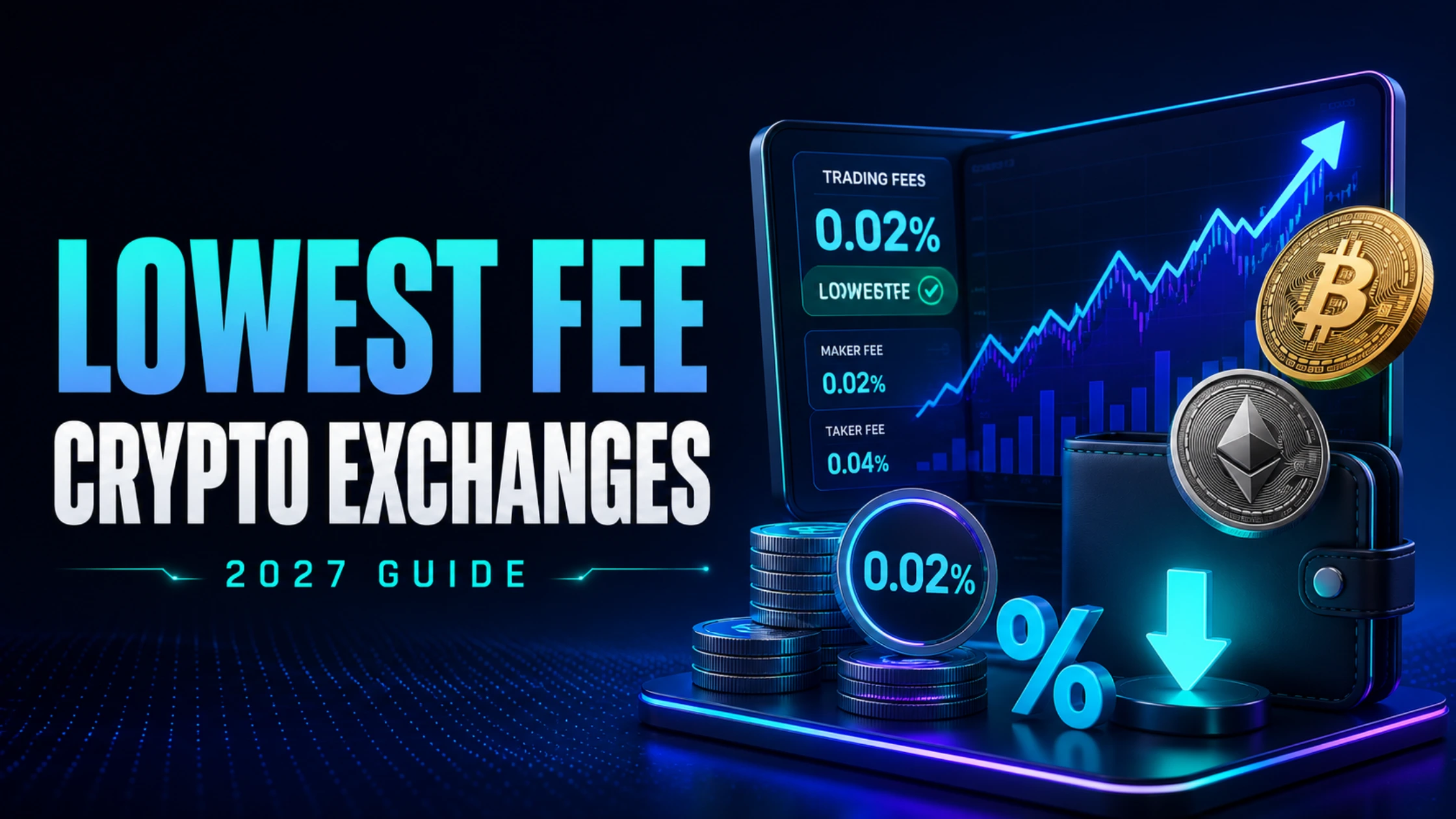
Compare the lowest-fee crypto exchanges in 2026, including MEXC, KCEX, Binance, Bitunix, Bybit, OKX, Bitget and Gate. Learn how spreads, slippage, funding, withdrawals and deposit costs affect the true price of trading crypto.
Summary
The crypto exchange with the lowest advertised trading fee is not always the cheapest exchange to use.
Your real cost may include:
- Deposit fees
- Currency-conversion charges
- Buy and sell spreads
- Maker or taker fees
- Slippage
- Withdrawal charges
- Blockchain network fees
- Futures funding payments
- Margin interest
- Copy-trading profit sharing
- Bot subscriptions
- Liquidation costs
Our leading low-fee exchange choices for 2026 are:
- Best for zero-fee spot trading: MEXC
- Best for extremely low futures trading fees: KCEX
- Best mainstream low-fee ecosystem: Binance
- Best low-fee exchange for spot and futures combined: Bitunix
- Best low-fee active-trading interface: Bybit
- Best for trading tools, automation and Web3: OKX
- Best low-fee copy-trading platform: Bitget
- Best for broad altcoin access: Gate
- Best additional futures-focused option: BloFin
- Best low-fee South African route: VALR
For pure spot trading fees, MEXC and KCEX are among the strongest current choices. For users who also care about liquidity, fiat access, trading tools and market depth, Binance, Bybit, OKX and Bitunix may produce a lower total cost despite charging a visible trading fee.
The Cheapest Crypto Exchange Is Not Always the One With Zero Fees
A crypto exchange can advertise zero trading fees and still be more expensive than a platform charging 0.10%.
This happens because the trading commission is only one part of the transaction.
Imagine that one exchange charges no commission but executes your order 0.40% away from the best market price. Another exchange charges 0.10% but provides a much tighter spread and better liquidity.
The exchange charging a visible fee may leave you with more cryptocurrency.
This is why Decentralised News measures real fees, not merely the percentage published beside the trading screen.
The DN True Cost Formula
Use the following formula when comparing exchanges:
Real crypto exchange cost equals deposit cost plus currency conversion plus spread plus trading fee plus slippage plus withdrawal cost plus any ongoing product costs.
For futures traders, the formula should also include:
- Opening and closing fees
- Funding payments
- Margin borrowing
- Liquidation penalties
- Forced settlement charges
- The cost of poor execution during volatile periods
For copy traders, add:
- Profit sharing
- Lead-trader fees
- Excessive turnover
- Hidden leverage
- The cost of copying entries after the lead trader
For bot users, add:
- Subscription costs
- API-specific fees
- Increased trading frequency
- Failed-order or partial-fill costs
What Is a Maker Fee?
A maker order adds liquidity to the exchange order book.
A limit buy order placed below the current selling price may remain open until another trader accepts it. Because it adds an order to the book, it can qualify for the maker fee.
Maker fees are often lower than taker fees.
Some exchanges charge no maker fee, while high-volume programs may even pay a small rebate.
What Is a Taker Fee?
A taker order removes liquidity from the order book.
Market orders are usually taker orders because they execute immediately against existing bids or offers.
A limit order can also become a taker order when it is placed at a price that causes immediate execution.
Active traders should not assume that selecting “limit order” automatically guarantees a maker fee. The order must normally rest on the book first.
1. MEXC: Best Exchange for Zero-Fee Spot Trading
Join MEXC with referral code 16yJL
MEXC is our leading choice for traders whose primary objective is minimizing explicit spot-trading commissions.
At the time of review, MEXC states that eligible spot trading pairs carry zero maker and taker fees. The exchange also runs low-fee or zero-fee futures programs, although futures eligibility, API pricing and individual trading pairs can follow separate rules. est suited to:
- Spot traders
- Altcoin traders
- High-frequency manual traders
- Users who rebalance portfolios frequently
- Traders who want access to emerging token markets
- Users prepared to inspect order-book liquidity
- Futures traders willing to verify the rate on each contract
Why MEXC can be extremely cost-effective
A zero spot commission is particularly valuable to traders who:
- Enter and exit frequently
- Rebalance several assets
- Use smaller position sizes
- Trade market-neutral strategies
- Move between stablecoins and altcoins
- Generate large monthly turnover
A trader executing $100,000 in spot volume at a 0.10% fee would pay approximately $100 in explicit commissions.
At a zero trading fee, that particular commission is removed.
The hidden costs to inspect
Zero trading fees do not remove:
- Bid and ask spreads
- Slippage
- Withdrawal charges
- Blockchain costs
- Deposit or payment-provider fees
- Futures funding
- Price differences between exchanges
- API-specific rates
- The cost of trading illiquid tokens
MEXC’s wide token selection means market quality can vary significantly.
A liquid BTC or ETH market may execute efficiently. A newly listed small-cap token may have a much wider spread.
MEXC verdict
MEXC is the strongest current choice for traders prioritizing zero explicit spot fees and broad altcoin access.
The best results are likely to come from using limit orders and concentrating on markets with genuine liquidity.
2. KCEX: Best for Ultra-Low Futures Fees
Join KCEX with referral code 0MPMVM
KCEX has positioned itself aggressively around low trading fees.
Its published fee materials currently advertise:
- Zero spot maker fees
- Zero spot taker fees
- Zero futures maker fees
- A 0.01% futures taker fee
These rates make KCEX one of the most aggressive fee competitors in centralized crypto trading. est suited to:
- Fee-sensitive futures traders
- Market makers using post-only orders
- High-turnover strategies
- Altcoin futures traders
- Users who already understand derivatives
- Traders comparing several specialist venues
How much could a 0.01% futures taker fee cost?
Consider a $10,000 futures position.
A 0.01% taker fee would equal approximately $1 when opening the position.
Closing the position with another taker order would add approximately another $1.
The round-trip execution fee would therefore be about $2, excluding funding, slippage and any liquidation-related costs.
By comparison, a 0.06% taker fee would cost approximately $6 per side and $12 for the round trip.
Important limitations
Low futures fees do not make futures trading low risk.
The trader must still account for:
- Funding rates
- Leverage
- Liquidation distance
- Index and mark prices
- Order-book depth
- Insurance-fund rules
- System reliability
- Withdrawal access
- Contract-specific limits
A low trading fee cannot compensate for an oversized leveraged position.
KCEX verdict
KCEX is one of the strongest choices for traders focused on minimizing futures execution fees.
It is better suited to experienced traders than beginners.
3. Binance: Best Mainstream Low-Fee Ecosystem
Join Binance with referral code CPA_00SXKU7IO9
Binance combines relatively low standard fees with broad liquidity, numerous markets and a large crypto ecosystem.
Its published standard spot rate for regular users is currently 0.10% for maker and taker transactions. Eligible users can reduce the rate when paying fees with BNB, subject to the platform’s current terms. Binance also offers zero-fee or zero-maker-fee promotions on selected pairs. s best suited to:
- Mainstream spot traders
- High-liquidity Bitcoin and Ethereum traders
- Users who want a broad exchange ecosystem
- P2P traders
- Futures traders
- Bot users
- Traders seeking volume-based reductions
- Users who can benefit from selected promotional pairs
Why Binance can beat a zero-fee exchange
Binance can produce a lower real cost when:
- Its order book has a tighter spread.
- The user can deposit local currency efficiently.
- The required market has deeper liquidity.
- The trade experiences less slippage.
- The user qualifies for BNB or VIP reductions.
- Withdrawals are cheaper through the selected network.
- The user avoids converting between several exchanges.
Suppose Exchange A charges zero commission but produces 0.25% slippage.
Exchange B charges 0.10% but executes with 0.03% slippage.
Exchange B would produce the lower immediate trading cost in that example.
Binance fee-saving methods
Users may be able to reduce costs by:
- Paying eligible fees with BNB
- Using maker orders
- Trading liquid pairs
- Avoiding repeated small conversions
- Comparing spot trading with instant-buy pricing
- Monitoring zero-fee promotions
- Selecting an efficient withdrawal network
- Increasing volume only when trading is already justified
Do not trade more merely to reach a lower fee tier.
Binance verdict
Binance is our leading mainstream low-fee ecosystem because it combines competitive fees with liquidity and product breadth.
The platform may be cheaper in practice than a zero-fee exchange when execution quality and funding are considered.
4. Bitunix: Best Low-Fee Balance Across Spot and Futures
Join Bitunix with referral code 17hy
Bitunix offers competitive entry-level fees across both spot and derivatives markets.
Its published VIP 0 schedule lists:
- 0.08% spot maker fee
- 0.10% spot taker fee
- 0.02% futures maker fee
- 0.06% futures taker fee
Rates can decline further at higher VIP levels. s best suited to:
- Active spot traders
- Futures traders
- Users seeking one venue for both markets
- Limit-order traders
- Users who may qualify through volume or account balance
- Traders comparing alternatives to larger exchanges
Why the 0.08% maker rate matters
A trader executing $10,000 as a spot maker would pay approximately $8 at a 0.08% fee.
At a 0.10% fee, the same trade would cost approximately $10.
The difference appears small on one transaction, but it becomes meaningful across repeated turnover.
At $1 million in total executed volume:
- A 0.08% fee equals approximately $800.
- A 0.10% fee equals approximately $1,000.
The difference is approximately $200 before considering VIP reductions.
Bitunix verdict
Bitunix provides a strong balance for users who want competitive spot and futures fees without relying entirely on temporary zero-fee promotions.
5. Bybit: Best Low-Fee Active-Trading Experience
Join Bybit with referral code 46164
Bybit combines competitive fees with a polished interface designed for active traders.
Its standard published rates have generally included:
- 0.10% maker and taker fees for spot trading
- Approximately 0.02% maker and 0.055% taker for many derivatives contracts
The actual rate can vary according to account tier, region and product. best suited to:
- Active traders
- Futures traders
- Users who value execution tools
- Technical traders
- Traders using conditional orders
- Users who want spot, derivatives and automation in one interface
Why interface quality affects real cost
A trading interface can reduce indirect costs by helping the user:
- Place post-only orders
- Set stop losses
- Monitor liquidation distance
- Control slippage
- Avoid accidental market orders
- Manage partial exits
- Review fees before confirmation
A poorly configured trade can cost far more than the exchange commission.
Futures traders must include funding
A futures position may pay or receive funding at scheduled intervals.
A low entry fee does not guarantee a low total position cost.
A position held through several positive funding settlements can become expensive, particularly when leverage increases the notional exposure.
Bybit verdict
Bybit is not always the absolute cheapest exchange on the published fee alone.
It is one of the strongest low-fee choices when trading tools, market access and execution control are included.
6. OKX: Best Low-Fee Platform for Bots and Web3 Users
Join OKX with referral code 2136301
OKX uses tiered maker and taker fees that vary by market, region, trading volume and asset holdings.
Its fee examples commonly use approximately 0.08% maker and 0.10% taker for entry-level spot calculations, although users must confirm their actual account and pair rate. OKX has also adjusted pair groupings and futures tiers during 2026. st suited to:
- Spot traders
- Futures traders
- Trading-bot users
- Multi-chain Web3 users
- Users who want integrated exchange and wallet tools
- Traders who can use maker orders
The bot-turnover problem
A bot may execute hundreds or thousands of transactions.
Even a small fee difference becomes significant when turnover is high.
For example, total monthly executed volume of $500,000 would produce:
- About $500 in fees at 0.10%
- About $400 in fees at 0.08%
- About $250 in fees at 0.05%
- No explicit commission at 0%
This does not include spread or slippage.
A bot that trades too frequently can destroy an otherwise profitable strategy.
OKX verdict
OKX is a strong low-fee choice for traders who want integrated bots, advanced orders and Web3 access.
7. Bitget: Best Low-Fee Copy-Trading Exchange
Bitget publishes a standard spot fee of 0.10% for maker and taker orders, with eligible reductions when using BGB for fees.
Its standard futures rates have commonly been listed near 0.02% for makers and 0.06% for takers, although VIP and promotional rates can differ. best suited to:
- Copy traders
- Futures traders
- Users who want trader-discovery tools
- Users who can benefit from BGB fee deductions
- Active traders seeking another liquid venue
Copy trading creates additional costs
A follower may pay more than the ordinary exchange fee.
The full cost can include:
- Trading fees
- Futures funding
- Lead-trader profit sharing
- Slippage between the leader and follower
- High portfolio turnover
- Losses from hidden leverage
- Poor execution when many followers enter simultaneously
A lead trader generating frequent trades may produce higher exchange fees without improving net returns.
Bitget verdict
Bitget is our leading low-fee specialist for copy trading, but users must measure net performance after profit sharing, funding and turnover.
8. Gate: Best for Low-Fee Altcoin Market Discovery
Join Gate with referral code UgUVAVoJ
Gate uses regional and tiered fee schedules.
Its European schedule currently lists a 0.10% maker and taker entry rate, with lower fees available at higher tiers. Other regions and product groups may differ. est suited to:
- Altcoin traders
- New-listing researchers
- Bot users
- High-volume traders
- Users seeking broad product coverage
- Traders willing to compare pair-specific liquidity
Why altcoin liquidity matters more than the headline fee
Suppose a small token has:
- A 1% bid and ask spread
- Thin order-book depth
- A 0.10% trading fee
The spread alone can be ten times larger than the commission.
A zero-fee exchange does not solve this problem if its market is equally illiquid.
Gate verdict
Gate can be cost-effective for broad altcoin access, particularly when users qualify for tier reductions.
Every smaller market should be assessed individually.
9. BloFin: Strong Futures-Focused Alternative
Join BloFin with referral code Decentralised
BloFin’s published regular rates currently include:
- 0.10% for spot trades
- 0.02% for futures maker orders
- 0.06% for futures taker orders
Higher tiers can reduce futures fees further. Certain high-risk spot tokens may carry higher rates. best suited to:
- Futures traders
- Users seeking an alternative derivatives venue
- Traders qualifying for VIP reductions
- Users comparing several specialist platforms
BloFin verdict
BloFin is a competitive futures-focused alternative, particularly for users who value a tiered route to lower derivatives costs.
10. WEEX: Strong for Zero Spot Maker Fees
Join WEEX with referral code 3whse
Current WEEX materials advertise zero spot maker fees and a 0.10% spot taker fee. Futures fees and promotions can vary, so users should confirm the rate shown for their account and contract. est suited to:
- Limit-order spot traders
- Futures users
- Traders seeking zero maker fees
- Users comparing specialist platforms
- Altcoin traders
WEEX verdict
WEEX can be highly cost-effective for users whose limit orders qualify as makers.
A trader using market orders should compare taker fees and slippage carefully.
Kraken: Not the Lowest Headline Fee, but Potentially Competitive in Context
Kraken should not be presented as the lowest-fee exchange for an entry-level spot trader under its July 2026 standard schedule.
Kraken’s standard retail service currently charges a 1% fee on instant and recurring trades, with spread and payment costs potentially applying. Kraken Pro’s July 2026 entry tier lists 0.40% maker and 0.80% taker, with rates declining as volume, futures activity or eligible assets on the platform increase. ill produce a competitive real cost when:
- It supports a lower-cost bank transfer.
- The required fiat pair is available directly.
- Liquidity is stronger.
- A user qualifies for a better tier.
- The alternative requires currency conversion.
- The user values a mature fiat gateway.
- Funds would otherwise move through several platforms.
Kraken verdict
Kraken is not the winner for lowest entry-level trading commissions.
It remains relevant when fiat access, direct currency pairs, execution quality and operational suitability are included in the comparison.
VALR and Luno: Why Local Funding Can Beat Offshore Fees
VALR
Join VALR with referral code VAZP2TAW
VALR can offer a lower real cost to South Africans when direct rand deposits avoid international card fees and foreign-currency conversion.
It is particularly suitable for users who want:
- ZAR deposits
- Local bank withdrawals
- Spot markets
- Limit orders
- A route into more advanced trading
Luno
Join Luno and use reward code MJV6YD
Luno can be convenient for a simple rand-funded purchase.
Users should compare instant-buy pricing with exchange-order pricing, since convenience transactions may include a larger effective spread or fee than order-book trading.
Local exchange verdict
A South African user should compare the full rand-to-crypto journey.
An offshore exchange with a lower trading commission may become more expensive after:
- Foreign-currency conversion
- International payment fees
- Card costs
- Stablecoin purchase spreads
- Transfer costs
- Additional blockchain withdrawals
Worked Fee Examples
Example 1: A $100 Spot Purchase
At a zero trading fee:
- Explicit exchange commission: $0
At a 0.08% fee:
- Approximate commission: $0.08
At a 0.10% fee:
- Approximate commission: $0.10
At a 1% fee:
- Approximate commission: $1 before any spread or payment charge
For a very small purchase, the deposit method and fixed withdrawal charge may matter more than the trading fee.
Example 2: A $1,000 Spot Purchase
At a zero trading fee:
- Explicit exchange commission: $0
At a 0.08% fee:
- Approximate commission: $0.80
At a 0.10% fee:
- Approximate commission: $1
At a 0.40% fee:
- Approximate commission: $4
At a 0.80% fee:
- Approximate commission: $8
A 0.20% spread would add another $2, even on an exchange advertising zero commission.
Example 3: $10,000 in Monthly Trading Volume
At a zero trading fee:
- Approximate commission: $0
At a 0.08% fee:
- Approximate commission: $8
At a 0.10% fee:
- Approximate commission: $10
At a 0.40% fee:
- Approximate commission: $40
At a 0.80% fee:
- Approximate commission: $80
These examples use total executed volume. Buying and later selling create two separate trades.
How Spread Can Cost More Than the Fee
Assume Bitcoin’s fair market price is $100,000.
Exchange A charges no commission but sells at $100,300.
The effective spread cost is approximately 0.30%.
Exchange B charges a 0.10% fee but sells at $100,050.
The approximate combined immediate cost is 0.15%.
In this example, Exchange B is cheaper despite charging a visible commission.
How Slippage Can Cost More Than the Fee
A trader places a $20,000 market order in a thin altcoin market.
The quoted price changes as the order consumes several levels of the order book.
If the average fill is 0.50% worse than expected, the slippage costs approximately $100.
A 0.10% trading fee would cost another $20.
The slippage is five times the commission.
How Withdrawal Fees Change the Result
Suppose two exchanges offer the same trade price.
Exchange A charges no trading fee but charges $15 to withdraw the selected asset.
Exchange B charges $1 in trading fees and $2 to withdraw through an efficient network.
For a small purchase, Exchange B may be substantially cheaper.
Always check:
- Which networks are supported
- The withdrawal minimum
- The current withdrawal charge
- Whether the destination supports the same network
- Whether a cheaper network creates additional bridge risk
The Cheapest Exchange by Trading Style
Long-term Bitcoin buyer
Prioritize:
- Low-cost fiat funding
- Tight BTC spreads
- Reliable withdrawals
- Strong security
- Direct local currency pairs
Potential choices include Binance, Kraken, VALR and Luno, depending on country and funding method.
Frequent spot trader
Prioritize:
- Low maker and taker fees
- Tight spreads
- Market depth
- API reliability
- Volume reductions
Potential choices include MEXC, KCEX, Binance, Bitunix, OKX and Gate.
Altcoin trader
Prioritize:
- Liquidity on the specific token
- Withdrawal availability
- Contract verification
- Spread
- Delisting risk
Potential choices include MEXC, Gate, Binance, Bitget and Bitunix.
Futures trader
Prioritize:
- Maker and taker fees
- Funding
- Market depth
- Liquidation rules
- Order types
- System reliability
Potential choices include KCEX, MEXC, Bybit, Binance, OKX, Bitunix, BloFin and WEEX.
Copy trader
Prioritize:
- Trading fees
- Profit sharing
- Lead-trader turnover
- Slippage
- Funding
- Drawdown
Potential choices include Bitget, BingX and Bybit.
Ways to Reduce Crypto Exchange Fees
Use bank transfers where practical
Card purchases can introduce payment-provider and foreign-currency costs.
Learn limit orders
A non-marketable limit order may qualify for a lower maker fee.
Use post-only mode
Post-only instructions can prevent an order from executing immediately as a taker.
Trade liquid pairs
BTC, ETH and major stablecoin markets generally have tighter spreads than small altcoins.
Compare instant buy with spot trading
A simple purchase screen may include a higher fee or spread.
Avoid unnecessary conversions
Moving from fiat to one stablecoin, then another stablecoin, then an altcoin creates multiple potential costs.
Select withdrawal networks carefully
A lower-cost network can reduce withdrawal expense, but the sending and receiving platforms must support the same network.
Use token discounts only when justified
Holding an exchange token solely to reduce fees introduces price risk.
Calculate whether the expected discount is large enough to justify that exposure.
Do not chase VIP tiers
Trading more to save a small percentage can increase losses, taxes and operational risk.
DN True Cost Calculator
[Interactive tool placeholder: DN Crypto Exchange True Cost Calculator]
The calculator should allow readers to enter:
- Deposit amount
- Deposit charge
- Currency-conversion rate
- Spread
- Maker or taker fee
- Expected slippage
- Withdrawal fee
- Blockchain cost
- Number of monthly trades
- Futures funding
- Bot subscription
- Copy-trading profit share
The output should show:
- Total immediate cost
- Cost as a percentage
- Round-trip cost
- Monthly cost
- Annualized cost
- Break-even price movement
Frequently Asked Questions
Which crypto exchange has the lowest fees in 2026?
MEXC and KCEX currently advertise zero spot maker and taker fees.
KCEX also advertises zero futures maker fees and a 0.01% futures taker fee.
The cheapest exchange in practice still depends on spread, liquidity, funding and withdrawals.
Is zero-fee crypto trading really free?
No.
Zero-fee trading usually refers only to the maker or taker commission.
Spread, slippage, withdrawals, network charges, funding and payment costs may still apply.
Which mainstream crypto exchange has low fees?
Binance is one of the strongest mainstream low-fee choices, particularly for users who can access BNB reductions or eligible promotional pairs.
OKX, Bybit, Bitget and Bitunix are also competitive.
Which exchange has the lowest futures fees?
KCEX currently advertises a 0% maker and 0.01% taker structure for futures.
MEXC also runs extremely low-fee or zero-fee programs on eligible futures markets.
Always verify the specific contract and account rate.
Are maker fees always lower than taker fees?
Often, but not always.
Some exchanges charge the same rate for both, while others provide zero maker fees or rebates.
Do market orders cost more?
Market orders usually incur taker fees and may experience slippage.
The total cost can therefore be higher than a carefully placed maker order.
Is MEXC cheaper than Binance?
MEXC currently has the lower published spot commission.
Binance may still produce better real execution on a particular pair if it provides a tighter spread, deeper liquidity or cheaper funding.
Is Kraken a low-fee exchange?
Kraken is not currently the lowest-fee choice for an entry-level spot trader.
It can become more competitive at higher tiers or when direct fiat access and liquidity reduce other costs.
Which low-fee exchange is best in South Africa?
VALR can be highly cost-effective for users seeking direct rand deposits and withdrawals.
Luno may be convenient for smaller or simpler purchases.
Global alternatives include Binance, MEXC, Bybit, OKX and Bitget, subject to local availability.
Are withdrawal fees fixed?
Not always.
Withdrawal costs can vary by asset, network, blockchain conditions and platform policy.
Review the live charge before confirming.
Final Verdict
The lowest-fee crypto exchange in 2026 depends on what is being measured.
For explicit spot-trading commissions, MEXC and KCEX are the leading choices in this guide.
For futures execution fees, KCEX offers one of the most aggressive published structures.
Binance remains our leading mainstream low-fee ecosystem.
Bitunix offers a strong combination of competitive spot and futures rates.
Bybit and OKX provide a compelling balance of fees, liquidity and trading tools.
Bitget is particularly relevant to copy traders.
Gate is useful for broad altcoin discovery.
South African users should compare VALR and Luno against the full cost of funding an offshore platform.
The correct decision should be based on the total journey:
- How money enters the exchange.
- How the order is executed.
- How often the user trades.
- How assets leave the platform.
- What additional risks the platform or product introduces.
A zero fee is valuable.
A low total cost is more important.
Affiliate Disclosure
Some links in this guide are affiliate or referral links. Decentralised News may receive compensation when eligible readers register or use a featured platform.
Affiliate relationships do not determine rankings. Exchanges are assessed according to published fees, execution considerations, funding access, functionality and material risks.
Disclaimer
This content is for educational and informational purposes only. It does not constitute financial, investment, legal or tax advice.
Fees, promotions and platform availability may change. Cryptocurrency and derivatives involve substantial risk. Leveraged positions can be liquidated rapidly.
Readers must be at least 18 years old, verify local eligibility and review the live fee shown inside the platform before depositing or trading.
:::
2. Decentralised News Flagship Version
Lowest-Fee Crypto Exchanges in 2027: The DN True Cost Rankings
Meta description: Discover the lowest-fee crypto exchanges in 2027 using the DN True Cost Index. Compare spot fees, futures fees, spreads, slippage, funding, withdrawals and real trading costs across MEXC, KCEX, Binance, Bitunix, Bybit, OKX and more.
Suggested URL slug: lowest-fee-crypto-exchanges-2027
Edition: 2027 Early Edition
Last reviewed: July 2026
AI Summary
The cheapest crypto exchange is not necessarily the platform advertising zero commission.
Decentralised News evaluates exchanges using the DN True Cost Index, which considers:
- Fiat funding
- Currency conversion
- Spread
- Maker and taker fees
- Slippage
- Market liquidity
- Withdrawal charges
- Blockchain costs
- Futures funding
- Margin interest
- API-specific rates
- Copy-trading profit sharing
- Bot-generated turnover
2027 category leaders
Category | Leading platform | Core advantage |
Best for zero-fee spot trading | Zero explicit maker and taker fees on eligible spot trading | |
Best for ultra-low futures fees | Zero futures maker and 0.01% taker rate | |
Best mainstream low-fee ecosystem | Competitive rates combined with market depth | |
Best spot and futures fee balance | 0.08% spot maker and competitive derivatives rates | |
Best for execution tools | Competitive fees with an advanced trading interface | |
Best for bots and Web3 | Low-cost trading integrated with automation | |
Best for low-fee copy trading | Competitive fees and copy-trader infrastructure | |
Best for altcoin market discovery | Broad markets with tier-based reductions | |
Best futures-focused alternative | Competitive regular and VIP derivatives rates | |
Best zero-maker specialist alternative | Zero spot maker fee | |
Best South African true-cost route | Direct rand funding and local withdrawals |
Overall conclusion: MEXC wins the explicit spot-fee category, while KCEX leads the published futures-fee category. Binance ranks as the strongest mainstream option when liquidity and ecosystem breadth are included.
Rates shown are based on official schedules reviewed in July 2026 and are not predictions of guaranteed 2027 pricing.
Why Most Crypto Fee Comparisons Are Misleading
Most exchange comparisons begin and end with a maker-and-taker table.
That approach is incomplete.
The percentage charged by the exchange may be one of the smallest components of a transaction.
A user can pay more through:
- A poor fiat exchange rate
- An expensive card purchase
- A wide spread
- Slippage on an illiquid order book
- A fixed withdrawal charge
- An inefficient blockchain network
- Futures funding
- Multiple unnecessary conversions
- Repeated bot activity
- Profit sharing with a copied trader
The correct unit of analysis is not the fee shown beside the order.
It is the amount of usable cryptocurrency or fiat value remaining after the complete transaction path.
The DN True Cost Index
The DN True Cost Index ranks exchanges according to the costs most likely to affect a real user.
Component | Weight | What it measures |
Spot or derivatives commission | 20% | Maker, taker and contract-execution fees |
Spread and liquidity | 20% | Difference between market value and executable price |
Fiat funding | 15% | Bank, card and local currency costs |
Slippage | 15% | Price deterioration caused by order size and market depth |
Withdrawals | 10% | Platform and blockchain cost of moving funds |
Recurring product costs | 10% | Funding, margin interest, bot or copy-trading costs |
Fee transparency | 5% | Ability to inspect costs before confirmation |
Discount accessibility | 5% | Whether lower rates require realistic volume or token holdings |
The resulting score is user-specific.
An offshore exchange may score highly for a USDT futures trader but poorly for a small South African buyer funding with rand.
Current Entry-Level Fee Comparison
Exchange | Spot maker | Spot taker | Futures maker | Futures taker | Important qualification |
0% on eligible spot | 0% on eligible spot | Pair and program dependent | Pair and program dependent | API and regional rates can differ | |
0% | 0% | 0% | 0.01% | Confirm availability and live contract rate | |
0.10% | 0.10% | Product dependent | Product dependent | Spot can fall to 0.075% with eligible BNB payment | |
0.08% | 0.10% | 0.02% | 0.06% | Lower at higher VIP tiers | |
0.10% | 0.10% | About 0.02% | About 0.055% | Region, contract and tier can differ | |
Often around 0.08% | Often around 0.10% | Tier dependent | Tier dependent | Market groups and regions differ | |
0.10% | 0.10% | 0.02% | 0.06% | BGB and VIP reductions may apply | |
0.10% in current EU entry schedule | 0.10% in current EU entry schedule | Tier dependent | Tier dependent | Global and product schedules differ | |
0.10% | 0.10% | 0.02% | 0.06% | High-risk spot tokens may cost more | |
0% in current materials | 0.10% | Account dependent | Account dependent | Verify contract and regional rate | |
0.40% at July 2026 entry tier | 0.80% at July 2026 entry tier | 0.02% | 0.05% | Spot rates decline through volume, futures activity or assets held |
The table reflects official materials available during the July 2026 review. MEXC and KCEX publish zero spot fees, Binance lists a standard 0.10% spot rate, Bitunix lists 0.08% and 0.10%, and Kraken’s revised entry tier became 0.40% maker and 0.80% taker on July 9, 2026. st Rankings
Rank | Platform | Best use case | DN fee score | Main cost advantage | Principal hidden-cost risk |
1 | MEXC | Frequent spot and altcoin trading | 9.5/10 | Zero explicit spot commission | Variable liquidity and API-specific fees |
2 | KCEX | High-turnover futures trading | 9.4/10 | 0% maker and 0.01% taker futures | Funding and specialist-platform risk |
3 | Binance | Mainstream liquid markets | 9.2/10 | Low fees plus deep major-pair liquidity | Fiat and withdrawal costs vary |
4 | Bitunix | Combined spot and futures | 9.0/10 | Strong entry-level maker rate | Taker turnover and funding |
5 | OKX | Bots and advanced trading | 8.9/10 | Competitive maker structure and automation | Bot-generated excessive turnover |
6 | Bybit | Active futures execution | 8.9/10 | Competitive derivatives pricing | Funding and leverage-related costs |
7 | Bitget | Copy trading and futures | 8.7/10 | Competitive base and token discounts | Profit sharing and copied turnover |
8 | WEEX | Spot maker strategies | 8.6/10 | Zero spot maker fee | Taker and contract-specific rates |
9 | Gate | Broad altcoin trading | 8.5/10 | Tiered reductions and market breadth | Slippage on thin markets |
10 | BloFin | Futures-focused trading | 8.4/10 | Competitive derivatives rates | Funding and higher-risk token fees |
The DN fee score assesses transaction economics only. It is not a complete rating of security, regulation, customer support or platform risk.
1. MEXC: Lowest Explicit Spot-Trading Fees
Join MEXC with referral code 16yJL
MEXC occupies the first position because its current official materials state that eligible spot trading carries zero maker and taker fees. profile
Cost area | Assessment |
Spot commission | Category-leading |
Futures commission | Highly competitive but pair and program dependent |
Altcoin spread | Varies substantially |
Withdrawal cost | Asset and network dependent |
API cost | May differ from website and application |
Fiat funding | Region and provider dependent |
Best user | Frequent spot or altcoin trader |
The $1 million turnover effect
A trader generating $1 million in total spot turnover would pay:
- $0 at a 0% commission
- $800 at 0.08%
- $1,000 at 0.10%
- $4,000 at 0.40%
This calculation isolates the trading fee.
A 0.15% average slippage cost across the same turnover would equal $1,500, which would exceed the commission saved against a 0.10% exchange.
MEXC’s decisive advantage
Zero explicit commission gives the trader more room to absorb:
- Small expected edges
- Portfolio rebalancing
- Frequent entries and exits
- Stablecoin rotations
- Market-neutral positioning
MEXC’s decisive limitation
Market quality is not uniform.
A trader should inspect:
- Spread
- Depth within 0.10%, 0.50% and 1% of the midpoint
- Recent volume
- Withdrawal status
- Contract address
- Token unlocks
- Market-maker concentration
MEXC verdict
MEXC is the explicit spot-fee winner.
The exchange becomes the real-cost winner only when the selected market also offers competitive liquidity and withdrawals.
2. KCEX: Lowest Published Futures Execution Fees
Join KCEX with referral code 0MPMVM
KCEX publishes one of the most aggressive futures structures in centralized trading:
- 0% maker
- 0.01% taker
Its spot schedule also advertises zero maker and taker fees. profile
Cost area | Assessment |
Spot commission | Category-leading |
Futures maker | Category-leading |
Futures taker | Category-leading |
Funding | Contract and market dependent |
Withdrawal | Asset and network dependent |
Fiat access | Less central to the proposition |
Best user | Experienced high-turnover futures trader |
Futures round-trip example
A trader opens and closes a $10,000 position using taker orders.
Futures taker rate | Opening cost | Closing cost | Round-trip cost |
0.01% | $1 | $1 | $2 |
0.05% | $5 | $5 | $10 |
0.06% | $6 | $6 | $12 |
0.08% | $8 | $8 | $16 |
The table excludes funding and slippage.
Why funding can reverse the ranking
Suppose a $10,000 position incurs 0.03% funding three times during the holding period.
The funding cost would total approximately $9.
That amount would exceed the $2 round-trip trading fee at a 0.01% taker rate.
KCEX verdict
KCEX wins the futures commission category.
The trader must still evaluate liquidity, funding, contract rules and platform access.
3. Binance: Best Mainstream Real-Cost Exchange
Join Binance with referral code CPA_00SXKU7IO9
Binance does not win the lowest published commission category.
It earns the mainstream real-cost award because low standard fees are combined with substantial market activity across many major pairs.
The standard spot schedule currently lists 0.10% maker and taker, with an eligible BNB fee-payment rate of 0.075%. ee profile
Cost area | Assessment |
Standard spot commission | Competitive |
BNB reduction | Strong |
Major-pair liquidity | Major strength |
Altcoin liquidity | Generally strong but pair-specific |
Fiat and P2P access | Broad but jurisdiction-dependent |
Withdrawal cost | Network dependent |
Best user | Mainstream active trader |
Execution can outweigh commission
Consider two exchanges for a $50,000 Bitcoin purchase.
Exchange | Commission | Slippage | Approximate combined cost |
Zero-fee exchange | $0 | 0.20%, or $100 | $100 |
Binance at 0.10% | $50 | 0.03%, or $15 | $65 |
Binance at 0.075% | $37.50 | 0.03%, or $15 | $52.50 |
The numbers are illustrative, but the principle is critical.
A visible fee can be cheaper than invisible execution loss.
Binance verdict
Binance is the strongest mainstream choice for users who need low fees, liquid markets and several services within one ecosystem.
4. Bitunix: Best Balanced Entry-Level Schedule
Join Bitunix with referral code 17hy
Bitunix offers a clearly structured entry tier:
- Spot maker: 0.08%
- Spot taker: 0.10%
- Futures maker: 0.02%
- Futures taker: 0.06%
The platform reduces rates as qualifying activity or balances increase. ee profile
Cost area | Assessment |
Spot maker | Better than the common 0.10% standard |
Spot taker | Competitive |
Futures maker | Competitive |
Futures taker | Competitive |
VIP pathway | Accessible through several qualifying measures |
Best user | Trader combining spot and futures |
Maker-order savings
Total executed volume | 0.08% maker fee | 0.10% fee | Difference |
$10,000 | $8 | $10 | $2 |
$100,000 | $80 | $100 | $20 |
$1,000,000 | $800 | $1,000 | $200 |
$10,000,000 | $8,000 | $10,000 | $2,000 |
Bitunix verdict
Bitunix is one of the clearest low-fee choices for a user who wants both spot and futures markets under one account.
5. OKX: Best True-Cost Platform for Automation
Join OKX with referral code 2136301
OKX combines competitive maker and taker structures with built-in automated strategies.
Its exact schedule varies by market group, region and user tier. Official fee examples commonly illustrate approximately 0.08% maker and 0.10% taker spot fees. rofile
Cost area | Assessment |
Spot maker | Competitive |
Spot taker | Competitive |
Bots | Major strength |
Futures | Competitive and tiered |
Web3 transactions | Separate on-chain costs |
Best user | Automated or multi-product trader |
The turnover trap
Suppose a bot starts with $5,000 and executes $1 million in cumulative annual turnover.
Average fee | Annual explicit trading cost |
0% | $0 |
0.05% | $500 |
0.08% | $800 |
0.10% | $1,000 |
A strategy earning 3% on the original $5,000 would generate only $150 before fees.
High turnover can therefore overwhelm the investment capital’s apparent return.
OKX verdict
OKX is our leading low-fee automation platform, provided users measure total turnover rather than only the initial account balance.
6. Bybit: Best for Low-Cost Execution Control
Join Bybit with referral code 46164
Bybit’s standard materials list 0.10% spot maker and taker fees, with many derivatives contracts near 0.02% maker and 0.055% taker. profile
Cost area | Assessment |
Spot commission | Competitive |
Futures commission | Competitive |
Order controls | Major strength |
Funding | Position dependent |
Copy trading | Additional cost variables |
Best user | Active technical trader |
Why order controls have economic value
Features such as post-only, reduce-only and conditional exits can prevent:
- Accidental taker execution
- Unintended position increases
- Poor exits
- Duplicate orders
- Excessive slippage
- Uncontrolled liquidation risk
Bybit verdict
Bybit ranks highly because fee control is supported by strong execution tools.
It is most suitable for users who understand how those tools work.
7. Bitget: Best Copy-Trading Cost Structure
Bitget’s standard published rates include 0.10% spot maker and taker, with eligible BGB reductions, and approximately 0.02% maker and 0.06% taker for futures. e profile
Cost area | Assessment |
Spot commission | Competitive |
Futures commission | Competitive |
BGB deduction | Useful when justified |
Copy-trading infrastructure | Category strength |
Profit sharing | Additional cost |
Best user | Copy trader or futures trader |
The DN Copy Trading Cost Formula
Copy trading cost equals trading commission plus funding plus slippage plus profit sharing plus losses caused by strategy risk.
Illustrative copy-trading example
A follower earns a $500 gross profit.
Costs include:
- $40 in trading and funding charges
- $50 in profit sharing
- $20 in follower slippage
The net profit falls to $390.
The platform’s visible trading fee explains only part of the difference.
Bitget verdict
Bitget is the strongest fee-conscious choice for copy trading, but users should judge lead traders by net returns after every cost.
8. WEEX: Best Zero-Maker Alternative
Join WEEX with referral code 3whse
WEEX currently advertises zero spot maker fees and a 0.10% spot taker fee in its official comparison materials. profile
Cost area | Assessment |
Spot maker | Category-leading |
Spot taker | Competitive |
Futures | Account and product dependent |
Altcoin access | Strong |
Best user | Limit-order trader |
When zero maker fees help
Zero maker fees are most valuable to traders who:
- Use post-only orders
- Avoid immediate execution
- Rebalance regularly
- Provide liquidity
- Run patient entry strategies
WEEX verdict
WEEX is a compelling alternative for traders able to execute consistently as makers.
9. Gate: Best Low-Fee Altcoin Discovery Platform
Join Gate with referral code UgUVAVoJ
Gate’s current European entry schedule lists 0.10% maker and taker, with substantial reductions at higher tiers. Other account regions and products can follow different schedules. profile
Cost area | Assessment |
Entry spot commission | Competitive |
VIP progression | Strong |
Market breadth | Major advantage |
Small-token spread | Variable |
Withdrawal options | Asset dependent |
Best user | Experienced altcoin trader |
Gate verdict
Gate can be inexpensive for high-volume or tier-qualified users.
The real cost of small-token trading remains dominated by liquidity and slippage.
10. BloFin: Best Additional Futures-Fee Alternative
Join BloFin with referral code Decentralised
BloFin publishes 0.10% spot fees and 0.02% maker and 0.06% taker futures fees for regular users.
Its VIP structure can reduce futures rates substantially. e profile
Cost area | Assessment |
Spot commission | Standard |
Futures commission | Competitive |
VIP futures reductions | Strong |
High-risk token fee | Can be higher |
Best user | Futures-focused trader |
BloFin verdict
BloFin is a competitive alternative for derivatives users, especially those who qualify for higher fee tiers.
Kraken’s New Fee Economics
Kraken’s July 2026 cross-platform tier redesign changed how the exchange should be evaluated.
The entry Kraken Pro spot tier is now:
- 0.40% maker
- 0.80% taker
The platform determines the user’s tier using the most favourable of spot volume, futures volume or eligible assets held on Kraken. Rates decline materially as the user qualifies for higher tiers. Kraken retail interface separately charges a 1% trading fee on instant and recurring transactions, with spreads and payment fees potentially applying. e profile
Cost area | Assessment |
Entry-level spot commission | High relative to low-fee competitors |
High-tier pathway | Improved through assets and cross-platform activity |
Futures fees | Competitive |
Fiat integration | Potential real-cost advantage |
Instant purchase cost | Must be reviewed carefully |
Best user | Fiat-focused investor or higher-tier Kraken client |
Why Kraken can still make economic sense
Suppose a user can deposit euros directly into Kraken at low cost.
The alternative route requires:
- Converting euros to dollars.
- Paying an international card fee.
- Buying a stablecoin.
- Withdrawing the stablecoin.
- Paying a network fee.
- Depositing to another exchange.
- Finally buying Bitcoin.
The cheaper trading commission may be overwhelmed by the cost and complexity of reaching the exchange.
Kraken verdict
Kraken does not currently win the entry-level spot-fee category.
It may remain competitive for particular fiat routes, futures users and clients qualifying through eligible asset holdings or trading activity.
South African True-Cost Comparison
A South African investor should calculate costs from the starting point of rand, not USDT.
Route A: Direct local exchange
Potential steps:
- Deposit ZAR through a local bank.
- Buy BTC, ETH or a stablecoin.
- Hold locally or withdraw.
Potential platforms:
Route B: Fund an international exchange
Potential steps:
- Pay a card or payment-provider cost.
- Convert ZAR into a foreign billing currency.
- Pay an exchange purchase spread.
- Trade the desired market.
- Withdraw or convert back later.
Potential platforms:
Route C: Local stablecoin bridge
Potential steps:
- Deposit ZAR locally.
- Buy USDT or USDC.
- Withdraw to an international exchange.
- Trade there.
This route can provide access to additional markets, but it adds:
- A local trading fee or spread
- A stablecoin withdrawal charge
- A blockchain fee
- Transfer risk
- An additional tax and recordkeeping event
South African conclusion
VALR or Luno may provide the lowest cost for a simple local purchase.
MEXC, KCEX, Bybit, OKX or Binance may become more economical when the user requires specific international markets and the transfer costs are spread across larger trading activity.
The DN Real-Cost Worked Examples
Scenario 1: Small Monthly Bitcoin Buyer
The user buys $100 of Bitcoin every month.
Cost item | Exchange A | Exchange B |
Deposit cost | $3 | $0 |
Spread | $0.20 | $0.60 |
Trading fee | $0 | $0.10 |
Monthly total | $3.20 | $0.70 |
Exchange A has zero trading fees but costs more because of funding.
Scenario 2: Active Spot Trader
The user generates $100,000 in monthly turnover.
Rate | Monthly commission | Annual commission |
0% | $0 | $0 |
0.05% | $50 | $600 |
0.08% | $80 | $960 |
0.10% | $100 | $1,200 |
0.40% | $400 | $4,800 |
A 0.05% difference equals $600 annually at this turnover.
Scenario 3: Illiquid Altcoin Trade
The user buys and later sells $5,000 of a small token.
Cost | Entry | Exit | Total |
Trading fee at 0.10% | $5 | $5 | $10 |
Slippage at 0.75% | $37.50 | $37.50 | $75 |
Spread at 0.50% | $25 | $25 | $50 |
Combined estimated cost | $67.50 | $67.50 | $135 |
The $10 commission is only a small part of the $135 total.
Scenario 4: Leveraged Futures Trade
The user opens and closes a $25,000 notional position.
Taker rate | Round-trip execution fee |
0.01% | $5 |
0.05% | $25 |
0.055% | $27.50 |
0.06% | $30 |
0.08% | $40 |
If the position also pays 0.04% funding twice, another $20 is added.
Scenario 5: Automated Bot
The user deposits $10,000, but the bot generates $2 million in annual turnover.
Average fee | Annual trading commission |
0% | $0 |
0.02% | $400 |
0.05% | $1,000 |
0.08% | $1,600 |
0.10% | $2,000 |
The relevant number is turnover, not account size.
Fee Saving Strategies That Actually Work
1. Optimize the funding route
Compare bank transfer, card, P2P and stablecoin transfer costs before opening an account.
2. Separate convenience from execution
Use instant-buy functions for convenience only after reviewing the spread.
Use the spot order book when greater control is required.
3. Trade as a maker where practical
Use limit and post-only orders without sacrificing execution quality.
4. Measure depth, not only reported volume
Inspect how much can be bought or sold within a narrow percentage of the midpoint.
5. Calculate round-trip costs
Every strategy eventually requires an exit.
Include both the opening and closing transaction.
6. Include funding before entering futures
A low execution fee can be outweighed by repeated funding payments.
7. Avoid needless stablecoin hops
Every conversion introduces potential spread, fee and recordkeeping requirements.
8. Consolidate withdrawals carefully
Fewer withdrawals can reduce fixed charges, but leaving excessive funds on an exchange increases custody exposure.
9. Do not buy an exchange token blindly
A fee discount has value only when it exceeds the token’s price, liquidity and custody risks.
10. Reject volume for volume’s sake
Trading solely to qualify for a lower tier is usually false economy.
The DN Fee Audit Checklist
Before funding an exchange, record:
Question | Why it matters |
What does it cost to deposit my currency? | Funding can exceed trading fees |
Is currency conversion required? | Foreign-exchange spreads are often hidden |
What is the executable spread? | The displayed price may not be achievable |
Am I a maker or taker? | The fee may differ |
What is the market depth? | Large orders create slippage |
What does it cost to withdraw? | Fixed charges hurt small portfolios |
Which network is cheapest and supported? | Wrong networks can cause permanent loss |
Does the product charge funding? | Futures costs continue after entry |
Does the API use different rates? | Automation may not receive advertised promotions |
Does a copied trader generate excessive turnover? | Frequent trading compounds costs |
Is the discount temporary? | Promotions can end |
Is the exchange legally available to me? | Access and recourse vary by country |
Decentralised News Tool
DN Crypto Exchange True Cost Calculator
Estimate the real cost of funding, trading and withdrawing from a crypto exchange, including visible fees, spreads, slippage, funding, automation and copy-trading costs.
Enter your assumptions
Use live fees shown in your exchange account. Enter percentages as numbers, for example 0.10 for 0.10%.
Frequently Asked Questions
Which crypto exchange has the lowest fees in 2027?
Based on schedules reviewed in July 2026, MEXC and KCEX lead the explicit spot-fee category.
KCEX also leads the published futures-fee category with zero maker and a 0.01% taker fee.
These rates may change before or during 2027.
Which exchange is cheapest for spot trading?
MEXC currently advertises zero maker and taker fees across eligible spot trading.
KCEX also advertises zero spot fees.
Liquidity, spread and withdrawals still need to be compared.
Which exchange is cheapest for futures?
KCEX currently publishes one of the lowest general futures structures.
MEXC also offers extremely low or zero fees on eligible contracts and programs.
Which mainstream exchange is cheapest?
Binance provides one of the strongest combinations of competitive fees and major-market liquidity.
OKX, Bybit, Bitget and Bitunix are also highly competitive.
Why does liquidity matter if trading is free?
Poor liquidity causes spread and slippage.
Those costs can exceed the exchange commission many times over.
Is a market order more expensive?
A market order generally pays the taker fee and can experience slippage.
A limit order can reduce these costs, but it may not execute.
Are withdrawal fees included in trading fees?
No.
Withdrawals usually follow a separate asset and network schedule.
Can exchange-token discounts save money?
Yes, but the exchange token itself can decline in value.
Compare the expected fee reduction with the amount of token exposure required.
Is zero-fee trading permanent?
Not necessarily.
Some zero-fee structures are standard policies, while others are pair-specific or promotional.
Always inspect the live account rate.
Which low-fee exchange is best for South Africans?
VALR may provide the lowest complete rand-funded route for active local users.
Luno may be suitable for simple purchases.
International exchanges may become cheaper for specialized trading after stablecoin transfer and funding costs are considered.
Which exchange is cheapest for copy trading?
Bitget, BingX and Bybit provide copy-trading infrastructure.
The correct comparison must include profit sharing, funding, follower slippage and lead-trader turnover.
Which exchange is cheapest for bots?
MEXC and KCEX offer exceptionally low explicit trading fees, while OKX provides integrated bot functionality.
API users must verify whether promotional rates apply to automated trading.
Final 2027 Rankings
Award | Winner |
Lowest explicit spot fees | |
Lowest published futures fees | |
Best mainstream real-cost exchange | |
Best combined spot and futures schedule | |
Best for trading automation | |
Best for active execution | |
Best for low-fee copy trading | |
Best zero-maker alternative | |
Best low-fee altcoin discovery | |
Best futures-focused alternative | |
Best South African true-cost route |
The Decentralised News Verdict
The phrase “lowest-fee exchange” has no meaning until the user defines:
- Starting currency
- Payment method
- Trading pair
- Order type
- Position size
- Trading frequency
- Withdrawal plan
- Product type
- Country
For spot commissions, MEXC and KCEX lead the current rankings.
For futures commissions, KCEX publishes the lowest general structure in this comparison.
For mainstream users, Binance may offer the strongest balance between fees and liquidity.
Bitunix provides an attractive entry-level combination across spot and futures.
OKX is particularly suited to automated strategies, while Bybit combines competitive derivatives pricing with strong execution tools.
Bitget is the leading fee-conscious copy-trading choice, and Gate remains relevant to broad altcoin discovery.
The best exchange is not the one that removes the most visible fee.
It is the exchange that preserves the most value from the moment money enters the platform until the moment the final asset or fiat withdrawal arrives.
Affiliate Disclosure
Some links in this publication are affiliate or referral links. Decentralised News may receive compensation when eligible readers register or use a featured service.
Affiliate relationships do not guarantee a ranking or positive assessment. Platforms are evaluated according to published costs, liquidity considerations, funding access, functionality and material risk.
Risk Disclaimer
This publication is for educational and informational purposes only. It does not constitute financial, investment, legal, accounting or tax advice.
Fee schedules, promotions, market access and platform products can change without notice. Cryptocurrency and derivatives involve significant risk. Leverage, funding and liquidation can create losses far greater than the apparent trading fee.
Readers must be at least 18 years old, verify local eligibility and review all live charges before depositing or trading.