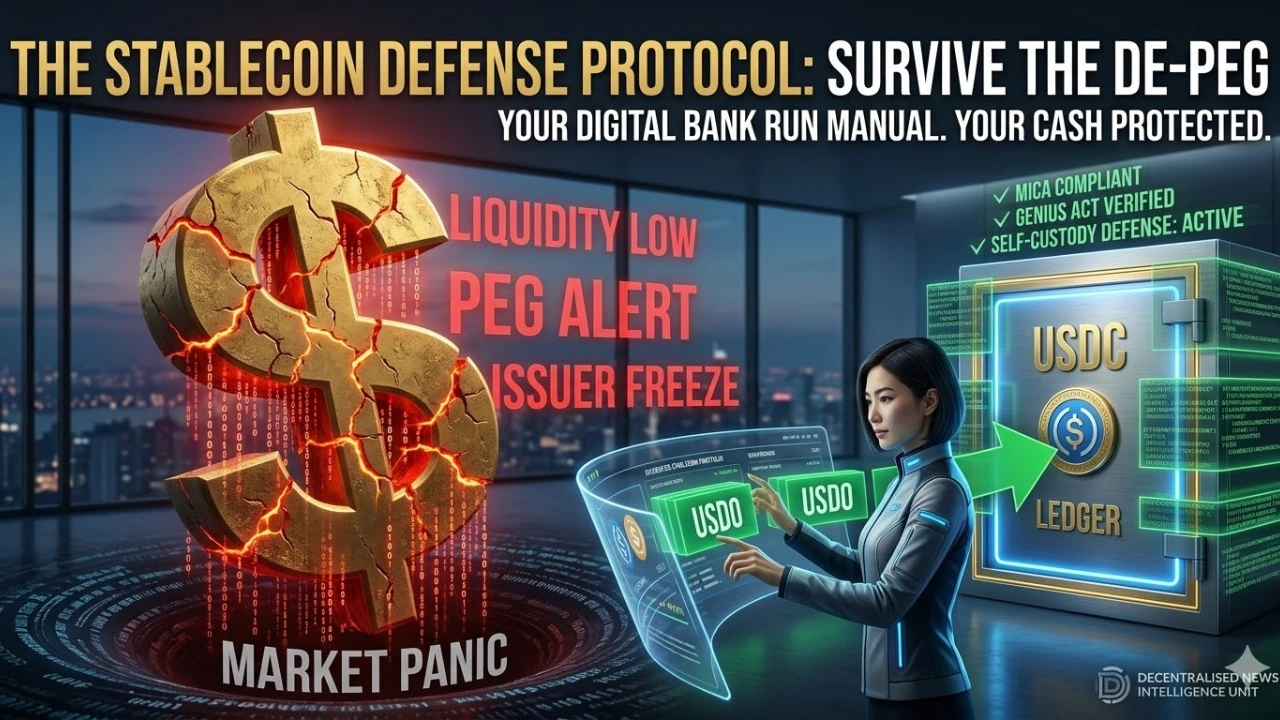
In the traditional world, a bank run is slow. In the 2026 machine-economy, a stablecoin de-pegging event is instantaneous. When a stablecoin loses its 1:1 parity with the US Dollar, it isn’t just a “glitch”—it is a signal that the market no longer trusts the underlying collateral or the issuer’s liquidity.
We saw it with USDC during the SVB collapse of 2023, and more recently with the temporary volatility in USDe following the 2025 trade-tension shocks. If you hold 100% of your dry powder in a single stablecoin, you are one “liquidity crunch” away from a total portfolio freeze.
Here is the 2026 Stablecoin Defense Protocol to ensure your cash stays at $1.00, no matter what happens to the issuer.
1. The 2026 Risk Map: Centralized vs. Synthetic
Not all de-pegs are created equal. To protect yourself, you must understand why a coin might fail.
Category A: The Centralized “Bank-Wire” Risk (USDC, USDT, PYUSD)
These coins are backed by treasuries and cash in real-world banks.
- The Risk: A “Bank Run” on the custodial bank (like SVB) or a regulatory freeze under the GENIUS Act.
- The Safety Valve: Diversify across Bybit and Binance, which offer real-time reserve proofs.
Category B: The Synthetic “Yield” Risk (USDe, USD0)
These coins are “delta-neutral” and backed by crypto-assets + short positions.
- The Risk: A “Negative Funding” spiral where the cost to maintain the hedge exceeds the yield, or an exchange-level hack.
- The Safety Valve: Use Aevo or GMX to hedge your own stablecoin exposure during periods of extreme volatility.

2. Three Warning Signs of an Imminent De-peg
Before a coin hits $0.90, the “on-chain smoke” is visible. Watch for:
- CEX-DEX Price Divergence: If MEXC shows a stablecoin at $0.995 while Uniswap shows $0.980, liquidity is exiting.
- Spike in Redemption Fees: If the issuer (like Circle or Tether) suddenly increases fees or “pauses” redemptions, EXIT IMMEDIATELY.
- Curve Pool Imbalance: Check the 3-Pool. If USDT or USDC makes up more than 70% of the pool, the “Smart Money” is dumping that specific asset.
3. The “Emergency Exit” Protocol
If you wake up and your stablecoin is at $0.97, do not “wait and see.” Follow these steps:
Step 1: Swap to a “Flight to Quality” Asset
Don’t swap for fiat (it takes too long). Swap for the most liquid alternative.
- If USDC de-pegs: Swap to USDT or PYUSD on ChangeNOW for an instant, non-KYC exit.
- The “Hard Exit”: Swap directly into Bitcoin (BTC) or Ethereum (ETH). These are volatile, but they have no “issuer risk.”
Step 2: Use an Aggregator to Avoid Slippage
In a panic, “Slippage” can cost you 10% of your stack.
Step 3: Move to a “Regulatory Safe” Haven
In 2026, USDC is the only global stablecoin with full MiCA (EU) and GENIUS Act (US) compliance. If you want to sleep at night, keep 50% of your stack in a regulated trust like Circle or Paxos (PYUSD).

4. Institutional Defense: Stablecoin Insurance
In 2026, you can actually “insure” your peg.
- Action: Use Unusual Whales to track “whale” exits from stablecoin pools.
- Action: Consider buying “De-peg Protection” on InsurAce or Nexus Mutual. It costs about 2-3% per year but pays out if the coin stays below $0.95 for more than 48 hours.
Stablecoin Safety Toolkit (Affiliate Master Component)
Role | Tool | Advantage | Call to Action |
Emergency Swap | No accounts, instant exit | ||
Regulated Storage | 100% Reserve Visibility | ||
Liquidity Access | Deepest Alt-Stable Pools | ||
Whale Tracker | Spot large-scale exits |

Start Here — Build Your Crypto Infrastructure Safely
You don’t need to use everything at once.
Professionals reduce risk by having access to multiple rails so they are never dependent on a single platform.
Below is a simple, practical setup used by many experienced traders and investors.
1) Your Fiat Gateway (Primary Access)
Best starting point for deposits & withdrawals
Binance — reliable onboarding, deep liquidity, global coverage
👉 sign up
Why open this:
- Move from bank → crypto easily
- Convert large amounts efficiently
- Emergency exit capability
2) Your Trading Execution Venue (Fast & Flexible)
Best for active trading and broad market access
MEXC — huge altcoin selection & low trading friction
👉 sign up
Why open this:
- Trade markets not listed elsewhere
- Better execution during volatility
- Lower dependence on a single exchange

3) Your Advanced Tools & Derivatives Platform
Best for leverage, hedging and professional execution
Bybit — strong order controls & derivatives infrastructure
👉 sign up
Why open this:
- Proper stop loss tools
- Hedging capability
- Strategy flexibility
4) Your Yield & Passive Income Layer
Best for structured products and capital efficiency
Gate.com — structured yield & automated earning tools
👉 sign up
Why open this:
- Earn on idle capital
- Diversify platform risk
- Access structured strategies
5) Your Altcoin & Ecosystem Expansion Layer
Best for early market access and wide listings
KuCoin — broad token ecosystem
👉 sign up
Why open this:
- Access emerging markets
- Portfolio diversification
- Redundancy if one platform restricts access

Why This Structure Matters
Using one exchange creates a single point of failure.
Using multiple rails creates:
- Liquidity redundancy
- Faster reaction ability
- Lower operational risk
- Greater opportunity access
You don’t need large capital to start — you just need prepared infrastructure.
Practical Next Step
Open accounts gradually and verify them before you need them.
Most people only prepare during stress —
professionals prepare before it.
(Decentralised News provides infrastructure education, not financial advice. Always use proper security practices.)