
Macro Intelligence | Sovereign Capital | June 2026
The Sovereign Wealth Playbook: How Abu Dhabi, Norway, and Singapore Are Quietly Positioning in Crypto Before the Institutions Arrive
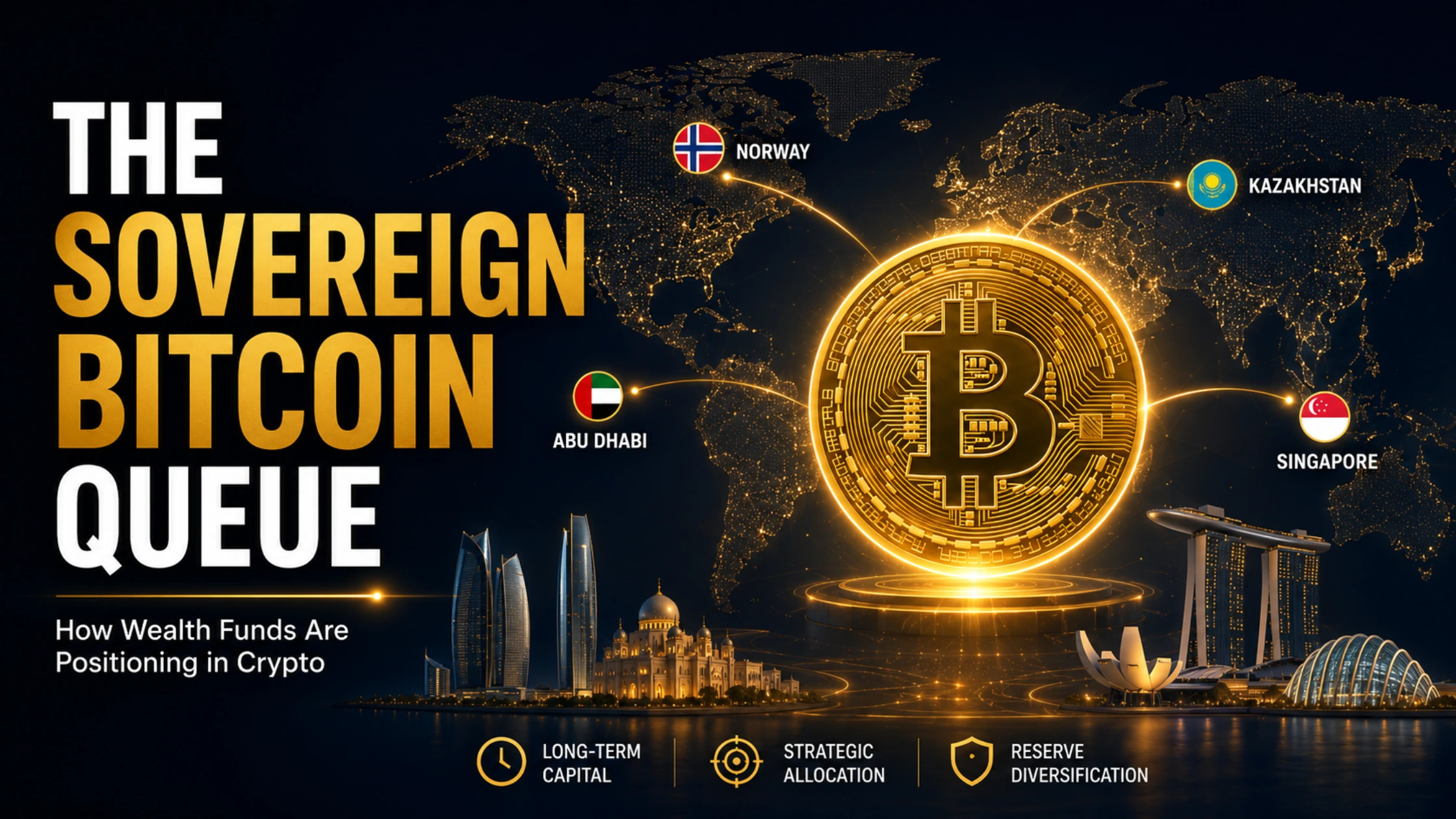
The world's largest pools of sovereign capital are quietly accumulating Bitcoin and crypto infrastructure exposure before the second wave of institutional adoption arrives. Abu Dhabi's Mubadala raised its BlackRock IBIT stake 16% to $566M in Q1 2026 — the fifth consecutive quarter of additions — while Al Warda (affiliated with ADIC) held a separate $408M position, bringing combined UAE sovereign IBIT exposure above $974M. Norway's $2T NBIM grew its indirect Bitcoin exposure 151% in 2025 to 9,573 BTC ($837M) entirely through passive index holdings in Strategy, MARA, Metaplanet, Coinbase, and Block — driven by mandate mechanics, not conviction. Kazakhstan allocated $350M from its National Fund to a formal crypto reserve in January 2026. Singapore's GIC and Temasek maintain infrastructure positions but have retreated from direct Bitcoin after the FTX loss. Saudi Arabia's PIF is exploring proxies but constrained by OPEC dollar-pricing politics. This article maps the incentive structure, disclosed holdings, and political constraints of seven sovereign wealth funds, producing ranked accumulation probability scores and the specific market triggers that unlock each fund's next move. Total disclosed and estimated SWF Bitcoin exposure has crossed $2.3 billion, a figure that will look small in 18 months if the sovereign accumulation wave accelerates.
The most important buyers in the Bitcoin market are not retail investors. They are not even hedge funds. They are people who manage the fiscal reserves of nation-states, answer to finance ministries rather than LPs, and take positions that persist for decades regardless of quarterly volatility. And they are buying quietly.
The pattern is deliberately opaque. Sovereign wealth funds do not issue press releases when they accumulate positions. They file 13Fs with the SEC 45 days after quarter-end, bury Bitcoin ETF holdings in table rows with 300 other positions, and describe their rationale in annual reports using language calibrated to avoid political controversy in their home countries. The information is public. The synthesis is not.
This article performs that synthesis. It maps every disclosed crypto position across seven major sovereign wealth funds, traces the political and economic incentive structure that explains each decision, and produces a ranked probability framework for sovereign accumulation over the next 18 months. The conclusion is not subtle: the sovereign accumulation wave is early, it is real, and it has not yet priced into Bitcoin's market structure in the way it will.
"I was with a sovereign wealth fund this week discussing whether to put 2% or 5% of their portfolio in Bitcoin. If everyone adopted that conversation, it would be $500,000 to $700,000 per Bitcoin."
— Larry Fink, World Economic Forum, Davos, January 2025Abu Dhabi: The Most Aggressive Sovereign Accumulator on Earth
The disclosed positions
The Abu Dhabi Bitcoin accumulation story involves two separate sovereign vehicles operating in parallel. Mubadala Investment Company — Abu Dhabi's $330B diversified sovereign fund — first disclosed an IBIT position of $436M in Q4 2024. It has added every single subsequent quarter: $408.5M in Q1 2025 (value dipped due to BTC price decline but shares increased), $630.6M by December 2025 after Bitcoin crossed $100,000, and $566M in Q1 2026 (shares up 16% to 14.7M despite value dipping on BTC price decline). The share count has increased in every reporting period. This is systematic accumulation, not passive drift.
Separately, Al Warda Investments — an entity affiliated with the Abu Dhabi Investment Council (ADIC) — reported 8.2 million IBIT shares worth approximately $408M as of Q4 2025. ADIC itself tripled its own direct IBIT position in Q3 2025, reaching $518M. Combined, Abu Dhabi-linked sovereign entities held approximately $974M in IBIT across the most recent available filings — with the Mubadala position alone having been disclosed for five consecutive quarters of additions.
The incentive structure
Abu Dhabi's Bitcoin accumulation is the clearest example of sovereign incentive alignment in the market. The UAE's economy is structurally dependent on hydrocarbon revenues priced in U.S. dollars. As the dollar faces long-term debasement through U.S. fiscal expansion (Bessent's 3-3-3 plan, GENIUS Act stablecoin demand), the purchasing power of Abu Dhabi's dollar-denominated oil revenues erodes. Bitcoin is the most liquid, non-sovereign alternative reserve instrument available that cannot be seized, sanctioned, or debased. It is not a bet against the dollar. It is a hedge against the dollar's purchasing power trajectory.
The UAE regulatory context reinforces this: Abu Dhabi's ADGM (Abu Dhabi Global Market) and Dubai's VARA (Virtual Asset Regulatory Authority) have both created institutional-grade crypto frameworks, making Abu Dhabi the most regulatory-advanced major sovereign for digital asset holdings. The political incentive (become the global digital asset hub) and the financial incentive (hedge oil debasement) are aligned. The result: systematic, quarter-by-quarter IBIT accumulation at the disclosure threshold that triggers SEC reporting.
Norway: The Reluctant Holder With $837 Million in Bitcoin It Didn’t Choose to Buy
The disclosed positions
Norway's situation is categorically different from Abu Dhabi's and is poorly understood in crypto coverage. Norges Bank Investment Management (NBIM) — the $2 trillion Government Pension Fund Global, the world's largest sovereign wealth fund — holds 9,573 BTC in indirect exposure as of December 2025, per K33 Research analysis of SEC filings. That $837M position was not a deliberate Bitcoin investment. It is the mechanical output of index replication.
NBIM must replicate global equity indices. Strategy (MSTR) is in the Nasdaq-100, Russell 1000, and multiple other indices. When MSTR accumulates Bitcoin, NBIM's indirect BTC exposure grows even though NBIM made no Bitcoin-specific decision. Strategy accounts for 81% of NBIM's indirect BTC exposure ($677M of $837M). The remainder comes from MARA, Coinbase, Block, and Metaplanet — all index constituents NBIM holds through its sector mandate.
K33's Vetle Lunde noted something important in his January 2026 analysis: NBIM's BTC exposure has been capped at "just under 0.04% of the fund's assets" across the two most recent reporting periods. This consistency suggests it is not purely passive but may reflect a deliberate weighting decision. "This may indicate a somewhat deliberate weighting in this exposure," Lunde said. Standard Chartered's Geoffrey Kendrick went further in August 2025: "The point here is that Norges is using MSTR as a way to gain exposure to the underlying. The increase in one quarter (83%) has to be a proactive position."
The incentive structure
Norway's sovereign wealth fund exists to convert finite oil wealth into permanent international financial assets for future generations. Its mandate explicitly prohibits investments that conflict with its ethical guidelines — and historically, its managers have resisted direct crypto holdings as incompatible with the fund's ESG framework. But the mandate says nothing about holding Bitcoin indirectly through equity index constituents. The distinction is legally significant: NBIM cannot buy Bitcoin; it is obligated to buy MSTR.
The scenario that changes Norway's position is one of two events: either Bitcoin ETFs are added to a major global equity index (which would force NBIM to hold them), or NBIM's mandate is expanded to allow direct alternative asset allocation to digital assets — a process that requires Ministry of Finance approval and parliamentary support. Neither is likely within 12 months. But the indirect exposure will continue growing as MSTR's market cap grows within NBIM's tracked indices.
Singapore: The Infrastructure Investor Still Burned by FTX
The disclosed positions
Singapore's two sovereign vehicles — GIC ($936B AUM) and Temasek ($521B AUM) — take different approaches and have different track records. GIC has maintained crypto infrastructure positions: it was among investors in Coinbase's $300M raise in 2018, backed Anchorage Digital (a crypto custody bank) in 2021, and holds OSL equity. These are infrastructure and custody bets rather than direct Bitcoin exposure. GIC's estimated crypto-linked exposure is approximately $150M — almost entirely in infrastructure equity, not BTC directly.
Temasek's story is more complicated. The fund invested $200M in FTX for a 1% stake in 2021 and a further $65M in FTX's U.S. subsidiary. When FTX collapsed in November 2022, Temasek wrote down the entire $273M. In July 2023, Temasek CEO Dilhan Pillay publicly stated the fund would "cease crypto industry investments" following the FTX loss and a governance review. Since then, Temasek has maintained its blockchain infrastructure positions (including the SGX-Temasek digital asset JV) but has not re-entered direct crypto or exchange investments.
The incentive structure
GIC's mandate is "to preserve and enhance the international purchasing power of Singapore's financial reserves." This framing is not hostile to Bitcoin — a non-sovereign asset that tends to appreciate against the dollar during debasement cycles — but GIC has historically interpreted the purchasing power mandate as requiring low-volatility, diversified investments rather than high-beta alternative assets. The Monetary Authority of Singapore (MAS) has created one of the world's most sophisticated crypto regulatory frameworks, creating the regulatory clarity GIC would need to expand its position. The friction is not regulatory. It is institutional culture post-FTX.
Singapore's most likely next move is tokenized real-world assets and blockchain infrastructure VC rather than direct Bitcoin. The SGX-Temasek digital asset exchange JV is precisely this: settlement infrastructure for tokenized bonds and securities, not spot crypto exposure. GIC may expand its Coinbase equity position if Coinbase's stock appreciates significantly as US regulatory clarity improves under the Bessent-Warsh regime.
The Full Sovereign Exposure Map: Disclosed Holdings and Incentive Scores
| Fund | Country | AUM ($B) | BTC Exposure (Est.) | % of AUM | Method | Accumulation Probability (18M) |
|---|---|---|---|---|---|---|
| Mubadala + ADIC | UAE / Abu Dhabi | $330B | $974M IBIT | 0.30% | Direct ETF (IBIT) — 5 consecutive quarters of additions | 91 / HIGH |
| Kazakhstan NIC | Kazakhstan | $70B | $350M allocated | 0.50% | Crypto hedge fund allocations; direct BTC purchase planned | 78 / HIGH |
| NBIM (Norway) | Norway | $2,000B | $837M indirect | 0.04% | Index equity (MSTR 81%, MARA, COIN, Block, Metaplanet) | 65 / MODERATE |
| Luxembourg FSIL | Luxembourg | ~$700B | ~$9M BTC ETF | 0.001% | Direct Bitcoin ETF allocation; 1% alternatives policy | 60 / MODERATE |
| Saudi Arabia PIF | Saudi Arabia | $925B | ~$0 disclosed | 0% | Exploring proxies; OPEC constraint on direct BTC | 52 / MODERATE |
| GIC (Singapore) | Singapore | $936B | ~$150M infra equity | 0.02% | Infrastructure equity (Coinbase, Anchorage, OSL) — no direct BTC | 48 / LOW-MOD |
| Temasek (Singapore) | Singapore | $521B | ~$0 post-FTX | 0% | FTX $273M writedown. Crypto investment pause declared July 2023. | 32 / LOW |
The Contagion Thesis: Why Sovereign Accumulation Accelerates From Here
The most important dynamic in sovereign wealth fund crypto adoption is not the positions themselves. It is the peer pressure mechanism. When Abu Dhabi's SWFs began disclosing IBIT holdings in 2024, every finance minister and sovereign fund CIO in the Gulf region received a signal: a comparable peer has allocated, the sky has not fallen, and the political cover for doing the same now exists.
This is how institutional adoption waves propagate. Not through simultaneous conviction, but through sequential permission. The first mover removes the political risk for the second; the second removes it for the third. Saudi Arabia's PIF is constrained by OPEC's dollar-pricing architecture — being seen as endorsing a dollar-alternative reserve would be diplomatically sensitive. But if Abu Dhabi's accumulation reaches $5B and Kuwait follows with $1B, the Saudi calculus changes. The peer pressure becomes inversion pressure: not adopting starts to look like being left behind.
Larry Fink's Davos statement about meeting with SWFs debating 2-5% allocations is the clearest public signal that this propagation is already occurring in private. The 13F disclosures are a lagging indicator. The conversations are happening 45 days before the filings appear.
The Norway mandate question
The scenario with the most asymmetric impact on Bitcoin price is a Norwegian mandate expansion. NBIM manages $2 trillion. Its current BTC exposure is 0.04% of AUM. If the Ministry of Finance approved a 0.5% alternative asset class allocation that included Bitcoin ETFs, NBIM would need to purchase approximately $10B in IBIT at current prices. That single policy change — which requires parliamentary support and is not imminent — would be the largest single institutional Bitcoin purchase in history by a factor of 10x. Track the Ministry of Finance annual review of NBIM's investment mandate (published each spring) as the leading indicator.
The Saudi OPEC constraint
Saudi Arabia's Public Investment Fund ($925B AUM) is the most consequential undisclosed potential position in global finance. PIF already holds tech equity stakes in Lucid, Nintendo, EA, Activision, and has made aggressive moves into non-oil assets under Vision 2030. The constraint is not financial. It is geopolitical: Saudi Arabia sets oil prices in dollars through OPEC coordination. Publicly endorsing Bitcoin as a reserve asset would signal a hedge against the dollar — which would be read as a signal that OPEC itself might move toward alternative pricing mechanisms. That risk is real enough that PIF will accumulate crypto via equity proxies (MSTR, COIN) through existing tech mandates rather than directly through a disclosed Bitcoin ETF position. Watch for MSTR appearing in PIF's SEC filings.
Market Implications: What Sovereign Accumulation Does to Bitcoin’s Price Structure
Sovereign wealth funds are not traders. They do not sell on drawdowns. Abu Dhabi's Mubadala held and added to its IBIT position through Bitcoin's 23% decline from Q3 2025 peak. NBIM holds MSTR through -40% and -50% drawdowns because it cannot sell without generating index tracking error. The structural effect of sovereign accumulation is not demand spikes — it is supply removal. Each SWF position represents Bitcoin that will not be sold in any normal market condition for years to decades.
At $2.3B in total disclosed sovereign exposure, the current SWF accumulation is approximately 0.1% of Bitcoin's total market cap. At the 2% portfolio allocation Fink is actively advocating to his SWF meetings, across the seven funds in this article alone, total potential exposure reaches approximately $100B. That is a 40x increase from current levels, representing potential demand equivalent to 40% of Bitcoin's current market cap entering over a multi-year accumulation window.
Track Bitcoin's structural price floor against the DN Cycle Position Clock and the Debasement Clock. Access BTC exposure through Bybit or Binance. For institutions in the region, access through BloFin.
The Risks to the Sovereign Accumulation Thesis
Risk 2 — BTC price decline changes political calculus: A sustained Bitcoin bear market (BTC below $40,000 for 6+ months) would make it politically untenable for sovereign funds to defend their positions to home-country constituents. Unrealised losses on SWF Bitcoin positions become a political liability that mandates review.
Risk 3 — FTX-style contagion event: Another major crypto institutional collapse would trigger another Temasek-style retreat. The difference in 2026 is that the sovereign positions are held in regulated BlackRock ETFs rather than unregulated exchange equity — the counterparty risk profile is categorically better. But the political risk of association remains.
Risk 4 — OPEC dollar-pricing crisis: If oil-exporting sovereigns accumulate enough Bitcoin to signal a genuine move away from petrodollar pricing, the U.S. government may apply diplomatic pressure to halt accumulation. This risk is more theoretical than practical at current position sizes but becomes material above $50B in Gulf SWF Bitcoin exposure.
The Bottom Line: The Queue Is Forming
The second wave of institutional Bitcoin adoption will be led by sovereign wealth funds, not ETF retail flows. Abu Dhabi is already 5 quarters into systematic accumulation. Kazakhstan formalised its reserve in January 2026. Norway holds $837M involuntarily and may formalise it voluntarily. Luxembourg is the first European SWF to make a direct allocation. Saudi Arabia is watching from the sidelines. Singapore is licking FTX wounds but has not abandoned infrastructure exposure.
The queue is forming. The Bitcoin the queue will need to buy is the Bitcoin currently in circulation, held by retail participants with much shorter time horizons and much lower conviction floors than a Gulf sovereign wealth fund buying for 30-year national reserve purposes. The structural price implication of a long-horizon buyer displacing a short-horizon seller is not complicated. But timing it is. Track the DN Sovereign Accumulation Tracker above for the disclosure signals that confirm the next mover.
Frequently Asked Questions
As of the most recent SEC filings (Q1 2026), Abu Dhabi's Mubadala Investment Company holds 14.7 million IBIT shares valued at approximately $566M — the fifth consecutive quarter of additions, representing a 16% increase in share count from Q4 2025. Separately, Al Warda Investments (affiliated with the Abu Dhabi Investment Council) reported 8.2 million IBIT shares worth approximately $408M as of Q4 2025. Combined, Abu Dhabi-linked sovereign entities hold approximately $974M in IBIT exposure, making Abu Dhabi the world's largest disclosed sovereign Bitcoin ETF holder.
Indirectly, yes. NBIM — which manages Norway's $2T Government Pension Fund Global — holds 9,573 BTC equivalent ($837M) as of December 2025, per K33 Research analysis of SEC filings. This exposure is entirely indirect: NBIM holds shares in Strategy (MSTR, 81% of exposure), MARA, Coinbase, Block, and Metaplanet because these are constituents of global equity indices NBIM must track by mandate. NBIM cannot buy Bitcoin directly under its current investment mandate. Standard Chartered's Geoffrey Kendrick noted that NBIM's 83% increase in BTC exposure in Q2 2025 alone "has to be a proactive position" — suggesting some deliberate positioning within the index mandate rather than purely passive replication.
Singapore's Temasek invested $265M in FTX across 2021-2022 and wrote down the entire position after FTX's collapse in November 2022. Temasek CEO Dilhan Pillay publicly stated in July 2023 that the fund would "cease crypto industry investments." The loss prompted a governance review of the due diligence process. GIC, Singapore's other major sovereign fund, did not invest in FTX but maintains crypto infrastructure equity positions (Coinbase, Anchorage, OSL). Both funds now favour blockchain infrastructure and tokenized real-world assets over direct crypto or exchange equity. The key constraint is institutional culture, not regulatory environment — Singapore's MAS has created one of the world's most advanced institutional crypto frameworks.
In January 2026, Kazakhstan's National Investment Corporation (NIC), a subsidiary of the National Bank, received a $350M transfer from the National Fund of Kazakhstan to establish a national crypto reserve. The initial phase invests in crypto-focused hedge funds (five funds under review) rather than buying Bitcoin directly. A second phase is expected to include direct Bitcoin purchases and potentially ETF holdings. Kazakhstan has been a major Bitcoin mining hub since Chinese miners relocated post-2021 ban, giving the country direct operational familiarity with the asset. The country is also developing a spot Bitcoin ETF on the Astana International Exchange and a comprehensive Digital Asset Law expected by 2026.
Saudi Arabia's Public Investment Fund ($925B AUM) is constrained by the geopolitics of oil pricing. OPEC coordinates oil prices in U.S. dollars. A direct, publicly disclosed PIF Bitcoin position would be interpreted as a sovereign hedge against the dollar — signalling that Saudi Arabia is preparing for alternative oil pricing mechanisms. This would create significant diplomatic friction with the U.S. and potentially destabilise OPEC's dollar-pricing architecture. PIF is more likely to accumulate Bitcoin exposure via equity proxies (MSTR, Coinbase) through its existing technology mandate — positions that provide economic exposure without the political signalling of a direct Bitcoin ETF disclosure. Watch PIF's 13F filings for MSTR appearing in its technology equity holdings.
The scenario with the most asymmetric Bitcoin price impact is an expansion of NBIM's investment mandate to allow direct Bitcoin ETF allocation. NBIM manages $2T. If the Ministry of Finance approved a 0.5% alternative asset allocation to Bitcoin ETFs, NBIM would need to purchase approximately $10B in IBIT at current prices — the largest single institutional Bitcoin purchase in history by a factor of roughly 10x. This requires Ministry of Finance approval and parliamentary support; it is not imminent. However, NBIM's mandate is reviewed annually each spring by the Ministry of Finance. The leading indicator is not a Bitcoin announcement but a mandate expansion to a broader "alternative assets" category that could include digital assets.
SWFs are not traders. Abu Dhabi's Mubadala held and added through Bitcoin's 23% decline from Q3 2025's peak. NBIM holds MSTR through -40-50% drawdowns because it cannot sell without generating index tracking error. SWF accumulation removes Bitcoin from circulating supply for 10-30+ year time horizons. At $2.3B in total disclosed sovereign exposure (~0.1% of Bitcoin market cap), the current effect is modest. At 2% portfolio allocation (Fink's stated advocacy target), the seven funds in this article would collectively hold approximately $100B — a 40x increase from current levels representing demand equivalent to 40% of Bitcoin's current market cap entering over a multi-year accumulation window.
The DN Sovereign Accumulation Tracker is a proprietary framework scoring seven sovereign wealth funds on their probability of increasing crypto allocation in the next 18 months (0-100). Scores are based on: existing position trajectory (Abu Dhabi has added 5 consecutive quarters = highest score); political and economic incentives (oil debasement hedge, USD diversification, regulatory environment); mandate constraints (Norway cannot buy directly; Temasek declared pause); and specific market triggers that would unlock the next move. A score of 70+ indicates high probability; 50-70 moderate; below 50 low probability. All scores are editorial inference based on public disclosures and should not be treated as investment advice.
Based on the DN Sovereign Accumulation Tracker, after Abu Dhabi (already accumulating) and Kazakhstan (formalised in January 2026), the highest-probability next mover is Luxembourg's FSIL (probability score 60), which already allocated 1% to Bitcoin ETFs in 2025 under a revised alternatives policy and may increase to 2% under MiCA. Norway's NBIM scores 65 but cannot expand without a mandate change. Saudi Arabia's PIF (52) is constrained by OPEC politics. Kuwait, Qatar, and the UAE's other funds are the most-discussed undisclosed candidates per Fink's Davos comments, suggesting Gulf accumulation may already be occurring below the SEC disclosure threshold through non-US vehicles.
Embed grant: The DN Sovereign Accumulation Tracker may be reproduced with attribution to decentralised.news.
DN-INTERNAL links to resolve: DN Power Brokers Framework, DN Fink Conviction Index, Cycle Position Clock, Debasement Clock, MSTR Contagion Index.
Sources: Mubadala SEC 13F Q1 2026, Al Warda / ADIC SEC 13F Q4 2025, K33 Research Vetle Lunde Jan 2026 NBIM analysis, Standard Chartered Geoffrey Kendrick Aug 2025 SWF report, Kazakhstan NIC Jan 2026 announcement, Temasek Holdings 2026 annual data (Wikipedia), CryptoBriefing Feb 2026 Mubadala report, Bitcoin.com News May 2026, CCN NBIM $500M report Feb 2025, CryptoNews.net NBIM Nov 2025.
As of: June 13, 2026. All probability scores are editorial inference. Not financial advice.