
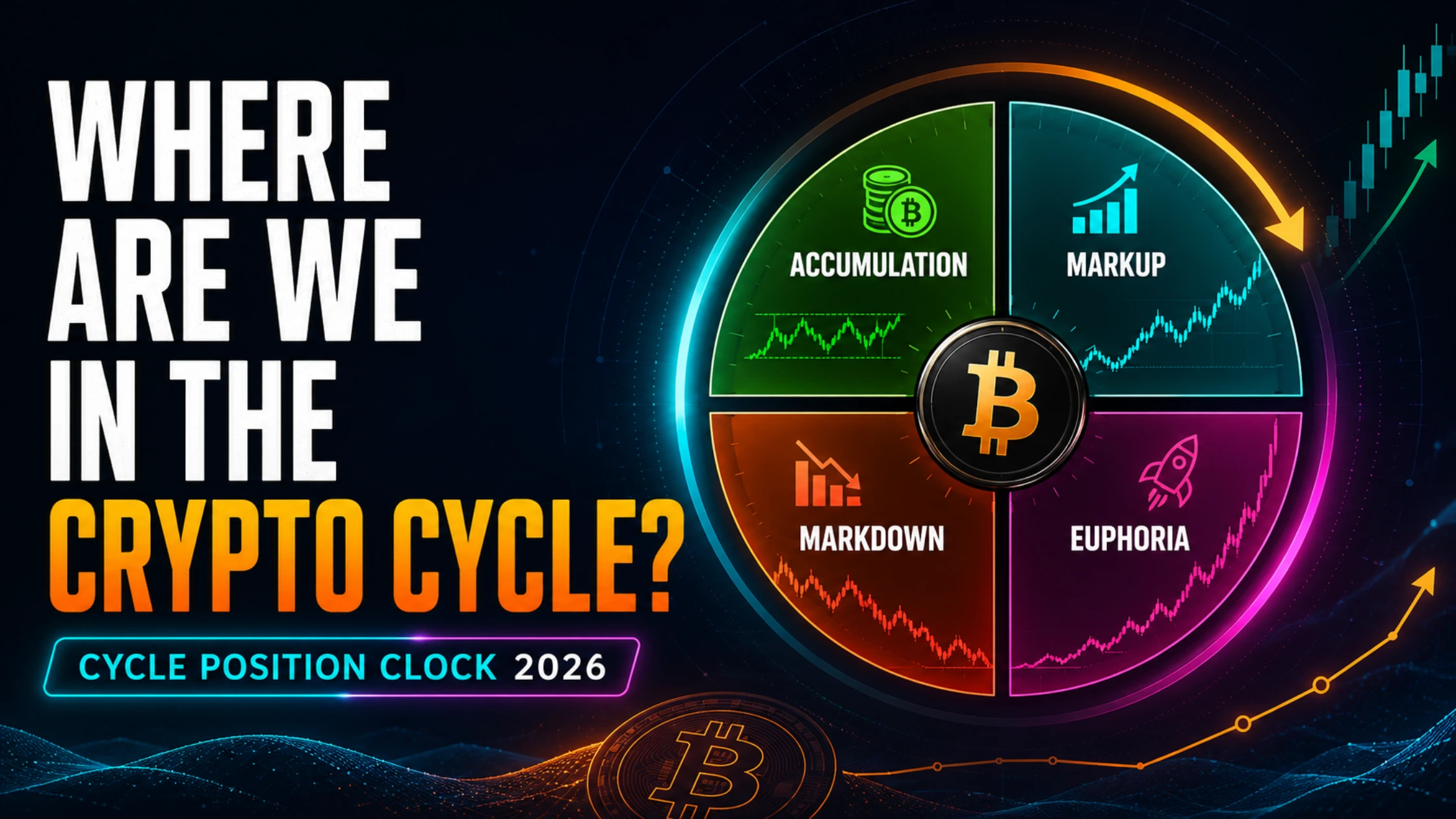
Where Are We in the Crypto Market Cycle? The DN Cycle Position Clock for 2026
One dial that fuses halving timing, valuation, sentiment and dominance into a single read — accumulation, markup, euphoria or markdown.
The crypto market moves in a recognisable four-phase cycle — accumulation, markup, euphoria and markdown — loosely anchored to Bitcoin's roughly four-year halving rhythm. No single indicator pinpoints the phase, so the DN Cycle Position Clock synthesises four: how far through the halving cycle we are, how Bitcoin is valued versus its power-law trend, market sentiment, and Bitcoin dominance versus altcoins. It places each signal on a circular dial and computes their consensus, along with a signal-agreement reading that shows how strongly the four point the same way — high agreement at clear cycle extremes, low agreement during the murky transitions between phases.
"Where are we in the cycle?" is the question every crypto investor is really asking, because the phase you are in should dictate almost everything — how much risk to carry, whether to accumulate or take profit, how much to trust the prevailing mood. The trouble is that no single chart answers it. Halving timing gives a rough calendar, valuation tells you if price is stretched, sentiment captures the crowd, and dominance shows where money is rotating — but each, alone, can mislead. The signal is in their consensus.
The Cycle Position Clock builds that consensus into one iconic dial. It takes four of Decentralised News's core signals, places each on a circular clock of the market cycle, and reads where they collectively point — accumulation at the top, rotating clockwise through markup, euphoria and markdown. Crucially, it also shows how much the four signals agree, so you know whether you are looking at a clear, high-conviction phase or a murky transition where caution is warranted.
—
The four phases
Markets that are driven by human emotion and capital flows tend to move in cycles, and crypto — young, reflexive and sentiment-soaked — exhibits this more clearly than almost any other asset. The cycle has four recognisable phases, each with its own psychology and its own correct behaviour:
Accumulation
After the crash, when prices are low, sentiment is bleaden and the crowd has left. Smart money quietly builds positions. The hardest phase to buy in, and historically the most rewarding.
Markup
Price grinds higher, belief slowly returns, and the trend establishes itself. The phase of steady participation, where trends are your friend and dips get bought.
Euphoria
Vertical price, mainstream attention, leverage everywhere and the conviction that it is different this time. The phase that feels best and is most dangerous — historically the time to take profit.
Markdown
The unwind. Price falls, leverage is flushed, narratives break and the crowd capitulates. Painful for holders, but the phase that sets up the next accumulation.
The phases always run in the same order, clockwise around the dial, even though their length and intensity vary. The whole art of cycle investing is knowing which one you are in — because the behaviour that wins in markup destroys you in markdown, and the courage that pays in accumulation is recklessness in euphoria. The clock exists to keep you honest about which phase is actually on the board.
Reading the clock
Each of the four signals is placed as a marker on the dial according to what it implies about the cycle, and the bold hand shows their consensus — the DN Cycle Position. But the single most useful thing on the clock is not the hand; it is the signal-agreement reading. When all four markers cluster together, agreement is high and the phase call is strong: the cycle is in one of its clear, high-conviction states. When the markers scatter around the dial, agreement is low, and that itself is the message — the market is in a transition between phases, where the structural calendar says one thing and price or sentiment say another.
(halving 30% · valuation 30% · sentiment 20% · dominance 20%)
Signal agreement = length of the combined vector — high when signals align
Using a circular mean rather than a simple average is deliberate and matters. The cycle is a loop, so an "early" signal and a "late" signal are not opposites that average to the middle — they are neighbours near the top of the clock. Treating the signals as angles and combining them as vectors handles that wrap correctly, so a market that is late in the halving calendar but cheap and fearful on price reads as the markdown-to-accumulation boundary it actually is, not as a meaningless "markup" in between. The low agreement that comes with such a reading is the honest flag that the cycle is turning.
What each phase demands
The clock is only useful if it changes behaviour, and each phase asks for something different. Accumulation demands courage and patience — buying when it is uncomfortable and the crowd is gone, with a long horizon. Markup demands participation and trend-following — staying invested, adding on strength, not fighting the tape. Euphoria demands discipline and profit-protection — the hardest ask, because it means selling into strength and resisting the story that this time is different, while moving gains into safe custody. Markdown demands patience and capital preservation — protecting what you have, avoiding falling knives, and preparing the dry powder for the accumulation to come.
The recurring mistake is doing the right thing one phase too late: accumulating in euphoria, panic-selling in markdown, turning cautious only after the bottom. The clock's value is in nudging behaviour earlier — toward caution as euphoria builds and toward courage as the markdown exhausts itself. It will never be perfectly timed, but being roughly right about the phase beats being precisely wrong about the price.
The DN signal stack behind it
The clock is a capstone — it does not invent new data, it synthesises four signals each of which is a Decentralised News tool in its own right. Halving timing is the structural backbone, the calendar the whole cycle loosely follows. Valuation comes from the power-law fair-value model, which says whether price is stretched above or sitting below its long-term trend. Sentiment, drawn from the Fear and Greed reading, captures the crowd's emotional state. And Bitcoin dominance versus altcoins, from the Altseason Index, shows how far risk appetite has rotated down the curve — late-cycle euphoria is typically when money floods from Bitcoin into the speculative tail. Each is a lens; the clock is the composite. To interrogate any single signal, follow it back to its own tool below.
Frequently asked questions
Where are we in the crypto market cycle right now?
The DN Cycle Position Clock answers this by synthesising four signals — halving timing, power-law valuation, sentiment and Bitcoin dominance — into a single phase: accumulation, markup, euphoria or markdown. Set the signals to current conditions above to see the consensus phase and how strongly the four agree. Low agreement indicates a transition between phases.
What are the four phases of a market cycle?
Accumulation (low prices, low sentiment, smart money buying), markup (steady uptrend as belief returns), euphoria (vertical price, mania, peak risk) and markdown (the unwind and capitulation). They run in that order, and each rewards different behaviour — courage in accumulation, discipline in euphoria.
What is the DN Cycle Position?
It is Decentralised News's single read of where the market sits in its cycle, computed as the weighted circular mean of four signals placed on a cycle clock. It is paired with a signal-agreement figure showing how strongly the four signals point the same way — high at clear extremes, low during transitions.
Does the Bitcoin halving really drive the cycle?
The roughly four-year halving rhythm has historically coincided with the cycle's broad shape, which is why it forms the clock's structural backbone. But it is a loose anchor, not a precise timer, and it is only one of four signals here precisely because timing has varied and may continue to. The clock weights it alongside valuation, sentiment and dominance rather than relying on it alone.
Why does signal agreement matter?
Because a phase call is only as trustworthy as the agreement behind it. When all four signals cluster, the phase is clear and high-conviction. When they scatter, the market is between phases and the single phase label is less reliable — the low agreement is itself a signal to act with more caution and wait for confirmation.
Can I use the clock to time the market?
It is a framework for context and behaviour, not a precise timing tool, and it cannot predict tops or bottoms. Its value is in nudging you toward the right posture for the phase — caution as euphoria builds, courage as markdown exhausts. Cycles can also stretch, compress or break, so combine it with your own research and risk management.
This tool and article are for educational and informational purposes only and do not constitute financial, investment or trading advice. The DN Cycle Position is a synthesis of four signals, two of which are set subjectively to current conditions, and it cannot predict market tops, bottoms or phase changes. Market cycles can stretch, compress or break, and past patterns may not repeat. Bitcoin price is fetched from a third-party API and may be delayed. Cryptocurrency is highly volatile and high-risk. Always do your own research and consider consulting a licensed financial professional. Decentralised News may earn a commission from services linked in this article at no additional cost to you.





