Last Updated: July 2026 | Reading Time: 16 minutes
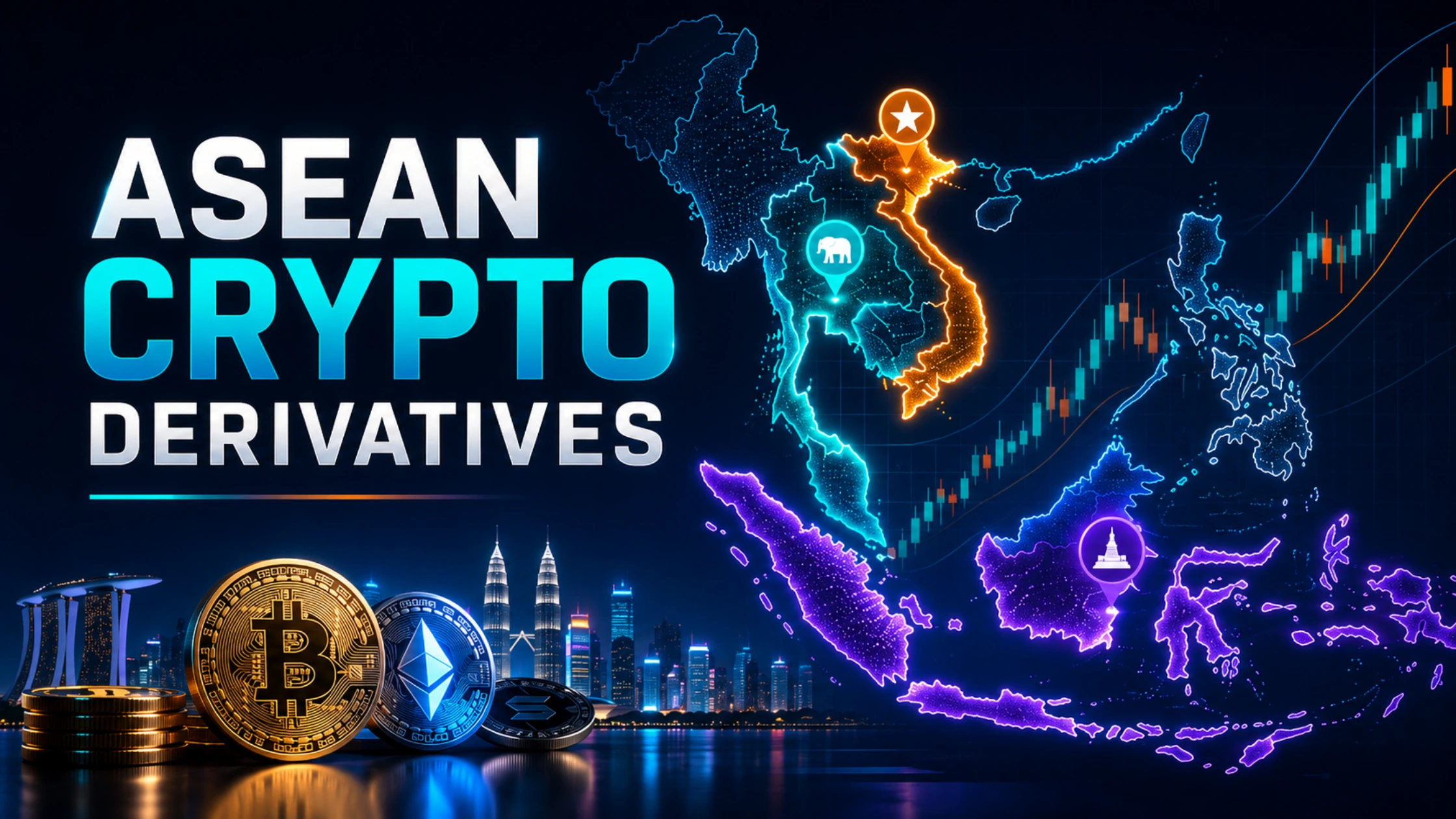
Southeast Asia is not a single market. It is three regulatory universes, six time zones, and a patchwork of banking systems that share one common trait: an insatiable appetite for leverage. Vietnam, Thailand, and Indonesia collectively account for over 30 million active crypto traders, yet each country treats derivatives differently… from Vietnam’s impending domestic-only licensing regime to Thailand’s new derivatives act to Indonesia’s commodity-to-financial-asset reclassification.
I spent the first half of 2026 trading across all three jurisdictions opening local accounts, testing IDR, THB, and VND on-ramps, and comparing execution quality on the platforms that actually settle in this region. This article is the operational playbook, not the tourist guide. We will cover what is legal, what is tolerated, what is banned, and where your capital is actually safe.
Regulatory Fragmentation Across ASEAN
If you treat Southeast Asia as one trading zone, you will lose money to compliance surprises. The regulatory divergence between Vietnam, Thailand, and Indonesia is wider than the gap between the EU and the US.
Vietnam — The Domestic Pivot (Effective September 2026)
Vietnam has been the wild west of ASEAN crypto adoption. With 17–21 million crypto holders and over $200 billion in annual on-chain volume, it ranks among the top five globally for retail participation. That era ends on September 1, 2026.
Decree No. 284/2026/ND-CP takes effect on that date, imposing administrative penalties on Vietnamese investors who trade crypto through exchanges not licensed by the Ministry of Finance. Fines range from VND 30 million to VND 50 million per violation. More importantly, the decree signals that the government will actively block access to offshore platforms.
The licensing reality: As of July 2026, no foreign exchange can obtain a Vietnamese license. Resolution No. 05/2025/NQ-CP restricts licenses to Vietnamese enterprises with minimum charter capital of VND 10 trillion (~$400 million), 65% contributed by domestic financial institutions, and foreign ownership capped at 49%. Five domestic applicants are under review: VIX Crypto Asset Exchange, Loc Phat Vietnam, Vietnam Prosperity Crypto Asset Exchange (CAEX), Techcom Crypto Asset Exchange, and Vietnam Digital Asset JSC.
The platform response: Binance withdrew its local community support staff in March 2026 and has not secured a license pathway. OKX Ventures took a strategic stake in CAEX in April 2026, positioning OKX as a minority technology partner rather than a direct operator. Other international platforms — including MEXC, Bitget, and Gate — have made no public licensing moves and may face access restrictions after September 1.
What this means for traders: If you are a Vietnamese resident trading on offshore exchanges after September 1, 2026, you are operating in a newly enforced gray zone with explicit financial penalties. The practical enforcement mechanism will likely be ISP-level blocking of offshore exchange domains and banking restrictions on transfers to known exchange accounts, not door-to-door fines. But the legal risk is real and newly codified.
Thailand — The Derivatives Opening
Thailand has taken the opposite approach. Rather than banning offshore platforms, it is building a regulated domestic derivatives market to compete with them.
In February 2026, Thailand’s Cabinet approved amendments to the Derivatives Act B.E. 2546, formally recognizing digital assets as legitimate underlying instruments for regulated futures and options. The SEC is now drafting licensing rules for derivatives exchanges and coordinating with the Thailand Futures Exchange (TFEX) to launch crypto futures products.
The current market structure: Retail crypto trading is legal and active. Bitkub, the country’s largest licensed exchange, holds a 77% market share with approximately $20–30 million in daily volume and over $1.1 billion in exchange reserves. Other licensed venues include Gulf Binance (Binance TH) and orbix (formerly Satang Pro). Crypto ETFs are expected to launch in late 2026, subject to final SEC guidelines.
The critical restriction: Crypto remains banned as a payment method under Bank of Thailand rules. You cannot legally pay for goods or services with Bitcoin, USDT, or any digital asset. Trading for investment purposes is permitted. Using crypto for remittance or commerce is not.
For derivatives traders: The TFEX futures products are not yet live as of July 2026. Until they launch, Thai traders seeking leverage use offshore perpetual futures platforms — MEXC, Bybit, Bitget — which operate in a tolerated but unlicensed capacity. The SEC has not aggressively prosecuted individual traders on offshore platforms, but this tolerance may shrink once domestic futures markets go live.
Indonesia — The Financial Asset Transition
Indonesia completed the most significant regulatory overhaul in January 2025, when supervisory authority over crypto assets transferred from the commodity regulator (Bappebti) to the financial services authority (OJK). Crypto is now classified as a tradable digital financial asset, not a commodity.
The tax structure: Indonesian crypto traders pay a 0.1% final income tax on transactions plus 0.11% VAT. This applies to all trades on both local and international platforms. There is no capital gains distinction — every transaction is taxed at settlement.
The licensing framework: OJK Regulation No. 27/2024 (as amended in January 2026) formally recognizes digital financial asset derivatives and requires specific OJK approval for any entity offering crypto derivatives trading. Local licensed spot exchanges include Indodax, Tokocrypto, and Pintu. For derivatives, many Indonesian traders continue to use offshore platforms, though OJK has signaled intent to block unlicensed foreign operators that actively target Indonesian residents.
The payment restriction: Like Thailand, Indonesia prohibits using crypto as a payment instrument. QRIS — Indonesia’s unified QR payment standard — is for fiat rupiah transactions only. There is no legal crypto payment rail.
Best Platforms for VND/THB/IDR Pairs — MEXC and Bitget
For traders who need local currency on-ramps and deep derivatives liquidity, two offshore platforms dominate the Southeast Asian retail market in 2026: MEXC and Bitget.
MEXC — The Altcoin and Leverage Hub
MEXC has aggressively targeted Southeast Asia with localized payment support, Vietnamese/Thai/Indonesian language interfaces, and a referral ecosystem built around high-volume retail traders.
Why it matters for SEA:
- Local currency P2P: MEXC P2P supports VND, THB, and IDR settlements through local bank transfers and e-wallets
- Derivatives depth: Up to 500x leverage on select USDT-M perpetual pairs — the highest verified leverage among major exchanges
- Listing speed: MEXC consistently lists new tokens faster than Tier-1 exchanges, with over 3,100 trading pairs
- Fee structure: 0% maker / 0.05% taker on spot; 0% maker / 0.02% taker on futures — among the lowest in the industry
The regulatory exposure: MEXC is not licensed by major Tier-1 regulators. It appears on the UK FCA Warning List and has received regulatory alerts from Hong Kong SFC, Germany’s BaFin, and Japan’s FSA. For SEA traders, the operational risk is not local prosecution — MEXC is not prohibited in Vietnam, Thailand, or Indonesia at the time of writing — but counterparty risk. The exchange holds bi-monthly proof of reserves and maintains a $100 million Guardian Fund, but it is ultimately an offshore custodial platform.
My MEXC experience in SEA: I used MEXC P2P to acquire USDT with IDR via BCA bank transfer. The trade settled in 8 minutes. The futures interface is standard — TradingView charts, bracket orders, and copy trading. Execution on BTC and ETH perps was reliable. On low-cap altcoin perps, slippage was noticeable above $50,000 notional.
MEXC restriction note: MEXC officially prohibits users from Singapore, but Vietnam, Thailand, and Indonesia are currently supported regions. This could change if local regulators force ISP blocks.
Bitget — The Copy Trading Ecosystem
Bitget has positioned itself as the social trading layer for Southeast Asian derivatives traders. Its copy trading infrastructure — where followers automatically mirror lead traders’ positions — has found particular traction in Thailand and Vietnam, where Telegram signal groups often link directly to Bitget leaderboards.
SEA-relevant features:
- P2P marketplace: VND, THB, and IDR supported with local bank transfer settlement
- Copy trading: Over 100,000 lead traders, with performance metrics including 90-day Sharpe ratio and max drawdown
- Futures fees: 0.02% maker / 0.06% taker — competitive but higher than MEXC
- Bitget Wallet Card: Launched in South Asia in July 2026, offering USDT/USDC top-up and global Mastercard acceptance with up to 3% cashback
The compliance angle: Bitget requires mandatory KYC for all users as of 2024. This reduces anonymity but also reduces the risk of sudden account freezes for incomplete verification — a common issue on lower-tier platforms.
My Bitget experience: I followed three lead traders from Thai Telegram groups over 30 days. Two were profitable (net +12% and +8%), one blew up his account with 50x leverage on a SOL position. The copy trading mechanics worked flawlessly — positions opened and closed automatically — but the quality of signal providers is highly variable. Bitget’s leaderboard filters (AUM, win rate, max drawdown) are useful but not foolproof.
Platform recommendation for SEA:
Need | Best Platform | Rationale |
Lowest fees, highest leverage | MEXC | 0% maker futures, 500x max leverage |
Copy trading, social features | Bitget | Largest copy trading ecosystem |
Local THB on-ramp, regulated custody | Bitkub | Licensed Thai exchange, bank integration |
Local IDR on-ramp, tax simplicity | Indodax | OJK-licensed, automatic tax withholding |
Altcoin breadth | MEXC | 3,100+ pairs vs Bitget’s ~800 |
High-Leverage Alternatives — Bitunix (Code: 17hy) and Deepcoin (Code: 8771662)
Beyond the top tier, two smaller exchanges compete for Southeast Asian high-leverage traders: Bitunix and Deepcoin. Both offer leverage exceeding 100x and minimal KYC friction. Both also carry significant risks that the marketing materials omit.
Bitunix — The High-Risk Fringe
Bitunix offers up to 125x leverage on futures, non-KYC onboarding (email only), and withdrawal limits up to 500,000 USDT per day with basic security verification. On paper, it is a privacy-focused derivatives venue.
The reality: Bitunix has accumulated an alarming volume of user complaints. As of mid-2026, its Trustpilot profile is dominated by reports of:
- Account freezes under “risk control” with no explanation
- Withdrawal blocks lasting 30+ days
- Demands for forfeiture of trading profits to unlock accounts
- Bonus programs that fail to credit promised rewards
Multiple users report that after generating profits — particularly from futures bonuses — their accounts were placed under review and they were forced to accept P&L deductions to recover partial funds. The pattern is consistent enough that it cannot be dismissed as isolated user error.
My assessment: Bitunix is not a platform for capital you cannot afford to lose. The non-KYC onboarding is appealing for privacy, but the same lack of regulatory oversight means there is no recourse when withdrawals are blocked. If you use Bitunix, treat it as a short-term trading pit, not a custody solution. Deposit only what you are willing to have frozen.
Use code 17hy if you choose to register, but enable every security feature and withdraw profits frequently to self-custody.
Deepcoin — The Derivatives-Only Venue
Deepcoin launched in 2018 and positions itself as a futures-first exchange with 125x leverage, coin-settled inverse perps, and a clean execution interface. It serves over 1 million users and reports multi-billion-dollar daily volume.
The strengths:
- Competitive futures fees (~0.02% maker / 0.05% taker)
- Both USDT-margined and coin-settled perpetuals
- Copy trading and API access
- No mandatory KYC for basic trading
The weaknesses:
- No fiat on-ramps — crypto deposits only
- No verifiable major-market license
- Thin liquidity on altcoin perps compared to Tier-1 exchanges
- User complaints about funding rate manipulation — specifically, reports that negative funding rates flipped to positive immediately before settlement, costing long position holders
My Deepcoin experience: I ran a small futures test account for 14 days. Execution on BTC and ETH was acceptable. On a mid-cap altcoin perp, a $20,000 order moved the book by 0.4%. The funding rate on my BTC position flipped from -0.01% to +0.015% in the 10 minutes before funding settlement — suspicious timing, though not provably manipulative without internal data.
The verdict: Deepcoin is functional for experienced traders who already hold crypto and want high leverage with minimal friction. It is not suitable for beginners, long-term holders, or anyone who needs fiat on-ramps or regulatory protection.
Use code 8771662 for fee discounts if you register.
DEX Options — GMX and gTrade for Non-Custodial Leverage
For traders who prioritize self-custody over convenience, decentralized perpetual exchanges offer an alternative to the regulatory uncertainty of offshore CEXs.
Gains Network (gTrade)
gTrade migrated to v10 in August 2025 and remains one of the most actively developed decentralized perpetual platforms. It offers:
- Up to 150x leverage on crypto pairs
- Up to 500x leverage on forex
- 290+ trading pairs across crypto, forex, stocks, indices, and commodities
- Multi-collateral margin: USDC, DAI, WETH, and GNS
- Gasless trading via signature-based execution
The architecture: gTrade uses a hybrid oracle system (Chainlink + Pyth) and a synthetic liquidity model that does not require traditional AMM liquidity pools. This enables deep leverage without liquidity provider risk.
The token reality: The GNS token trades at roughly $0.50 as of July 2026, down 96% from its all-time high. The protocol has processed over $133 billion in lifetime volume, but the token collapse has reduced the value of governance and revenue-sharing incentives.
For SEA traders: gTrade is accessible from any jurisdiction with an internet connection. There is no KYC, no IP blocking, and no local regulatory compliance. The trade-off is smart contract risk, oracle failure risk, and the need to self-manage collateral wallets.
GMX
GMX operates on Arbitrum and Avalanche, offering spot swaps and perpetual futures with up to 50x leverage. The GMX V2 model uses isolated GM pools for each trading pair, reducing correlation risk for liquidity providers.
For SEA traders: GMX is ideal for BTC and ETH hedging with self-custody. The 50x leverage cap is lower than gTrade or CEX alternatives, but the liquidity is deeper and the smart contract risk is lower due to extensive audit history. The primary friction is bridging assets to Arbitrum — a process that requires Ethereum mainnet gas fees and technical familiarity that many retail SEA traders lack.
The DEX recommendation: If you are in Vietnam and concerned about the September 2026 offshore exchange crackdown, gTrade and GMX are your hedge against CEX disappearance. No government can block a smart contract. But no government can recover your funds if you sign a malicious transaction or bridge to the wrong chain either.
Payment Rails — Local Bank Transfers, E-Wallets, and QRIS
The crypto leg of a trade is global. The fiat leg is stubbornly local. Understanding each country’s settlement infrastructure is essential.
Vietnam — Bank Transfer Dominance
Vietnamese traders primarily use domestic bank transfers for P2P crypto settlement. The key banks are:
- Vietcombank — reliable, fast, strict on crypto-linked transfers
- Techcombank — popular among P2P merchants, high daily limits
- MB Bank — fast mobile app, moderate compliance scrutiny
- ACB — business-friendly, commonly used by high-volume traders
E-wallets: MoMo, ZaloPay, and ViettelPay are used for smaller P2P transactions (under VND 50 million). They offer instant settlement but lower limits and higher scrutiny for crypto-linked flows.
The post-September risk: Once Decree 284 is enforced, banks may receive explicit guidance to flag or block transfers to known P2P crypto sellers. The current system works because banks do not actively surveil transfer descriptions. That tolerance may end.
Thailand — PromptPay and Bank Integration
Thailand’s payment infrastructure is the most advanced in ASEAN for crypto integration.
- PromptPay — real-time bank transfers using mobile numbers or national ID. Settlement in under 30 seconds. Supported by all major Thai banks.
- Licensed exchange integration — Bitkub and other Thai-licensed exchanges link directly to domestic bank accounts for THB deposits and withdrawals
- TrueMoney Wallet — occasionally used for small P2P trades, but less common than direct bank transfer
My Thai settlement test: A THB deposit to Bitkub from SCB cleared in 4 minutes. A withdrawal from Bitkub to Kasikorn Bank cleared in 11 minutes. The banking integration is seamless because the exchange is licensed and the bank recognizes it as a legitimate counterparty.
Indonesia — QRIS, BI-FAST, and E-Wallets
Indonesia has the most complex payment ecosystem:
- BI-FAST — Bank Indonesia’s real-time interbank transfer system. Launched December 2021, now processing over 1.5 billion transactions per quarter. Flat fee of IDR 2,500 per transfer. Supports transfers up to IDR 250 million.
- QRIS — the unified QR payment standard for merchant transactions. Not usable for crypto P2P because crypto is prohibited as a payment method. QRIS is for fiat merchant payments only.
- E-wallets: OVO, GoPay, and DANA are widely used for P2P crypto settlement on international exchanges. They offer instant transfers but lower limits (typically IDR 10–20 million per transaction).
Local exchange on-ramps: Indodax, Tokocrypto, and Pintu accept direct bank transfers (BCA, Mandiri, BNI, BRI) and e-wallet deposits. Tax (0.1% income + 0.11% VAT) is automatically withheld on licensed platforms.
The offshore workaround: Indonesian traders using MEXC or Bybit P2P typically settle via BCA or Mandiri bank transfer, bypassing the licensed exchange tax infrastructure. This is tolerated but not legal. The OJK has signaled intent to crack down on unreported offshore trading, though enforcement remains limited.
Community Sentiment and Telegram Signal Culture
No analysis of Southeast Asian crypto trading is complete without addressing the information layer. In all three countries, Telegram is the dominant coordination platform for retail derivatives traders.
Vietnam: Crypto Telegram groups range from 5,000 to 50,000 members. The culture is high-leverage, high-frequency. Signal providers post Binance or MEXC futures entries with 25x–50x leverage. The language is Vietnamese, but the strategies are universal — mostly breakout scalping and funding rate arbitrage. The best groups charge membership fees in USDT. The worst groups are pump-and-dump operations targeting low-cap altcoins on MEXC.
Thailand: Thai Telegram trading communities are more structured. Many groups link directly to Bitget copy trading profiles, allowing members to auto-follow signal providers. The SEC’s investor protection messaging has penetrated somewhat — groups often include disclaimers about risk and position sizing. But leverage remains aggressive. The dominant narrative in early 2026 was “wait for the ETF” — a belief that Thailand’s upcoming crypto ETFs will trigger a retail bull run.
Indonesia: Indonesian crypto Telegram culture is the most commercially sophisticated. Signal groups often operate as formal businesses with registered entities, customer service teams, and tiered subscription models. The focus is heavily on futures scalping (Binance, Bybit, MEXC) with an emphasis on “modal kecil, profit besar” (small capital, big profit) — the eternal retail leverage fantasy. Many groups partner with offshore exchanges for referral revenue, creating an incentive structure that prioritizes trading volume over trader profitability.
My observation: In all three countries, the Telegram signal ecosystem is a net negative for most participants. The signal providers make money from referral fees and subscription charges, not from their own trading. Followers pay for the illusion of edge while generating commission volume for the provider. If you are following signals in SEA Telegram groups, calculate how much you have paid in subscription fees, exchange fees, and liquidation losses versus how much you have made from the signals themselves. The math is rarely flattering.
Open an Account on MEXC with Code 16yJL
Southeast Asian crypto derivatives trading in 2026 is a landscape of converging pressures. Vietnam is closing its doors to offshore platforms. Thailand is building regulated domestic alternatives. Indonesia is taxing every transaction while allowing offshore access to persist. The only constant is demand for leverage — and the platforms that provide it.
For traders who need access now, before Vietnam’s September deadline and before Thailand’s domestic futures market launches, MEXC and Bitget remain the most functional offshore options. MEXC offers the lowest fee structure and the deepest altcoin leverage. Bitget offers the best social trading infrastructure.
If you are trading from Vietnam, be aware that your window for unlicensed offshore trading is closing. If you are in Thailand, the regulatory trajectory is toward domestic custody — consider whether you want to build positions on offshore platforms that may face access restrictions. If you are in Indonesia, pay your taxes. The OJK is building surveillance infrastructure, and the 0.21% total tax burden is cheaper than an audit.
Use referral code 16yJL when opening a MEXC account. It provides access to new-user rewards and fee discounts that compound if you are trading leverage frequently.
The hard truth about SEA leverage trading: The platforms are ready. The payment rails are functional. The regulatory noose is tightening in some places and loosening in others. But the math of high-leverage perpetual futures is the same in Hanoi, Bangkok, and Jakarta as it is everywhere else: most retail traders lose money. The edge is not in the platform. It is in your position sizing, your stop discipline, and your willingness to not trade when there is no setup.
The ASEAN derivatives boom is real. Whether you survive it is up to you.
Open an account on MEXC with code 16yJL.