Sai Review 2027: Gasless Perps, Stock Trading, Fees, Points and Risks Explained
Sai is an emerging self-custodial perpetual DEX on Nibiru that combines gasless trading, oracle-settled crypto and real-world markets, unified collateral and unusually transparent fee mechanics. Its strongest idea may also be the feature traders are most likely to misunderstand: a rapid-close fee that can make ultra-short leveraged trades far more expensive than the headline 0.05% taker rate suggests.
What Matters
Sai is best understood as an emerging multi-asset perpetual infrastructure layer rather than another crypto-only perp DEX. It already combines crypto, equity-linked and commodity perpetual markets with gasless trading, self-custody, oracle pricing, liquidity vaults and a GraphQL data layer. The trade-off is maturity: current public liquidity and trader scale remain modest, and Sai's short-hold fee mechanics mean traders cannot judge its true cost from the 0.05% taker fee alone.
Sai's most interesting competitive angle is not simply low fees. It is the combination of synthetic multi-asset market creation, scheduled-market risk controls and a developer surface that can serve bots and future AI agents. The protocol is structurally positioned for a market where the next perp DEX competition is not only BTC liquidity, but who can turn a reliable external price into a programmable on-chain derivative.
Sai scores strongly for architecture, developer tooling, RWA design and transparency of fee mechanics. It scores lower for current liquidity depth, evidence of scale and audit-report visibility. This is an editorial product assessment, not a safety certification.
What Is Sai?
Sai is a decentralized perpetual trading protocol on Nibiru. Its core contracts are implemented in Rust and compiled to WebAssembly, while the wider Nibiru environment supports both Wasm and EVM-style interactions. Sai combines perpetual-market contracts, liquidity vaults, oracle prices and fee logic into an on-chain trading system.
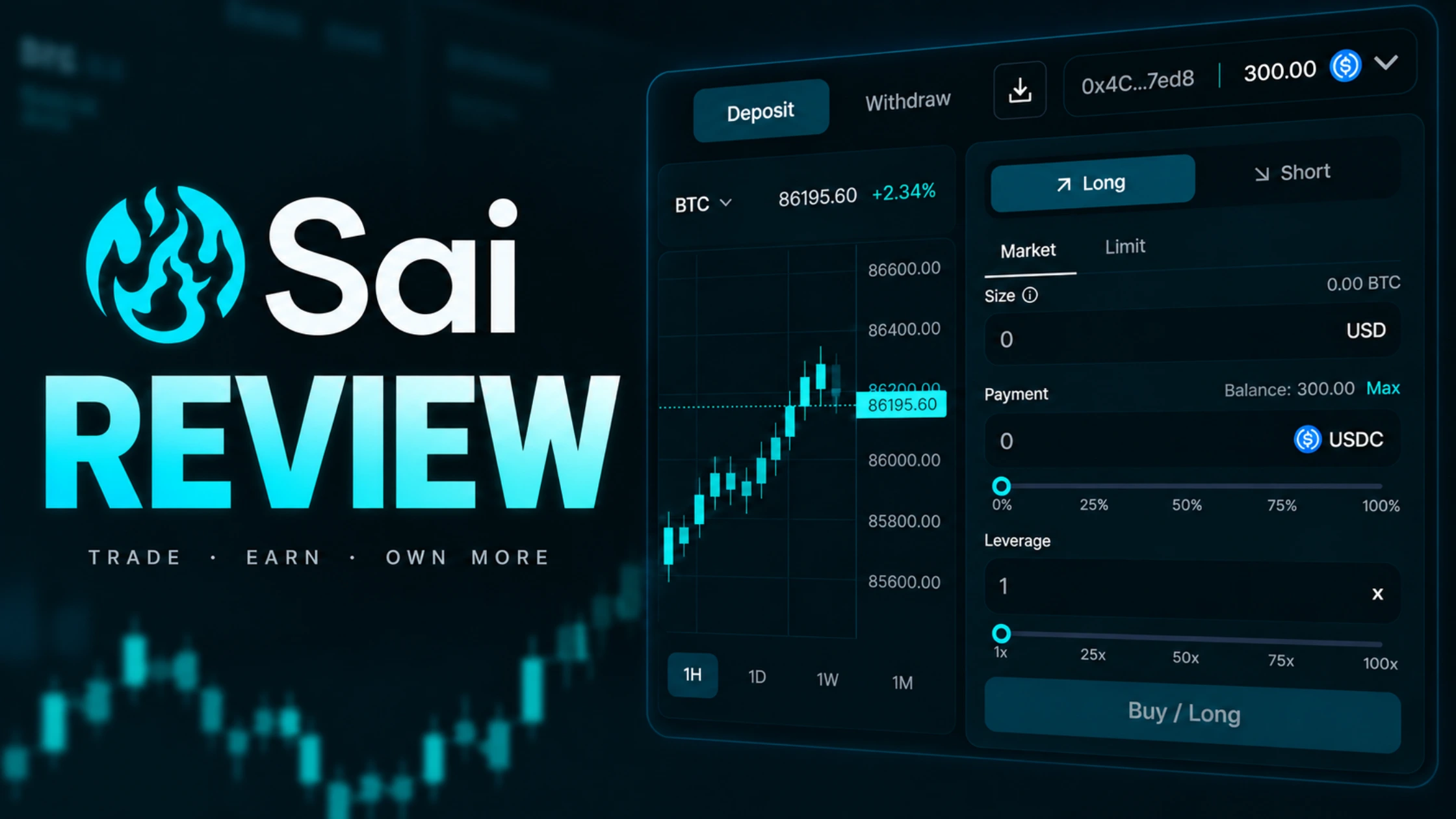
For the trader, the experience is designed to resemble a conventional derivatives venue: connect a wallet, deposit collateral, select a market, choose long or short, set leverage and manage the position with familiar controls. Underneath that interface, however, Sai does not depend on a traditional central limit order book for every market.
Sai at a Glance
| Feature | Sai | DN interpretation |
|---|---|---|
| Network | Nibiru | MultiVM environment with Wasm and EVM compatibility. |
| Core product | Perpetual futures | Crypto plus expanding traditional-market exposures. |
| Execution model | Oracle reference + price-impact logic | Different cost/risk structure from an orderbook venue. |
| Collateral | USDC; other supported collateral documented | Bridging remains part of the onboarding workflow. |
| Maker fee | 0% | Attractive for maker-style execution where applicable. |
| Base taker fee | 0.05% | Low headline rate, but not the whole cost stack. |
| Referral rate | 0.0425% | 15% default referral discount on base trading fees. |
| Rapid-close fee | Up to ~1.15% global curve | Critical for very short-duration trades. |
| Protected rapid-close peak | 2.117% | Applies to selected higher-risk markets. |
| Trading gas | Zero on Nibiru | Does not eliminate bridge or external-chain gas. |
| Developer data | Sai Keeper GraphQL | Strong foundation for dashboards, bots and agents. |
| Stock perps | Live | Synthetic exposure, not ownership of shares. |
| Points | Sai Points | Seasonal incentives with discretionary program rules. |
Why Sai Is More Interesting Than Another Crypto Perp DEX
Crypto perpetual trading is becoming crowded. Competing only on BTC leverage, a token incentive or a slightly lower maker fee is a difficult way to build a durable moat.
Sai is instead moving toward a broader question:
That question creates a much larger potential market. Sai has already moved beyond crypto into stock and commodity-linked perpetuals. The project has also publicly discussed expansion into equities, commodities, FX, rates, prediction or event markets, pre-launch tokens and community-selected long-tail markets. Some of these are roadmap items rather than live products, and we treat them accordingly.
The strongest Sai thesis is not "another low-fee perp exchange." It is market manufacturing. Oracle-settled synthetic derivatives can support exposure to assets without requiring the underlying asset itself to be deposited, bridged or quoted in a deep local order book. If the oracle, risk engine and liquidity system scale, the protocol can potentially expand much faster than an orderbook model that needs independent market-maker depth for every new listing.
Stock and Commodity Perps Change the Comparison Set
Sai launched stock perpetual trading in April 2026, initially highlighting Nvidia alongside Brent Oil and stating that more major equities would be added on a rolling basis. The product provides leveraged long and short exposure to the referenced price without transferring ownership of the underlying stock.
That distinction matters. A Sai stock perp is a derivative. It should not be confused with a tokenized share or brokerage account.
| Instrument | Economic exposure | Underlying ownership? |
|---|---|---|
| Sai stock perp | Leveraged synthetic price exposure | No |
| Spot share | Direct equity ownership through a broker/custodian structure | Yes, subject to account structure |
| Tokenized equity product | Depends on issuer and legal wrapper | Varies |
| Crypto perp | Leveraged synthetic crypto exposure | No underlying spot ownership |
How Sai Execution Works
Sai uses an oracle reference price combined with a configurable price-impact model. The purpose is to prevent a trader from consuming theoretically unlimited protocol risk at the oracle midpoint.
In simplified terms, price impact rises as the new position adds to directional open interest relative to the market's configured one-percent depth. That means larger orders or more crowded directional exposure can receive worse execution.
This is not the same as walking an order book. But economically, the system is solving a similar problem: how much does the price need to move against the trader when they demand more liquidity?
Oracle execution creates a different risk stack
- Oracle integrity: the external reference needs to be accurate and timely.
- Update frequency: temporary differences between the oracle and live external markets can matter.
- Market hours: stocks and other scheduled assets are not continuously tradeable like BTC.
- Vault exposure: LPs ultimately absorb trader PnL.
- Configured depth: price impact is a risk parameter, not naturally emergent order-book depth.
After-Hours Leverage Is One of Sai's Smarter RWA Features
Traditional markets close while blockchains continue running. That creates a problem for any on-chain stock or commodity derivative.
Sai addresses this with scheduled-market controls. When an underlying market is closed, ordinary opens and voluntary closes can be blocked. For configured markets, live positions carried through the close can also be subject to an after-hours effective leverage cap.
Stored trade: 100 USDC collateral at 50x leverage
After-hours cap: 5x
Effective exposure during the protected period: treated as 100 USDC at 5x for risk and PnL calculations.
The cap is not additional collateral. It is a protocol-level exposure reduction. Sai's documentation also says normalization can charge fees on the exposure that is removed and, if necessary, can lead to the trade being closed.
This design is important because the hard part of "stocks on-chain" is not displaying an Nvidia ticker. The hard part is managing gaps, stale reference markets and liquidation risk when the underlying market is closed.
Sai Fees: Cheap Headline, More Complex Reality
| Fee | Current documented rate | What to know |
|---|---|---|
| Maker | 0% | No maker fee. |
| Base taker | 0.05% | Charged on total position size. |
| Taker with referral | 0.0425% | Default 15% referral discount. |
| Trigger fee | 0.01% | Applies to automated triggers such as SL/TP/limit execution. |
| Trading gas | 0 | On Nibiru. Bridging can still require gas. |
| Deposits / withdrawals | 0 on Sai L1 | External bridge/network costs can still apply. |
| Borrowing | Variable | Depends on open-interest skew. |
| Rapid close | Up to ~1.15% | Decays toward zero over roughly 12 minutes. |
| Liquidation penalty | Fixed protocol penalty | Separate from normal trading-fee discounts. |
The Fee Most Traders Could Miss: Sai's Rapid-Close Penalty
Sai charges an additional fee when a position is voluntarily closed very soon after opening. The documented rationale is to protect LPs from traders capturing brief differences between the on-chain oracle and the live market price.
The global fee curve starts around 1.15% of position size at the instant a trade opens, decays exponentially with a roughly 76-second constant and is forced to zero after approximately 300 blocks, or around 12 minutes.
| Approx. hold time | Rapid-close rate on position | At 10x, fee vs collateral | At 50x, fee vs collateral |
|---|---|---|---|
| 0 seconds | 1.15% | 11.5% | Capped at 50% |
| ~1 minute | ~0.51% | ~5.1% | ~25.7% |
| ~2 minutes | ~0.23% | ~2.3% | ~11.5% |
| ~3 minutes | ~0.10% | ~1.0% | ~5.1% |
| ~5 minutes | ~0.02% | ~0.2% | ~1.0% |
| ~7 minutes | ~0.004% | ~0.04% | ~0.2% |
| ~12 minutes+ | 0% | 0% | 0% |
Selected protected markets currently use a higher peak rate of 2.117%. Sai's current documentation names SUI, ADA, DOGE, HYPE and ZEC in this group. Referral and fee-tier discounts do not reduce the rapid-close fee.
The shorter the holding period and the higher the leverage, the less useful Sai's headline taker fee becomes as a measure of actual trading friction. A 0.05% taker fee can coexist with an economically large cost relative to collateral when a leveraged position is closed inside the rapid-close window.
Sai True Trading Cost & Rapid-Close Lab
Model Sai's base trading fees, referral discount, borrowing cost, trigger fee and rapid-close penalty to see how holding time changes the real cost of a leveraged position.
| Hold time | Rapid-close rate | Fee on position | Fee vs collateral | Total modeled friction |
|---|
DN cost signals
Risk context
Borrowing Fees Are Not a Fixed Funding Rate
Sai's interface may present the current borrowing rate in a familiar funding-rate format, but the mechanism should not be treated as a fixed cost for the life of a trade.
Borrowing fees depend on open-interest imbalance. The protocol compares market-level and borrowing-group conditions for the position's direction and accumulates the applicable rate over time. The displayed hourly rate is therefore an estimate of the current state, not a locked borrowing rate.
This matters for positions held over hours or days. The opening fee can be known in advance. The future borrowing cost cannot.
Liquidations and High Leverage
Like any leveraged perpetual venue, Sai can liquidate positions when remaining equity falls below the protocol's risk thresholds. Maximum leverage is market-specific rather than a single platform-wide number.
High leverage also magnifies fees against collateral because standard fees are charged on position size. A 0.05% fee on a 50x notional is economically very different from a 0.05% fee on an unleveraged position.
Sai Liquidity Positions: Who Pays Winning Traders?
Sai's liquidity layer is built around Sai Liquidity Positions, or SLPs. LPs deposit supported assets into vaults that back groups of perpetual markets.
The important economic point is that SLPs are not passive bank-like deposits. They are exposed to trader PnL.
| Event | Trader | SLP / vault |
|---|---|---|
| Trader loses | Negative PnL | Vault economics improve, subject to protocol fee logic. |
| Trader wins | Positive PnL | Liquidity ultimately funds settlement. |
| High activity | Pays trading / borrowing fees | LPs receive designated fee share. |
| Market stress | Liquidation risk rises | Vault solvency and risk parameters matter more. |
That means SLP APY should never be interpreted as risk-free stablecoin interest. Yield is compensation for smart-contract, oracle, liquidity and trader-counterparty exposure.
Sai Keeper Is Probably the Most Underrated Part of the Product
Sai Keeper is the protocol's GraphQL indexing and query layer. It exposes real-time and historical data across perpetual positions, trade history, borrowing rates, liquidity pools, oracle prices and fees.
| Data domain | Examples | Why it matters |
|---|---|---|
| Perpetuals | Open/closed trades, trade history, borrowings | Portfolio tools, bots and analytics. |
| Liquidity pools | TVL, APY, shares, deposits, withdrawals | LP dashboards and risk monitoring. |
| Oracles | Token prices, timestamps, metadata | Price monitoring and execution checks. |
| Fees | Transactions, daily stats, summaries | Cost analysis and protocol-revenue research. |
| Subscriptions | Real-time GraphQL / WebSocket updates | Event-driven applications and automated trading. |
For developers, this removes the need to maintain a custom indexer simply to consume Sai's on-chain data.
Sai's current user base may be small, but its developer architecture is unusually aligned with the direction of agentic finance. Bots already need structured market data, live positions, fees, borrowing, oracle updates and execution state. Sai Keeper provides much of that information today. The 2026 roadmap then extends the concept toward MCP, natural-language trading, AI co-pilots and agent-managed strategies. Those latter features remain roadmap items until independently confirmed live.
Sai Points: Useful Incentive, Not Guaranteed Value
Sai launched its points program in August 2026. Qualifying trading, bounties, referrals and certain bridging activity contribute toward a season score. The published framework states that points can convert to USDC at season close, while activity tiers can increase a trader's season multiplier.
Examples in the current program include a 2.5% season multiplier after $7,500 of weekly volume and a 10% multiplier at $1 million. Referral activity also contributes additional points.
But the program terms give Sai broad discretion to alter weighting, extend a season, exclude suspicious activity and change program rules. The published rules also allow minimum holding-time requirements for volume qualification and prohibit wash trading and sybil activity.
Current Funding Friction Is Still a Weakness
Sai's present model is more Web3-native than a CEX. Users need supported collateral and may need to bridge it onto Nibiru before trading.
The project's roadmap explicitly identifies this as a growth bottleneck and proposes direct card funding, additional fiat on-ramps and multichain deposits that abstract away manual bridging. Those plans are strategically sensible, but roadmap features should not be treated as live until they are actually deployed.
Security and Audit Transparency
Sai publishes substantial technical material, including contract architecture, fee parameters, developer interfaces and methods for verifying certain state values on-chain. That level of transparency is a positive feature.
Audit disclosure is less complete.
A January 2025 Nibiru ecosystem update listed Sai as having an audit completed while its integration was still being finalized. The same document's near-term checklist also referred to completing the security audit, which creates some ambiguity in the historical record. During this review, we did not find a prominently linked current report within Sai's main documentation showing the auditor, exact scope, audited commit and coverage of subsequent upgrades.
Our position is therefore deliberately narrow:
What we can verify: Nibiru ecosystem documentation reported an audit as completed in January 2025.
What we could not verify from Sai's current public documentation: a prominently linked current report tying an identified auditor and audited code revision to the live production contracts.
What would improve confidence: publish the report, auditor, commit hash or deployment mapping, remediation status and coverage of material upgrades.
Jurisdictional Availability
On-chain access does not mean jurisdiction-free access. Sai's current Terms of Use restrict several jurisdictions and prohibit attempts to circumvent restrictions. Users should confirm their own eligibility and local derivatives rules before accessing stock, commodity or crypto perpetuals.
This is especially important for real-world-asset derivatives because the regulatory treatment of synthetic equity and commodity exposure varies materially by country.
Sai vs Other Perpetual Architectures
| Platform model | Core strength | Main trade-off |
|---|---|---|
| Sai | Oracle-settled multi-asset market engine, gasless trading, strong developer surface | Early liquidity; rapid-close complexity |
| Orderbook perp DEX | Trader-to-trader price discovery and visible depth | Every new market needs sustainable market-maker liquidity |
| Peer-to-pool synthetic DEX | Broad synthetic market coverage | LP solvency, oracle and skew economics |
| Centralized futures exchange | Deep mature liquidity and fast matching | Custody and centralized counterparty exposure |
Best Sai Alternatives
No single venue is a perfect substitute because Sai combines crypto, RWA markets, oracle settlement and a developer-first data layer.
| Platform | Best comparison point | Access |
|---|---|---|
| Avantis | Cross-asset on-chain perpetuals, including crypto and RWA markets. | Explore Avantis |
| gTrade | Established synthetic leveraged trading across crypto and traditional-market exposures. | Explore gTrade |
| GRVT | Orderbook-style architecture and more institutionally oriented positioning. | Explore GRVT |
| Lighter | Crypto-focused orderbook perpetual trading. | Explore Lighter |
| GMX | Established pool-backed perpetual architecture. | Explore GMX |
| Superp | Experimental long-tail and alternative derivatives architecture. | Explore Superp |
Who Is Sai Best For?
Strong fit
- Self-custodial multi-asset perp traders.
- Users interested in stock and commodity-linked on-chain derivatives.
- Developers building dashboards, bots or market analytics.
- Agentic-finance builders looking for structured trading data.
- Liquidity providers who understand trader-counterparty risk.
- Traders who typically hold positions beyond the rapid-close window.
Weak fit
- Ultra-short scalpers who have not modeled the rapid-close penalty.
- Beginners attracted primarily by leverage.
- Users uncomfortable with bridging and self-custodial workflows.
- Very large traders who require proven institutional-scale depth.
- Users in restricted jurisdictions.
- Anyone treating LP yield as guaranteed stablecoin income.
What Sai Gets Right
Gasless tradingTransparent fee parametersRWA-aware risk controlsGraphQL data layerSelf-custodyMulti-asset roadmap
1. The fee mechanics are unusually explicit. Sai does not hide the rapid-close curve. The documentation publishes the formula, cap, example costs and on-chain verification path.
2. The after-hours framework solves a real RWA problem. Scheduled markets require different risk controls from 24/7 crypto markets.
3. Sai Keeper gives the protocol a credible developer surface. This matters for bots, analytics and eventually autonomous agents.
4. The platform is not positioning itself as a single-asset exchange. Cross-asset market creation is a more defensible long-term thesis than competing only on BTC leverage.
What Sai Still Needs to Prove
Liquidity depth. Architecture is not a substitute for capital. Sai needs larger, more durable LP capacity and sustained trader participation.
Large-order execution. Configured synthetic depth should be tested across increasingly large notional sizes and stress conditions.
Audit transparency. A current report mapped clearly to production contracts would materially strengthen due diligence.
RWA resilience. The after-hours system is thoughtful, but long-term evidence through volatile closes, weekends and gap events matters more than the design on paper.
Funding UX. Bridging remains a friction point until planned multichain and fiat flows are fully live.
What Would Change Our View?
| Would raise our assessment | Would lower our assessment |
|---|---|
| Sustained multi-million-dollar liquidity across vaults and markets. | Persistent decline in LP depth or active traders. |
| Public current audit reports mapped to live contract versions. | Material exploit, oracle incident or unresolved settlement failure. |
| Competitive $100K+ execution with transparent price impact. | Rapid or unexplained fee/risk parameter changes. |
| Broad RWA usage through market closes without major incidents. | Repeated failures or closures in scheduled RWA markets. |
| Production multichain funding and fiat onboarding. | Onboarding remaining materially harder than competing venues. |
| Live MCP/agent execution with documented permissioning and risk controls. | Agentic roadmap expanding faster than security controls. |
Final Verdict
Sai is one of the more technically interesting emerging multi-asset perpetual DEXs we have reviewed.
It has several genuine differentiators: gasless execution, self-custody, stock and commodity perpetuals, scheduled-market risk controls, transparent short-hold protection, liquidity vaults and an unusually capable GraphQL data layer.
Its current weakness is not imagination. It is scale.
Sai still needs to prove that liquidity, trader activity, large-order execution and security disclosure can mature at the same pace as the market architecture.
The rapid-close fee is an especially useful example of why this protocol deserves more careful analysis than a fee-table comparison. The mechanism can make Sai look expensive to an ultra-short scalper and inexpensive to a trader holding beyond the protected window. Both statements can be true.
The first generation of perpetual DEXs competed over who could recreate a centralized crypto futures experience on-chain. The next generation may compete over who can convert any reliable external price into a programmable, risk-managed on-chain derivative. Sai is structurally aligned with that second race. Whether it becomes important will depend on whether liquidity can catch up with the architecture.
Best feature: multi-asset oracle-settled architecture.
Most underrated feature: Sai Keeper developer layer.
Biggest hidden cost: rapid-close penalty.
Biggest present weakness: liquidity maturity.
Biggest opportunity: becoming a programmable market engine beyond crypto.
How We Review at Decentralised News
This review uses a documented-evidence approach rather than ranking a platform solely by marketing claims or affiliate availability.
| Review dimension | What we evaluate |
|---|---|
| Architecture | Execution model, contracts, collateral design, oracle dependencies and settlement. |
| Execution | Order types, price impact, large-order implications, fees and short-hold mechanics. |
| Risk | Liquidation, borrowing, smart contracts, LP solvency, market hours and bridge exposure. |
| Transparency | Public documentation, on-chain parameters, audit evidence and developer access. |
| Market breadth | Crypto, RWA and long-tail market capability. |
| Developer readiness | APIs, real-time subscriptions, contract access, bot and agent support. |
| Commercial fit | Whether the product actually solves a useful trading workflow for a defined user type. |
Scores are editorial assessments based on the evidence available at the research date. They are not security certifications, guarantees of future performance or exhaustive hands-on benchmarking of every market at every order size.
Primary Sources and Evidence Ledger
- Sai Documentation — current protocol overview, collateral, gasless trading and developer links. Accessed September 22, 2026.
- Sai Fees Documentation — taker/maker fees, referral discount, borrowing, rapid-close curve, protected markets, cap and verification methodology.
- Sai After-Hours Leverage — scheduled-market restrictions and leverage normalization.
- Sai Keeper — GraphQL API, WebSocket subscriptions, perp, LP, oracle and fee data domains.
- Sai Stock Perps Launch — live equity exposure, Nvidia and Brent Oil launch context.
- Sai Points — points conversion, volume multipliers, referrals and program rules.
- Sai 2026 Roadmap — multichain, fiat, MCP, bots, AI and additional-market roadmap items.
- Nibiru Ecosystem Update #2 — historical Sai development and audit-status evidence.
- Sai Terms of Use — jurisdictional and eligibility restrictions.
Frequently Asked Questions
What is Sai?
Sai is a self-custodial perpetual futures protocol on Nibiru. It uses on-chain smart contracts, oracle reference pricing and liquidity vaults to support leveraged crypto and selected real-world-asset markets.
What is Sai's base taker fee?
The current documented base taker fee is 0.05% of total position size. A valid default referral discount of 15% reduces the base rate to 0.0425%.
What is the Sai referral code?
The Decentralised News referral code is DECENTRALISED. The referral link is Sai with DECENTRALISED.
What is Sai's rapid-close fee?
It is an additional fee applied to voluntary closes shortly after a position opens. The documented global curve starts around 1.15% of position size, decays rapidly and reaches zero after roughly 12 minutes. Selected protected markets use a higher peak.
Does the Sai referral discount reduce the rapid-close fee?
No. Sai's current fee documentation states that fee-tier and referral discounts do not reduce the rapid-close fee.
Can you trade stocks on Sai?
Yes. Sai launched stock perpetuals in 2026. These provide synthetic leveraged price exposure and do not give the trader ownership of the underlying company shares.
Is trading gasless on Sai?
Sai documents zero trading gas on Nibiru. Users can still incur costs when bridging or moving assets on other networks.
What is Sai Keeper?
Sai Keeper is a GraphQL indexing and query layer for protocol data, including perpetual trades, borrowing, liquidity pools, oracle prices and fee analytics. It also supports real-time subscriptions.
Does Sai support AI agents or MCP?
Sai already has a developer data layer suitable for bots and automated applications. Sai MCP, natural-language trading and additional agent-oriented features appear in the project's 2026 roadmap. We treat those items as roadmap initiatives until independently confirmed live.
Has Sai been audited?
Nibiru ecosystem documentation from January 2025 reported a Sai audit as completed. During this review, we did not find a prominently linked current Sai audit report mapping an identified auditor and audited revision to the live production contracts, so users should independently verify the applicable report and deployment coverage.
Is Sai safe?
No leveraged DeFi protocol should be described as risk-free. Sai exposes users to smart-contract, oracle, liquidity, liquidation, bridge, stablecoin, blockchain and market risks. Audits and transparent parameters can reduce uncertainty but cannot eliminate these risks.
Who is Sai best for?
Sai is most interesting for self-custodial multi-asset perp traders, RWA-perp users, developers, bots and agentic-finance builders. It is a weaker fit for ultra-short scalpers who have not modeled the rapid-close fee and for users who require proven institutional-scale liquidity.