
Our flagship RISEx review examines its onchain orderbook, RISE Chain architecture, fees, latency, APIs, margin, points, XLP, security, risks and alternatives for 2027.
Research Verified: 21 July 2026
Summary
RISEx is attempting to solve one of decentralised finance’s longest-running market-structure problems.
Onchain exchanges have historically had to choose between transparency and speed. Automated market makers are composable but do not replicate a professional central limit orderbook. Hybrid DEXs offer faster execution but move matching into private infrastructure.
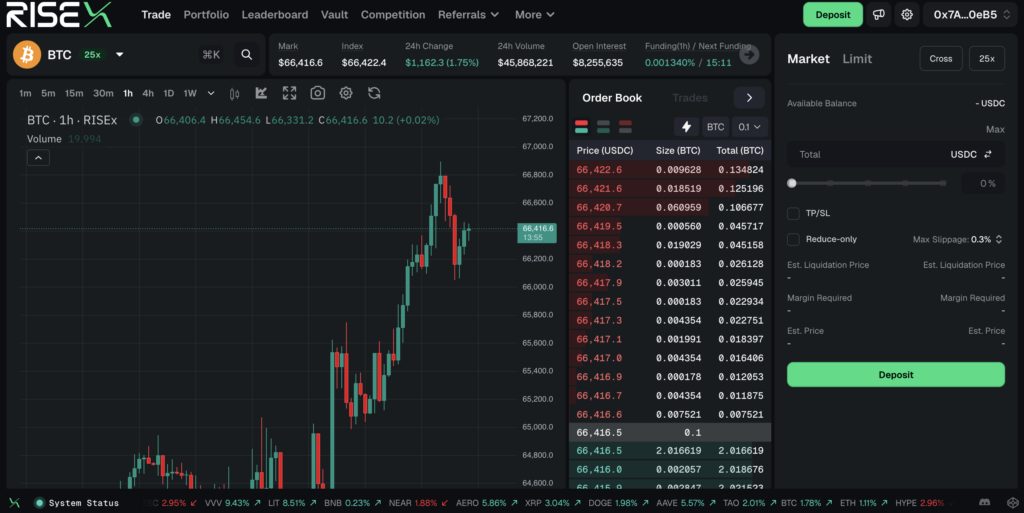
RISEx takes a more ambitious approach. Its orderbook, matching, margin and settlement logic execute inside the EVM on RISE Chain, an Ethereum Layer 2 designed for millisecond-scale financial applications.
The exchange had processed approximately $3.50 billion in cumulative perpetual volume by 21 July 2026. DefiLlama showed roughly $1.71 billion in 30-day volume and $20.5 million in open interest at the time of review.
Standard fees begin at 3 basis points for takers and 1 basis point for makers. The highest published tier charges 1.5 basis points for takers and no maker fee.
RISEx is not yet the complete unified exchange implied by its long-term vision. Current activity centres on cryptocurrency perpetual futures. Spot markets, tokenized RWAs, AutoYield and broader multi-asset margin remain future growth areas.
Flagship verdict: RISEx is one of the strongest emerging demonstrations that a fully onchain EVM orderbook can attract real volume. Its technology is differentiated, but liquidity depth, API maturity and delivery of the wider roadmap will determine whether it becomes lasting market infrastructure.
Decentralised News Community Codes
7R5C69E2
005TCVKK
29BAR1B6
YC3M9RZZ
OV61S9WD
9YMLHLCH
UZBIMOJH
VP50JCTV
9VLTQWA2
M6TA3IPU
VAMAC2WB
NAF6O6NT
ODFLVAXY
VHIK3BO9
BEK5YZTE
5N9BF0SF
Z5MSIFR0
ONNHKVMI
KLU7GHSS
Use the first code that the platform accepts. Codes may already be claimed or no longer valid.
RISEx at a Glance
Category | RISEx |
Official styling | RISEx |
Platform type | Fully onchain perpetual futures DEX |
Native network | RISE Chain |
Settlement alignment | Ethereum Layer 2 |
Execution model | Onchain central limit orderbook |
Primary live product | Cryptocurrency perpetual futures |
Current main collateral | USDC |
Margin modes | Cross and isolated |
Base maker fee | 0.01% |
Base taker fee | 0.03% |
Lowest maker fee | 0% |
Lowest taker fee | 0.015% |
Fee lookback | Rolling 14-day volume |
Account categories | API Trader and Click Trader |
Order types | Market, limit, post-only, reduce-only, GTC, GTT, FOK and IOC |
TP/SL | Supported |
REST API | Available |
WebSocket feeds | Available |
WebSocket trading writes | Not yet supported |
REST rate limit | 500 requests per 10 seconds per IP |
WebSocket request limit | 10 per second per IP |
Oracle | Stork |
Points season | Ignite |
Internal liquidity vault | XLP |
AutoYield | Coming soon |
Audits claimed | Spearbit and yAudit |
Public testnet | Available |
Community codes | Available below |
DN Rating
Category | Score |
Architectural innovation | 9.5/10 |
Onchain transparency | 9.1/10 |
Trading fees | 9.0/10 |
Order functionality | 8.6/10 |
API capability | 8.0/10 |
API maturity | 6.9/10 |
Current liquidity | 7.3/10 |
Margin flexibility | 8.1/10 |
Security disclosure | 7.6/10 |
Points transparency | 6.4/10 |
Roadmap potential | 9.2/10 |
Beginner suitability | 6.2/10 |
Overall | 8.1/10 |
These are Decentralised News editorial scores, not safety guarantees or investment ratings.
Current Market Snapshot
Metric | Snapshot on 21 July 2026 |
Cumulative perpetual volume | Approximately $3.50 billion |
30-day perpetual volume | Approximately $1.71 billion |
Seven-day perpetual volume | Approximately $597 million |
24-hour perpetual volume | Approximately $112 million |
Open interest | Approximately $20.5 million |
Current principal product | Crypto perpetual futures |
The market figures above came from DefiLlama and change continuously.
The RISE team separately reported surpassing $3 billion in perpetual volume and $1 million in platform revenue before announcing planned growth into spot, tokenized assets and unified margin.
The RISEx Thesis
RISEx is based on three propositions:
- A professional orderbook should be onchain.
- Onchain liquidity should be synchronously composable with DeFi.
- Ethereum-compatible infrastructure can become fast enough to support real-time markets.
The exchange is built around MarketCore, RISE Chain’s native orderbook infrastructure.
Because the orderbook shares the same execution state as other EVM contracts, developers can design transactions that combine market execution with collateral movement, lending, vaults or portfolio management.
This is materially different from a hybrid DEX where the blockchain sees only deposits, withdrawals and final settlement outcomes.
How RISEx Compares With Other Exchange Architectures
Model | Matching | Settlement | Main Strength | Main Weakness |
Centralised exchange | Private server | Internal ledger | Speed and liquidity | Custody and counterparty risk |
Hybrid orderbook DEX | Offchain engine | Onchain or rollup | Fast execution | Private matching dependency |
AMM perpetual DEX | Pool or oracle model | Onchain | Composability | Different price-discovery model |
Keeper-based DEX | Conditional smart-contract requests | Onchain | Transparent rules | Variable execution delay |
RISEx | Onchain EVM orderbook | Onchain EVM state | Atomic composability | Layer 2 and smart-contract dependency |
RISEx’s advantage is architectural integrity. The orderbook is not a separate service layered above DeFi.
Its challenge is whether that architecture can attract sufficient depth and market-making activity to compete with less transparent but highly liquid venues.
What Is Live and What Is Still Coming?
Feature | Status in July 2026 |
Cryptocurrency perpetuals | Live |
Fully onchain orderbook | Live |
Cross margin | Live |
Isolated margin | Supported |
REST API | Live |
Read-only WebSockets | Live |
Public testnet | Live |
Points programme | Live |
Internal XLP market maker | Live |
Public XLP deposits | Not yet available |
AutoYield | Coming soon |
Mature spot exchange | Expansion area |
Tokenized RWAs | Expansion area |
Broader unified spot-perp margin | Expansion area |
WebSocket order placement | Planned |
Public maker-rebate programme | Coming soon |
RISEx’s roadmap is credible enough to analyse, but readers should not merge future architecture with current product availability.
Fee Schedule
RISEx determines fees using combined rolling 14-day trading volume.
Tier | 14-Day Volume | Taker Fee | Maker Fee |
1 | $0 | 0.0300% | 0.0100% |
2 | $5 million | 0.0250% | 0.0075% |
3 | $25 million | 0.0210% | 0.0050% |
4 | $100 million | 0.0170% | 0.0025% |
5 | $500 million | 0.0155% | 0% |
6 | $1 billion | 0.0150% | 0% |
Direct Cost by Notional
Executed Notional | Tier 1 Maker | Tier 1 Taker | Tier 6 Taker |
$1,000 | $0.10 | $0.30 | $0.15 |
$10,000 | $1.00 | $3.00 | $1.50 |
$100,000 | $10.00 | $30.00 | $15.00 |
$1 million | $100.00 | $300.00 | $150.00 |
A complete round trip normally includes both an entry and an exit fee.
RISEx says a formal market-maker rebate programme is planned. Zero published maker fees should not be confused with an active negative-fee rebate programme.
Account Types and Latency Bumps
RISEx applies artificial delays after orders and cancellations are processed.
Account Type | Taker Delay | Maker Delay | Cancel Delay |
API Trader | 100 ms | 10 ms | 0 ms |
Click Trader | 300 ms | 200 ms | 200 ms |
Why the Delay Exists
Latency bumps can reduce the ability of fast participants to exploit users who receive market information or submit orders more slowly.
RISEx gives cancellations the most favourable treatment for API Traders, while taker orders receive the longest delay.
Makers must use post-only orders to qualify for maker treatment. Other immediately executable limit orders are treated as takers.
What This Means for Traders
The advertised one-millisecond orderbook update speed describes chain and market-state performance.
It does not mean every trader’s instruction is filled within one millisecond.
Actual experience depends on:
- Account type
- Order classification
- Network location
- Wallet signing
- REST processing
- Orderbook depth
- Blockchain inclusion
- Applied latency bump
Margin Architecture
Feature | Current Position |
Main collateral | USDC |
Cross margin | Supported |
Isolated margin | Supported |
Leverage changes | Supported |
Manual isolated-margin adjustment | Supported |
Unified spot and perp margin | Architectural direction |
Multi-asset collateral | Future expansion |
AutoYield collateral | Coming soon |
The API exposes account balances, cross-margin equity, isolated-margin adjustments and leverage changes.
Cross Margin
Cross margin makes the account more capital-efficient by allowing available collateral to support several positions.
It also creates portfolio contagion.
A loss in one market can weaken every other cross-margin position.
Isolated Margin
Isolated margin contains more of the trade’s risk within its allocated collateral.
It is generally easier to use when strategies should have independent maximum losses.
The Unified-Margin End State
RISEx is architected around a future in which spot assets, perpetual positions, lending markets and yield-bearing collateral can share one execution environment.
That end state is not yet fully delivered.
Supported Order Controls
Function | Availability |
Market order | Yes |
Limit order | Yes |
Post only | Yes |
Reduce only | Yes |
Good-Til-Cancelled | Yes |
Good-Til-Time | Yes |
Fill-or-Kill | Yes |
Immediate-or-Cancel | Yes |
Client order ID | Yes |
Self-trade prevention | Yes |
Take profit | Yes |
Stop loss | Yes |
Cancel all | Yes |
Builder fee routing | Yes |
Self-Trade Prevention
RISEx lets traders select whether a detected self-trade expires:
- The maker order
- The taker order
- Both orders
This is valuable for market makers operating multiple strategy instances.
Builder Fees
Third-party interfaces can charge a builder fee after receiving user approval. The approved maximum is included in signed order logic.
This could support a broader ecosystem of:
- Trading terminals
- Bots
- Strategy vaults
- Aggregators
- Mobile interfaces
- Portfolio managers
Funding Framework
Funding Feature | RISEx |
Direction | Long-to-short or short-to-long |
Notional reference | Index price |
Default hourly cap | Plus or minus 4% |
Purpose | Align perpetual and underlying price |
Main account effect | Changes equity and liquidation distance |
RISEx uses index price rather than mark price when calculating funding notional.
The published cap is extremely wide. Traders should distinguish between a theoretical safety boundary and an ordinary observed funding rate.
A crowded market can make funding more important than entry and exit fees.
Oracle Framework
RISEx obtains index pricing through Stork, an independent oracle network.
Oracle Risk | Potential Effect |
Delayed update | Incorrect margin or funding calculations |
Wrong source price | Distorted risk engine |
Data-provider outage | Reduced trading reliability |
Market gap | Sudden index adjustment |
Thin underlying market | Unstable reference price |
Orderbook-index divergence | Unusual funding or execution |
A fully onchain exchange can make its logic transparent without making every external data input infallible.
Liquidation and Insurance Structure
Stage | Function |
Account-health monitoring | Measures collateral against requirements |
Health factor above 1 | Account remains above liquidation threshold |
Health factor at or below 1 | Liquidation can begin |
Position execution | Exposure is reduced or closed |
Liquidation fee | 1% under the documented positive-recovery condition |
Fee destination | XLP insurance resources |
Internal liquidity | XLP market maker |
The system can still experience losses during:
- Fast market gaps
- Insufficient orderbook liquidity
- Oracle disruption
- Correlated liquidations
- Smart-contract failure
- XLP market-making losses
An insurance mechanism reduces certain deficits. It does not guarantee every account against loss.
XLP Vault
Category | Current Status |
Purpose | Internal market-making capital |
Full name | Exchange Liquidity Protocol vault |
Operational | Yes |
Primary RISEx market maker | Yes |
Receives liquidation-related value | Yes |
Public deposits | Not yet available |
Public withdrawals | Not yet available |
XLP could eventually become an important part of RISEx’s liquidity strategy.
It also concentrates a set of complex risks:
- Inventory exposure
- Adverse selection
- Liquidation deficits
- Market concentration
- Vault accounting
- Withdrawal liquidity
- Smart-contract vulnerabilities
Public access should be evaluated only after final terms, performance history and withdrawal conditions are available.
AutoYield and Productive Collateral
RISEx’s AutoYield concept is designed to let unused collateral earn yield while it remains available to support trading.
Potential Benefit | Corresponding Risk |
Higher capital efficiency | Additional smart-contract exposure |
Yield on unused collateral | Lending or vault losses |
Atomic withdrawal for margin | Integration failure |
No manual transfer required | Complex risk interactions |
Unified DeFi state | Contagion between protocols |
Official documentation marks AutoYield as coming soon.
RISEx’s launch discussion says future AutoYield infrastructure is expected to use Yearn-managed vaults, while lending and portfolio-margin concepts may integrate other DeFi systems. The article explicitly notes that its ideas span live, developing and conceptual stages.
API and Developer Review
API Coverage
Category | Functions |
Accounts | Balances, deposits, positions and transfers |
Margin | Cross balance, isolated margin and leverage |
Authentication | EIP-712 login, signer keys and nonces |
Orders | Place, cancel, query and cancel all |
TP/SL | Create, view and cancel |
Markets | Configurations, history, funding and books |
Portfolio | PnL, equity, statistics and charts |
Points | Epochs, wallet points, history and tiers |
System | Configuration and feature flags |
Builders | Builder list, approvals and fees |
API Limits
Interface | Published Limit |
REST | 500 requests per 10 seconds per IP |
WebSocket requests | 10 per second per IP |
WebSocket Channels
Channel | Function |
Orderbook | Real-time book changes |
Orders | Account order updates |
Positions | Position-state updates |
Trades | Matched trade feed |
Funding | Funding-rate data |
Fills | Account fills |
Main Limitation
The WebSocket interface is read-only. Order placement and cancellation through WebSockets are planned but not currently available.
Documentation Risk
The API reference warns that it is under heavy development and that major changes are expected. Production developers should pin versions, monitor updates and maintain regression tests.
Testnet and Integration Security
RISEx operates separate mainnet and testnet infrastructure.
Environment | WebSocket |
Mainnet | wss://ws.rise.trade/ws |
Testnet | wss://ws.testnet.rise.trade/ws |
The testnet configuration endpoint publishes current contract addresses.
A testnet is valuable for validating:
- EIP-712 signatures
- Permit logic
- Order placement
- Nonce handling
- TP/SL
- Cancels
- Reconnection
- Position reconciliation
- Margin updates
It does not reproduce mainnet liquidity, slippage, funding or real market stress.
Points and Incentive Design
RISEx’s Ignite programme distributes points according to a changing, unpublished model.
Component | Current Position |
Public season | Ignite |
Distribution cadence | Epoch based |
Formula | Not published |
Weightings | Can change weekly |
Qualifying activity | Includes orders, costs and referrals |
Pre-season users | Genesis Traders |
Referral bonus | 10% of invitee-generated points to code owner |
RISE points allocation | 100% directed to RISEx participants |
Why the Formula Is Hidden
RISEx says undisclosed, changing weightings make the programme harder to game.
The disadvantage is that users cannot calculate the expected reward from a particular trading strategy.
Points Economics
A rational user should compare:
Expected points value
against:
Fees + spread + slippage + funding + liquidation risk + tax consequences
When the expected token value is unknown, the left side of that equation is highly speculative.
Invite-Code Programme
RISEx unlocks invite codes according to weekly trading-volume milestones.
Weekly Volume | Codes Generated |
$600,000 | 1 |
$1.5 million | 2 |
$2.4 million | 3 |
$4.2 million | 4 |
$6 million | 5 |
Weekly maximum | 5 |
The owner of an invite code currently earns additional points equal to 10% of the invited user’s points.
Security Assessment
Positive Security Characteristics
Control | Intended Benefit |
Fully onchain orderbook | Public market state |
EIP-712 signatures | User-authorised instructions |
Server does not hold signer key | Reduced key-custody exposure |
Revocable signers | Limits compromised automation keys |
Bitmap nonces | Replay protection |
Ethereum Layer 2 | Ethereum-aligned settlement |
Testnet | Safer integration testing |
Self-trade prevention | Prevents unintended internal matching |
Public status page | Operational visibility |
Spearbit and yAudit reviews | External code review |
Order submissions use client-signed EIP-712 permits. The server constructs and submits the transaction without retaining the signer’s key.
The team says the rewritten protocol contracts were audited by Spearbit and yAudit.
Transparency Still Needed
A complete institutional security package should provide:
- Prominent links to final audit reports
- Exact audited commits
- Deployed-contract verification
- Upgrade permissions
- Multisignature structure
- Emergency-pause conditions
- Sequencer assumptions
- Oracle-failure procedures
- Bug-bounty terms
- XLP loss-allocation rules
An audit name without verified scope is not sufficient for a large deposit decision.
Maintenance and Operational Controls
RISEx documents a distinct maintenance state.
Action During Maintenance | Behaviour |
Resting limit order | Accepted |
Market order | Rejected |
Crossing limit order | Rejected |
Passive liquidity | Can remain available |
Immediate liquidity taking | Restricted |
Algorithmic strategies should query system status before submitting orders and maintain a kill switch when execution modes change.
RISEx Risk Matrix
Risk | Potential Impact | Practical Mitigation |
Smart-contract bug | Loss or frozen collateral | Limit balances and review audits |
RISE Chain outage | Orders or withdrawals disrupted | Keep leverage conservative |
Sequencer disruption | Delayed inclusion | Monitor status page |
Oracle failure | Incorrect risk calculations | Maintain margin buffers |
Thin market depth | Slippage | Measure book depth |
Cross-margin contagion | Multiple positions liquidated | Use isolated margin |
Funding spike | Rapid equity reduction | Check live funding |
API change | Bot failure | Version and test integrations |
Latency bump | Poor execution assumptions | Benchmark by account type |
Points-rule change | Lower expected rewards | Ignore points in base-case PnL |
XLP loss | Reduced liquidity or insurance capacity | Monitor vault disclosures |
Roadmap delay | Missing expected features | Judge only live products |
Regulation | Access or trading restrictions | Verify local eligibility |
Phishing | Wallet compromise | Bookmark official domain |
Signing-key leak | Unauthorised trading | Use revocable restricted signers |
RISEx Pros and Cons
Advantages | Disadvantages |
Fully onchain CLOB | Newer liquidity venue |
EVM composability | Layer 2 dependency |
Ethereum alignment | Smart-contract risk |
Competitive fees | Funding can become expensive |
Zero maker fees at high tiers | Maker rebate programme not live |
Cross and isolated margin | Cross-margin contagion |
Professional order controls | No mature spot product yet |
Strong REST coverage | API remains under development |
Real-time WebSockets | WebSocket writes not supported |
Public testnet | Testnet cannot reproduce mainnet |
Points and invite programme | Weightings are undisclosed |
XLP internal liquidity | Public access not yet available |
AutoYield vision | AutoYield not live |
Spearbit and yAudit claims | Audit scope needs verification |
Public status page | No guarantee of uninterrupted uptime |
Best RISEx Alternatives for 2027
Onchain Orderbook Alternatives
Platform | Main Comparison | Affiliate Access |
Lighter | Verifiable orderbook execution | Join Lighter |
edgeX | Professional perpetual CLOB | |
Paradex | Advanced APIs and portfolio trading | |
Aster | Multi-market orderbook trading | Join Aster |
Aevo | Perpetuals and crypto options | |
ApeX Omni | Multi-chain orderbook perps |
Alternative Onchain Models
Platform | Trading Model | Affiliate Access |
MYX | Matching-pool perpetuals | |
GMX | Oracle and liquidity-pool execution | |
gTrade | Synthetic crypto and macro markets | |
Helix | Injective-based orderbook trading | Join Helix |
Centralised Futures Alternatives
Platform | Main Comparison | Affiliate Access |
Bybit | Broad derivatives ecosystem | |
MEXC | Altcoin perpetual markets | |
Bitget | Futures and copy trading | |
BingX | Social and copy trading | |
BloFin | Futures-focused platform | |
Bitunix | Streamlined perpetual trading | |
KCEX | Fee-focused futures access | |
Deribit | Professional options and futures |
Which Platform Fits Each Trader?
Trader Priority | Platform to Research |
Fully onchain EVM orderbook | RISEx |
Verifiable order matching | Lighter |
Advanced API trading | Paradex |
Professional emerging CLOB | edgeX |
Perpetuals and options | Aevo |
Broader multi-market DEX | Aster |
Pool-based trading | GMX |
Synthetic macro markets | gTrade |
Injective-native trading | Helix |
Large centralised liquidity | Bybit |
Altcoin futures | MEXC |
Professional crypto options | Deribit |
How to Use RISEx More Carefully
- Verify the official domain.
- Use an available Decentralised News invite code.
- Begin with a dedicated trading wallet.
- Test with limited USDC.
- Review live market configuration.
- Avoid maximum leverage.
- Use isolated margin for experimental strategies.
- Monitor funding and account health.
- Set reduce-only exits.
- Test order cancellation.
- Test a withdrawal.
- Use revocable signer keys for bots.
- Never expose a main wallet private key to trading software.
- Monitor API and contract changes.
- Query system status before sending orders.
- Treat points as uncertain.
- Do not assume roadmap features are live.
- Keep long-term holdings outside the trading account.
Final RISEx Review Verdict
RISEx is one of the clearest challenges yet to the assumption that a professional orderbook must be partly centralised.
It has already demonstrated that a fully onchain EVM exchange can process billions of dollars in perpetual volume while maintaining a recognisable central limit orderbook experience.
Its fees are competitive. Its account-level latency model is thoughtful. Its API already covers most of the functionality required by professional traders, despite remaining under development.
The larger opportunity lies in composability.
If RISEx successfully adds spot assets, tokenized RWAs, AutoYield and unified margin, the orderbook could become a shared liquidity layer rather than an isolated trading application.
That outcome is not guaranteed.
The platform must deepen liquidity, stabilise its APIs, publish more accessible security evidence and deliver its roadmap without making the system too complex to evaluate.
The points programme will help attract activity, but durable market quality cannot be created by incentives alone. It requires recurring organic traders, reliable market makers and sufficient depth during volatile conditions.
RISEx is best suited to sophisticated users who understand both perpetual futures and onchain infrastructure.
It is not yet a replacement for every trading venue. It is a credible early example of what an Ethereum-native trading layer could become.
RISEx Review FAQs
What is RISEx?
RISEx is a fully onchain perpetual futures exchange native to RISE Chain.
What is RISE Chain?
RISE Chain is an Ethereum Layer 2 designed for fast, composable financial applications.
Is RISEx fully onchain?
Yes. Its orderbook, matching, margin and settlement execute inside the EVM.
Is RISEx custodial?
RISEx uses wallet-signed instructions and onchain contracts rather than a conventional exchange custody account. Smart-contract and Layer 2 risks remain.
How fast is RISEx?
The platform advertises one-millisecond orderbook updates. Account-level latency bumps are separately applied to taker, maker and cancel instructions.
What are the RISEx fees?
Base fees are 0.03% for takers and 0.01% for makers. The highest published tier charges 0.015% for takers and 0% for makers.
What is an API Trader account?
It is an account profile with lower artificial order and cancellation delays than the Click Trader profile.
Does RISEx support isolated margin?
Yes.
Does RISEx support cross margin?
Yes.
Does RISEx offer unified margin?
Its architecture supports that direction, but full spot and multi-asset unified margin remain expansion areas.
Does RISEx have spot trading?
The current main product is perpetual futures. Spot trading is part of the announced growth roadmap.
Does RISEx have tokenized stocks?
Tokenized RWAs are a future expansion area.
What order types does RISEx support?
Market, limit, post-only, reduce-only, GTC, GTT, FOK, IOC and TP/SL controls are documented.
What oracle does RISEx use?
RISEx works with Stork for index pricing.
What is the RISEx funding cap?
The default documented cap is plus or minus 4% per hour.
Does RISEx have an API?
Yes. REST and WebSocket APIs are available.
Can an API trader place orders over WebSockets?
Not yet. WebSockets currently provide read and subscription functionality.
Does RISEx have subaccounts?
RISEx has introduced a modular subaccount standard designed for programmable trading accounts.
What is RIP-1?
RIP-1 is an open standard for modular RISEx subaccounts that can add programmable capabilities.
What is XLP?
XLP is the internal Exchange Liquidity Protocol vault supplying capital to RISEx’s market maker.
Can the public deposit into XLP?
Not at the time of review.
What is AutoYield?
AutoYield is a planned feature intended to earn onchain yield on unused trading collateral.
Does RISEx have a points programme?
Yes. Its first public season is called Ignite.
How are RISEx points calculated?
The exact formula is not public and can change weekly.
What do invite codes do?
The code owner can earn additional points equal to 10% of the invited user’s points under current rules.
Do points guarantee RISE tokens?
No guaranteed token amount, launch value or financial return should be assumed.
Is RISEx audited?
The team says the contracts were audited by Spearbit and yAudit.
What are the best RISEx alternatives?
Alternatives include Lighter, edgeX, Paradex, Aster, Aevo, MYX, GMX, Helix, Bybit, MEXC and Deribit.
Invite and Affiliate Disclosure
RISEx invite codes may generate additional points for the Decentralised News community account. This article also contains affiliate links to alternative platforms.
These relationships do not determine our editorial conclusions, scores or security analysis.
Educational Disclaimer
This article is provided for educational and informational purposes only. It is not financial, legal, tax, investment or trading advice.
Perpetual futures, points programmes and leveraged DeFi involve substantial risks. Users can lose all deposited collateral. Smart contracts, Layer 2 networks, APIs, wallets, oracles, liquidity vaults and trading interfaces can fail or be exploited.
Points have no guaranteed token conversion or monetary value. Confirm current fees, markets, leverage, funding, invite rules and legal availability before participating. Never trade with funds you cannot afford to lose. For adults aged 18 and over.





