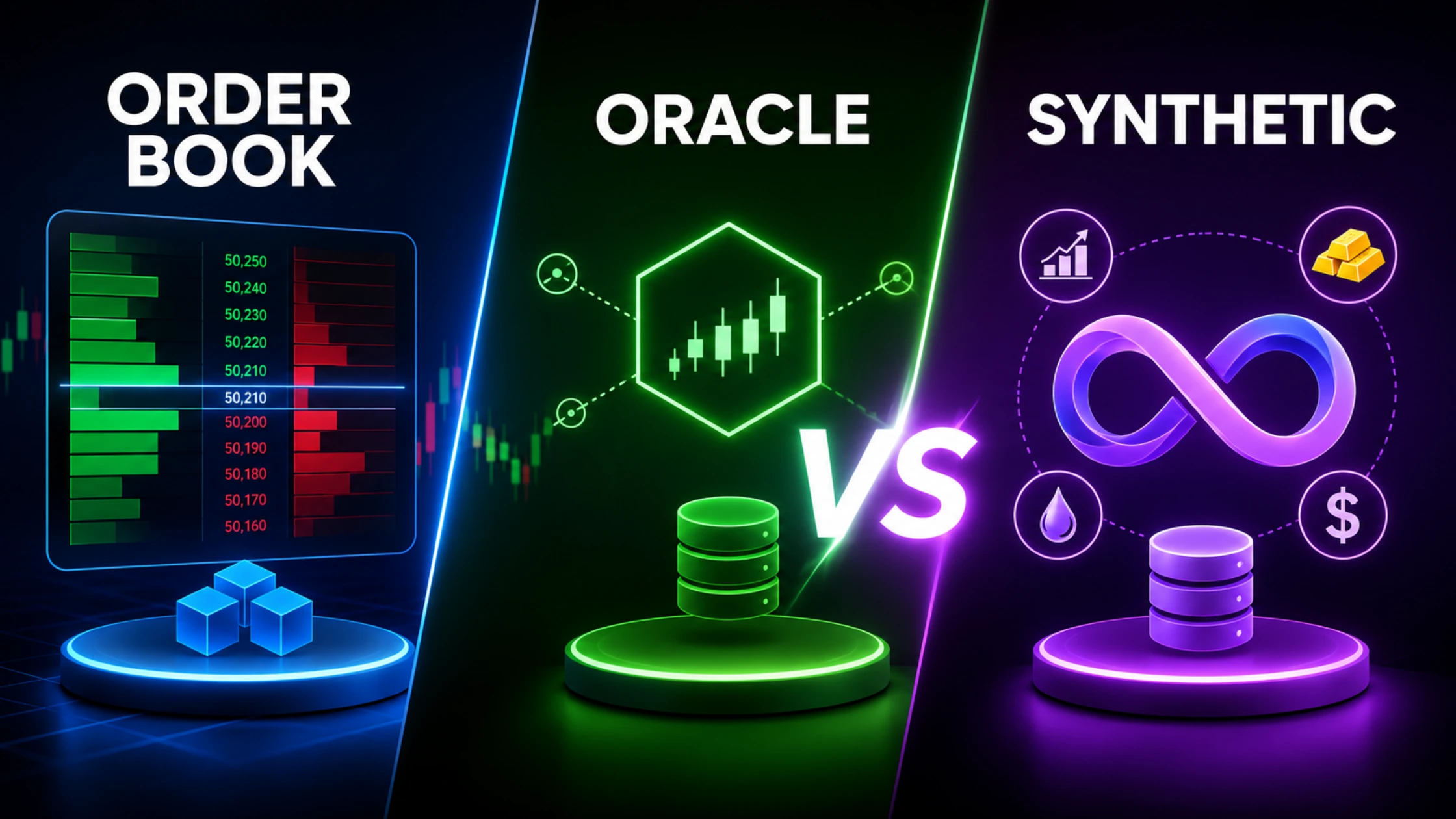
Order Book, Oracle or Synthetic Liquidity: Which Perpetual DEX Architecture Wins in 2027? Discover The Hidden Architecture Behind Every Perpetual Trade.
The Decentralised News Perp Market Architecture Map
The definitive comparison of order-book, AMM, oracle-priced pool, synthetic-vault and externally hedged perpetual DEX models, including Lighter, Paradex, GMX, gTrade, SynFutures, MYX and Ostium.
Last Research Verification: 28 July 2026
Affiliate Disclosure: Decentralised News may earn compensation when readers use selected platform links. Commercial relationships do not determine architecture classifications, scores or conclusions.
Summary
The strongest perpetual DEX architecture changes according to the market and strategy.
|
Trading Requirement |
Best Architecture |
Leading Examples |
|
Scalping and precise limit orders |
Central-limit order book |
|
|
Algorithmic and professional execution |
Central-limit order book |
Lighter, Paradex |
|
Permissionless markets |
Hybrid AMM |
|
|
Pool-backed wallet trading |
Oracle-priced liquidity pool |
|
|
Broad synthetic markets |
Synthetic counterparty vault |
|
|
Internal position netting |
Matching pool |
|
|
Stocks, commodities and forex |
Externally hedged oracle execution |
Best architecture for professional crypto execution: Central-limit order book
Best architecture for permissionless market creation: Hybrid AMM
Best architecture for passive pool liquidity: Oracle-priced pool
Best architecture for broad synthetic exposure: Counterparty vault
Best architecture for liquid RWA markets: Externally hedged oracle execution
The central conclusion is that “order book versus oracle” is an incomplete comparison.
A price feed does not reveal who supplies the capital, who carries trader profits and losses, or how a position is hedged.
GMX, gTrade and Ostium all use external pricing, but their liquidity and risk structures are materially different.
Every Perpetual Trade Has Three Hidden Questions
A trading interface usually shows:
- Market
- Price
- Leverage
- Position size
- Liquidation level
- Funding
The interface rarely begins with the three questions that determine the market’s actual architecture.
1. Who Discovers the Price?
The answer may be:
- Traders placing bids and asks
- An AMM curve
- A Chainlink or other oracle feed
- A consensus price system
- External exchanges
- Institutional liquidity providers
2. Who Takes the Other Side?
The counterparty may be:
- Another trader
- A professional market maker
- An AMM
- A liquidity pool
- A protocol vault
- A matching pool
- An external hedge counterparty
3. Who Pays When the Trader Wins?
Profits may come from:
- The losing trader
- A liquidity pool
- A synthetic vault
- Hedging gains
- Protocol reserves
- An insurance structure
- A combination of these sources
Two platforms using the same oracle can have completely different answers.
That is why the Perp Market Architecture Map separates price discovery from liquidity and counterparty risk.
DN Architecture Classification
The flagship framework uses five primary models.
|
Architecture |
Price Discovery |
Immediate Counterparty |
Economic Risk Bearer |
|
Central-limit order book |
Visible bids and asks |
Another order-book participant |
Trader or market maker |
|
Hybrid AMM |
Liquidity curve plus limit orders |
AMM liquidity or resting order |
Liquidity providers and traders |
|
Oracle-priced pool |
External oracle plus price-impact model |
Protocol liquidity pool |
Pool liquidity providers |
|
Synthetic counterparty vault |
External oracle or matching logic |
Vault or matching pool |
Vault, LPs and net trader exposure |
|
Externally hedged oracle |
Oracle and underlying-market quotes |
Onchain settlement layer |
External hedge plus protocol buffer or vault |
A platform may contain elements from several categories.
The classification is based on the dominant execution and risk-transfer mechanism.
DN Evaluation Methodology
|
Evaluation Category |
Weight |
What It Measures |
|
Execution precision |
20% |
Limit control, queue priority, partial fills and order instructions |
|
Slippage resilience |
15% |
How cost changes with order size and market imbalance |
|
Capital efficiency |
15% |
How much gross trading exposure can be supported by available capital |
|
Transparency |
10% |
Visibility of depth, pricing, collateral and counterparty risk |
|
Long-tail scalability |
10% |
Ability to launch and sustain less liquid markets |
|
Manipulation resistance |
15% |
Resistance to book, oracle, AMM and governance attacks |
|
Liquidity resilience |
10% |
Performance when market makers, LPs or external venues are stressed |
|
Operational complexity |
5% |
Dependence on sequencers, keepers, hedgers and settlement systems |
The framework evaluates architecture fit.
It does not claim that every platform within a category has equal security or liquidity.
The Perp Market Architecture Map
|
Model |
Slippage Visibility |
Capital Efficiency |
Market Transparency |
Long-Tail Support |
Main Failure Mode |
|
Central-limit order book |
High |
Medium |
High for visible depth |
Low to medium |
Liquidity disappears or matcher fails |
|
Hybrid AMM |
Medium |
Medium to high |
High onchain, lower execution intuition |
High |
Liquidity sits outside active range |
|
Oracle-priced pool |
Medium |
High |
High pool visibility, complex risk formulas |
Medium |
Oracle or pool imbalance harms LPs |
|
Synthetic vault |
Low to medium |
High |
Vault visible, risk model less intuitive |
High |
Vault loss, oracle failure or risk-cap change |
|
Externally hedged oracle |
Medium |
Very high for liquid RWAs |
Onchain settlement, partial external opacity |
Medium |
Hedge, oracle or settlement infrastructure fails |
Architecture 1: Central-Limit Order Book
The CLOB is the most direct representation of competitive liquidity.
A market maker posts a price at which it will buy and another price at which it will sell.
Traders decide whether to:
- Cross the spread
- Rest a limit order
- Improve the bid or ask
- Split the order
- Cancel
- Use a time-based execution algorithm
Order-Book Execution Formula
A useful measure is the difference between the volume-weighted execution price and the pre-trade midpoint.
Order-book execution cost = spread component + market impact + fees
The spread component exists even when the displayed market does not move.
Market impact occurs when the order consumes several price levels.
Strengths
|
Strength |
Why It Matters |
|
Visible depth |
Traders can estimate execution before submitting |
|
Limit-price control |
The trader can refuse an unacceptable price |
|
Queue priority |
Market makers can compete for execution |
|
Advanced orders |
Post-only, IOC, TWAP and scaled orders improve control |
|
Natural price discovery |
Price emerges from competing bids and asks |
|
API suitability |
The model maps well to professional systems |
Weaknesses
|
Weakness |
Consequence |
|
Market-maker dependence |
Thin markets may have little usable depth |
|
Visible intentions |
Large resting orders can reveal strategy |
|
Cancelled liquidity |
Displayed depth may disappear |
|
Infrastructure demands |
High throughput and low latency are required |
|
Thin-book manipulation |
Small markets can be moved cheaply |
|
Sequencer or matcher dependence |
Offchain components may censor or fail |
Lighter: Verifiable Price-Time Priority
Lighter implements an order book using price-time priority.
A taker order first matches with the best-priced opposing order. If several orders share the same price, the oldest order receives priority.
Its matching engine uses cryptographic proofs intended to verify correct order matching and liquidation behaviour.
The platform supports market, limit, post-only, immediate-or-cancel, stop-loss, take-profit and TWAP execution. Standard accounts currently receive zero maker and taker fees under published terms.
DN Architecture Assessment
|
Category |
Assessment |
|
Execution precision |
Excellent |
|
Visible liquidity |
Excellent |
|
Capital efficiency |
Moderate |
|
Long-tail scalability |
Liquidity dependent |
|
Manipulation surface |
Book, sequencer and market-maker behaviour |
|
Best strategy |
Scalping, active trading and market making |
Critical Insight
Cryptographic verification can prove that the matcher followed its stated rules.
It cannot guarantee that market makers will maintain tight quotes during a crisis.
Fair matching and abundant liquidity are separate properties.
Referral: Join Lighter using code 659323WR.
Paradex: Cloud Matching With Onchain Validation
Paradex uses a cloud-based matching engine with independent onchain trade validation.
The platform supports order-book trading across perpetual futures, options and spot markets.
Orders include market, limit, stop, scaled and TWAP instructions.
Paradex’s risk system evaluates orders against account margin, portfolio positions and market data before sending matches to the chain. If a matched trade fails onchain validation, the trade can be reversed through the platform’s bust process.
DN Architecture Assessment
|
Category |
Assessment |
|
Execution precision |
Excellent |
|
Product depth |
Excellent |
|
Portfolio efficiency |
Excellent |
|
Long-tail scalability |
Medium |
|
Operational complexity |
High |
|
Best strategy |
API trading, portfolio margin, options and basis strategies |
Critical Insight
Paradex demonstrates the hybridisation of the order-book model.
The book can be fast and professional while settlement remains independently validated onchain.
The benefit is exchange-like execution.
The cost is a more complex lifecycle involving:
- Cloud risk checks
- Matching
- Chain validation
- Possible trade busts
- Account resynchronisation
Referral: Access Paradex with code decentralised.
Architecture 2: Hybrid Automated Market Maker
An AMM replaces the collection of individual quotes with smart-contract liquidity.
A hybrid AMM adds features traditionally associated with an order book.
These may include:
- Concentrated liquidity
- Limit orders
- Range positions
- Oracle anchoring
- Dynamic curves
- Position-specific risk controls
AMM Execution Formula
The simplified execution cost is:
AMM execution cost = movement along the curve + spread or fee + oracle deviation
Concentrating liquidity near the current price reduces the first component.
The trade-off is that liquidity may become inactive if the market moves outside the selected range.
Why AMMs Matter for Perpetual Markets
Professional order books work well for Bitcoin and Ethereum because large market makers can hedge them across many venues.
A newly launched token may not have:
- Deep spot liquidity
- Reliable market makers
- Borrowing markets
- Derivatives hedges
- Institutional demand
An AMM can create a functioning market with smaller and more passive sources of capital.
SynFutures: Oyster AMM
SynFutures uses Oyster AMM, which combines concentrated liquidity and limit orders.
Market orders can execute against either active concentrated liquidity or native limit orders.
This model attempts to combine the continuous availability of an AMM with the price specificity of an order book.
DN Architecture Assessment
|
Category |
Assessment |
|
Permissionless market support |
Excellent |
|
Capital concentration |
Strong |
|
Execution intuition |
Moderate |
|
LP complexity |
High |
|
Long-tail scalability |
Excellent |
|
Best strategy |
New markets, alternative assets and LP-supported trading |
Critical Insight
A hybrid AMM does not eliminate the need for liquidity.
It changes the way liquidity is organised.
Instead of asking whether the order book is deep, the trader must ask:
- How much liquidity sits near the current price?
- How wide are the LP ranges?
- Which side of the market is undercapitalised?
- Can LPs withdraw quickly?
- How reliable is the oracle?
- What happens if the market moves outside active ranges?
Referral: Trade through SynFutures.
Architecture 3: Oracle-Priced Liquidity Pool
The oracle-priced pool separates price discovery from immediate liquidity.
External markets discover the price.
The oracle reports that price to the protocol.
The liquidity pool supplies capital for trading.
This can reduce dependence on a local order book.
Oracle-Pool Execution Formula
A conceptual model is:
Execution price = oracle reference price ± spread ± protocol price impact
The trader does not necessarily sweep several visible book levels.
Instead, the protocol modifies execution according to:
- Position size
- Pool composition
- Existing open interest
- Whether the trade improves balance
- Market risk
- Available liquidity
Capital-Efficiency Advantage
One pool can support repeated trading without requiring each LP to actively quote orders.
LP capital can earn:
- Trading fees
- Borrowing fees
- Funding
- Swap fees
- Liquidation-related revenue
The capital remains exposed to trader PnL and market imbalance.
GMX: Oracle Pricing With GM and GLV Pools
GMX uses Chainlink Data Stream oracle prices rather than a conventional order book.
Trading is backed by GM market pools and GLV automated liquidity vaults.
Liquidity providers earn a share of trading, liquidation, borrowing and swap fees, while the pools take on economic exposure associated with leveraged positions.
DN Architecture Assessment
|
Category |
Assessment |
|
Wallet-based execution |
Excellent |
|
Pool transparency |
Strong |
|
Capital efficiency |
Strong |
|
Long-tail scalability |
Medium |
|
Oracle dependence |
High |
|
Best strategy |
Swing trading and pool-backed major markets |
The Price-Impact Mechanism
A trade that pushes a market pool further away from its desired balance can receive negative price impact.
A trade that restores balance can receive positive price impact.
This creates a protocol-level incentive to improve pool health.
The model is different from book slippage.
The trader may not consume visible offers, but still pays for increasing the system’s risk.
Critical Insight
GMX changes the identity of the counterparty.
The trader is not primarily competing with another visible order.
The trader interacts with protocol liquidity whose return depends on:
- Fees
- Trader profitability
- Pool balance
- Borrowing demand
- Oracle integrity
- Market volatility
Referral: Trade on GMX using code decentralised.
Architecture 4: Synthetic Counterparty Vault
Synthetic markets separate price exposure from ownership and delivery.
A protocol can create a gold, stock, forex or crypto contract without holding the exact underlying asset for every trade.
The contract tracks the reference price.
A vault or pool settles the resulting profit and loss.
Synthetic-Vault Execution Formula
Trader PnL = price movement × position size, minus fees, spread and borrowing
The platform must ensure that the vault can pay profitable traders.
It may control risk through:
- Open-interest caps
- Leverage limits
- Dynamic borrowing fees
- Spread adjustments
- Position-size limits
- Vault collateral requirements
- Emergency governance controls
Capital-Efficiency Advantage
Opposing trader exposure can be netted.
If one group is long $100 million and another is short $90 million, the system’s net directional exposure is only $10 million.
The protocol does not necessarily need $190 million of separate hedge capital.
This is one reason synthetic architectures can support large gross open interest.
gTrade: Oracle-Based Synthetic Leverage
gTrade allows traders to open synthetic leveraged positions using supported collateral.
The relevant gToken vault acts as the principal economic counterparty.
Profitable trader PnL is paid from the vault.
Trader losses flow into the vault.
DN Architecture Assessment
|
Category |
Assessment |
|
Market breadth |
Excellent |
|
Capital efficiency |
High |
|
Long-tail scalability |
Strong |
|
Visible liquidity |
Low |
|
Counterparty-vault dependence |
High |
|
Best strategy |
Forex, commodities, stocks and broad synthetic exposure |
Why Market Coverage Can Expand Quickly
A synthetic platform does not need:
- A separate spot inventory for each asset
- A complete two-sided order book
- Direct delivery
- Share custody
- Physical commodity storage
- A market maker hedging every individual trade
It does require a credible price feed and enough counterparty capital.
Critical Insight
A trader can receive a clean oracle-based execution price while taking risks that are invisible in the trading ticket.
Those risks include:
- Vault drawdown
- One-sided open interest
- Borrowing-fee escalation
- Governance changes
- Position caps
- Oracle disruption
- Collateral depeg
Referral: Trade through gTrade using code decentralised.
MYX: Matching Pool Mechanism
MYX uses a Matching Pool Mechanism designed to internally match opposing long and short positions.
Only residual net exposure must be carried by liquidity or risk-management capital.
The architecture seeks to reduce slippage and increase the ratio of gross open interest to committed liquidity.
DN Architecture Assessment
|
Category |
Assessment |
|
Internal netting |
Excellent |
|
Capital efficiency |
Excellent in balanced markets |
|
Long-tail scalability |
Strong |
|
Architecture maturity |
Developing |
|
Model dependence |
High |
|
Best strategy |
Cross-chain and alternative perpetual markets |
Critical Insight
Capital efficiency depends on balance.
When long and short demand offset each other, internal matching can release capital.
When nearly every trader wants the same side, the protocol must still manage the residual exposure.
The true stress test is therefore not a balanced market.
It is a violent, one-directional market.
Referral: Join MYX using code PHSTTHK.
Architecture 5: Externally Hedged Oracle Execution
The externally hedged model uses onchain contracts for collateral and settlement while connecting the position to external liquidity.
It can be understood as a bridge between DeFi distribution and institutional market infrastructure.
Economic Flow
- The trader deposits collateral onchain.
- The protocol quotes a bid or ask using an oracle and underlying-market data.
- The position is opened onchain.
- Directional exposure is mirrored or hedged externally.
- Onchain PnL is settled when the position closes.
- The external hedge and onchain vault are periodically reconciled.
Main Advantage
Liquidity can scale with the underlying market rather than being limited entirely by one onchain pool.
A gold or S&P 500 market can reference the depth of the global market instead of requiring crypto-native LPs to recreate it from scratch.
Main Disadvantage
The system adds offchain dependencies.
The onchain smart contract may be verifiable, but the complete trade depends on:
- Oracle infrastructure
- Hedging counterparties
- Prime brokers
- Traditional exchanges
- Settlement systems
- Market opening hours
- Operational reconciliation
Ostium: Onchain Distribution, External Hedging
Ostium offers onchain perpetual exposure to stocks, ETFs, indices, commodities, forex and crypto.
Trader collateral remains in segregated smart contracts.
Trades settle in USDC.
The protocol uses consensus oracle prices, decentralised keepers, an onchain liquidity vault and an external hedging layer involving market makers and other institutional counterparties.
DN Architecture Assessment
|
Category |
Assessment |
|
RWA market fit |
Excellent |
|
Underlying-market connection |
Excellent |
|
Large-order scalability |
Strong |
|
Onchain settlement |
Strong |
|
External infrastructure dependence |
High |
|
Best strategy |
Macro, equity, commodity and forex trading |
Bid-and-Ask Execution
Ostium uses bid-and-ask execution.
Longs open at the ask and close at the bid.
Shorts open at the bid and close at the ask.
The spread reflects liquidity in the underlying market.
Crypto and stock pairs can also apply dynamic price impact according to order flow.
Carry Instead of Generic Crypto Funding
Ostium applies rollover costs linked to the economics of the underlying asset.
Examples include:
- Interest-rate carry for stocks and indices
- Futures term structure for commodities
- Currency and futures-market carry for forex
- Crypto funding and futures basis for digital assets
This can make the product more economically authentic, but potentially more complicated for traders accustomed to one simple funding-rate display.
Critical Insight
Ostium separates liquidity from onchain TVL more aggressively than conventional pool models.
This can increase capital efficiency.
It also means that analysing only the visible onchain vault does not reveal the entire execution and counterparty chain.
Referral: Trade on Ostium using code 1RCGN.
Slippage Comparison
|
Architecture |
Where Slippage Appears |
Best Conditions |
Worst Conditions |
|
Order book |
Multiple price levels and spread |
Deep, competitive book |
Thin book or disappearing market makers |
|
Hybrid AMM |
Movement through active liquidity |
Liquidity concentrated around current price |
Price moves outside LP ranges |
|
Oracle pool |
Price-impact formula and imbalance |
Trade improves pool balance |
Trade worsens one-sided exposure |
|
Synthetic vault |
Spread, borrowing, caps and risk adjustments |
Balanced open interest and healthy vault |
Traders crowd one side or vault capital falls |
|
Externally hedged |
Underlying spread, hedge impact and carry |
Deep native market is open |
Underlying market is closed or disrupted |
A platform advertising “zero slippage” may still charge the economic equivalent through:
- Spread
- Funding
- Borrowing
- Risk premiums
- Execution caps
- Delayed fills
- Rollover
- Market impact outside the platform
Transparency Comparison
|
Transparency Question |
Order Book |
AMM |
Oracle Pool |
Synthetic Vault |
Externally Hedged |
|
Can the trader see local liquidity? |
High |
High onchain |
High pool visibility |
Medium |
Partial |
|
Can the trader predict execution? |
High with stable book |
Medium |
Medium to high |
Medium |
Medium |
|
Is counterparty capital visible? |
Partial |
High |
High |
High onchain |
Partial |
|
Is offchain infrastructure involved? |
Often |
Low to medium |
Oracle providers |
Oracle and data providers |
High |
|
Are risk formulas easy to understand? |
Relatively |
Moderate to difficult |
Difficult |
Difficult |
Difficult |
An order book is not automatically more decentralised because its depth is visible.
An oracle pool is not automatically opaque because it lacks bids and asks.
Transparency must be evaluated across pricing, settlement, capital and governance.
Capital-Efficiency Comparison
|
Architecture |
Capital-Efficiency Mechanism |
Constraint |
|
Order book |
Market makers reuse collateral and hedge elsewhere |
Requires active quoting and external hedges |
|
Hybrid AMM |
Concentrates liquidity in active ranges |
Capital becomes inactive outside range |
|
Oracle pool |
One pool backs repeated trading flow |
LPs absorb imbalance and trader PnL |
|
Synthetic vault |
Nets trader exposure and uses one counterparty vault |
Vault must survive profitable trader periods |
|
Matching pool |
Internally offsets opposing positions |
Efficiency falls when flow becomes one-sided |
|
External hedge |
Reuses underlying institutional liquidity |
Depends on hedge and settlement infrastructure |
The most capital-efficient model may also have the most dependencies.
Efficiency is not free. It is achieved by transferring or netting risk somewhere else.
Manipulation Surface Map
|
Architecture |
Primary Manipulation Risk |
Potential Defence |
|
Order book |
Spoofing, wash trading and thin-book attacks |
Price bands, surveillance, self-trade prevention and fair matching |
|
AMM |
Pool manipulation and flash liquidity |
TWAPs, robust oracles and position limits |
|
Oracle pool |
Oracle delay or data-source attack |
Multiple sources, low-latency feeds and execution checks |
|
Synthetic vault |
Oracle attack and vault-draining strategy |
Open-interest caps, spread controls and borrowing fees |
|
Matching pool |
Model exploitation under one-sided flow |
Exposure limits and external hedging |
|
External hedge |
Hedge counterparty or settlement mismatch |
Multiple partners, buffers and reconciliation |
Long-Tail Market Support
Long-tail assets expose the difference between market creation and market quality.
Order Book
A new market can be listed quickly, but it remains unusable without market makers.
Hybrid AMM
A market can begin trading as soon as liquidity is deposited.
The initial liquidity may still be too shallow for meaningful position sizes.
Oracle Pool
The protocol needs a trusted oracle and adequate pool risk limits.
Synthetic Vault
Market creation can be efficient if a dependable price feed exists and the vault can absorb the exposure.
External Hedge
The model works best when a liquid external market already exists.
It is less suitable for assets with no reliable venue to hedge.
Strategy-to-Architecture Matrix
|
Strategy |
First Choice |
Second Choice |
Reason |
|
Scalping |
Order book |
Hybrid AMM |
Precise entries, exits and queue control |
|
Market making |
Order book |
Hybrid AMM |
Ability to quote both sides and manage inventory |
|
Swing trading |
Oracle pool |
Order book |
Simple execution and lower dependence on continuous management |
|
Funding arbitrage |
Order book |
Oracle pool |
API data and hedge execution |
|
Long-tail speculation |
Hybrid AMM |
Synthetic vault |
Easier market creation |
|
Forex trading |
Synthetic vault |
External hedge |
Broad market coverage |
|
Stock and commodity trading |
External hedge |
Synthetic vault |
Connection to deep underlying markets |
|
Large BTC or ETH order |
Deep order book |
Oracle pool |
Depends on measured depth and price impact |
|
Passive liquidity provision |
Oracle pool |
Hybrid AMM |
Pool-based fee income |
|
Algorithmic execution |
Order book |
Oracle pool |
APIs and predictable execution logic |
Which Architecture Is Best?
Best for Scalpers
Central-limit order book.
Use Lighter for low explicit fees and verifiable order matching.
Use Paradex for advanced multi-product and portfolio-margin strategies.
Best for Long-Tail Markets
Hybrid AMM or synthetic liquidity.
Use SynFutures when permissionless market creation is central.
Consider MYX when internal position matching and cross-chain access are more important.
Best for Pool-Backed Crypto Trading
Oracle-priced liquidity pool.
Use GMX when the desired market has a healthy GM pool and the trade does not create excessive imbalance.
Best for Synthetic Global Markets
Counterparty vault.
Use gTrade for broad forex, commodity, stock and crypto exposure.
Best for RWA Liquidity
Externally hedged oracle execution.
Use Ostium when connection to underlying stock, commodity, index or forex liquidity is the main requirement.
Perp Market Architecture Map
Choose your trading priorities to see whether an order book, AMM, oracle-priced pool, synthetic vault or externally hedged model is the strongest fit.
Your trading profile
Architecture fit score
The five market architectures
Central-Limit Order Book
Visible bids and asks match using price-time priority. Strongest for precise execution and professional order control.
Hybrid AMM
Concentrated liquidity and limit orders share one curve. Useful for permissionless markets and passive liquidity.
Oracle-Priced Pool
External prices guide execution while liquidity pools back positions. Removes the need for a deep visible order book.
Synthetic Counterparty Vault
A protocol vault or matching pool pays winning traders and absorbs losses, enabling broad synthetic markets.
Externally Hedged Oracle
Onchain positions are priced by an oracle and mirrored into deep external markets through institutional hedging.
Perp architecture comparison
| Model | Price discovery | Slippage source | Capital efficiency | Long-tail support | Main manipulation exposure | Representative platforms |
|---|---|---|---|---|---|---|
| Order book | Resting bids and asks | Book depth and spread | Medium | Liquidity dependent | Thin-book spoofing, sequencer or matcher dependence | Lighter, Paradex |
| Hybrid AMM | Liquidity curve plus limit orders | Curve movement and range depth | Medium–high | Strong | Pool concentration, oracle and range-management risk | SynFutures |
| Oracle-priced pool | External oracle plus protocol price impact | Pool imbalance and price-impact formula | High | Curated | Oracle latency, LP adverse selection and pool imbalance | GMX |
| Synthetic vault | Oracle or matching mechanism | Spread, risk caps, borrowing and vault exposure | High | Strong | Oracle risk, counterparty-vault solvency and model risk | gTrade, MYX |
| Externally hedged oracle | Consensus oracle and underlying-market quotes | Underlying bid/ask, market impact and carry | Very high | Curated global markets | Oracle, hedge execution, settlement and counterparty infrastructure | Ostium |
The Architecture Diversification Strategy
Traders often diversify assets while concentrating architecture risk.
A trader may use five protocols that all depend on:
- The same oracle provider
- Similar pool structures
- The same stablecoin
- One blockchain
- One bridge
- One type of keeper infrastructure
A stronger operating model can diversify across architectures.
For example:
- Lighter or Paradex for order-book execution
- GMX for oracle-pool liquidity
- gTrade for broad synthetic markets
- Ostium for externally hedged RWAs
- SynFutures for permissionless long-tail markets
This does not eliminate risk.
It reduces dependence on one market mechanism.
Embed the Proprietary Tool
Suggested embed position: After the Strategy-to-Architecture Matrix.
Tool title: DN Perp Market Architecture Map
The tool allows readers to select:
- Order size
- Execution-precision requirement
- Long-tail market requirement
- Capital-efficiency priority
- Oracle tolerance
- Asset type
- Trading style
It then ranks the five architectures and links readers to relevant platforms.
Final Rankings
|
Award |
Winner |
Reason |
|
Best architecture overall for professional execution |
Central-limit order book |
Greatest order control and visible price discovery |
|
Best order-book platform for active traders |
Zero-fee standard accounts and verifiable matching |
|
|
Best order-book platform for advanced portfolios |
Portfolio margin, APIs, options and sophisticated orders |
|
|
Best hybrid AMM |
Concentrated liquidity and native limit orders |
|
|
Best oracle-priced pool |
Mature pool-backed oracle execution |
|
|
Best synthetic vault |
Broad synthetic market coverage |
|
|
Best matching-pool innovation |
Internal long-short matching and capital efficiency |
|
|
Best externally hedged model |
Connection to deep underlying RWA liquidity |
|
|
Best long-tail architecture |
Hybrid AMM |
Markets can launch without a mature order book |
|
Best RWA architecture |
Externally hedged oracle |
Liquidity can scale with the underlying market |
Final Verdict
The central-limit order book remains the strongest model for liquid crypto markets, scalping and professional execution.
It exposes the spread, available depth and price levels the trader must cross.
Its weakness is that liquidity can vanish.
Hybrid AMMs solve a different problem.
They make market creation easier and allow liquidity to exist without a full professional market-making ecosystem.
Their weakness is that capital can be poorly positioned and execution may become difficult to predict.
Oracle-priced pools remove the need for a matching order on every trade.
They offer efficient wallet-based execution and passive liquidity provision.
Their weakness is that LPs, oracle systems and risk formulas become central to the trade.
Synthetic vaults make broad market coverage possible.
They can support forex, stocks, commodities and long-tail assets with limited dedicated capital.
Their weakness is that the trader depends on vault solvency and risk management.
Externally hedged platforms connect onchain settlement to global liquidity.
They are particularly powerful for real-world assets.
Their weakness is greater operational and counterparty complexity.
The market is not converging on one winning architecture.
It is separating into specialist systems.
The best perpetual DEX model is the model that matches the liquidity source, risk bearer and execution requirements of the trade being placed.
Frequently Asked Questions
What is the difference between an order-book and oracle perpetual DEX?
An order-book DEX matches bids and asks submitted by market participants. An oracle DEX uses an external reference price and executes against a pool, vault or other counterparty structure.
Which model has the lowest slippage?
A deep order book can provide the lowest slippage for liquid markets. Oracle and synthetic models may display low slippage but recover cost through spread, price impact, funding, borrowing or risk limits.
Which model is most capital efficient?
Matching pools, synthetic vaults and externally hedged architectures can be highly capital efficient because they net exposure or access external liquidity.
Which model is safest?
No architecture is always safest. Each has different risks involving matching engines, AMMs, oracles, liquidity pools, vaults, hedging counterparties and governance.
Is GMX an AMM?
GMX is best classified as an oracle-priced liquidity-pool perpetual DEX. It uses GM and GLV pools rather than a conventional central-limit order book.
Is gTrade an AMM?
gTrade is better described as a synthetic leveraged trading protocol backed by counterparty vaults and external oracle prices.
Is Ostium a synthetic platform?
Ostium provides synthetic perpetual exposure, but its execution model is distinguished by external institutional hedging and pricing linked to underlying markets.
Why do order books need market makers?
A usable order book requires participants to continuously quote bids and asks. Without market makers, spreads widen and larger orders create significant slippage.
Why do AMMs work better for long-tail markets?
An AMM market can begin trading when liquidity is deposited, even when no professional market maker is willing to operate a full order book.
Can oracle prices be manipulated?
Yes. Risk can arise from weak source markets, delayed updates, faulty aggregation or compromised infrastructure. Strong platforms use multiple sources, price checks and position limits.
What happens if a synthetic vault loses money?
The protocol may increase borrowing costs, reduce leverage, limit open interest, use reserves or socialise risk according to its design. Traders must understand the specific vault rules.
Should traders use more than one architecture?
Using multiple independently designed venues can reduce dependence on one oracle, liquidity model or settlement system, although it increases operational complexity.
Educational Disclaimer
This article is for educational and informational purposes only. It does not constitute financial, investment, legal or tax advice.
Perpetual contracts are leveraged derivatives and may cause rapid, complete loss of collateral. Order books, matching engines, sequencers, AMMs, oracles, smart contracts, liquidity pools, counterparty vaults, stablecoins, bridges, keepers and external hedging partners can fail.
Platform fees, markets, liquidity, leverage and access restrictions can change. Readers must be at least 18 years old and should independently verify every platform before depositing funds or opening a position.