
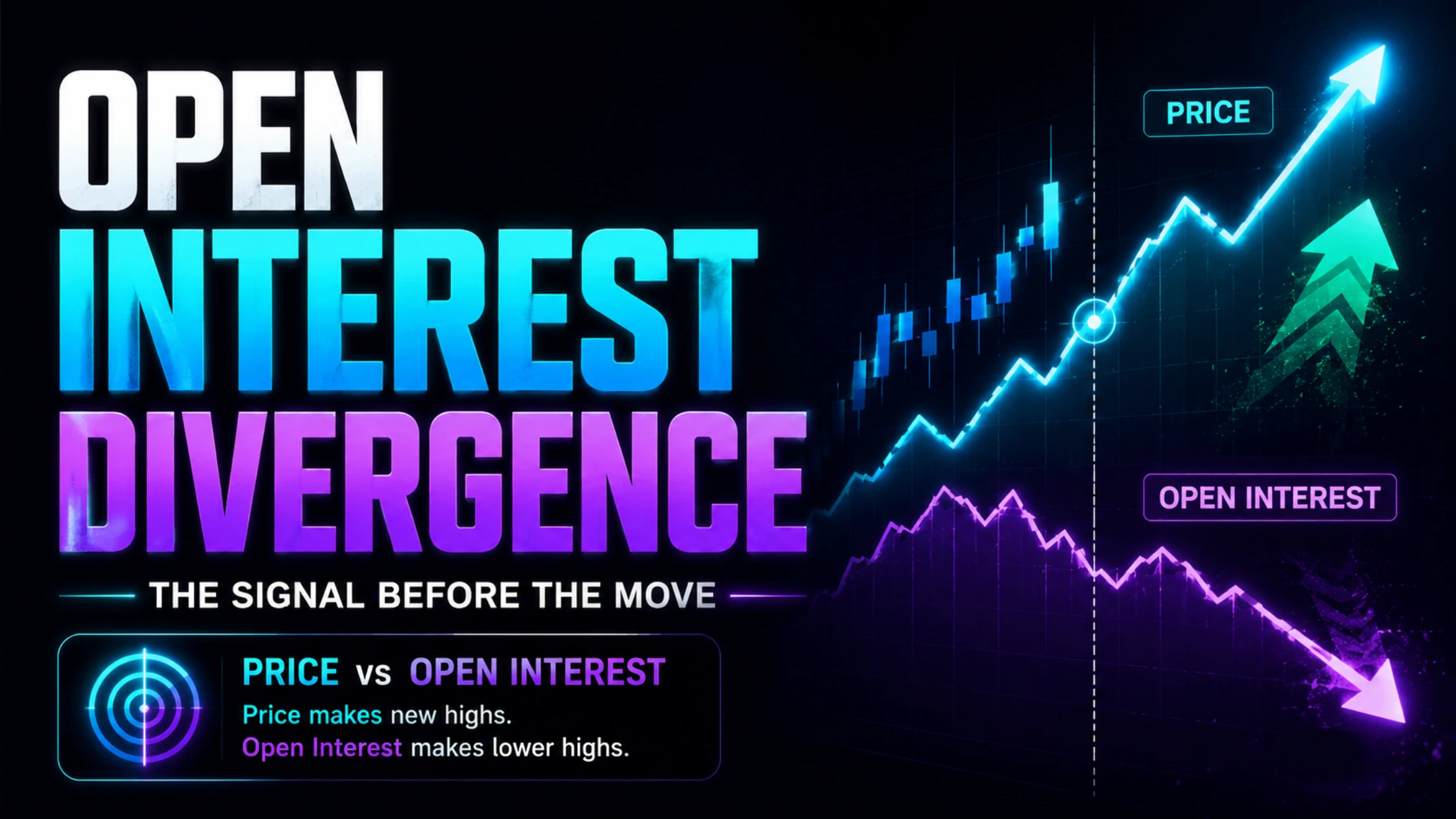
Open Interest Divergence: The Signal That Fires Before the Move
Price tells you what happened. Open interest tells you whether anyone believes it. The DN OI Divergence Reader crosses the two live and names which of four forces is actually moving the market.
Decentralised News · Updated June 12, 2026 · Live instrument · Reading time 11 min
Rising open interest with falling price means new shorts are entering, not longs exiting, which makes it a bearish continuation signal rather than mere profit-taking. That single distinction, whether a move is backed by fresh conviction or just unwinding, is what open interest adds to a price chart, and it is the difference between a trend with fuel behind it and a trend running on fumes. Open interest is the count of all derivative contracts currently open, and read against price direction it sorts every market move into one of four forces. The DN OI Divergence Reader below identifies which one is acting right now, live, for free.
The reason this matters more than price alone: a 5 percent rally looks identical on a candlestick chart whether it is powered by new buyers committing capital or by trapped shorts being forced to cover, but those two rallies have opposite futures. The first has fuel and tends to continue; the second is a fire consuming its own oxygen and tends to exhaust. Open interest is the only freely published number that tells them apart, and most traders never look at it.
What open interest actually counts
Open interest is the total number of derivative contracts that exist and have not been closed. It is not volume, which counts every trade including those that open and close in the same breath; open interest counts only positions still live. Every contract has a long and a short, so the number rises only when a new buyer and a new seller both commit fresh capital, and falls only when existing holders on both sides close. That mechanical fact is the whole signal: a change in open interest is a direct measurement of capital entering or leaving the leveraged market, and crossing its direction against price tells you who is doing the entering.
The four regimes
Two directions for price, two for open interest, four combinations. This is the complete map, and it is the table this instrument encodes:
| OI + price | Regime | Who is acting | Bias |
|---|---|---|---|
| OI up, price up | New money long | Fresh buyers opening longs, committing capital into strength | Bullish continuation |
| OI up, price down | New money short | Fresh sellers opening shorts, pressing weakness with new capital | Bearish continuation |
| OI down, price up | Short squeeze | Trapped shorts buying to close, not new buyers arriving | Bullish but hollow |
| OI down, price down | Long flush | Trapped longs selling to close, leverage being purged | Bearish but cleansing |
The two diagonals are the entire lesson. New money moves, where open interest and price rise or fall together, are conviction: capital is committing in the direction of the move, and trends backed by rising open interest tend to persist because the positioning behind them is real. Unwinding moves, where open interest falls as price travels, are exhaustion: a short squeeze that lifts price on shrinking open interest is shorts capitulating rather than buyers arriving, and once the last trapped short has covered, the fuel is gone and the rally stalls with nothing beneath it. The long flush is the mirror, a decline on falling open interest that is leverage purging rather than new sellers, which is why the cleanest entries so often follow flushes rather than precede them, the same logic the DN Liquidation Pressure Gauge reads from the cascade side.
Funding completes the picture
Open interest tells you that new positions opened; funding tells you the emotional temperature of the side that opened them. A new-money-long regime with mild positive funding is healthy participation; the same regime with funding stretched to extremes is a crowded long that has become its own liquidation fuel, conviction curdling into vulnerability. A new-money-short regime with deeply negative funding is an overcrowded short, the configuration that precedes the most violent squeezes, because every one of those new shorts is a forced future buyer. The Reader overlays funding on the regime for exactly this reason: the quadrant names the force, and funding tells you whether the force is early or exhausted. The options market's parallel reading of the same crowding is our DN Skew Reader.
Open interest crossed against price, classified into the force actually moving the market, with a conviction score and funding overlay.
Research instrument, not financial advice. The regime classifies the force currently moving the market from the signs of the open-interest and price changes; it is not a price target, and divergences can persist or reverse. If the OI-history feed is unavailable the regime reads from the live snapshot only; if all feeds fail, the tool shows our last verified snapshot, labeled with its date. Some links are referral links that support our free tools at no cost to you. Other publications may embed this instrument with a followed credit link to the canonical page on decentralised.news.
How traders use the regimes
- New money long, healthy funding: the trend you can lean on. Rising open interest confirms a rally has real positioning behind it. The risk is not the trend, it is the funding: when it stretches to extremes, the crowded long becomes the next long flush waiting for a spark, so ride it but watch the temperature.
- Short squeeze: fade the exhaustion, do not chase it. A rally on falling open interest is shorts covering, and it ends when the last forced buyer is done. Chasing a squeeze is buying from the people who are finishing, not starting; the higher-probability trade is anticipating the stall as open interest bleeds out.
- New money short, crowded funding: the squeeze setup. Fresh shorts pressing weakness is bearish continuation, but deeply negative funding flips the read: an overcrowded short is fuel for a violent upward squeeze, every new short a future forced buyer. The regime says bearish; the funding says the bears are vulnerable.
- Long flush: the cleanse before the entry. Falling price on falling open interest is leverage purging, not new conviction selling. Historically the cleanest long entries follow flushes, once open interest has reset and forced sellers are gone, which is the same regime our DN Dry Powder Index would pair with a loaded sidelines reading for the highest-quality setup this terminal can show.
Where to act on the reading
The Reader sources Bybit and Binance because they publish the cleanest free derivatives data, and both are also where the depth lives if the regime turns into a trade. Bybit offers the open-interest and funding data this tool reads alongside the deepest retail derivatives book and clean position tooling. Binance carries the largest open interest in the market, which is why its OI history is the reference series for divergence work in the first place. And BloFin is the derivatives-first venue whose position modes and sub-accounts suit the trader building setups around exactly these regimes. The venue-selection question itself is the DN Exchange Fit Engine, and the all-in cost of expressing any of these trades is the DN True Cost of Leverage.
Frequently asked questions
New short positions are being opened: fresh sellers committing capital to press the downside, which makes it a bearish continuation signal rather than longs taking profit. It indicates conviction behind the decline, not mere unwinding.
New money long: fresh buyers opening positions into strength, committing capital, which confirms the rally has real positioning behind it and tends to support continuation, especially while funding stays moderate.
A short squeeze: trapped shorts buying to close rather than new buyers arriving. The rally is hollow because it runs on covering rather than conviction, and tends to stall once the last forced buyer is done.
A long flush: trapped longs selling to close as leverage is purged. The decline is cleansing rather than driven by new conviction selling, which is why the cleanest entries often follow flushes once open interest resets.
The total number of derivative contracts currently open and not yet closed. Unlike volume, which counts all trades, open interest counts only live positions, so its direction measures capital entering or leaving the leveraged market.
It is best read as a confirming and contextual indicator: it does not predict direction on its own, but crossed against price it reveals whether a move is backed by new conviction or by unwinding, which often signals continuation or exhaustion before price confirms it.
Open interest shows that new positions opened; funding shows the crowding and emotional temperature of the side that opened them. Extreme funding on a new-money regime flags a crowded position that has become its own liquidation or squeeze fuel.
Price rising while open interest falls: existing short positions closing en masse rather than new longs opening. Because it runs on forced covering rather than fresh buying, it exhausts once the trapped shorts are out.
A live instrument that crosses open interest change against price change to classify the market into one of four regimes, new money long, new money short, short squeeze or long flush, with a 0 to 100 conviction score and a funding overlay.
Decentralised News publishes research, not financial advice. Leveraged trading involves substantial risk of loss including liquidation. Live readings are market data and change continuously; the regime classifies the current force, not a future price, and historical tendencies do not guarantee outcomes. Some links are referral links that support our free tools at no cost to you. The DN OI Divergence Reader methodology, and the wider instrument suite documented in the editor's books Blockchain Applied and Tokenized Trillions, is open to challenge via the contact page.