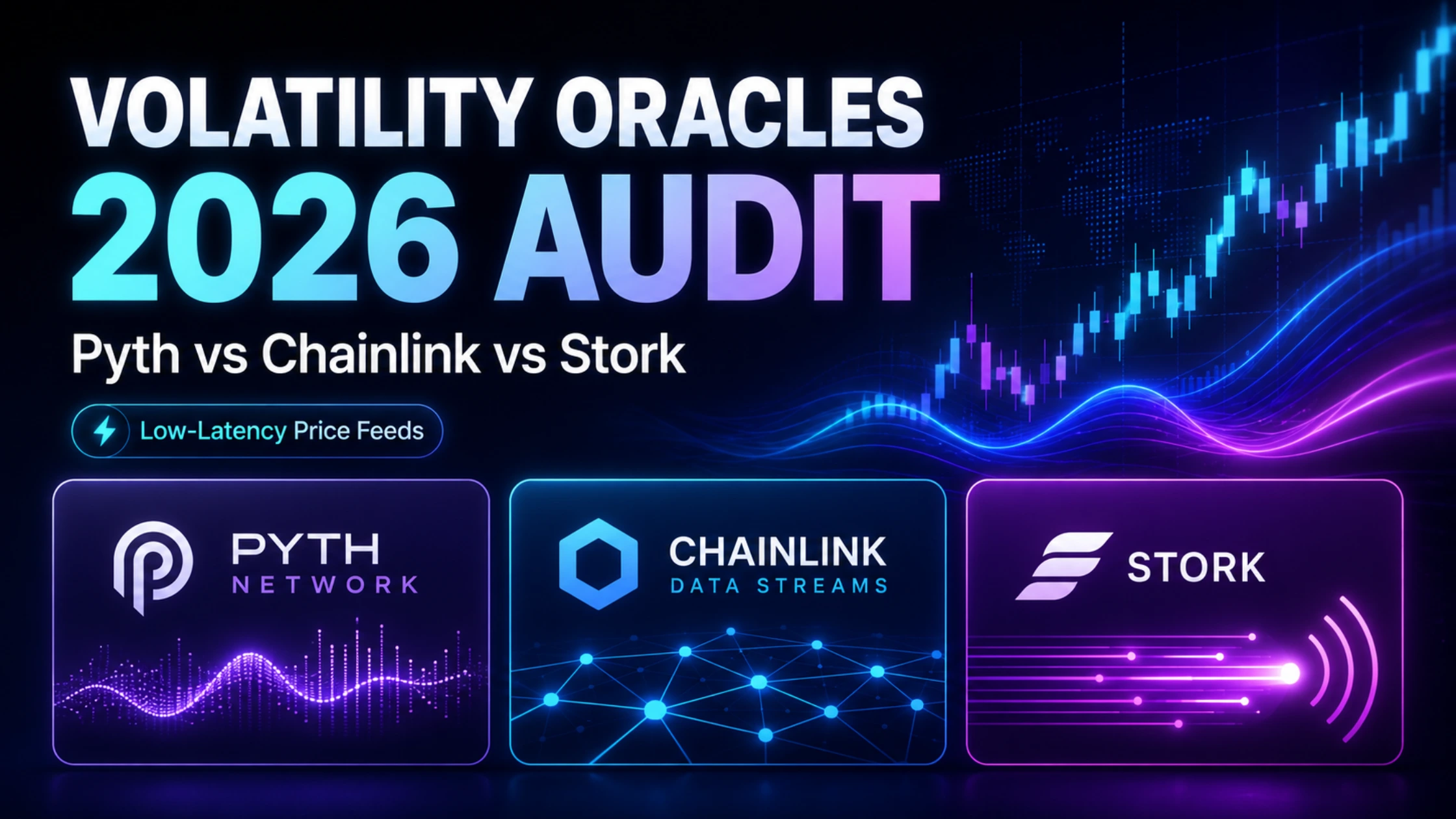
Onchain Volatility Oracles & Low-Latency Price Feeds: Pyth Network vs. Chainlink Data Streams vs. Stork (2026 Audit)
Key Takeaways (DN Oracle Benchmarks)
- The Pull vs. Push Paradigm Shift: Legacy "push-based" oracles update price feeds periodically or on fixed percentage thresholds, burning unnecessary gas and exposing derivatives platforms to latency arbitrage. Modern "pull-based" oracles allow smart contracts and off-chain execution bots to fetch real-time price payloads on demand, achieving sub-second update frequencies.
- Pyth Network leads decentralized derivatives market share, utilizing first-party institutional publishers (CEXs, market makers) on Pythnet to deliver sub-400ms pull-based price updates across 100+ EVM and non-EVM blockchains.
- Chainlink Data Streams provides sub-second, low-latency price feeds combined with automated execution infrastructure, powering high-volume synthetic venues like GMX v2.
- Stork Oracle targets high-frequency app-chains and ZK-rollups with sub-50ms WebSocket price updates, catering to HFT order books and algorithmic liquidation keepers.
Featured Oracle Execution Outlets & VIP Developer Portals
Access low-latency price feeds, WebSocket SDKs, and priority developer API keys using our verified partner portals:
- 🔹 Evedex Developer API Portal: Claim Evedex API Key & VIP Rate Limits — Promo Code:
9e3mk2nx - 🔹 deBridge (Cross-Chain Oracle & Capital Router): Launch deBridge Capital Router — Partner Link:
20473 - 🔹 LogX Router (Multi-Chain Aggregator): Launch LogX Derivatives Router — Promo Code:
0506B422.logX
1. The Latency Bottleneck: Why Onchain Perpetuals Require Pull-Based Oracles
In decentralized perpetual futures and options trading, the accuracy of the platform's liquidation engine and mark price relies entirely on the quality of its underlying price oracle.
Traditional "push" oracles operate by broadcasting price updates to a blockchain at set intervals (e.g., every 10 minutes) or whenever the spot price deviates by a fixed threshold (e.g., 0.5%). During periods of rapid market volatility, push oracles create two major vulnerabilities:
- Latency Arbitrage (Toxic MEV): Off-chain searcher bots spot price movements on Binance or Coinbase before the push oracle updates onchain, opening leveraged positions that exploit stale DEX prices at the expense of liquidity providers.
- Liquidation Glitches & Bad Debt: Stale oracle prices delay required liquidations during flash crashes, accumulating protocol bad debt or causing unfair liquidations when stale feeds catch up suddenly.
To eliminate latency arbitrage, modern derivatives platforms use Pull-Based Oracles. Instead of constantly pushing data onchain, price signatures are generated continuously off-chain. Traders and liquidation keepers "pull" verified price signatures into the exact transaction payload that opens, closes, or liquidates a position.
2. DN Oracle Benchmark Framework (DN-OBF)
Our engineering team evaluates decentralized oracle networks using five quantitative criteria:
- Price Update Latency (PUL): Time elapsed between an off-chain spot market price shift and the availability of a cryptographically signed price payload.
- First-Party Data Ratio: Percentage of price data sourced directly from primary liquidity venues (CEXs, market makers) versus secondary aggregators.
- Cross-Chain Payload Verification Cost: Gas cost required to verify an oracle cryptographic signature on destination smart contracts.
- Deviation & Stale Feed Guard: Onchain fallback mechanisms when primary off-chain price signers experience network partitions.
- WebSocket & REST SDK Depth: Quality of low-latency client libraries for automated trading bots and liquidation keepers.
3. Onchain Oracle Performance Comparison Matrix
Below are the empirical benchmarks from our 30-day continuous stress test on low-latency oracle feeds:
| Oracle Network | Architecture Model | Update Latency | Data Sourcing Model | Primary Advantage | Verified Developer Portal |
|---|---|---|---|---|---|
| Pyth Network | Pull-Based (Pythnet App-Chain) | < 400ms | First-Party (CEXs & HFTs) | Sub-second pull updates across 100+ EVM/non-EVM chains | deBridge Capital Router (20473) |
| Chainlink Data Streams | Low-Latency Pull + Automation Engine | < 500ms | Aggregated Decentralized Nodes | Native integration with Chainlink Automation & GMX v2 | LogX Router (0506B422.logX) |
| Stork | High-Frequency WebSocket Pull Engine | < 50ms | First-Party & Aggregated Feeds | Sub-50ms tick rate for ZK-rollups & HFT app-chains | Evedex API Portal (9e3mk2nx) |
4. Platform Deep Dives: Top Oracle Infrastructure Venues
1. Pyth Network — First-Party Financial Data Powerhouse
Pyth Network dominates non-EVM and EVM derivatives price discovery, serving as the primary oracle for Jupiter Perps, Synthetix, and Helix.
Key Highlights: First-party price feed generation from institutional trading desks (Jane Street, Cboe, Binance), aggregated on Pythnet and broadcast cross-chain in sub-400ms pull updates.
💡 Developer Pro Tip: Route cross-chain capital into Pyth-powered DEXs using the deBridge Intent Router (Code 20473).
2. Chainlink Data Streams — Institutional Security with Onchain Automation
Chainlink Data Streams represents Chainlink's low-latency solution designed specifically for high-volume derivatives exchanges like GMX v2.
Key Highlights: Sub-second off-chain price generation integrated directly with Chainlink Automation, allowing protocols to execute limit orders and liquidations instantly upon feed pull.
💡 Developer Pro Tip: Access multi-chain derivatives aggregators powered by Chainlink feeds via the LogX Router (Code 0506B422.logX).
3. Stork — Sub-50ms WebSocket Feeds for App-Chains & ZK-Rollups
Stork is built specifically for high-frequency trading venues requiring ultra-low latency updates.
Key Highlights: Sub-50ms WebSocket streaming ticks with low onchain cryptographic verification gas costs, tailored for ZK-validiums and algorithmic liquidation keepers.
💡 Developer Pro Tip: Request elevated rate limits and low-latency API access on the Evedex API Portal (Code 9e3mk2nx).
Frequently Asked Questions (FAQ)
What is the difference between a Push Oracle and a Pull Oracle?
Push Oracles broadcast price updates to a blockchain on fixed time or percentage variance triggers, paying gas for every update regardless of whether a trade occurs. Pull Oracles generate cryptographically signed price feeds off-chain continuously, allowing users or bots to "pull" the latest price payload onchain only when submitting an active transaction.
How does Pyth Network achieve sub-second price updates across dozens of blockchains?
Pyth aggregates first-party price data from institutional exchanges and market makers on a dedicated app-chain called Pythnet. Cryptographic price proofs are then relayed cross-chain on demand using low-latency messaging infrastructure.
Can low-latency oracles be manipulated by flash loans?
Because pull-based oracles aggregate data from first-party institutional market makers and global spot exchanges (Binance, Coinbase, Cboe) rather than local onchain AMM pools, they are immune to single-chain flash loan price manipulation.