
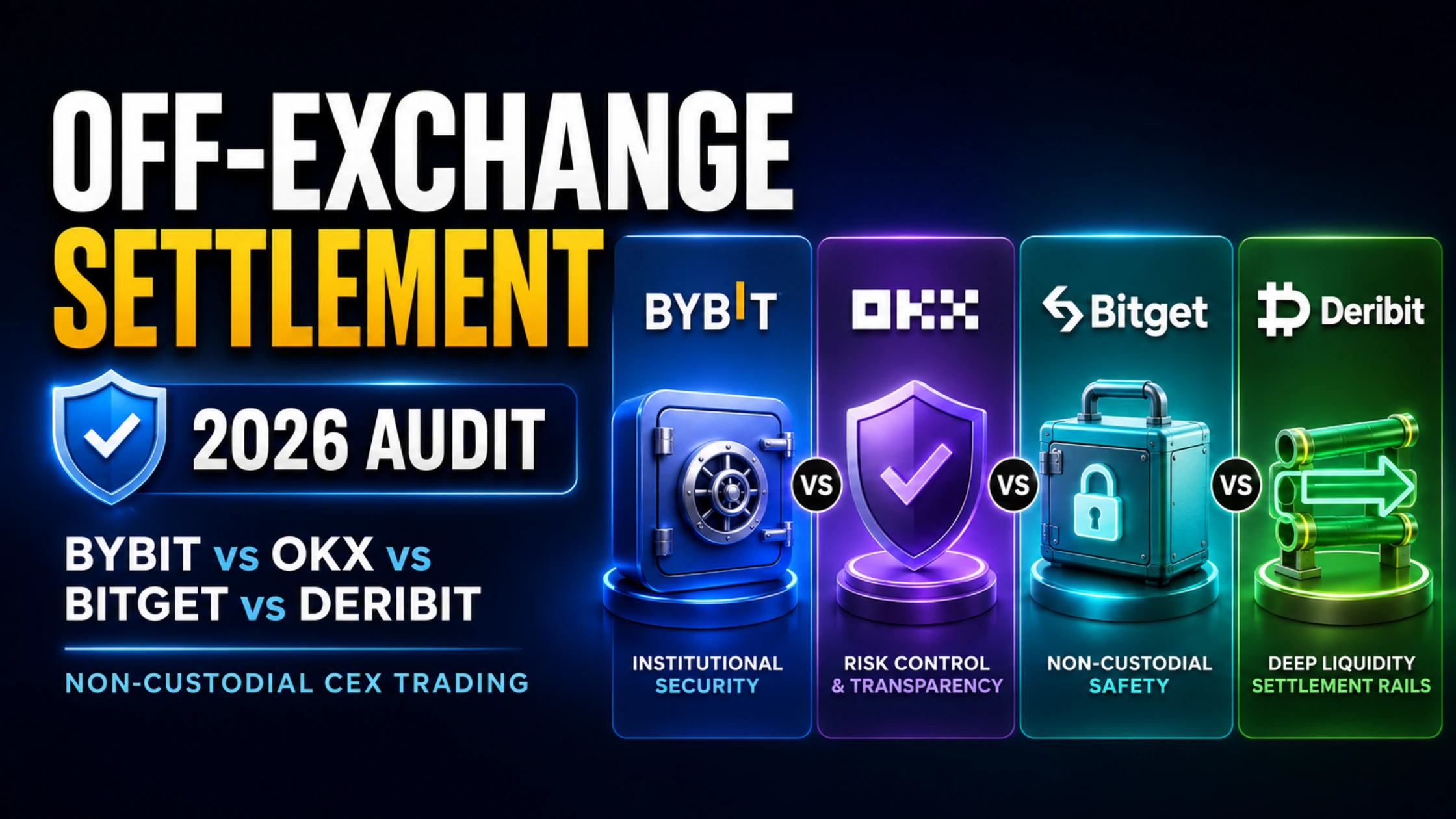
Institutional Off-Exchange Settlement & Non-Custodial CEX Trading: Bybit vs. OKX vs. Bitget vs. Deribit (2026 Audit)
Key Takeaways (DN Institutional Settlement Benchmarks)
- The Off-Exchange Settlement Revolution: Institutional crypto allocators and quantitative hedge funds no longer deposit spot assets directly onto centralized exchange balances. Instead, off-exchange settlement networks (such as Copper ClearLoop, Fireblocks Off-Exchange, and C桥 networks) keep trading collateral locked in independent, regulated custody while mirroring credit lines directly onto exchange order books.
- Zero Exchange Counterparty Risk: In the event of exchange operational insolvency, trading capital remains bankruptcy-remote inside independent custodian vaults, completely eliminating credit loss exposure.
- Bybit leads institutional off-exchange clearing volume via deep integrations with Copper ClearLoop and Fireblocks, providing unified margin and sub-20ms execution across perpetuals, options, and spot markets.
- OKX offers robust institutional mirror-clearing infrastructure, backing high-frequency market makers with custom credit allocation and real-time risk-monitoring APIs.
- Bitget expands off-exchange settlement channels for quantitative desks, pairing low taker fee schedules with non-custodial custodian clearing.
- Deribit maintains the gold standard for off-exchange options and volatility clearing, enabling portfolio-margined options trading directly against custodian-backed collateral reserves.
Featured Institutional Outlets & VIP Clearing Portals
Access institutional rate tiers, non-custodial API accounts, and priority clearing routing using our verified partner portals:
- 🔹 Bybit Institutional Desk: Launch Bybit Institutional Clearing Account — Referral Code:
46164 - 🔹 OKX Institutional Terminal: Launch OKX Non-Custodial Clearing Account — Referral Code:
2136301 - 🔹 Bitget Quant VIP Portal: Claim Bitget Institutional VIP Account — Referral Code:
nqef - 🔹 Deribit Options Desk: Claim Deribit 10% Fee Rebate — Promo Code:
5969.4030 - 🔹 deBridge (Cross-Chain Capital Router): Bridge Capital via deBridge — Partner Link:
20473 - 🔹 LogX Router (Multi-Chain Aggregator): Launch LogX Derivatives Router — Promo Code:
0506B422.logX
1. The Post-FTX Institutional Paradigm: Trading Without Exchange Custody
The primary structural weakness of early crypto market architecture was simple: forced exchange custody. To access the deep order book liquidity, tight spreads, and low taker fees of top centralized exchanges (CEXs), institutional asset managers were required to pre-fund exchange wallets, exposing millions of dollars in capital to exchange counterparty risk.
In 2026, Off-Exchange Settlement (OES) networks have unbundled execution from custody.
Under an Off-Exchange Settlement model:
- Collateral Remains Vault-Locked: Capital stays inside an independent, regulated custodian (e.g., Copper, Fireblocks, Komainu) in cold-storage vaults or MPC (Multi-Party Computation) trust structures.
- Mirror Credit Allocated: The custodian creates an immutable cryptographic link to the exchange, which mirrors an equivalent trading credit line onto the exchange's matching engine.
- P&L Netting & Settlement: Trades execute on the exchange at full CEX speed. Net gains and losses are settled periodically (e.g., every 4 to 24 hours) directly between custodian vaults onchain or via private clearing loops.
To evaluate which exchange provides the deepest OES liquidity, lowest latency overhead, and tightest spread execution, Decentralised News audited Bybit, OKX, Bitget, and Deribit.
2. DN Institutional Custody & Execution Score (DN-ICES) Framework
Our quantitative research team evaluates institutional off-exchange clearing venues using five specialized criteria:
- Custodian Ecosystem Breadth: The range of supported independent custodians (Copper ClearLoop, Fireblocks, Komainu, Cobic) integrated natively into the exchange risk engine.
- Settlement Latency & Rebalancing Frequency: The cycle interval (e.g., 2-hour, 4-hour, 8-hour) at which net P&L is settled onchain between custodian and exchange.
- Execution Latency Delta: Latency overhead added by custodian credit-check checks compared to direct exchange wallet execution.
- Bankruptcy Remote Isolation: Legal enforceability and cryptographic isolation of collateral during exchange liquidation events.
- Portfolio Margin Efficiency: Ability to cross-margin options, spot, and perpetual futures against off-exchange collateral balances.
3. Off-Exchange Settlement Venue Comparison Matrix
Below are the audited performance benchmarks from our continuous 30-day institutional clearing audit:
| Exchange | Integrated Custodians | Settlement Frequency | Latency Overhead | Supported Instruments | Verified Partner Portal |
|---|---|---|---|---|---|
| Bybit | Copper ClearLoop, Fireblocks, Komainu | Real-Time / 4-Hour | < 15ms | Perps, Options, Spot & Unified Margin | Bybit Institutional Desk (46164) |
| OKX | Fireblocks, Copper, Native Mirror | Real-Time / 8-Hour | < 18ms | Futures, Options & Spot Margin | OKX Terminal (2136301) |
| Bitget | Fireblocks, Independent Trust Vaults | 4-Hour / 12-Hour | < 22ms | Perpetual Futures & Spot Markets | Bitget Quant Desk (nqef) |
| Deribit | Copper ClearLoop, Fireblocks | Hourly / 8-Hour | < 12ms | BTC/ETH/SOL Options & Futures | Deribit VIP Desk (5969.4030) |
4. Platform Deep Dives: Top Institutional Settlement Venues
1. Bybit — The Institutional Liquidity Leader in Off-Exchange Settlement
Bybit has established itself as the primary liquidity hub for institutional funds, market makers, and quantitative trading desks using non-custodial clearing structures.
Key Highlights: Unified Margin Engine cross-margins perps, options, and spot against Copper ClearLoop/Fireblocks vault collateral with sub-15ms execution latency.
💡 Institutional Pro Tip: Register on the Bybit Institutional Desk (Code 46164) to configure off-exchange credit clearing and custom VIP fee tiers.
2. OKX — CEX Execution Speed with Cryptographic Custody
OKX provides robust, enterprise-grade mirror trading infrastructure tailored for high-frequency trading (HFT) firms and risk-averse funds.
Key Highlights: Real-time mark-to-market risk management automatically updates off-exchange credit lines across perps, quarterly futures, and options order books.
💡 Trader Pro Tip: Open non-custodial institutional trading accounts on the OKX Terminal (Code 2136301).
3. Bitget — Low Taker Fees for Off-Exchange Quantitative Desks
Bitget has expanded its institutional ecosystem by introducing flexible off-exchange clearing channels paired with competitive maker/taker fee tiers.
Key Highlights: Direct integration with Fireblocks and independent trust vaults enables rapid credit delegation for quantitative scalpers and arbitrage desks.
💡 Trader Pro Tip: Claim institutional fee rebates on Bitget via Referral Code nqef.
4. Deribit — The Global Standard for Non-Custodial Options Clearing
Deribit dominates institutional crypto options liquidity, serving as the primary options execution venue for global crypto hedge funds.
Key Highlights: Trade complex multi-leg options spreads while underlying collateral remains locked inside Copper ClearLoop or Fireblocks, backed by SPAN scenario margin releases.
💡 Trader Pro Tip: Access institutional options tools on the Deribit VIP Desk (Code 5969.4030) for a 10% trading fee discount.
Frequently Asked Questions (FAQ)
What is the main difference between onchain DEX trading and CEX off-exchange settlement?
Onchain DEX trading executes and settles every order directly on a blockchain or Layer-2 network. CEX Off-Exchange Settlement executes orders off-chain on a centralized exchange's high-speed matching engine, but keeps the underlying collateral locked in an independent, regulated custody vault (like Copper or Fireblocks) with periodic P&L netting.
Does off-exchange settlement increase execution latency?
Because trading credit is pre-delegated and mirrored onto the exchange before order placement, order matching occurs at native CEX speeds (sub-20ms). Custodian validation logic happens during setup and periodic settlement windows, ensuring zero latency impact on active order placement or cancellation.
What happens if an exchange goes bankrupt while an off-exchange account is open?
Because your trading collateral is held inside an independent, legally segregated custodian vault, it is bankruptcy-remote from the exchange. Only net unsettled P&L accumulated during the current clearing window is subject to settlement, preserving the vast majority of your capital.
Related reading:
Best Crypto Exchanges for Institutional Traders (2026)
Will Bitcoin ETFs Double AUM in 2026? Institutional Bets on the Next Bull Run
Deribit Options Strategy in 2026: The Institutional Playbook for Crypto Traders
FinchTrade Review: Institutional Stablecoin Settlement for PSPs, EMIs, & Exchanges
The Institutional Adoption Curve: Who Is Actually Buying Bitcoin in 2026?
Zero Price Risk: How Institutional Desks Monetize Leveraged Demand With Carry Arbitrage





