
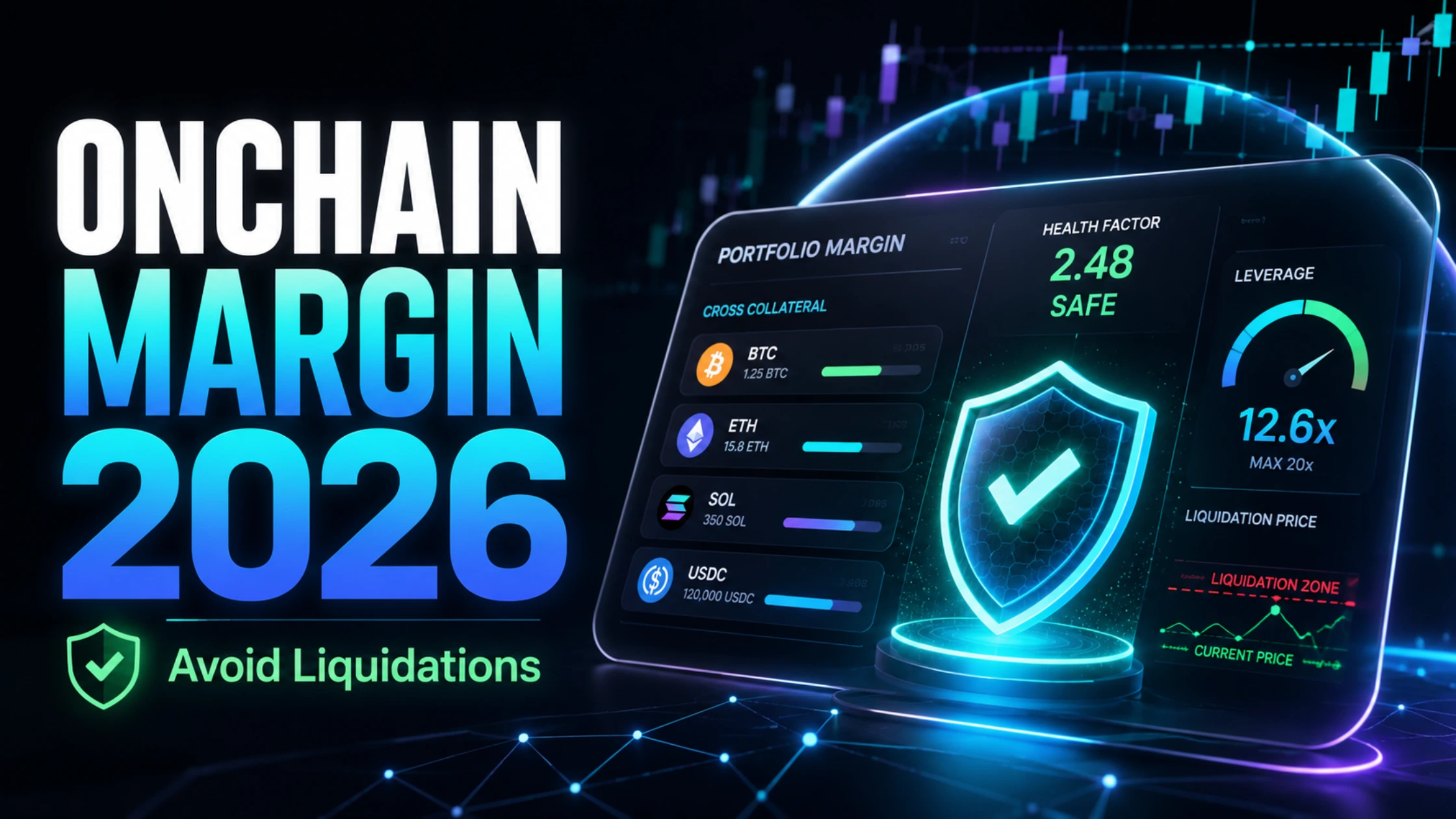
The Ultimate Guide to Onchain Portfolio Margin & Liquidation Prevention in High-Leverage Crypto Trading (2026 Audit)
Key Takeaways (DN Risk Management Benchmarks)
- The Liquidation Wick Trap: Over 80% of retail derivatives liquidations occur during temporary price wicks where mark prices momentarily touch liquidation thresholds before rebounding.
- Portfolio Margin vs. Isolated Margin: Legacy isolated margin locks collateral into single pairs, whereas advanced Portfolio Margin Engines (available on venues like Deribit, Aevo, and Paradex) evaluate net risk across your entire portfolio—offsetting long and short exposure to drastically lower maintenance margin requirements.
- Yield-Bearing Collateral Multipliers: Modern DEXs allow traders to post yield-bearing assets (aeUSD, JLP, stETH) as active margin collateral, earning passive interest while backing leveraged perpetual and options trades.
Featured Portfolio Margin Venues & VIP Risk Portals
Access advanced portfolio margin tools, fee discounts, and priority risk calculators using our verified partner portals:
- 🔹 Aevo Portfolio Margin Hub: Launch Aevo Unified Margin Desk — Referral Code:
decentralised - 🔹 Paradex ZK Risk Engine: Launch Paradex Zero-Knowledge Margin Terminal — Referral Code:
decentralised - 🔹 Deribit Institutional Desk: Claim Deribit 10% Fee Discount — Promo Code:
5969.4030 - 🔹 Evedex (Low-Latency Execution Engine): Claim Evedex VIP API Key — Promo Code:
9e3mk2nx - 🔹 Jupiter Perps (Solana JLP Collateral): Trade Jupiter Perps on Solana — Referral Code:
whj8az405rdo
1. The Onchain Liquidation Threat: Why Leveraged Traders Suffer Flash Crashes
Trading leveraged perpetual futures onchain offers unprecedented freedom, sub-second execution speeds, and self-custody. However, it also exposes traders to an aggressive risk vector: Automated Onchain Liquidation Engines.
Unlike traditional finance, where margin calls are preceded by phone alerts or multi-day grace periods, decentralized exchanges enforce strict, automated liquidations. If your account equity falls below the protocol's required Maintenance Margin Ratio (MMR), smart contracts or liquidation keepers instantly trigger a market sell-off, slashing your position and charging steep liquidation penalty fees.
To preserve capital during volatile sessions, quantitative traders utilize three core risk mitigation strategies:
- Cross-Asset Portfolio Margining: Offsetting opposing risk vectors across options, perpetuals, and spot holdings.
- Yield-Bearing Collateral Cushioning: Utilizing yield-accruing margin assets (e.g., aeUSD or JLP) to continuously increase account equity buffers over time.
- Dynamic Oracle Index Buffering: Trading on platforms that cross-reference multiple independent oracles (Pyth, Chainlink) to prevent single-feed liquidation wicks.
2. DN Capital Preservation Index (DN-CPI) Framework
Our risk engineering team evaluates derivatives trading venues using five quantitative criteria:
- Portfolio Margin Capital Savings: The percentage reduction in required maintenance margin when holding delta-hedged positions (e.g., long spot + short perp, or long call + short perp).
- Mark Price Smoothing Mechanics: The algorithm used to calculate mark prices (e.g., exponential moving average index vs. spot median) to prevent liquidation cascades.
- Liquidation Penalty Surcharge: The percentage penalty fee extracted by the exchange's insurance fund upon liquidation.
- Yield Collateral Haircut Rate: The risk discount applied when utilizing non-stables (e.g., stETH, JLP) as active margin collateral.
- ADL (Auto-Deleveraging) Transparency: Clear protocol parameters governing how profitable opposing positions are closed when insurance funds deplete.
3. Margin Architecture Benchmarks
Below is a technical comparison of the three primary margin models operating across derivatives exchanges in 2026:
| Margin Architecture | Capital Efficiency | Risk Isolation | Best Use Case | Verified Partner Venue |
|---|---|---|---|---|
| Isolated Margin | Low (Collateral locked per trade) | Maximum (Losses capped strictly to trade collateral) | High-leverage directional scalping & meme perps | Evedex VIP Portal (9e3mk2nx) |
| Cross Margin | Moderate (Shared account balance) | Moderate (All account collateral backs active trades) | Multi-position trend trading & grid bots | Jupiter Perps (whj8az405rdo) |
| Portfolio Margin | Maximum (Risk-based net delta offset) | Managed (Aggregated portfolio risk modeling) | Delta-neutral hedging, straddles & multi-leg quant strategies | Aevo Developer Hub (decentralised) |
4. Platform Deep Dives: Best Onchain Risk & Margin Engines
1. Aevo — Unified Margin with Yield-Bearing Collateral
Aevo operates an Ethereum L2 rollup built on the OP Stack. Its defining feature is a unified margin engine that seamlessly combines options, perpetual futures, and yield-bearing assets under a single risk model.
Key Highlights: Deposit aeUSD as base collateral to earn ~5% Treasury bill APY while actively backing leveraged trades. Opposing long and short delta risk across options and perps is offset to lower required maintenance margin.
💡 Trader Pro Tip: Register on the Aevo Developer Hub (Code decentralised) to configure unified portfolio margin accounts.
2. Paradex — ZK-STARK Portfolio Risk Engine
Powered by StarkNet's zero-knowledge app-chain architecture, Paradex delivers institutional-grade risk management with total transactional privacy.
Key Highlights: Scenario-based stress testing framework that calculates holistic account risk, coupled with zero public mempool exposure to eliminate front-running.
💡 Trader Pro Tip: Launch the Paradex ZK Risk Engine (Code decentralised) for private portfolio margin execution.
3. Deribit — The Gold Standard in Institutional Risk Modeling
Deribit commands the world's deepest crypto options order book and sets the benchmark for institutional risk management.
Key Highlights: Scenario-based portfolio margin engine evaluating account performance across 10 distinct price and volatility shock scenarios, delivering up to 10x higher capital efficiency for delta-neutral desks.
💡 Trader Pro Tip: Access institutional risk tools on the Deribit VIP Desk (Code 5969.4030) for a 10% trading fee rebate.
Frequently Asked Questions (FAQ)
What is the difference between Mark Price and Index Price?
The Index Price represents the global spot average of an asset across major exchanges. The Mark Price is a smoothed price metric calculated by the DEX (combining the Index Price with a moving average funding basis). Liquidation engines evaluate your margin health against the Mark Price to prevent short-lived market wicks from triggering unfair liquidations.
How does Portfolio Margin reduce my required margin?
Standard cross-margin calculates margin for each position independently. Portfolio Margin analyzes the net directional risk of your entire account. If you hold a Long ETH spot position and a Short ETH futures position, the portfolio engine recognizes that losses on one leg are offset by gains on the other, reducing your net risk and lowering your required margin.
What happens to my positions during Auto-Deleveraging (ADL)?
If market volatility is so extreme that an exchange's insurance fund cannot cover liquidated account losses, the exchange triggers Auto-Deleveraging (ADL). ADL automatically closes the most profitable opposing positions in the market to restore protocol solvency.





