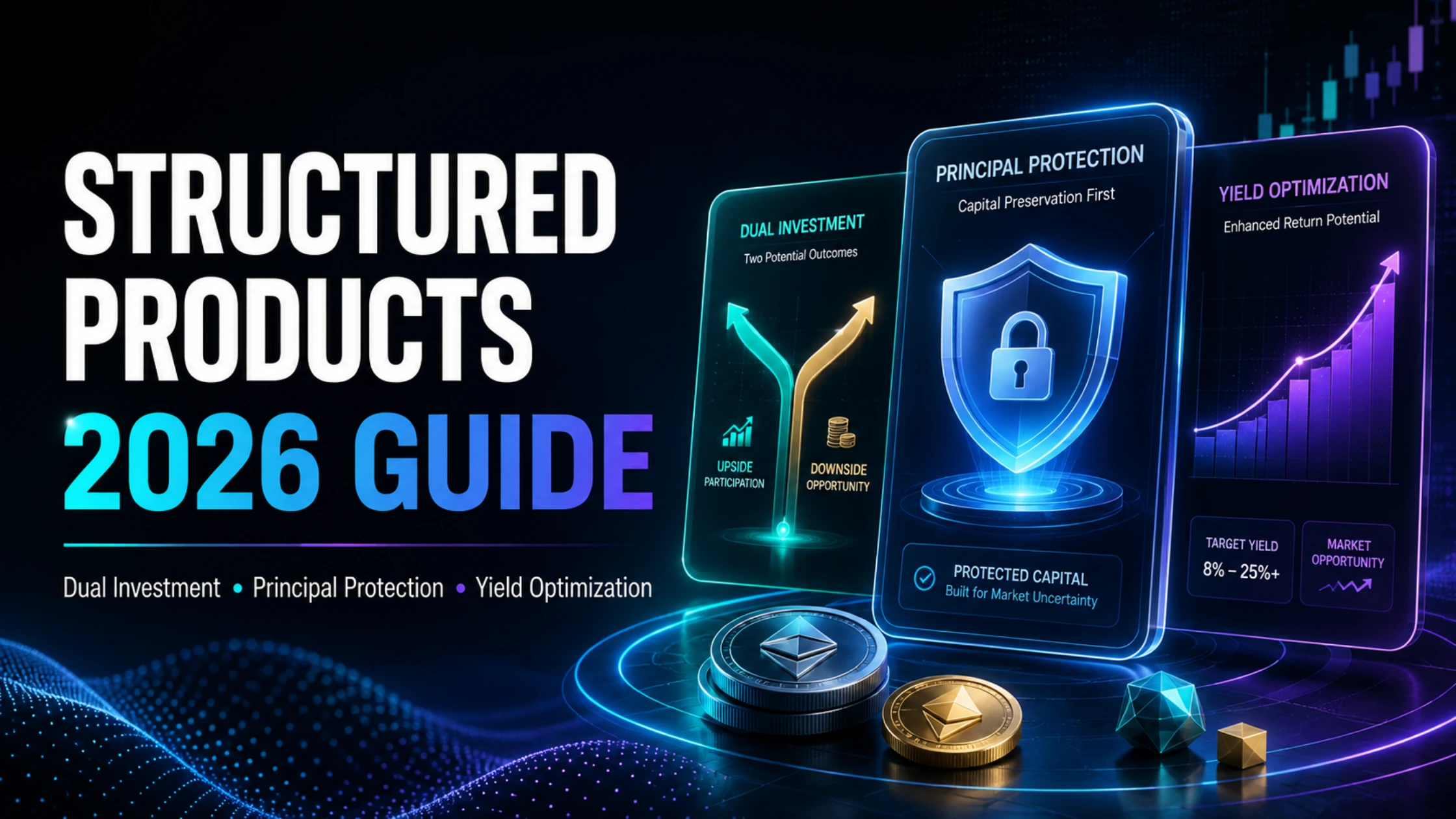
Mastering Crypto Structured Products: Dual Investment, Principal Protection, and Yield Optimization in 2026
The cryptocurrency yield landscape has matured from the wild west of inflationary, unsustainable token emissions into a sophisticated, institutional-grade financial ecosystem. By 2026, High-Net-Worth Individuals (HNWIs), family offices, and advanced retail investors are increasingly bypassing complex, multi-step DeFi yield strategies in favor of Crypto Structured Products.
Borrowed from traditional finance (TradFi) and adapted for the digital asset era, structured products package complex derivatives strategies (like options writing) into simple, user-friendly interfaces. They allow investors to generate enhanced yield, hedge downside risk, or systematically accumulate assets at a discount, all with predefined, transparent risk parameters.
This comprehensive guide breaks down the mechanics of modern crypto structured products, the top-tier platforms offering them in 2026, and the strict analytical frameworks required to deploy capital efficiently without falling victim to hidden opportunity costs or regulatory pitfalls.
The 3 Pillars of Crypto Structured Products in 2026
To utilize these instruments effectively, you must look past the marketing APY and understand the underlying derivatives mechanics.
- Dual Investment (Selling Options for Yield): This is the most popular structured product. It is fundamentally a Covered Call (if you deposit crypto) or a Cash-Secured Put (if you deposit stablecoins). You commit to selling your crypto at a predetermined “Target Price” on a future “Settlement Date.” In exchange, you receive a high, fixed Annual Percentage Yield (APY). If the price stays below the target, you keep your crypto plus the yield. If it rises above, your crypto is automatically sold at the target price, plus the yield.
- Principal-Protected Notes (e.g., “Shark Fin” Products): Designed for conservative investors, these products offer a guaranteed return of your initial principal (in stablecoins or BTC/ETH) while offering a bonus yield if the asset’s price stays within a predefined “observation range” during the investment period. It is essentially a zero-coupon bond combined with a digital barrier option, perfect for sideways or mildly trending markets.
- Auto-Invest and Volatility Harvesting: These products automate Dollar-Cost Averaging (DCA) during market dips. When an asset’s price drops below a certain threshold, the product automatically deploys stablecoins to buy the asset, often coupled with a simultaneous covered call to generate immediate yield on the newly acquired position.
Top Platforms for Crypto Structured Products in 2026
Accessing these products requires platforms with deep liquidity, transparent pricing, and robust regulatory compliance.

1. Binance: Best for Retail-Accessible Dual Investment and Shark Fin Products
Binance has perfected the user experience for crypto structured products, making institutional-grade derivatives strategies accessible to everyday investors with as little as $10.
- Core Features: Binance’s “Dual Investment” and “Shark Fin” interfaces clearly display the Target Price, Settlement Date, and the exact APY you will earn. The platform offers these products on major assets (BTC, ETH, SOL, BNB) with daily, weekly, and monthly settlement cycles.
- Regulatory Transparency: In 2026, Binance provides clear, standardized Key Information Documents (KIDs) for its structured products in regulated jurisdictions (like the EU under MiCA), detailing the exact worst-case scenarios and payoff structures.
- Why Investors Choose It: It eliminates the need to interact with complex DeFi options vaults or manage gas fees. The execution is seamless, the liquidity is deep, and the funds are instantly available for trading or withdrawal upon settlement.
👉 Explore High-Yield Dual Investment and Shark Fin Products on Binance (Use referral code: CPA_00SXKU7IO9)

2. Kraken: Best for Regulated, Institutional-Grade Structured Yield
For HNWIs and family offices who prioritize regulatory compliance and institutional custody over retail-friendly gamification, Kraken offers a highly curated suite of structured yield products.
- Core Features: Kraken’s structured products are designed with institutional risk parameters in mind. They offer customized, over-the-counter (OTC) structured notes for large clients, allowing for tailored strike prices, durations, and principal protection levels that are not available on retail interfaces.
- Segregated Custody: Unlike platforms that commingle user funds in opaque yield-generating strategies, Kraken’s structured products are backed by transparent, segregated reserves, ensuring that your principal is protected even in the event of broader market contagion.
- Why Investors Choose It: It provides the ultimate peace of mind. Investors get the yield enhancement of structured products backed by one of the most heavily audited, compliant, and secure exchanges in the world.
👉 Access Institutional-Grade Structured Crypto Yield on Kraken (Use referral code: QjZ0L3)

3. Ledger: Best for Securing Assets Pre- and Post-Settlement
While the structured product itself may be hosted on a centralized exchange, the assets you use to fund it, and the assets you receive upon settlement, must be secured with military-grade precision.
- Core Features: Ledger hardware wallets ensure that the initial transfer of funds into a structured product, and the subsequent withdrawal of your principal and yield, are protected by a FIPS 140-2 Level 3 certified Secure Element.
- Phishing Resistance: When interacting with any DeFi-native structured product alternatives (like Thetanuts or Ribbon Finance), Ledger’s Clear Signing technology ensures you are approving the correct vault contract and not a malicious look-alike designed to drain your wallet.
- Why Investors Choose It: It provides the ultimate physical circuit breaker. You maintain absolute sovereignty over your capital, moving it into structured products only when you choose, and withdrawing it to cold storage immediately upon settlement.
👉 Secure Your Structured Product Capital with a Ledger Hardware Wallet
Step-by-Step: How to Evaluate and Deploy a Structured Product
Do not chase the highest displayed APY. A high APY in a Dual Investment product simply means the market views the outcome as highly probable, or the option is deeply out-of-the-money. Follow this blueprint:
Step 1: Define Your Market Thesis
Are you willing to sell your BTC at $80,000? If yes, a Dual Investment product with an $80,000 target price is appropriate. If you believe the market will trade sideways between $60,000 and $70,000, a Shark Fin product is the optimal choice.
Step 2: Calculate the “Break-Even” and Opportunity Cost
In Dual Investment, your effective sell price is the Target Price + the Yield Earned.
- Example: You deposit 1 BTC. Target Price is $70,000. The yield is 5% (0.05 BTC). Your effective sell price is $70,000 + $3,500 (value of 0.05 BTC) = $73,500.
- If BTC rallies to $100,000, you still only receive $73,500 worth of value. You must be comfortable capping your upside at this level.
Step 3: Execute and Monitor
Select your product on a platform like Binance or Kraken, confirm the terms, and execute. Set a calendar reminder for the Settlement Date.
Step 4: Post-Settlement Action
Upon settlement, your funds will be returned either in the original asset + yield, or the alternate asset + yield. Immediately evaluate the new market conditions. Do not blindly “roll over” into the next structured product without reassessing your target prices based on the new market reality.
Risk Management: The Hidden Dangers of Structured Products
Structured products are not “free money.” They are carefully calibrated risk-transfer mechanisms. You must actively manage these pitfalls:
- Opportunity Cost (The “Sold Too Early” Risk): This is the most common complaint. In a raging bull market, your crypto will be called away at the target price, and you will miss out on the subsequent parabolic rally. Mitigation: Only use Dual Investment for assets you are genuinely willing to part with at the target price, or allocate only a portion (e.g., 20-30%) of your total holdings to these products.
- Downside Risk in Cash-Secured Puts: If you use USDC to buy a Dual Investment product to acquire ETH at a lower price, and ETH crashes to zero, you are still obligated to buy it at the target price. You will end up holding a depreciating asset. Mitigation: Only set target prices at strong, historically validated support levels where you would be happy to accumulate the asset long-term.
- DeFi Smart Contract Risk: If you opt for decentralized structured products (DeFi options vaults) to avoid centralized exchange counterparty risk, you inherit smart contract risk. Mitigation: Only use battle-tested, heavily audited DeFi vaults, and always interact with them via a Ledger hardware wallet.
- Tax Complexity: Structured products generate complex tax events. The yield is often taxed as ordinary income upon settlement, and if your asset is “called away” (sold), it triggers a capital gains event. Mitigation: Use automated crypto tax software to track these events accurately.
👉 Automate Your Complex Structured Product Tax Tracking with Koinly
Frequently Asked Questions (FAQ)
Q: Is Dual Investment the same as staking?
A: No. Staking involves validating a blockchain network and earning inflationary rewards or transaction fees, with your principal remaining intact (barring slashing). Dual Investment is an options-selling strategy. Your principal can be converted into a different asset at a predetermined price, meaning you are taking on directional market risk in exchange for higher yield.
Q: Can I cancel a structured product before the settlement date?
A: Generally, no. Once you subscribe to a Dual Investment or Shark Fin product, the funds are locked until the settlement date. This is because the platform has already used your capital to hedge the position in the derivatives market. Some platforms may offer a secondary market to sell your position, but usually at a discount.
Q: How are Dual Investment profits taxed?
A: Tax treatment varies by jurisdiction, but generally, the yield earned is treated as ordinary income at the fair market value on the settlement date. If your crypto is converted (sold) at the target price, it also triggers a capital gains or losses event based on your original cost basis. Because these events happen automatically, using a tool like Koinly is essential to avoid misreporting.
Q: Are structured products safe from exchange bankruptcy?
A: If you use a centralized exchange (CEX), you are exposed to counterparty risk. If the exchange fails, your funds may be lost. Mitigation: Use highly regulated, proof-of-reserves-audited platforms like Kraken or Binance, or opt for decentralized, self-custodial structured products (DeFi vaults) secured by a Ledger hardware wallet.
Risk Warning: Cryptocurrency structured products, including Dual Investment and principal-protected notes, carry significant risks. While some products offer principal protection under specific conditions, others expose you to market volatility, opportunity cost, and the risk of your assets being converted at unfavorable prices. You could sustain a loss of some or all of your initial investment.
Not Financial Advice: The information provided in this article is for educational and informational purposes only. It does not constitute financial, investment, legal, or tax advice. Always conduct your own research (DYOR) and consult with a qualified, licensed professional before investing in complex derivative-based structured products.
Affiliate Disclaimer: This article contains affiliate links. If you click on these links and sign up for a service or make a purchase, we may earn a commission at no additional cost to you. We only recommend platforms, tools, and services that we have thoroughly vetted and believe provide genuine value, security, and utility to our readers.
Related reading:
Crypto Structured Products in 2026: Autocallables, Range Accrual, and Options-Driven Yield Explained
Tokenized US Treasuries: Best On-Chain Yield Products Compared in 2026
Yield Derivatives Audit 2026: Pendle Finance vs. Spectra vs. Voltz Protocol