

Last fact checked: August 15, 2026
Research edition: DN Deposit Reliability Index
Which crypto exchanges handle deposits most reliably? The DN Deposit Reliability Index compares confirmation rules, crediting controls, network warnings, memo and tag handling, missing-deposit recovery and transparency across major exchanges.
Key Findings
A cryptocurrency deposit can be confirmed on the blockchain and still remain unavailable inside an exchange account.
That distinction is the starting point for the Decentralised News Deposit Reliability Index.
Most exchange comparisons focus on trading fees, liquidity or the number of supported coins. Deposit infrastructure receives far less scrutiny, even though it is one of the first places where an exchange’s operational quality becomes visible.
For a trader trying to add margin during a fast market, a 30-minute unexplained crediting delay can matter more than a 0.01% difference in trading fees.
For a user who sends XRP without the required destination tag, the difference between an automated recovery workflow and a weeks-long manual support process can be substantial.
And for anyone moving stablecoins between exchanges, selecting a network that exists on the sending platform but is not supported by the receiving platform can turn an otherwise successful blockchain transaction into an expensive recovery problem.
The DN Deposit Reliability Index is designed to measure that infrastructure.
Current baseline leaders
Rank | Exchange | DN Deposit Protection & Recovery Readiness Score | Strongest Area | Main Caveat |
1 | 96/100 | Self-service recovery infrastructure | Recovery still varies by asset/network | |
2 | 93/100 | Missing-deposit diagnostics | Requirements can differ by network | |
3 | 92/100 | Deposit recovery workflow | Recovery is not guaranteed | |
4 | 91/100 | Memo/tag self-service recovery | Some unsupported recovery requires $500+ value | |
5 | 89/100 | Confirmation transparency | More recovery cases require support | |
6 | 87/100 | Structured uncredited-deposit process | Some recovery remains manual | |
7 | 85/100 | Broad failed-deposit recovery coverage | Typical recovery can take 7–15 working days | |
8 | 84/100 | Pending-deposit visibility and status transparency | Unsupported networks may be unrecoverable | |
9 | 83/100 | Detailed network/confirmation documentation | Narrower supported deposit universe | |
10 | 81/100 | Clear network and confirmation guidance | Some wrong-network deposits cannot be recovered | |
11 | 74/100 | Published recovery rules | Complex recoveries can take 30–60 days |
Important methodology note
These scores measure deposit protection and recovery readiness, based on publicly verifiable deposit rules, support systems, confirmation transparency and recovery infrastructure.
They are not presented as live deposit-speed measurements.
Decentralised News has not completed standardized funded-account deposit timing across every venue in this comparison. Rather than convert marketing claims into fictional “test results”, the first edition establishes the auditable baseline against which subsequent transaction-level measurements can be added.
The permanent DN Deposit Reliability Index is designed to eventually combine:
documented deposit safeguards + live transaction recognition + post-confirmation crediting delay + exception recovery performance.
Why Crypto Deposit Reliability Matters
A blockchain transfer and an exchange deposit are not the same event.
Consider a trader sending 20,000 USDT from a self-custody wallet to an exchange.
The blockchain may show:
Transaction: Successful
But the exchange may show:
Deposit: Pending
Those two statements can both be true.
The transaction may have been permanently included in the blockchain while the exchange is still:
- waiting for additional confirmations
- detecting the incoming transaction
- reconciling the deposit address
- checking a memo or destination tag
- screening the transaction
- waiting for an internal wallet service
- performing compliance checks
- processing a Travel Rule requirement
- dealing with maintenance
- waiting for a manual review
This creates what DN calls the:
Exchange Credit Gap

The Exchange Credit Gap is the time between a deposit satisfying the exchange’s required blockchain conditions and the funds becoming usable by the customer.
That is different from blockchain settlement time.
And it is one of the metrics the traditional “fastest crypto exchange” article usually misses.
The Crypto Deposit Pipeline
A typical centralized exchange deposit moves through several stages.
Stage 1: Transaction broadcast
The sender broadcasts the transaction.
Stage 2: Blockchain inclusion
A validator or miner includes it in a block.
Stage 3: Exchange detection
The receiving exchange identifies the transaction.
Stage 4: Required confirmations
The exchange waits for its required number of confirmations.
Stage 5: Internal processing
The platform reconciles the deposit with the customer’s account.
Stage 6: Risk and compliance controls
Some deposits may require additional screening or information.
Stage 7: Account credit
Funds appear in the user’s balance.
Stage 8: Withdrawal unlock
Some platforms distinguish between funds being credited for trading and funds being sufficiently confirmed to withdraw again.
That means:
On-chain finality does not automatically mean exchange-level availability.
This is the central idea behind the DN Deposit Reliability Index.
DN Verdict
The strongest exchanges are not necessarily those with the fewest required confirmations.
A platform can use a conservative confirmation threshold and still provide an excellent deposit experience if it:
- clearly tells users what is required
- recognizes transactions quickly
- shows confirmation progress
- warns aggressively about unsupported networks
- identifies memo/tag requirements
- provides self-service recovery
- explains why a deposit is delayed
- maintains predictable recovery procedures
Conversely, an exchange that credits deposits rapidly under perfect conditions can still be operationally weak if one mistake pushes the user into an opaque manual-support process.
Deposit reliability should therefore measure both the happy path and the failure path.
How the DN Deposit Reliability Index Works
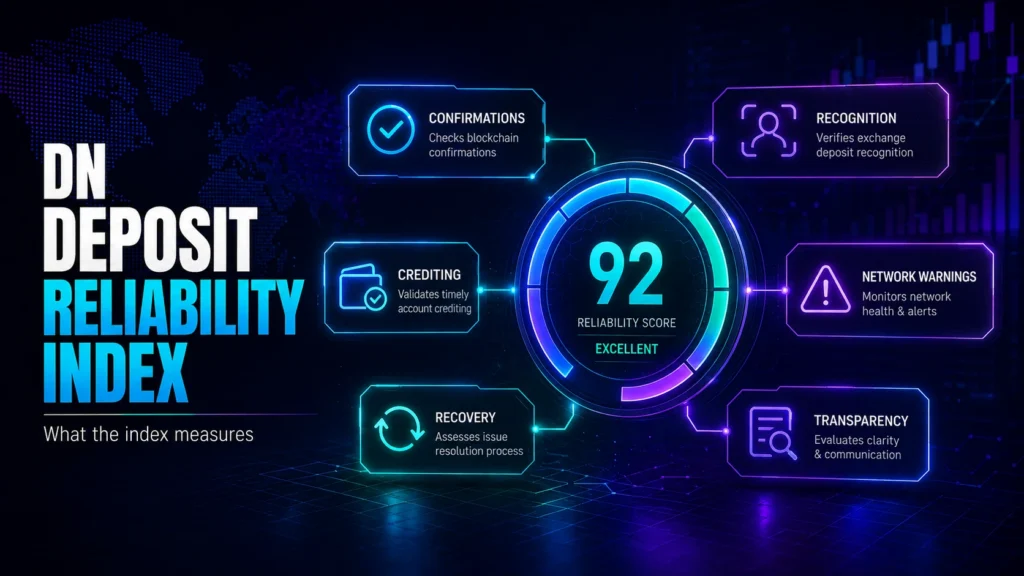
The full index is designed around seven components.
Metric | Full Index Weight | What DN Measures |
Deposit recognition | 20% | How quickly a valid on-chain transfer appears |
Post-confirmation crediting | 20% | Time between required confirmations and usable balance |
Confirmation transparency | 15% | How clearly requirements and progress are displayed |
Network protection | 15% | Wrong-chain warnings and supported-network clarity |
Memo/tag protection | 10% | Prevention and handling of missing destination identifiers |
Recovery architecture | 15% | Tools, eligibility, turnaround and costs |
Operational transparency | 5% | Status pages, maintenance and incident communication |
Current baseline score
Until standardized transaction-level testing exists across the full comparison universe, DN publishes a Deposit Protection & Recovery Readiness Score derived from the currently auditable factors:
- confirmation transparency
- supported-network warnings
- memo/tag handling
- recovery coverage
- self-service capability
- published recovery terms
- missing-deposit diagnostics
- operational transparency
When transaction tests are incorporated, those baseline scores will no longer substitute for actual performance.
What DN Verified
For this edition, Decentralised News reviewed current exchange deposit documentation, recovery systems, confirmation guidance, network warnings and exception-handling processes.
Research date: August 15, 2026
Areas verified:
- crypto deposit workflow
- confirmation requirements
- deposit status handling
- unsupported network warnings
- wrong-network recovery
- memo/tag requirements
- missing memo/tag recovery
- minimum-deposit handling
- old-address handling
- delayed-deposit processes
- recovery fees where published
- recovery turnaround where published
- status and maintenance information where available
What We Did Not Test
This edition does not claim to have independently measured:
- funded deposit latency across every exchange
- every cryptocurrency supported by each platform
- every blockchain network
- every geographic region
- every compliance scenario
- every recovery request
- large-value institutional deposits
- exchange internal wallet infrastructure
- exchange-wide deposit performance during extreme volatility
Those limitations matter because deposit performance can differ dramatically by asset, network, jurisdiction and market conditions.
1. Binance: Best Deposit Recovery Infrastructure
DN Deposit Protection & Recovery Readiness Score: 96/100
Best for: Users prioritizing comprehensive self-service recovery infrastructure.
Binance takes first place in the baseline ranking because its deposit recovery infrastructure is unusually extensive.
Its support system provides separate paths for deposits that have not been credited, missing or incorrect memos, old addresses, unsupported tokens and several other abnormal-deposit scenarios.
More importantly, Binance publishes expected recovery handling for multiple categories rather than simply telling users to “contact support.”
Its current self-service documentation lists examples including:
Deposit Problem | Published Indicative Handling |
Missing/wrong memo | 2–3 days |
Old/delisted token | 2–3 days |
Deposit not credited | 2–3 days |
Deposit to hot wallet | 2–3 days |
Smart retrieval | Around 14 days |
Unlisted token on supported network | Around 14 days |
Unsupported EVM network | Around 30 days |
Cross-address deposit | Around 30 days |
Some categories are free while more complex recovery cases can carry substantial fees. Binance explicitly states that recovery is not guaranteed and timing can vary.
That transparency earns significant credit.
One Click Arrival
Binance also documents a One Click Arrival function for certain deposits sent to retired addresses. Eligible transactions can be manually triggered for crediting rather than immediately becoming a support case.
Confirmation visibility
Binance’s wallet APIs expose network-level configuration including whether deposits are enabled and required confirmation information, allowing software to programmatically inspect deposit conditions.
Main weakness
Binance supports a very large number of assets and networks. That creates complexity.
A token being supported does not necessarily mean every representation of that token on every blockchain is supported.
DN Verdict
Strongest baseline recovery architecture in the study.
The scale of Binance’s self-service tooling is particularly important because reliability is not just about avoiding problems. It is about how efficiently a platform deals with them when they happen.
2. OKX: Best Deposit Diagnostics
DN Score: 93/100
Best for: Users who value clear deposit status information and self-service troubleshooting.
OKX performs strongly because it distinguishes several stages of deposit availability and provides dedicated tools for deposits that have not been credited.
Its support documentation explains that the deposit screen can show both:
- confirmations required for arrival
- confirmations required before withdrawal unlock
That distinction is excellent.
A user may therefore understand that funds have reached the exchange while still being subject to additional security confirmations before they can leave again.
OKX also surfaces a Find missing deposit workflow through its support tools.
For assets requiring an additional memo or tag, the deposit interface displays the requirement, while missing identifiers can be escalated through customer support.
Why this matters
Good deposit infrastructure should answer three different questions:
Has the blockchain transaction confirmed?
Has the exchange recognized it?
Can I actually use or withdraw the funds?
OKX does a relatively good job of separating those states.
Main limitation
Recovery remains dependent on the specific transaction, asset and network. No centralized exchange can guarantee recovery from every wrong-chain transfer.
DN Verdict
OKX narrowly misses first place but provides one of the clearest diagnostic models in the comparison.
3. Gate: Strong Recovery and Deposit Status Visibility
DN Score: 92/100
Best for: Users who want visible confirmation progress and a dedicated missing-deposit recovery process.
Gate provides a particularly useful combination of deposit-status transparency and recovery tooling.
Its deposit documentation states that required confirmation counts are visible on the deposit page and can be compared against the transaction’s current blockchain confirmation count.
Gate deposit statuses can also distinguish between:
- Pending
- Done
- Manual
A “Manual” state means the deposit is undergoing manual review rather than simply disappearing into an unexplained pending state.
Gate also operates a Deposit Not Received Recovery Request feature for eligible missing deposits.
Missing or incorrect tags and memos can be submitted through the recovery workflow.
Main limitation
Wrong-network recovery is not guaranteed. Gate explicitly warns that funds sent using an incorrect network may be permanently lost.
DN Verdict
Gate scores highly because it gives users meaningful visibility into both confirmation progress and abnormal-deposit states.
4. Bybit: Excellent Memo/Tag Recovery
DN Score: 91/100
Best for: Active traders who want structured recovery tools for common deposit mistakes.
Bybit has invested significantly in deposit recovery tooling.
As of June 2026, the platform provides a self-service appeal process for deposits that fail because of a missing memo or tag. Successful recoveries are returned to the source address.
Bybit also provides an unsupported-deposit recovery procedure.
But there is an important limitation.
For certain unsupported deposits, only recoverable assets with a value above $500 are eligible for refund, and applicable handling fees vary by asset.
The deposit interface itself warns users to ensure the sending and receiving networks match and surfaces tag/memo requirements for relevant assets.
DN Verdict
Bybit’s self-service handling of missing memo/tag deposits is a substantial positive.
The $500 eligibility threshold for some unsupported deposit recoveries prevents it from ranking higher.
5. Kraken: Best Confirmation Transparency
DN Score: 89/100
Best for: Users who want unusually detailed public confirmation requirements.
Kraken provides some of the most transparent public documentation around blockchain confirmation requirements.
Its deposit processing reference explains why confirmations are required and publishes asset-specific processing information. For Bitcoin, Kraken currently states that it credits deposits after four confirmations, which under normal block timing corresponds to approximately 40 minutes.
This does not mean Kraken is “slower” in an operational sense.
A four-confirmation BTC requirement is largely a security policy.
That is precisely why DN separates:
blockchain confirmation policy
from:
exchange crediting delay after the threshold is reached.
Kraken also publishes a structured missing-deposit checklist covering:
- incorrect networks
- minimum deposit limits
- missing destination tags
- expired addresses
- confirmation requirements
- maintenance
- incorrect currency types
Its crypto asset recovery framework includes missing or incorrect tags/memos and certain unsupported deposit cases, although recovery is not guaranteed.
DN Verdict
Kraken earns one of the highest transparency scores.
When live testing is added to the index, its relatively conservative confirmation requirements should not be confused with internal processing inefficiency.
Affiliate disclosure: The Kraken link above is a referral link. DN rankings are independent of commercial relationships.
6. MEXC: Strong Missing-Deposit Workflow
DN Score: 87/100
Best for: Altcoin users who value structured uncredited-deposit recovery.
MEXC provides detailed troubleshooting for deposits that fail to appear.
The exchange confirms that each cryptocurrency requires a specific number of blockchain confirmations before crediting and directs users to verify confirmation status before escalating the issue.
For missing or incorrect memo/tag deposits, MEXC operates an Uncredited Deposit Return Application.
Its current support material says review typically takes one to two business days, after which users are notified through email or an in-platform message.
MEXC also explicitly warns that the deposit network must match the sending network and that an incorrect or missing memo can prevent crediting.
DN Verdict
MEXC scores well for clearly documented exception handling.
The next question for the full DN Index is whether the exchange’s post-confirmation crediting speed and recovery turnaround match its documented processes under real-world conditions.
7. BingX: Broad Recovery Coverage, But Slower Manual Handling
DN Score: 85/100
Best for: Users who value a broad recovery workflow covering multiple failed-deposit scenarios.
BingX deserves more credit for deposit recovery than a superficial comparison might suggest.
Its missing-deposit process covers several scenarios:
- unsupported currencies
- missing or incorrect tags
- deposits below the minimum
- old deposit addresses
- suspended deposit services
- deposits rejected by risk controls
The platform also has an interesting solution for deposits below the minimum.
If an eligible deposit is too small to be credited, BingX says users may make another qualifying deposit of the same currency and network within three months, after which the earlier amount can be credited together with the new deposit.
That is more user-friendly than simply declaring every sub-minimum transfer lost.
The downside: recovery time
Many BingX manual recovery scenarios quote a processing period of 7 to 15 working days.
That is materially slower than the quickest recovery processes documented by some competitors.
DN Verdict
Good recovery breadth, weaker recovery speed.
BingX could move significantly higher in future index versions if live transaction testing shows strong normal-deposit recognition.
Affiliate disclosure: The BingX link above is a DN partner/referral link. Commercial relationships do not determine rankings.
8. Coinbase: Excellent Transparency, More Restrictive Recovery
DN Score: 84/100
Best for: Users prioritizing operational transparency and clear pending-transaction states.
Coinbase performs strongly on deposit visibility and infrastructure transparency.
Its Exchange documentation states that incoming transactions can appear almost immediately as Pending while the platform waits for the required network confirmations.
The wider Coinbase help system distinguishes several reasons a transaction may remain pending, including:
- insufficient confirmations
- network synchronization issues
- network congestion
- account requirements
- unsupported networks
Coinbase also maintains a detailed public status infrastructure separating issues by blockchain and product. This makes it easier to determine whether a missing deposit is a personal account problem or a platform-wide incident.
Recovery limitation
Coinbase provides unsupported-asset recovery for eligible assets and networks, but not every transfer qualifies. Funds sent over unsupported networks may remain unrecoverable.
DN Verdict
One of the strongest platforms for operational transparency, but a more restrictive recovery envelope prevents a higher baseline score.
Coinbase is included despite having no DN referral relationship because affiliate status is not a ranking criterion.
9. Deribit: Excellent Documentation for a Narrower Asset Universe
DN Score: 83/100
Best for: Derivatives traders moving BTC, ETH and supported collateral assets.
Deribit is a specialist rather than a broad altcoin exchange, but its deposit documentation is unusually specific.
Its current published requirements include examples such as:
- BTC: 1 confirmation
- ETH: 12 confirmations
- USDT on ERC-20: 1 confirmation
- USDC on ERC-20: 12 confirmations
- SOL: 1 confirmation
- XRP: 1 confirmation
Deribit also operates a coin recovery process for certain unsupported networks, unsupported assets and XRP deposits with missing or incorrect tags. Recovery is considered case by case. XRP tag-related recoveries currently carry a 5% fee with a $25-equivalent minimum.
Another useful detail is Deribit’s treatment of Travel Rule information.
A qualifying deposit can arrive and be credited to account equity while remaining locked for trading, transfer or withdrawal until required information is supplied.
That is a perfect illustration of why:
deposit arrived and funds usable are not always the same event.
DN Verdict
Excellent technical transparency, but a narrower deposit universe and more case-by-case recovery process keep Deribit below the mass-market exchanges.
Affiliate disclosure: The Deribit link above is a referral link.
10. Bitget: Clear Standard Deposit Flow, More Limited Error Recovery
DN Score: 81/100
Best for: Users making standard deposits through clearly supported networks.
Bitget provides clear instructions around network matching, confirmation requirements and memo/tag deposits.
Its deposit documentation tells users to select the exact network used by the sending platform and warns that an incorrect network can result in permanent loss.
Bitget also explains that each cryptocurrency has its own confirmation requirement and that users can inspect confirmation status using the transaction ID and an appropriate blockchain explorer.
Missing or incorrect memo/tag deposits can be escalated through support.
However, Bitget states that unsupported-network recovery is not always possible.
Its documentation also says deposits below the minimum required amount are not credited and cannot be processed.
DN Verdict
Strong normal-flow documentation, but less forgiving exception handling than the highest-ranked exchanges.
Affiliate disclosure: The Bitget link above is a referral link. Referral code: nqef.
11. WOO X: Transparent Recovery Terms, But Complex Cases Can Take Weeks
DN Score: 74/100
Best for: Experienced users comfortable with clearly defined but potentially lengthy recovery procedures.
WOO X deserves credit for publishing unusually specific recovery rules.
For missing memo deposits, WOO X currently quotes a recovery period of approximately two weeks and a fee equal to five times the token’s withdrawal fee.
Unsupported token or network deposits require more than $500 equivalent, carry a published $200 recovery fee, and can take approximately 30 to 60 days.
The exchange also warns that contract-transfer deposits may not be credited and that users must ensure the network and any required memo/tag match exactly.
DN Verdict
Transparency is a positive.
Recovery burden is the weakness.
A published 30-to-60-day pathway is arguably better than an unexplained missing deposit, but it is still materially less attractive than rapid automated recovery.
Affiliate disclosure: The WOO X link above is a referral link. Referral code: NCYDOFZF.
The Most Important Metric: Post-Confirmation Credit Delay
Suppose two exchanges each require 12 Ethereum confirmations.
Both deposits reach confirmation 12 at 14:05:00 UTC.
Exchange A
Funds available: 14:05:04
Post-confirmation credit delay: 4 seconds
Exchange B
Funds available: 14:18:22
Post-confirmation credit delay: 13 minutes 22 seconds
Their blockchain confirmation policies are identical.
Their exchange infrastructure performance is not.
This is why the future transaction-tested version of the DN Index will record:
DN Post-Confirmation Credit Lag
Credit Lag = Exchange Credit Timestamp − Required Confirmation Timestamp
That metric isolates exchange processing from the blockchain itself.
A Second Metric: Deposit Recognition Lag

An exchange can sometimes detect a deposit before it has enough confirmations to release the funds.
That is useful.
The user sees:
Deposit detected. 3/12 confirmations.
rather than wondering whether the address was wrong.
DN therefore distinguishes:
Recognition Lag
Recognition Lag = Exchange Detection Timestamp − First On-Chain Confirmation Timestamp
and:
Credit Lag
Credit Lag = Spendable Balance Timestamp − Required Confirmation Timestamp
The best deposit system minimizes both while clearly communicating what is happening between them.
Why Confirmation Counts Alone Can Be Misleading
An exchange requiring more confirmations is not automatically less reliable.
Confirmations protect against blockchain reorganization and double-spend risk.
Different networks also behave differently.
Bitcoin confirmations arrive roughly in ten-minute block intervals on average.
Ethereum operates on a very different finality model.
Solana behaves differently again.
Exchanges can also apply additional security thresholds to particular networks after incidents or protocol changes.
The correct comparison therefore asks:
Once the exchange’s own stated safety threshold has been reached, how efficiently does its internal system recognize and release the funds?
That is the fairer test.
Unsupported Network Warnings: One of the Most Important Exchange UX Features
Stablecoins have made deposit interfaces much more dangerous.
“USDT” may exist on:
- Ethereum
- Tron
- BNB Smart Chain
- Arbitrum
- Solana
- TON
- other networks
The ticker can look identical while the settlement network is completely different.
A good exchange should therefore make the selected network impossible to overlook.
DN’s network-safety component looks for:
- explicit network selection
- visible network name
- matching-network warnings
- deposit availability status
- unsupported-network warnings
- address-format checking
- network suspension messaging
- recovery guidance
The safest design is not simply:
Select USDT.
It is:
You are depositing USDT via Arbitrum. Only send USDT using the Arbitrum network to this address. Sending assets using another network may result in loss.
That small piece of interface design can prevent very expensive mistakes.
Memo and Destination Tag Handling
Some blockchain networks use shared deposit addresses and distinguish customers using an additional identifier.
Depending on the network, this may be called:
- memo
- destination tag
- comment
- payment ID
XRP and XLM are common examples.
A transaction can therefore be perfectly valid on-chain while the exchange has no automated way to determine which customer owns it.
That creates another version of the exchange credit gap:
Blockchain knows where the asset went.
Exchange does not know which internal account should receive it.
The best platforms do three things:
- Make the memo/tag highly visible.
- Warn users before they send.
- Provide a structured recovery process if they still make a mistake.
What Happens When You Deposit Using the Wrong Network?
There is no universal answer.
Four outcomes are possible.
1. Automatic credit
Rare, but possible where the platform already supports and monitors the network.
2. Manual credit
The exchange can technically access the funds and assigns them to the account.
3. Refund
The exchange recovers the asset and sends it back to a compatible address.
4. Permanent loss
The platform cannot or will not recover the transfer.
The transaction being visible on a block explorer does not prove the exchange can easily retrieve it.
Centralized exchange deposit addresses are often part of complex custody and wallet infrastructure.
Manual access can require operational approvals, custom tooling and security procedures.
That is why unsupported-network recovery fees can be substantial.
The Minimum Deposit Trap
One of the least appreciated deposit risks is sending less than the platform’s minimum.
Different exchanges handle this differently.
Some may eventually aggregate subsequent deposits.
Others may require recovery.
Others may simply not credit the amount.
This means users should verify:
asset
network
deposit address
memo/tag
minimum amount
before pressing send.
BingX’s approach is particularly interesting because some below-minimum deposits can be credited after the user makes a subsequent qualifying deposit on the same network within the stated period.
Binance, by contrast, states that deposits below its minimum deposit amount are not recoverable under its incorrect-deposit framework.
This is exactly the kind of difference the DN Index is designed to surface.
Exchange Deposit Reliability by User Type
Best for users worried about making a deposit mistake
Binance
Its self-service recovery coverage currently sets the benchmark.
Best for understanding why a deposit is pending
OKX and Gate
Both provide useful diagnostic/status structures.
Best for confirmation transparency
Kraken
Its public confirmation documentation is particularly clear.
Best for missing memo/tag recovery
Bybit
Self-service handling is a meaningful advantage.
Best for transparent incident communication
Coinbase
Its granular public status infrastructure is among the strongest in the comparison.
Best specialist derivatives venue
Deribit
Its narrower asset set is offset by unusually detailed protocol and confirmation documentation.
What Traders Should Do Before Every Large Crypto Deposit
1. Check the receiving exchange first
Do not begin from the sending wallet.
Open the receiving exchange and generate the current deposit instructions.
2. Confirm the exact asset
USDC is not USDT.
ETH is not stETH.
Native assets are not always equivalent to wrapped representations.
3. Confirm the network on both sides
The sending network and receiving network must match.
Do not assume that an EVM-compatible address means every EVM network is supported.
4. Check whether a memo/tag is required
If the exchange provides one, use it exactly.
5. Check the minimum deposit
Especially when making a small test transfer.
Ironically, a “test deposit” can itself become unrecoverable if it is below the exchange’s minimum.
6. Check deposit status
A network may be temporarily suspended.
Never assume yesterday’s supported network is available today.
7. Use a small test transfer for large movements
But make sure the test amount exceeds the minimum deposit.
8. Preserve the TxID
The transaction hash is the primary reference if support intervention becomes necessary.
DN Pro Tip: A Confirmed Blockchain Transaction Is Your Starting Evidence
If a deposit is missing, first determine whether the transaction is actually confirmed on-chain.
You need:
- correct blockchain
- transaction hash
- destination address
- token
- amount
- confirmation count
If the blockchain transaction itself is still pending, the exchange may have nothing to process yet.
If the transaction is fully confirmed and the receiving address, network and memo are correct, the investigation moves from the blockchain layer to the exchange layer.
DN Pro Tip: Screenshot the Deposit Page Before Sending a Large Transfer
Deposit addresses, supported networks and platform requirements can change.
For a significant transfer, preserving a screenshot showing:
- exchange
- asset
- network
- deposit address
- memo/tag
- timestamp
can provide useful evidence if a dispute or recovery request follows.
Do not include passwords, authentication codes or sensitive account information.
DN Missing Crypto Deposit Diagnostic Tool
The tool below is designed to help readers distinguish between a blockchain delay, insufficient confirmations, an exchange-processing delay and a potentially incorrect deposit.
It does not access wallets or require a seed phrase.
Never enter a private key or seed phrase into a deposit-recovery website.