Crypto's App Store Moment 2027
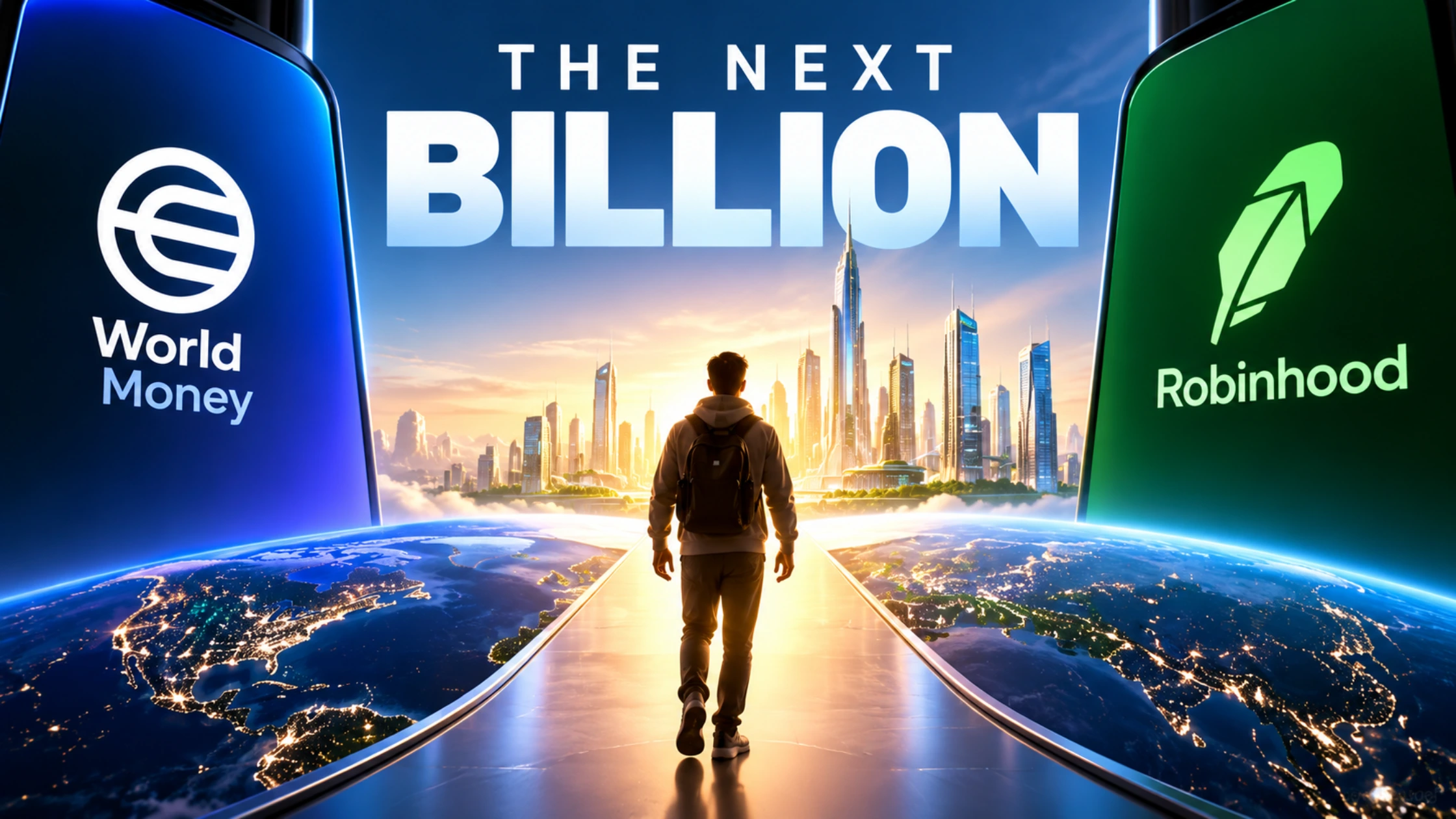
World Money, Robinhood Chain, Fomo, Hyperliquid, tokenized securities, stablecoins and institutional blockchain rails may be signaling a profound shift in digital assets: the next phase of adoption may occur when consumers stop thinking about blockchains at all.
What Matters
The crypto industry's first era was about creating networks.
Its second era was about creating assets.
Its third era may be about making both disappear behind applications.
World Money now combines stablecoin balances, payments, investing, earning, virtual accounts, portfolio management and Mini Apps inside one self-custody interface being rolled out across more than 150 countries.
Robinhood has launched its own Ethereum-compatible Layer 2, integrated tokenized financial assets, DeFi, perpetual futures and is preparing agentic crypto trading.
Fomo abstracts multiple chains behind a one-click consumer trading experience.
Hyperliquid alone is processing hundreds of billions of dollars of perpetual volume per month.
Meanwhile:
- global estimated crypto ownership reached 741 million in 2025;
- estimated active crypto users remain only around 40–70 million;
- tokenized real-world assets reached approximately $33.8 billion by May 2026;
- BlackRock's largest Bitcoin ETP has approximately $60 billion of assets;
- J.P. Morgan's Kinexys infrastructure has processed more than $4 trillion cumulatively;
- stablecoins reached roughly $320 billion of market capitalization by May 2026.
These developments look disconnected if viewed as individual products.
They look much more coherent if viewed as the emergence of a programmable financial distribution layer.
The Crypto App Store Threshold
Technology rarely achieves mass adoption when users finally understand its underlying infrastructure.
It achieves mass adoption when they no longer need to.
Most internet users do not understand:
- TCP/IP;
- DNS;
- HTTP routing;
- content delivery networks;
- database replication.
They open an app.
Mobile software experienced a similar transition.
Before the modern app-store model, mobile software distribution was fragmented.
Apple's App Store changed the problem.
It bundled:
- discovery;
- identity;
- payment;
- distribution;
- installation;
- updates;
- developer access;
- consumer trust.
Apple launched the store with approximately 500 applications in July 2008.
Users downloaded more than 10 million applications in its first three days.
Downloads reached one billion within nine months and more than 1.5 billion within the first year.
Those figures cannot be compared directly with crypto-user counts.
An app download is not a person.
But the structural lesson is powerful.
Crypto Has Spent 15 Years Building the Back End
Bitcoin solved decentralized digital scarcity.
Ethereum generalized programmable settlement.
Stablecoins connected blockchain ledgers with fiat denomination.
DEXs enabled permissionless markets.
Rollups reduced transaction cost.
Wallet infrastructure improved key management.
Bridges connected previously isolated networks.
Tokenization began moving conventional financial claims onto digital ledgers.
Those developments were foundational.
But foundations do not guarantee mass adoption.
A billion users should not need to choose:
- a chain;
- a bridge;
- a gas token;
- an RPC;
- a wallet connection;
- a token route;
- a signing method.
The Financial App Layer
The distinction looks small.
Economically, it is enormous.
World Money Is a Distribution Event, Not Merely a Wallet Launch
World's new product illustrates the transition unusually clearly.
World Money is beginning to roll out in more than 150 countries.
The app combines:
- stablecoin balances;
- eight supported currency balances;
- virtual accounts;
- payments;
- cross-border transfers;
- portfolio tracking;
- price alerts;
- investment access;
- Morpho-powered Earn programs;
- Mini Apps;
- World ID.
In the United States, Stripe is the default funding flow and Apple Pay can turn ordinary money into stablecoins that typically arrive within minutes.
That is a significant change in user architecture.
The user does not need to begin by deciding:
“I want to use blockchain.”
The user begins with:
“I want to move or manage money.”
World ID Adds Something Crypto Has Historically Lacked
Blockchain networks are good at proving:
what an address did.
They are much weaker at proving:
what kind of entity controls the address.
That problem becomes larger as autonomous AI agents proliferate.
World is explicitly positioning proof-of-human infrastructure alongside financial functionality.
That creates the possibility of a financial stack combining:
- identity;
- payments;
- savings;
- assets;
- applications;
- reputation;
- human/agent distinction.
Whether World becomes the dominant implementation is uncertain.
The architectural direction is more important than the individual provider.
Robinhood Is Approaching the Same Destination From the Opposite Direction
World begins with identity and crypto-native rails.
Robinhood begins with brokerage distribution.
But their architectures are converging.
Robinhood Chain is now a live, permissionless Layer 2 built with Arbitrum technology and designed around financial services and tokenized real-world assets.
Robinhood says Stock Tokens are available through Robinhood Wallet in more than 120 countries, subject to local restrictions.
Those tokens can interact with decentralized markets and potentially be used in lending and collateral applications.
This distinction becomes important because the U.S. regulatory direction is moving toward a different model.
Under the SEC's September 2026 Innovation Exemption, eligible tokenized NMS stock must preserve the rights and privileges associated with the traditional security, including dividends and voting rights.
Pure synthetics are excluded from the exemption.
That could produce two parallel tokenized-equity architectures:
- economic-exposure wrappers;
- legally equivalent tokenized securities.
Robinhood Is Also Collapsing the Boundary Between CeFi and DeFi
The same Robinhood interface increasingly spans:
- brokerage;
- crypto;
- self-custody;
- tokenized assets;
- onchain lending;
- perpetual markets;
- AI trading.
Its Wallet now connects eligible users to decentralized perpetual trading on Lighter.
Robinhood has also announced Agentic Accounts for crypto, using Trading MCP so eligible users can connect third-party AI models to financial tools while setting capital and risk boundaries.
Fomo Represents the Crypto-Native Version of the Same Trend
The Fomo app demonstrates what happens when chain abstraction becomes a product feature rather than a user responsibility.
Its App Store listing supports trading across:
- Solana;
- Robinhood Chain;
- BNB Chain;
- Base;
- Ethereum;
- Monad.
The marketing proposition is not:
“learn how to bridge between six networks.”
It is:
trade across supported networks from one interface.
That is what mature infrastructure looks like.
Hyperliquid Shows That Onchain Markets Are No Longer Toys
The distribution layer requires serious underlying markets.
Hyperliquid is one of the clearest examples of crypto-native infrastructure reaching a scale that can no longer be dismissed as experimental.
As observed on 18 September 2026, DefiLlama showed approximately:
- $7.2 billion in 24-hour perpetual volume;
- $240 billion in 30-day perpetual volume;
- more than $7 billion of open interest;
- more than $5.3 trillion of cumulative perpetual volume.
These numbers fluctuate continuously.
Their significance is structural.
Onchain derivatives infrastructure is processing institutional-scale notional volume.
The Next Billion: Ownership Is Not the Hardest Problem Anymore
The one-billion-owner threshold sounds dramatic.
Mathematically it is no longer extraordinary.
Starting with 741 million estimated owners, annual growth of 12.4% would reach one billion in approximately 2.6 years.
That is a mechanical extrapolation, not a forecast.
Growth can accelerate or slow materially.
The more important number is the active-user estimate.
a16z estimates roughly 40–70 million active crypto users against hundreds of millions of owners.
Using the 741 million ownership estimate merely as a rough comparison suggests only around 5%–9% are regularly active.
The methodologies are different, so the numbers should not be treated as a precise conversion funnel.
But the directional gap is enormous.
The Billion-User Opportunity Is Activation
Imagine a person already owns Bitcoin through an ETF.
That investor is economically exposed to crypto.
But they may never have:
- used a wallet;
- transferred a stablecoin;
- used a DEX;
- posted onchain collateral;
- received tokenized securities;
- used machine payments.
The next adoption wave can therefore occur without finding a completely new population.
It can convert existing exposure into utility.
The Internet Analogy Is Useful, But Only at the Correct Layer
Approximately six billion people, around 74% of the global population, were using the internet in 2025.
The internet took decades to move from specialist infrastructure to near-ubiquity.
Crypto should not be expected to reproduce that trajectory exactly.
Money is:
- more regulated;
- more trust-sensitive;
- more jurisdiction-dependent;
- more consequential when systems fail.
The relevant analogy is not adoption speed.
It is abstraction.
Tokenization Is the Institutional Version of the App Layer
The retail revolution hides blockchain complexity behind apps.
Institutional finance hides it behind familiar financial instruments.
Fidelity Digital Assets estimates tokenized RWAs expanded twentyfold between early 2024 and May 2026 to approximately $33.8 billion.
That remains small relative to global securities markets.
But the growth rate matters.
Institutions do not need to abandon:
- bonds;
- funds;
- equities;
- money-market instruments;
- collateral.
The assets can remain familiar.
The rails change underneath them.
BlackRock Is Building the Bridge From Both Directions
BlackRock's 2026 chairman's letter argues that tokenization may be roughly where the internet stood in 1996.
BlackRock says it now has nearly $150 billion of AUM connected to digital assets, including digital-asset ETPs and tokenized-fund infrastructure.
IBIT alone held approximately $59.9 billion in net assets on 17 September 2026.
That number is economically important because it demonstrates the power of institutional abstraction.
IBIT allows investors to obtain Bitcoin exposure through:
- existing brokerage accounts;
- conventional portfolio systems;
- institutional custody architecture;
- standardized market infrastructure.
The investor does not need to operate a Bitcoin wallet.
The blockchain asset is abstracted into a traditional allocation primitive.
J.P. Morgan Shows the Reverse Path: TradFi Moving Onchain
J.P. Morgan is not merely providing clients with crypto exposure.
It is rebuilding parts of institutional financial infrastructure on blockchain rails.
Kinexys had processed more than $4 trillion cumulatively and was averaging around $7 billion in daily transactions by May 2026.
Its infrastructure supports use cases including:
- onchain payments;
- collateral movement;
- repo;
- tokenization;
- delivery-versus-payment settlement;
- deposit tokens.
JPM Coin is available to institutional clients on Base.
It represents a bank deposit token rather than an independent stablecoin.
That distinction matters.
The Institutional Access Ladder
Lowest operational novelty. Investors access exchanges, miners, treasury companies and infrastructure through ordinary securities.
Direct asset-price exposure inside familiar custody, reporting and portfolio systems.
Futures, options and increasingly perpetual structures can provide hedging and tactical exposure within established derivatives mandates.
Conventional assets begin moving onto programmable ledgers while retaining regulated financial-product structures.
Institutional cash and collateral become programmable without requiring the user to hold an independent cryptoasset.
Institutions hold native cryptoassets directly through qualified or institutional custody infrastructure.
Institutions interact directly with staking, DeFi, onchain liquidity, tokenized collateral and programmable settlement.
Why Sovereign Wealth and Pension Capital Can Arrive Slowly, Then Suddenly
Large pools of capital are not constrained only by conviction.
They are constrained by:
- investment mandates;
- custody;
- board approval;
- consultants;
- accounting;
- liquidity requirements;
- regulatory interpretation;
- risk limits.
That creates a long delay between:
recognizing an asset
and:
being institutionally capable of owning it.
ETPs dramatically compress that delay.
They allow an institution to use infrastructure it already understands.
A sovereign investor can buy a listed Bitcoin product without creating an internal wallet-security department.
That is why institutional adoption can appear slow for years and then accelerate once the product wrapper becomes acceptable.
The Two-Sided Abstraction Flywheel
The CLARITY Failure Did Not Stop the Regulatory Machine
On 15 September 2026, the U.S. Senate rejected cloture on the motion to proceed to H.R. 3633, the Digital Asset Market Clarity Act.
The vote was 49–50.
The legislation therefore did not advance.
That matters.
Statutory market structure can provide greater durability than temporary agency interpretation.
But the failure did not return the United States to regulatory stasis.
Two days later, the SEC issued its tokenized-stock Innovation Exemption.
Earlier in 2026:
- the SEC and CFTC jointly clarified treatment of several crypto-asset categories;
- Project Crypto became a joint SEC/CFTC initiative;
- the CFTC established an Innovation Task Force;
- the CFTC approved a regulated Bitcoin perpetual contract.
That Gap Matters for Institutional Capital
An entrepreneurial trader may tolerate regulatory ambiguity.
A pension committee often cannot.
The difference between:
“the regulator currently permits this”
and:
“the law clearly authorizes this structure”
can be economically significant.
Temporary exemptions can catalyze experimentation.
Statutory certainty can unlock longer-duration capital.
The U.S. Is Not the Only Regulatory Experiment
The European Union has moved into the post-transition phase of MiCA.
The latest general grandfathering period for eligible legacy providers ended no later than 1 July 2026.
Unauthorised providers must stop regulated activities until appropriate authorization is obtained.
The United Kingdom is following a different timetable.
Its FCA authorization gateway opens on 30 September 2026, with the broader crypto regime scheduled to commence in October 2027.
The global picture therefore is not:
“crypto is now regulated.”
It is:
jurisdictions are progressively replacing regulatory voids with explicit perimeters.
Why Markets Could Rally Even After a Rate Hike and Legislative Setback
The immediate September market response appears confusing only if every signal is treated independently.
The Federal Reserve raised rates.
The CLARITY bill stalled.
Those sound negative for risk assets.
But markets price changes in expected future conditions, not headlines in isolation.
At the same time:
- the rate hike had been substantially anticipated;
- economic activity remained solid;
- Treasury yields subsequently eased;
- oil prices declined;
- the SEC opened a path for tokenized-stock experimentation;
- crypto market structure continued moving forward through regulatory agencies.
Bitcoin consequently recovered toward the upper-$70,000 region on 18 September, though short-term price action is not evidence of a durable cycle shift.
The Current Macro Regime Is Unusual
The Federal Reserve's target range now sits at 3.75%–4.00%.
The Fed says:
- economic activity is expanding solidly;
- capital investment is robust;
- inflation remains elevated.
That is not a recessionary easing regime.
It is monetary restraint inside an expanding economy.
But system liquidity is more nuanced than the policy rate.
Tight Monetary Policy Can Coexist With Supportive Market Plumbing
The Fed continues to operate an ample-reserves framework.
Standing repo operations remain available to support implementation and market function.
Treasury has meanwhile increased the size of certain long-end liquidity-support buybacks from a maximum $2 billion to at least $4 billion per operation.
This May Explain the Strange Crypto Market
A Policy-Tight / Structure-Easing environment should not necessarily lift every token.
It should favor infrastructure with identifiable economic utility:
- Bitcoin as institutional collateral/reserve exposure;
- stablecoins;
- tokenized securities;
- high-volume onchain markets;
- custody;
- settlement infrastructure;
- identity;
- agentic execution.
The long tail of speculative assets still depends much more heavily on abundant liquidity and reflexive risk appetite.
The Dollar Is Not Obviously Being Replaced
A common crypto thesis assumes digital assets inevitably weaken the U.S. dollar.
The current evidence is more complicated.
The IMF reported that the dollar represented approximately 57.13% of allocated global foreign-exchange reserves in the first quarter of 2026.
That share was slightly higher than the prior quarter.
At the same time, the overwhelming majority of stablecoin value remains dollar-denominated.
BIS researchers estimate approximately 98% of stablecoin value is linked to the dollar.
Stablecoins May Be Exporting the Dollar Onto New Rails
Dollar-backed stablecoin issuers hold large amounts of Treasury bills and other short-duration dollar instruments.
BIS research estimates stablecoin issuers purchased roughly $33 billion of Treasury bills in 2025 and held approximately $153 billion of T-bill exposure by year-end.
The BIS estimated total stablecoin capitalization at approximately $320 billion by the end of May 2026.
This creates a monetary paradox.
Stablecoins can:
- disintermediate bank deposits;
- move outside conventional payment networks;
- increase capital mobility;
while simultaneously:
- increasing dollar usage;
- creating Treasury demand;
- extending U.S. monetary denomination internationally.
That Could Strengthen the Dollar and Weaken Parts of Banking at the Same Time
Those outcomes are not contradictory.
A user in an inflation-prone economy may increasingly prefer:
digital USD exposure
without opening a U.S. bank account.
That may reduce demand for local-currency deposits.
But it increases demand for dollar-denominated assets.
The geopolitical implications are substantial.
Stablecoins can create a privately distributed form of digital dollarization that moves faster than conventional correspondent banking.
The Financial Composability Multiplier
This is one of tokenization's least appreciated implications.
A conventional security is primarily an investment record.
A programmable security can potentially become an input into other financial software.
That does not eliminate regulation.
It increases the possible range of regulated financial operations.
The Real Competition Is Becoming Distribution
Early crypto competition centered on:
- block time;
- transaction throughput;
- consensus;
- token incentives;
- TVL.
Those remain relevant.
But successful infrastructure increasingly has to win distribution.
World has identity distribution.
Robinhood has brokerage distribution.
BlackRock has institutional asset-management distribution.
J.P. Morgan has banking and treasury distribution.
Apple and Stripe provide payment/on-ramp distribution.
Hyperliquid provides market infrastructure.
The next winner may therefore not be the protocol with the most elegant architecture.
It may be the interface that aggregates the greatest number of useful financial outcomes.
DN Billion-User Financialization Engine
When Could Crypto Reach One Billion Owners?
This scenario engine separates ownership growth from actual user activation. It does not generate a price target and does not claim that historical growth will continue.
Ownership growth and conversion assumptions are user-defined. The readiness score is a DN scenario framework, not a statistical estimate or forecast.
The More Important Question: What Happens After One Billion?
A billion owners does not necessarily mean a billion economically active users.
The larger opportunity is the conversion from:
asset owner
to:
financial-network participant.
That is why superapps matter more than another exchange listing.
DN Institutional Onchain Access Architect
Which Digital-Asset Access Layer Fits an Institution?
This tool maps governance constraints to the lowest-friction digital-asset access architecture. It is an educational framework, not an investment recommendation.
The 2026–2031 Financial Adoption Map
| Phase | Likely Development | What Changes | Primary Bottleneck |
|---|---|---|---|
| 2026–2027 | Distribution Consolidation | Wallets, brokerages and superapps bundle more financial functions | Regulation + UX + trust |
| 2027–2028 | One-Billion Ownership Threshold Becomes Plausible | Ownership continues broadening if current growth persists | Activation rather than acquisition |
| 2028–2029 | Tokenized Collateral Expansion | Securities increasingly become usable in digital settlement and credit | Legal finality + interoperability |
| 2029–2030 | Invisible Crypto Adoption | Users increasingly consume blockchain rails without explicit crypto behavior | Consumer protection + reliability |
| 2030+ | Agentic Financial Layer | Software agents transact across money, markets and tokenized assets | Identity + authorization + accountability |
These periods are scenario ranges, not deterministic forecasts. Technological, regulatory and macro developments can accelerate, delay or reverse the sequence.
Invisible Crypto Adoption
- receiving salary into a stablecoin balance;
- holding a tokenized money-market fund;
- trading a tokenized security inside a brokerage;
- using a bank deposit token for 24/7 settlement;
- having an AI agent settle a machine payment;
- using an app that abstracts chains entirely.
This may eventually make conventional crypto-user statistics less useful.
A person can use blockchain infrastructure without owning a speculative token.
Likewise, an institution can settle onchain without describing itself as a crypto investor.
The Most Important Adoption Metric May Eventually Stop Being Wallet Count
Future adoption may be better measured using:
- economic value settled onchain;
- tokenized asset balances;
- stablecoin payment activity;
- active financial accounts;
- collateral reuse;
- institutional settlement volume;
- machine-generated transactions;
- number of financial functions per active user.
That last measure is particularly important.
An app becomes financially sticky when the same account is used for:
salary + savings + investment + payments + borrowing + trading.
The Financial App Layer Could Create Winner-Take-Most Economics
When multiple financial functions live in one interface, each new function increases the usefulness of the existing balance.
Payments make the wallet useful.
Stablecoins make balances portable.
Trading makes balances investable.
Credit makes assets productive.
Identity reduces counterparty friction.
Mini Apps create distribution.
AI agents create automation.
This produces a flywheel.
Why This Is Also an AI Story
Human-operated applications reduce transaction friction.
Agentic systems may multiply transaction frequency.
An AI agent can continuously:
- rebalance;
- route liquidity;
- compare yields;
- move collateral;
- pay for services;
- negotiate;
- hedge;
- settle obligations.
That changes the addressable market from:
people making financial decisions
to:
people + software making financial decisions.
This Connects Directly to the Agentic Finance Stack
The infrastructure studied across DN's Agentic Finance research increasingly fits inside one larger system:
What the Bull Case Gets Wrong
The strongest case for digital finance can still fail if the analysis assumes every token benefits.
Infrastructure adoption does not guarantee token-value capture.
A blockchain can process more economic activity while:
- fees fall;
- competition increases;
- applications capture the customer relationship;
- stablecoins capture monetary utility;
- regulated securities capture investment flows.
What the Bear Case Gets Wrong
The opposite error is assuming high interest rates prevent adoption.
High rates can suppress:
- speculative leverage;
- venture valuations;
- long-duration asset multiples;
- low-quality token demand.
They do not necessarily stop:
- stablecoin payments;
- tokenized Treasury adoption;
- bank settlement modernization;
- institutional custody;
- regulatory infrastructure;
- financial application development.
Structural adoption and speculative liquidity are different cycles.
The DN Base Case: 2026–2028
DN Base Case: Digital finance enters a distribution-consolidation phase.
Ownership continues growing, but the important transition is from holding crypto toward using applications that abstract crypto infrastructure.
Bitcoin and stablecoins remain the primary bridges between traditional capital and digital markets.
Tokenized Treasury and fund products continue gaining institutional traction.
Tokenized stocks expand, but legal form and jurisdiction remain fragmented.
Consumer apps increasingly bundle payments, stablecoins, markets and credit.
Institutions expand digital exposure mostly through regulated wrappers before moving further down the Institutional Access Ladder.
High policy rates restrain broad speculative excess, making adoption more selective than the classic 2020–2021 everything-rally.
The Upside Scenario: The Financial App Supercycle
Adoption could accelerate substantially if several developments occur together:
- inflation moderates;
- real yields fall;
- regulatory frameworks become more durable;
- stablecoin funding becomes nearly invisible;
- tokenized assets receive legal parity with conventional securities;
- wallet security becomes consumer-grade;
- chain abstraction becomes universal;
- AI agents become economically useful.
Under that regime, digital finance can become a distribution phenomenon rather than a speculative cycle.
The Downside Scenario: Fragmentation Without Adoption
The transition can fail or slow substantially if:
- regulatory exemptions are reversed;
- tokenized assets fail to achieve legal finality;
- major stablecoins suffer reserve or liquidity failures;
- wallet or bridge losses damage mainstream trust;
- high interest rates persist long enough to suppress investment;
- superapps remain jurisdictionally fragmented;
- users remain owners but do not become active participants.
The Most Likely Outcome Is Bifurcation
The digital-asset ecosystem is unlikely to grow uniformly.
The strongest structural beneficiaries may be categories with direct financial utility:
- Bitcoin;
- stablecoins;
- tokenized funds and securities;
- institutional custody;
- high-volume exchanges and DEXs;
- identity infrastructure;
- payment rails;
- agentic financial infrastructure.
Thousands of other tokens may remain weak even if the broader onchain economy grows.
The Five Signals DN Would Track Quarterly
| Signal | Acceleration | Failure Signal |
|---|---|---|
| Ownership-to-Activity Gap | Active users grow faster than passive owners | Ownership rises but active usage stagnates |
| Distribution Compression | Funding, trading and payments require fewer user steps | Users still manage chains and infrastructure manually |
| Institutional Access | ETPs, tokenized funds and settlement volumes expand | Mandates and custody remain bottlenecks |
| Regulatory Durability | Temporary exemptions become durable frameworks | Access depends primarily on reversible agency discretion |
| Financial Composability | Assets become usable across investment, payment and collateral functions | Tokenized markets remain isolated replicas of traditional systems |
What Would Prove the DN Thesis Wrong?
The Financial App Layer thesis is falsifiable.
It would weaken materially if:
- crypto ownership continues growing but active users remain structurally flat;
- stablecoin payments fail to expand beyond crypto trading;
- tokenized securities remain tiny relative to conventional wrappers;
- major banks abandon production blockchain infrastructure;
- consumer apps revert toward chain-specific UX rather than abstraction;
- institutions stop climbing the access ladder;
- regulatory fragmentation prevents cross-border scale;
- users consistently prefer centralized ledger infrastructure when equivalent products exist.
Any of those outcomes would suggest that blockchain remains a specialist asset class rather than becoming a general financial substrate.
The Bigger Prediction
The 2030 Financial Interface
The most plausible future financial app does not offer a “crypto section.”
It offers:
- cash;
- stocks;
- bonds;
- cryptoassets;
- tokenized private markets;
- credit;
- payments;
- prediction markets;
- AI agents.
Some assets settle in conventional databases.
Some settle on public chains.
Some use permissioned ledgers.
The consumer may never know which.
DN Research Methodology
This research separates five distinct drivers that are frequently conflated in crypto analysis:
- Consumer distribution: the ability to access digital finance without managing blockchain infrastructure.
- Institutional abstraction: the availability of regulated wrappers, custody and settlement systems that fit existing governance.
- Regulatory structure: the difference between temporary agency access and durable statutory or final-rule frameworks.
- Macro liquidity: the cost and availability of capital rather than headline monetary-policy direction alone.
- Financial utility: whether blockchain rails provide payments, investment, collateral, settlement or automation that users actually need.
The DN Billion-User Financialization Engine uses explicit user assumptions rather than claiming a statistical forecast.
The Institutional Access Architect is a governance-pathway framework rather than an investment allocator.
Frequently Asked Questions
Could crypto reach one billion owners by 2028?
It is mathematically possible if estimated global ownership continues growing at roughly the 12.4% annual pace reported for 2025. Starting from approximately 741 million owners, constant 12.4% annual growth reaches one billion in roughly 2.6 years. That is an extrapolation rather than a prediction.
Why does DN call this crypto's App Store moment?
The comparison refers to distribution architecture rather than identical adoption rates. The App Store bundled discovery, identity, payment, installation and software distribution. Financial superapps are beginning to bundle stablecoins, payments, trading, tokenized assets, credit and blockchain connectivity in a similar way.
What is Invisible Crypto Adoption?
DN Invisible Crypto Adoption describes users consuming blockchain-based financial services without consciously interacting with wallets, chains, gas, bridges or other crypto-native infrastructure.
Does Robinhood Stock Token ownership mean investors own the underlying stock?
Not necessarily. Robinhood states that its current non-U.S. Stock Tokens are tokenized debt securities that provide economic exposure but do not grant legal or beneficial rights against the issuer of the underlying security. Product structures and jurisdictions differ.
Does the SEC tokenized-stock exemption permit synthetic stock tokens?
The September 2026 U.S. Innovation Exemption is designed for eligible tokenized NMS stocks that preserve the rights and privileges of the underlying securities. Purely synthetic representations are excluded from the relief.
Did the CLARITY Act become law?
No. On September 15, 2026 the U.S. Senate failed to invoke cloture on the motion to proceed to H.R. 3633 by a 49–50 vote. The failure to advance the bill does not prevent future congressional action or agency rulemaking.
Are Treasury buybacks equivalent to quantitative easing?
No. Treasury buybacks are debt-management and market-liquidity operations financed within Treasury's broader issuance program. They should not be equated with central bank money creation or QE.
Are stablecoins weakening the dollar?
Not necessarily. Most stablecoin value is currently denominated in U.S. dollars and major issuers hold substantial dollar assets including Treasury bills. Stablecoins can reduce reliance on conventional banking rails while simultaneously extending dollar usage internationally.
What is the Institutional Access Ladder?
It is a DN framework describing how large investors can progress from familiar listed securities and ETPs toward derivatives, tokenized assets, bank deposit tokens, direct digital-asset custody and eventually native onchain participation as governance and operational capability permit.
What is the biggest obstacle to the next billion crypto users?
The evidence suggests the challenge is increasingly activation rather than awareness. Hundreds of millions of people are estimated to own crypto, while estimates of regularly active users remain far smaller. Better distribution, funding, utility and abstraction are therefore critical.
Primary Evidence Base
- World — Introducing World Money: A Financial Super App for Humans, September 2026.
- Robinhood — Robinhood Chain Mainnet, Stock Tokens, DeFi and Agentic Trading announcement, July 2026.
- U.S. Securities and Exchange Commission — Innovation Exemption for Tokenized NMS Stock, September 2026.
- U.S. Senate — Roll Call Vote 234 on motion to proceed to H.R. 3633, September 2026.
- Commodity Futures Trading Commission — Joint SEC/CFTC crypto-asset interpretation, March 2026.
- Commodity Futures Trading Commission — Bitcoin perpetual approval and policy statement, May 2026.
- Federal Reserve — FOMC Statement and Implementation Note, September 2026.
- U.S. Treasury — Long-End Liquidity Support Buyback announcement, August 2026.
- Crypto.com Research — Crypto Market Sizing 2025.
- a16z Crypto — State of Crypto 2025.
- Apple — App Store launch and download milestone releases, 2008–2009.
- International Telecommunication Union — Facts and Figures 2025.
- Fidelity Digital Assets — Tokenization: A Transformation of Financial Infrastructure, June 2026.
- BlackRock — 2026 Chairman's Letter.
- BlackRock / iShares — IBIT fund data, September 2026.
- J.P. Morgan — Kinexys milestones and Project Acacia materials, 2026.
- Bank for International Settlements — Annual Economic Report 2026 and stablecoin research.
- International Monetary Fund — COFER Q1 2026.
- European Securities and Markets Authority — MiCA transition materials.
- Financial Conduct Authority — U.K. crypto authorization timetable.
- DefiLlama — Hyperliquid derivatives metrics, observed 18 September 2026.
- Apple App Store — Fomo application description, observed September 2026.
Research Disclaimer: This article combines observed current data with conditional Decentralised News hypotheses. Concepts including the Financial App Layer, Invisible Crypto Adoption, Distribution Compression, Regulatory Durability Gap, Dollar Substrate Migration and the Two-Sided Abstraction Flywheel are DN analytical frameworks rather than recognized economic accounting standards.
Projection Disclaimer: The one-billion-user scenarios are mathematical extrapolations based on user-defined assumptions. They are not predictions of actual adoption.
Regulatory Disclaimer: Digital-asset rules differ substantially between jurisdictions and can change rapidly. Temporary regulatory exemptions do not guarantee permanent market access.
Investment Disclaimer: Nothing on this page constitutes personalized investment, financial, tax, legal or trading advice. Digital assets, tokenized securities, stablecoins, perpetuals and onchain financial products can involve substantial risk and loss of principal. 18+.