
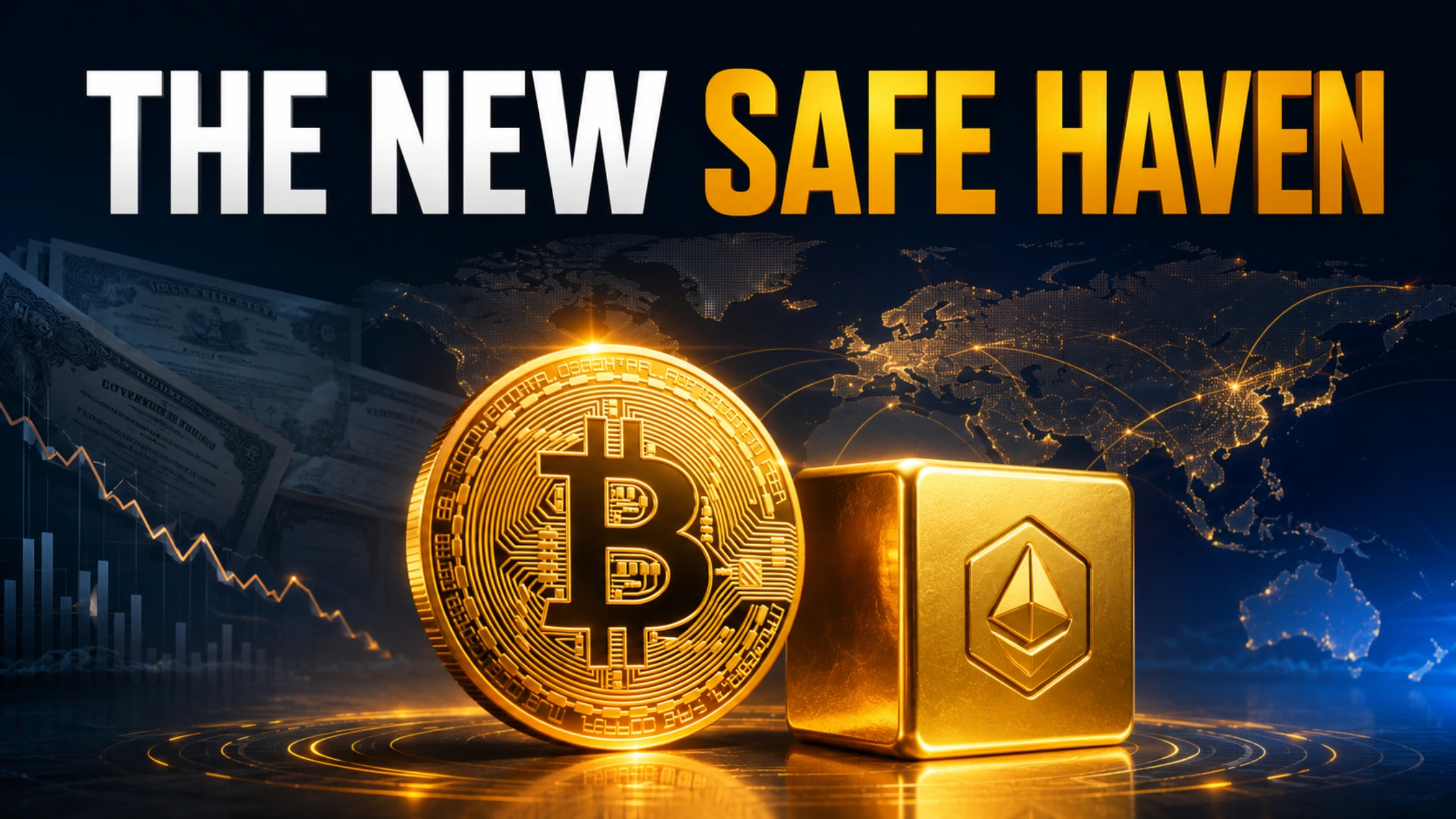
Sovereign debt is no longer a simple safe-haven asset. This guide explains why investors are watching Bitcoin, tokenized gold, physical gold, real yields, debt sustainability and self-custody as part of a modern geopolitical hedging framework.
For decades, the standard geopolitical hedge was simple.
When the world became dangerous, capital fled into sovereign bonds.
U.S. Treasuries.
German Bunds.
Japanese government bonds.
Cash.
Gold.
That was the traditional flight to safety.
But 2026 is forcing investors to ask a harder question:
What happens when the “safe” asset is issued by the same governments running unsustainable debt burdens?
This is the uncomfortable shift at the center of the new geopolitical hedging debate.
Sovereign bonds still matter.
They remain deep, liquid and central to global finance.
But they are no longer risk-free in the way many investors were taught.
If debt levels are high, interest costs are rising and governments cannot politically cut spending enough to stabilize deficits, then bondholders face a different kind of risk.
Not always default.
Often something slower:
Financial repression.
Inflation.
Currency debasement.
Capital controls.
Negative real returns.
That is why Bitcoin and tokenized gold have entered the conversation.
Not because they are perfect.
They are not.
Bitcoin is volatile.
Tokenized gold carries issuer and smart contract risk.
Physical gold carries storage and liquidity friction.
But together, they represent a new category of hedge:
Non-sovereign, portable, digitally accessible hard assets.
This article explains the 2026 geopolitical hedge framework, why Bitcoin and tokenized gold matter, how they differ from traditional safe havens, and how investors can think about allocation without falling into hype or reckless certainty.
Summary: Bitcoin, Tokenized Gold and Geopolitical Hedging
The uploaded framework argues that traditional geopolitical hedging is changing because sovereign debt is becoming a source of systemic risk rather than a pure safe haven.
High government debt, rising interest expense and political resistance to spending cuts can push countries toward financial repression, where inflation runs higher than bond yields and bondholders lose purchasing power over time.
In that environment, investors increasingly look for assets outside the direct control of sovereign balance sheets.
Bitcoin offers portability, fixed supply and self-custody.
Gold offers a long history as a hard asset and geopolitical hedge.
Tokenized gold offers faster settlement and easier digital liquidity, but with issuer, custody and smart contract risks.
A sensible framework does not treat Bitcoin or tokenized gold as guaranteed protection.
Instead, it treats them as part of a diversified hedge against currency debasement, capital controls, banking risk and sovereign debt stress.
The uploaded article emphasizes a portfolio framework where investors consider a small allocation to Bitcoin and gold-based assets, monitor sovereign stress indicators, and prioritize custody discipline.
The key takeaway:
The modern geopolitical hedge is not only about owning hard assets.
It is about owning assets that can survive stress in the banking system, the bond market and the currency system.
Why the Old Safe-Haven Model Is Under Pressure
The old model assumed that sovereign debt was the safest asset in the world.
In many situations, it still functions that way.
During market panic, investors often buy government bonds.
Central banks still use sovereign debt markets as policy channels.
Banks still hold sovereign bonds as core balance-sheet assets.
Pension funds still rely on them.
But the long-term risk profile is changing.
Many major governments now face a difficult combination:
High debt levels.
Large fiscal deficits.
Rising interest expenses.
Aging populations.
Defense spending pressures.
Energy transition costs.
AI infrastructure spending.
Lower political tolerance for austerity.
When debt grows faster than the economy’s ability to service it, the system has limited choices.
A government can cut spending.
It can raise taxes.
It can grow faster.
It can default.
Or it can inflate away the real value of the debt over time.
The last option is often the most politically convenient.
That is the foundation of the modern hard-asset hedge.
Investors are not only hedging market volatility.
They are hedging the purchasing power of money itself.
What Fiscal Dominance Means in Plain English
Fiscal dominance sounds technical, but the idea is simple.
It happens when government debt becomes so large that central banks are pressured to support the bond market, even if inflation remains a problem.
Instead of setting policy only to control inflation, the central bank must also worry about whether the government can afford its debt.
That can lead to financial repression.
Financial repression means savers earn less than the real inflation rate.
For example:
Bond yields may look positive.
But inflation may be higher.
The real return may be negative.
Purchasing power quietly falls.
This is not a dramatic default.
It is a slow transfer from savers to debtors.
Governments with large debt burdens benefit when inflation reduces the real value of what they owe.
Bondholders and cash savers pay the price through reduced purchasing power.
That is why investors are rethinking what “safe” means.
A bond can be safe in nominal terms and still lose real value.
Why Bitcoin Belongs in the Geopolitical Hedge Conversation
Bitcoin is not a traditional safe haven.
It can fall sharply.
It trades with liquidity cycles.
It is still volatile.
It can behave like a risk asset in short timeframes.
But Bitcoin has several properties that make it relevant in a sovereign debt and capital-control world.
1. Fixed Supply
Bitcoin has a hard supply limit.
No central bank can issue more Bitcoin to finance a deficit.
That makes it structurally different from fiat currency.
2. Portability
Bitcoin can be moved globally without physically transporting metal, cash or securities.
That matters in a world where capital controls can appear quickly during crises.
3. Self-Custody
If properly self-custodied, Bitcoin can be held outside the banking system.
This reduces exposure to bank freezes, broker restrictions and some forms of counterparty risk.
Self-custody is powerful, but it also requires responsibility.
Lose the private keys and the asset may be lost permanently.
4. Neutral Settlement
Bitcoin can settle across borders without relying on a traditional correspondent bank.
This is why it increasingly appears in discussions about neutral money, sanctions, sovereign pressure and alternative settlement rails.
5. No Sovereign Issuer
Bitcoin is not issued by a government.
That makes it different from sovereign debt, bank deposits and fiat cash.
It does not remove all risk.
But it changes the risk category.
The Confiscation Risk Question
Every asset has a control point.
Physical gold can be seized if stored in an accessible vault.
Bank deposits can be frozen.
Brokerage accounts can be restricted.
Real estate can be taxed, regulated or expropriated.
Securities can be immobilized inside financial plumbing.
Bitcoin’s control point is different.
If held correctly, the private key is the control point.
That is what makes Bitcoin unique.
A government can regulate exchanges.
A bank can refuse transfers.
A platform can freeze an account.
But the Bitcoin network itself does not require permission from a local bank.
This does not make Bitcoin immune from legal, physical or coercive risk.
It does make it harder to confiscate remotely when properly self-custodied.
That is the “unconfiscatability” argument.
It should not be overstated.
But it should not be ignored.
Why Gold Still Matters
Gold has survived every monetary regime.
It has no central issuer.
It has thousands of years of history as a store of value.
It is widely recognized.
It performs well in some crisis environments.
It is not dependent on a blockchain, smart contract or internet connection.
That makes gold an important hard-asset hedge.
But gold has practical drawbacks.
Physical gold can be expensive to buy and sell.
Dealer spreads can be wide.
Storage costs can add up.
Insurance can be expensive.
Large transfers are slow.
Cross-border movement can be difficult.
Verification requires trust, custody and logistics.
This is why tokenized gold has become more interesting.
It attempts to combine gold’s hard-asset history with digital liquidity.
What Is Tokenized Gold?
Tokenized gold is a digital token designed to represent ownership of physical gold.
Examples include products such as Paxos Gold and Tether Gold.
The basic idea is that each token represents a claim on gold stored by an issuer or custodian.
This gives users digital access to gold exposure.
Potential benefits include:
Faster settlement.
Easier transfer.
Smaller trade sizes.
Lower trading friction.
24/7 market access.
On-chain composability.
Better liquidity than some physical-gold channels.
But tokenized gold is not the same as holding coins or bars in your own possession.
It introduces new risks.
Issuer risk.
Custodian risk.
Smart contract risk.
Regulatory risk.
Redemption risk.
Blockchain network risk.
Counterparty risk.
That is why tokenized gold should be treated as a useful instrument, not a perfect replacement for physical gold.
Physical Gold vs Tokenized Gold
The difference is not simply “old versus new.”
It is a tradeoff.
Physical Gold
Physical gold is best for maximum independence from digital systems and counterparties.
Its strengths:
No smart contract risk.
No blockchain dependency.
No issuer token risk.
Long historical trust.
Useful in extreme systemic scenarios.
Its weaknesses:
Storage costs.
Insurance costs.
Dealer spreads.
Transport friction.
Security risk.
Slow liquidation.
Harder to use for rapid rebalancing.
Tokenized Gold
Tokenized gold is best for liquidity, speed and digital portfolio management.
Its strengths:
Fast settlement.
Easy transfer.
Fractional access.
Lower friction.
Useful for active hedging.
Potential DeFi integration.
Its weaknesses:
Issuer dependence.
Custodian dependence.
Smart contract risk.
Possible redemption restrictions.
Regulatory risk.
Potential freeze or blacklist mechanics depending on the issuer.
The better question is not which one is “best.”
The better question is what risk you are hedging.
For full systemic breakdown, physical gold may be stronger.
For liquid digital hedging, tokenized gold may be more practical.
For portable sovereign-risk hedging, Bitcoin has a different role again.
A Practical 2026 Geopolitical Hedge Framework
A sensible geopolitical hedge should not depend on one asset.
Bitcoin, physical gold and tokenized gold can play different roles.
Bitcoin
Bitcoin is the high-volatility, high-conviction non-sovereign asset.
It may offer stronger upside if fiat debasement accelerates.
It also carries deeper drawdown risk.
Bitcoin should be sized carefully.
Physical Gold
Physical gold is the old-world hard-asset hedge.
It is less technologically dependent.
It may be useful in extreme scenarios.
But it is less liquid and harder to move.
Tokenized Gold
Tokenized gold is the digital liquidity layer for gold exposure.
It may be useful for investors who want gold exposure that can move quickly across platforms.
It should be used with full awareness of issuer and redemption risk.
Cash and Short-Term Instruments
Cash still matters.
A hedge portfolio needs liquidity.
Even if fiat is being debased over time, cash can protect against forced selling during volatility.
Productive Assets
A hedge should not replace an entire portfolio.
Businesses, equities, income-producing assets and real assets can still matter.
The goal is not to abandon everything.
The goal is to add resilience.
How Much Should Investors Allocate?
There is no universal number.
The uploaded framework discusses a 5% to 10% allocation to Bitcoin and hard-asset hedges.
That may be reasonable for some investors.
It may be too high for others.
The correct allocation depends on:
Age.
Income.
Debt.
Risk tolerance.
Country of residence.
Currency exposure.
Investment horizon.
Existing assets.
Emergency fund.
Legal and tax considerations.
Ability to self-custody safely.
A conservative investor might start smaller.
A high-conviction investor might allocate more.
A trader might use dynamic exposure.
A long-term saver might use a fixed strategic allocation.
The most important rule is simple:
Do not size a hedge so large that its volatility forces you to sell at the worst time.
A hedge that creates panic is not a hedge.
Dynamic Hedging: Watching Sovereign Stress
The uploaded framework references sovereign credit default swap spreads as one way to monitor sovereign risk.
In plain English, a credit default swap is a market-based insurance contract against default.
When the cost of that insurance rises, the market is pricing higher sovereign stress.
Most retail investors do not need to trade CDS directly.
But they can watch the same idea through simpler signals:
Government bond yields.
Real yields.
Debt-service costs.
Currency weakness.
Inflation trends.
Fiscal deficit data.
Credit rating outlooks.
Central bank balance sheets.
Banking stress indicators.
Gold and Bitcoin flows.
The point is not to build a perfect formula.
The point is to increase hedges when sovereign stress is rising and reduce excess hedges when stress fades.
This prevents emotional buying during panic and emotional selling during calm.
Execution: Where Investors Can Act
Execution matters because a hedge is only useful if you can access it, move it and secure it.
Bitcoin Access
Buy Bitcoin on Kraken
Trade Bitcoin on Bybit
Trade Bitcoin on Binance
Trade Bitcoin on OKX
Buy Bitcoin on VALR with code VAZP2TAW
Gold and Tokenized Gold Access
Some platforms may offer access to tokenized gold, gold-linked tokens or gold-backed instruments depending on jurisdiction and availability.
Before using any tokenized gold product, check:
Who issues it.
Where the gold is stored.
Whether redemption is available.
Whether the token can be frozen.
Which blockchain it uses.
What fees apply.
Whether the issuer is regulated.
Whether reserves are independently verified.
Custody
For long-term Bitcoin holdings, self-custody may reduce counterparty risk.
Explore Ledger hardware wallets
A hardware wallet can help protect private keys, but it does not remove personal responsibility.
Users must protect recovery phrases.
They must avoid phishing.
They must understand that lost keys can mean lost funds.
For tokenized gold, custody depends on the token, chain and wallet used.
Self-custody of a token does not remove issuer risk.
It only removes some platform custody risk.
Why Capital Controls Matter
Capital controls are restrictions on moving money out of a country or converting local currency into foreign assets.
They often appear when governments face debt stress, currency pressure or banking instability.
Capital controls can include:
Withdrawal limits.
Foreign exchange restrictions.
Limits on offshore transfers.
Brokerage restrictions.
Bank account freezes.
Exchange delays.
Mandatory conversion rules.
This is why investors think about portable assets before a crisis, not during one.
Once controls appear, execution becomes harder.
A geopolitical hedge should be built when markets are functioning, not only when everyone is rushing for the exit.
The Role of Self-Custody
Self-custody is central to the Bitcoin hedge thesis.
If Bitcoin is held on an exchange, the investor still has counterparty risk.
The exchange can freeze withdrawals.
Banking partners can fail.
Regulators can impose restrictions.
Platforms can suffer hacks.
Self-custody reduces those risks.
But it introduces different risks.
Private key loss.
Seed phrase theft.
Poor backup practices.
Physical security issues.
Inheritance planning problems.
User error.
A serious hedge requires a serious custody plan.
That may include:
Hardware wallets.
Offline seed phrase backups.
Geographic redundancy.
Multi-signature setups for larger balances.
Clear inheritance instructions.
No cloud screenshots.
No sharing recovery phrases.
A hedge is not complete until custody is solved.
Risks to the Thesis
1. Bitcoin Volatility
Bitcoin can fall sharply even if the long-term thesis is intact.
A geopolitical hedge with Bitcoin must account for large drawdowns.
2. Gold Underperformance
Gold can underperform for long periods, especially when real yields are high or investor demand shifts elsewhere.
3. Tokenized Gold Counterparty Risk
Tokenized gold depends on issuers, custodians, auditors, legal structures and redemption mechanisms.
It is not the same as physical possession.
4. Regulatory Risk
Governments may restrict exchanges, stablecoins, tokenized assets or crypto transfers during stress.
5. Custody Risk
Self-custody protects against some risks but creates responsibility.
Poor custody can destroy the hedge.
6. Over-Allocation Risk
A hedge can become dangerous if it is too large relative to the investor’s needs and tolerance.
7. False Crisis Signals
Not every spike in sovereign stress becomes a full debt crisis.
Dynamic hedging can help, but signals can be noisy.
Common Mistakes
Mistake 1: Assuming Bonds Are Always Safe
Sovereign bonds can protect during deflationary shocks, but they can lose purchasing power during inflationary repression.
Mistake 2: Treating Bitcoin as Risk-Free
Bitcoin is non-sovereign, but it is not risk-free.
Volatility is part of the asset.
Mistake 3: Treating Tokenized Gold as Physical Gold
Tokenized gold is a claim on gold through an issuer.
It carries different risks from physical possession.
Mistake 4: Buying the Hedge Too Late
The best time to build resilience is before capital controls or market stress appear.
Mistake 5: Ignoring Custody
Buying the right asset is not enough.
The asset must be secured properly.
Final Verdict: The Hedge Has Changed
The geopolitical hedge of 2026 is not the same as the hedge of the last century.
Sovereign bonds still matter.
But they no longer deserve blind trust.
When debt burdens rise, interest expense accelerates and governments face political limits, the risk shifts from default alone to financial repression and currency debasement.
That is where Bitcoin and gold re-enter the conversation.
Bitcoin offers portability, fixed supply and self-custody.
Physical gold offers historical hard-asset resilience.
Tokenized gold offers digital liquidity, but with issuer and smart contract tradeoffs.
The strongest framework does not worship any single asset.
It builds layers.
Liquidity for flexibility.
Bitcoin for non-sovereign portability.
Gold for hard-asset history.
Tokenized gold for digital settlement.
Self-custody for control.
Risk management for survival.
The real lesson is simple:
In a world where sovereign debt is no longer unquestionably safe, investors need hedges that do not depend entirely on sovereign promises.
That does not mean panic.
It means preparation.
FAQ
Why are investors questioning sovereign bonds as safe havens?
Investors are questioning sovereign bonds because high debt levels, rising interest costs and inflation can reduce real purchasing power even if nominal repayment continues.
What is fiscal dominance?
Fiscal dominance happens when government debt is so large that central banks are pressured to keep financing conditions manageable, even if inflation remains a concern.
Why is Bitcoin considered a geopolitical hedge?
Bitcoin is considered a geopolitical hedge because it has fixed supply, global portability, self-custody and no sovereign issuer.
Is Bitcoin risk-free?
No. Bitcoin is volatile and can experience large drawdowns. It should be sized carefully.
Why does gold still matter?
Gold has a long history as a hard asset and store of value. It is not issued by a government and can be useful in crisis environments.
What is tokenized gold?
Tokenized gold is a blockchain-based token designed to represent ownership or a claim on physical gold held by an issuer or custodian.
Is tokenized gold the same as physical gold?
No. Tokenized gold may offer faster settlement and easier trading, but it carries issuer, custody, smart contract and redemption risk.
How much should investors allocate to Bitcoin and gold?
There is no universal allocation. The uploaded framework discusses 5% to 10% as a possible hedge range, but the right number depends on risk tolerance, country, income, age, goals and custody ability.
Why does self-custody matter?
Self-custody can reduce exchange and platform risk, but it requires careful private key and recovery phrase management.
Is this financial advice?
No. This is educational market analysis and should not be treated as personal financial advice.
Simple Disclaimer
This article is for educational and research purposes only and does not constitute financial advice, investment advice, legal advice, tax advice or a recommendation to buy or sell any asset. Bitcoin, gold, tokenized gold and crypto assets carry risk and can lose value. Tokenized gold may involve issuer risk, smart contract risk, custodian risk, redemption risk and regulatory risk. Self-custody can reduce some counterparty risks but creates private key and recovery phrase responsibilities. This content is intended for adults aged 18 and over. Always do your own research, verify product details, understand your local laws and consult qualified professionals where appropriate.





