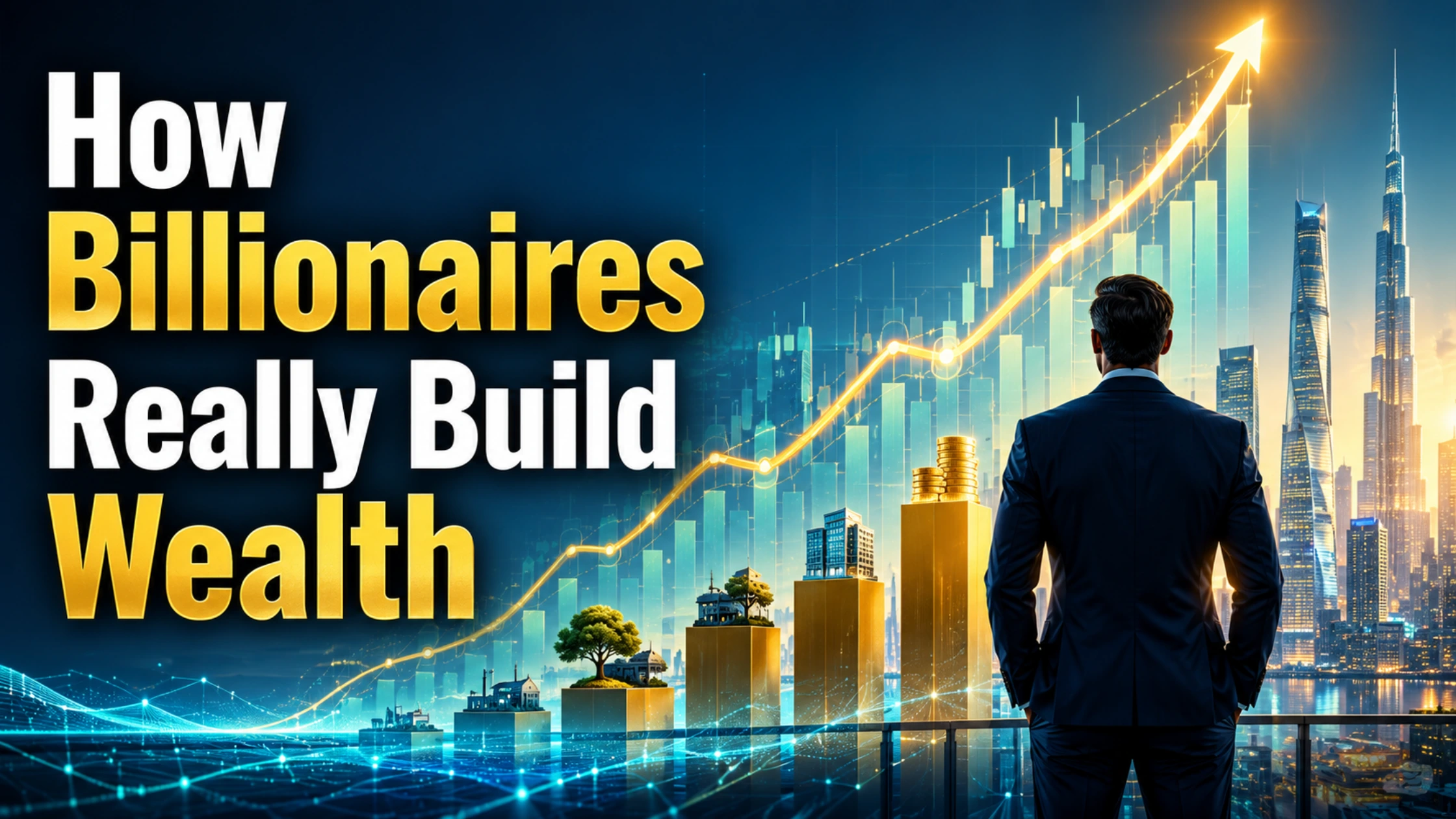
Billionaire wealth is rarely accidental. The world’s most durable wealth creators use repeatable engines: capital concentration, asymmetric upside, scale leverage, systematic edge and moat pricing power. Decentralised News breaks down the model and introduces the DN Wealth Architecture Simulator.
Most people study billionaires as if they are exceptions to every rule.
They focus on biography, personality and myth.
Buffett is patient.
Musk is relentless.
Bezos is obsessive.
Arnault is tasteful.
Simons is mathematical.
Dalio is systematic.
Huang is strategic.
Those labels are not wrong, but they are incomplete.
The deeper lesson is not that these people share the same personality.
They do not.
The deeper lesson is that the most durable wealth creators tend to build or control compounding systems.
They do not merely own assets.
They own engines.
A stock can go up.
A trade can work.
A business can have a good year.
But billionaire-level wealth usually comes from something stronger:
A system that keeps converting capital, information, distribution, technology, scarcity or trust into more economic power.
That is what Decentralised News calls the Algorithm of Wealth.
It is not a promise.
It is not a get-rich formula.
It is a model for understanding how major wealth is built, scaled and defended.
At its core are four engines:
Capital concentration.
Asymmetric risk.
Scale leverage.
Moat pricing power.
A fifth discipline sits above them all:
Survival.
Without survival, even the best engine eventually fails.
Summary
Billionaire wealth is usually not created by random speculation. It is created by ownership of scalable systems.
The Capital Engine represents the Buffett, Munger and Pabrai model: concentrated ownership of high-quality assets purchased with margin of safety.
The Alpha Engine represents the Simons and Dalio model: systematic edge, quantitative signals, macro cycles, correlation management and rules-based decision-making.
The Scale Engine represents the Musk, Gates and Bezos model: technology, operational leverage, network effects and infrastructure control.
The Moat Engine represents the Arnault, Bezos and Huang model: pricing power, brand scarcity, ecosystem lock-in, distribution control and technical dependency.
The unified DN wealth equation is:
Wealth creation accelerates when concentrated capital is deployed into asymmetric opportunities that can scale, defend margins and survive volatility.
The central mistake is copying billionaire concentration without billionaire-level control, liquidity, information, timing or risk tolerance.
The DN Wealth Architecture Simulator helps readers test how concentration, asymmetry, scale, moat strength, risk controls and leverage interact over time.
The Four Wealth Engines
Wealth Engine | Core Logic | Representative Figures | Main Strength | Main Failure Risk |
Capital Engine | Buy or build assets that compound over long periods | Warren Buffett, Charlie Munger, Mohnish Pabrai | Patience, valuation discipline, compounding | Value traps, slow growth, poor timing |
Alpha Engine | Extract repeatable edge from data, macro or structure | Jim Simons, Ray Dalio | Systematic process, non-emotional decisions | Overfitting, model failure, crowding |
Scale Engine | Build systems where revenue grows faster than cost | Elon Musk, Bill Gates, Jeff Bezos | Explosive growth, operational leverage | Execution risk, cash burn, dilution |
Moat Engine | Protect profit through scarcity, lock-in or pricing power | Bernard Arnault, Jensen Huang, Jeff Bezos | Margin defence, long-term durability | Complacency, disruption, overvaluation |
The engines are different, but the richest outcomes often appear when they overlap.
Buffett is not only a value investor. Berkshire Hathaway also uses insurance float as a capital engine and owns businesses with moats.
Bezos is not only a founder. Amazon combines scale, logistics, data, marketplace depth and cloud infrastructure.
Huang is not only a chip executive. Nvidia’s advantage is both hardware scale and software ecosystem lock-in through CUDA.
Arnault is not only a luxury buyer. LVMH combines scarcity, heritage, distribution, pricing power and disciplined capital allocation.
The lesson is engine stacking.
The larger the wealth outcome, the more likely multiple engines are working together.
Engine One: The Capital Engine
The Capital Engine is the oldest and cleanest wealth model.
It asks:
Can capital be deployed into an asset that compounds for a long time at attractive rates?
This is the Buffett and Munger tradition.
The core principles are simple, but difficult:
Understand the business.
Buy with margin of safety.
Avoid permanent capital loss.
Prefer high return on invested capital.
Let time do the heavy lifting.
Avoid unnecessary activity.
Concentrate only when the odds justify it.
This model sounds conservative, but it can produce extraordinary results because compounding is nonlinear.
A business that can reinvest capital at high returns for decades can become far more valuable than a faster-moving but fragile opportunity.
Capital Engine Variable | What It Measures | Why It Matters |
Return on invested capital | Efficiency of capital deployment | High ROIC compounds faster |
Margin of safety | Gap between value and price | Protects against error |
Reinvestment runway | Length of future growth opportunity | Extends compounding period |
Balance sheet strength | Ability to survive downturns | Prevents forced selling |
Management discipline | Quality of capital allocation | Determines long-term compounding |
The Capital Engine is not glamorous.
That is often why it works.
Engine Two: The Alpha Engine
The Alpha Engine is built on repeatable edge.
It is the Simons and Dalio lesson.
Where the Capital Engine says “own great assets patiently,” the Alpha Engine says “build a system that repeatedly identifies mispricing, regime shifts or structural inefficiencies.”
Jim Simons built Renaissance Technologies around mathematical signals and statistical discipline.
Ray Dalio built Bridgewater around macro systems, liquidity cycles and risk balancing.
The common idea is that emotion is unreliable.
Systems are more scalable.
The Alpha Engine focuses on:
Signals.
Rules.
Probabilities.
Correlation.
Macro regimes.
Liquidity cycles.
Non-correlated returns.
Risk-adjusted performance.
Alpha Engine Variable | What It Measures | Failure Mode |
Signal quality | Whether the model has real predictive value | Noise mistaken for edge |
Frequency | How often the edge can be applied | Too few valid opportunities |
Correlation | Relationship to other risks | Hidden concentration |
Adaptability | Ability to adjust when regimes change | Model decay |
Discipline | Ability to follow rules under stress | Emotional override |
The Alpha Engine can be powerful, but it is dangerous when misunderstood.
Many traders think they have a system.
Few have a system that survives changing markets.
Engine Three: The Scale Engine
The Scale Engine creates wealth when growth can outrun cost.
This is the founder and technology model.
Software is the cleanest example.
A company can build a product once and distribute it globally.
The same logic applies to marketplaces, platforms, logistics systems, data networks, AI infrastructure, media brands and crypto protocols.
The Scale Engine focuses on:
Low marginal cost.
Distribution advantage.
Network effects.
Automation.
Vertical integration.
Infrastructure control.
Product velocity.
Market creation.
Scale Engine Factor | Strong Version | Weak Version |
Distribution | Built-in demand channels | Paid growth dependency |
Marginal cost | Costs rise slowly as revenue grows | Costs rise with every customer |
Network effects | More users improve the product | More users add complexity only |
Infrastructure | Controlled or deeply integrated | Rented from stronger platforms |
Capital efficiency | Scale improves margins | Scale increases losses |
Scale is seductive because it can create enormous upside.
But it is also where many investors and founders overestimate the outcome.
Growth without margin is not enough.
Scale without a moat attracts competition.
Operational leverage works both ways.
If revenue rises faster than cost, wealth compounds.
If fixed costs rise before demand arrives, losses compound too.
Engine Four: The Moat Engine
The Moat Engine protects the profit pool.
This is where many wealth stories become durable.
A company may grow quickly, but if competitors can copy it easily, excess profit eventually disappears.
Moats preserve value.
They can come from:
Brand.
Scarcity.
Trust.
Regulation.
Distribution.
Data.
Ecosystem lock-in.
Switching costs.
Developer dependency.
Cultural status.
Bernard Arnault’s LVMH empire is a classic Moat Engine.
Luxury brands do not only sell products.
They sell status, scarcity, heritage and pricing power.
Jensen Huang’s Nvidia is also a Moat Engine.
Nvidia’s advantage is not only GPUs.
It is the broader ecosystem: CUDA, developers, software libraries, data-centre adoption, AI workflows and enterprise dependency.
Moat Type | Example Logic | Why It Protects Wealth |
Brand moat | Customers pay more for identity and status | Supports pricing power |
Network moat | More users make the system stronger | Makes switching harder |
Software moat | Tools and workflows become embedded | Creates dependency |
Regulatory moat | Rules favour incumbents | Raises barriers to entry |
Distribution moat | Company controls demand access | Lowers customer acquisition cost |
Data moat | Usage creates better intelligence | Improves product advantage |
A moat is not just a slogan.
It must show up in margins, retention, pricing power or resilience.
The Unified Wealth Equation
The DN wealth model can be expressed as:
Variable | Meaning | Practical Question |
Cc | Capital concentration | How much capital is deployed where real edge exists? |
Av | Asymmetric value | Is upside much larger than survivable downside? |
Ae | Alpha edge | Is there repeatable informational, analytical or systematic advantage? |
Ol | Operational scale leverage | Can output grow faster than cost? |
Mp | Moat pricing power | Can the system defend margins over time? |
Sr | Survival reserve | Can the strategy endure drawdowns, delays and shocks? |
The simplified equation:
Wealth durability = concentration × asymmetry × scale × moat × survival
This is not a literal promise of future returns.
It is a diagnostic model.
It helps identify whether a strategy is a compounding engine or only a story.
The Sequencing Law
The most important part of the model is timing.
The strategies used to build wealth are not always the strategies used to preserve it.
Phase | Primary Objective | Dominant Engine | Main Risk |
Formation | Find edge | Capital or Alpha | No clear advantage |
Expansion | Concentrate and scale | Scale Engine | Overextension |
Dominance | Build moat | Moat Engine | Competitive attack |
Preservation | Protect capital | Diversification and liquidity | Complacency or inflation |
Legacy | Institutionalise ownership | Governance and structures | Poor succession |
This is why “concentration builds wealth, diversification preserves it” is true but incomplete.
Concentration only works when paired with edge.
Diversification only preserves wealth when the assets are durable.
The mistake is copying the wrong phase.
A person with no edge copying a founder’s concentration is not behaving like a billionaire.
They are taking uncompensated risk.
DN Wealth Architecture Simulator
Model how concentration, asymmetry, alpha, scale, moat power, leverage and risk controls interact over time. This is an educational simulator, not a prediction engine.
Strongest engine
--
Main fragility
--
Wealth Engine Scorecard
Diagnostic Question | Strong Signal | Weak Signal |
Is there a real edge? | Proprietary insight, distribution, skill or control | Generic enthusiasm |
Is the upside asymmetric? | Large upside with defined downside | Unlimited downside or unclear risk |
Can it scale? | Revenue can grow faster than cost | Growth requires linear spending |
Does it have a moat? | Pricing power, retention or lock-in | Easy to copy |
Can it survive stress? | Liquidity, patience and low forced-selling risk | Leverage, fragility or dependence on one exit |
Is the phase clear? | Strategy matches build, scale or preserve stage | Mixed objectives |
This scorecard matters for investors, founders and crypto participants.
A token can have a narrative without an engine.
A startup can have growth without a moat.
A stock can have quality without upside.
A strategy can have conviction without survival.
The best opportunities score well across multiple engines.
Application to Crypto, AI and Digital Assets
The Algorithm of Wealth is not only a billionaire biography model.
It applies directly to crypto and AI.
Market Theme | Engine Type | Key Question |
Bitcoin | Scarcity, network effect, monetary belief | Does the network continue to absorb capital? |
Ethereum | Developer ecosystem and settlement layer | Does usage reinforce the moat? |
AI infrastructure | Scale, capital intensity, bottleneck ownership | Does demand justify valuation and capex? |
DePIN | Network supply and tokenized infrastructure | Can token incentives become real cash flow? |
Exchanges | Liquidity, distribution, regulatory access | Does depth create defensible user behaviour? |
Stablecoins | Distribution, trust and settlement utility | Does circulation create durable economics? |
Crypto media | Distribution and trust | Can attention become durable authority? |
Crypto investors often chase upside.
AI investors often chase growth.
But the Algorithm of Wealth asks the harder questions:
Where is the moat?
Where is the cash flow?
Where is the switching cost?
Where is the survival reserve?
Where is the real user behaviour?
Where is the edge?
This is how narrative becomes analysis.
The Failure Map
Failure Mode | What Happens | Example Pattern |
Overconcentration | One mistake destroys the strategy | All capital in one fragile position |
Excess leverage | Drawdown forces liquidation | Borrowed capital controls the timeline |
No moat | Competitors copy the model | Margins collapse |
Scale illusion | Revenue grows but losses grow too | Growth depends on subsidies |
Alpha decay | The signal stops working | Model overfit to old data |
Liquidity trap | Asset cannot be exited under stress | Private or thinly traded exposure |
Narrative addiction | Story replaces economics | Hype without engine |
The purpose of the framework is not to eliminate risk.
That is impossible.
The purpose is to identify which risks are being paid for, and which are simply hidden fragility.
Final Verdict: Study Engines, Not Just Outcomes
The world’s richest people are often treated as mysteries.
But the systems beneath their wealth are more visible than their myths suggest.
They concentrate when they have edge.
They structure upside asymmetrically.
They build systems that scale.
They defend margins through moats.
They diversify after the engine has created wealth.
And above all, they survive.
This is the difference between a good idea and a wealth architecture.
A good idea can produce a return.
A wealth architecture can produce repeated compounding.
That is the lesson for founders, investors, crypto builders, AI entrepreneurs and capital allocators.
Do not only ask:
What should I buy?
Ask:
What engine am I building?
What edge do I have?
What can scale?
What protects the profit?
What can destroy the position?
What survives if the timeline is longer than expected?
The algorithm of wealth is not a secret code.
It is a disciplined way of seeing the world.
Capital seeks engines.
The best engines compound.
The strongest engines survive.
FAQ
What is the Algorithm of Wealth?
The Algorithm of Wealth is Decentralised News’ model for understanding how major wealth is built through capital concentration, asymmetric risk, systematic edge, scale leverage, moat pricing power and survival discipline.
Is this a formula for becoming a billionaire?
No. It is an educational framework for analysing wealth creation systems, not a promise or financial plan.
What is the Capital Engine?
The Capital Engine focuses on high-quality assets, disciplined valuation, return on invested capital, margin of safety and long-term compounding.
What is the Alpha Engine?
The Alpha Engine uses repeatable edge from data, macro structure, quantitative signals or rules-based systems.
What is the Scale Engine?
The Scale Engine builds businesses or platforms where revenue can grow faster than cost through technology, distribution, automation or network effects.
What is the Moat Engine?
The Moat Engine protects profits through brand, scarcity, ecosystem lock-in, switching costs, regulation, distribution or technical dependency.
Why does sequencing matter?
Because the strategy that builds wealth is often different from the strategy that preserves it. Concentration may build the engine, while diversification protects the outcome.
How does this apply to crypto?
Crypto projects can be analysed by asking whether they have real network effects, token utility, cash flow, distribution, liquidity, moat strength and survival capacity.
How does this apply to AI?
AI companies and infrastructure themes can be analysed through scale, bottleneck ownership, capital intensity, customer concentration, pricing power and valuation risk.
What is the DN Wealth Architecture Simulator?
It is a proprietary educational tool that models how concentration, asymmetry, alpha, scale, moat strength, leverage and risk controls interact over time.
Is this financial advice?
No. This article is educational research and should not be treated as financial advice.
Simple Disclaimer
This article is for educational and informational purposes only and does not constitute financial advice, investment advice, business advice, legal advice, tax advice or a recommendation to buy, sell, hold or use any asset, security, token, company, fund or financial product. Wealth creation involves risk, uncertainty, execution difficulty, volatility and potential loss of capital. References to well-known entrepreneurs and investors are used for educational analysis only and do not imply endorsement, guaranteed outcomes or replicable results. This content is intended for adults aged 18 and over. Always conduct independent research and consult qualified professionals where appropriate.