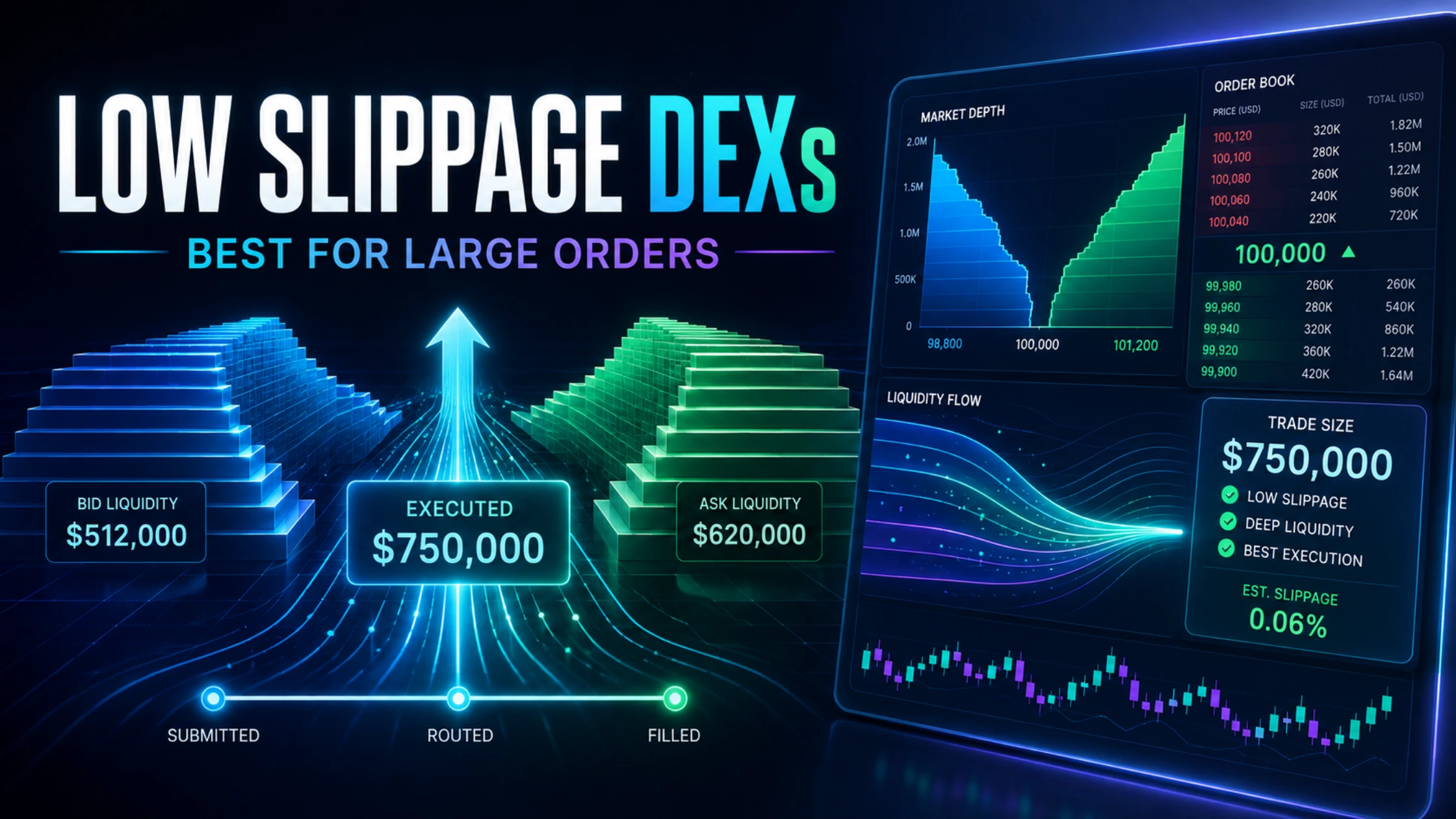
Our flagship ranking compares perpetual DEXs for large orders by depth, RFQ access, hidden orders, TWAP, AMM impact, funding, APIs and all-in execution cost.
Research Verified: 6 August 2026
Editorial Note: This 2027 guide is based on platform architecture and fee information verified in August 2026. It does not claim that any platform will consistently execute a $1 million order at the quoted fees or without slippage.
Summary
The perpetual exchange with the lowest advertised fee is not necessarily the cheapest exchange for a large trade.
At $1 million notional:
- One basis point equals $100.
- Ten basis points equal $1,000.
- A 0.04% taker fee costs $400.
- A 0.25% price impact costs $2,500.
- A 1% failed hedge or delayed execution costs $10,000.
For professional-size orders, depth and execution method matter more than headline marketing.
Decentralised News Large-Order Ranking
Rank | Platform | Large-Order Advantage | Principal Limitation |
1 | GRVT | Institutional order book, maker rebates and professional APIs | Best rates require substantial volume |
2 | Lighter | Large-depth incentives and zero-fee Standard Accounts | Intentional latency on Standard orders |
3 | Paradex | Private accounts, interactive liquidity and advanced APIs | Retail and Pro orders receive different treatment |
4 | Aevo | RFQ and OTC infrastructure | RFQ differentiation is strongest for options |
5 | Aster | Hidden orders and up to 110 scaled child orders | Hidden orders do not guarantee liquidity |
6 | ADEN | Iceberg, scaled and TWAP orders across 400-plus markets | Depth varies widely by market |
7 | edgeX | Scaled orders, competitive fees and mobile support | Public depth must be tested per contract |
8 | ApeX Omni | Worst-price endpoint, FOK, IOC and market-depth APIs | Strict price controls can cancel the order |
9 | MYX | Oracle-priced Matching Pool with zero-slippage design | Pool and oracle capacity must be independently tested |
10 | gTrade | Transparent synthetic impact and 30-band depth model | Funding and borrowing can compound |
11 | GMTrade | Positive impact when a trade balances the pool | One-sided orders can incur negative impact |
12 | Ondo Perps | TWAP and institutional RWA order books | RWA weekend and reopening risk |
13 | EVEDEX | Slippage limits, partial fills and cashback | Incomplete fills can leave residual exposure |
14 | Antarctic | Privacy-focused execution | Less independently observable large-order depth |
15 | AlphaX and TXFlow | Emerging low-fee and multichain alternatives | Public execution data remains limited |
The ranking weights documented execution architecture rather than unaudited claims about daily volume or liquidity.
The Decentralised News Large Order Score
Category | Weight | What Is Measured |
Executable depth | 25% | Size available within 1, 2, 5, 10 and 25 bps |
Execution controls | 20% | RFQ, hidden, iceberg, TWAP, FOK and IOC |
Implementation shortfall | 15% | Executed VWAP versus arrival midpoint |
Fee economics | 10% | Maker, taker and block-execution charges |
Exit capacity | 10% | Cost and fill quality when closing |
Funding and carry | 10% | Expected cost over the holding period |
API reliability | 5% | Depth feeds, batch orders and cancellation controls |
Custody and settlement | 5% | Smart-contract, sequencer and withdrawal risks |
The Core Measurement
Implementation shortfall measures the signed difference between the executed volume-weighted average price and the midpoint recorded immediately before execution.
It captures costs that a maker or taker fee alone misses.
$100,000 and $1 Million Test Specification
Test Component | $100,000 Test | $1 Million Test |
Primary market | BTC and ETH perpetuals | BTC and ETH perpetuals |
Secondary market | One altcoin or RWA contract | One altcoin or RWA contract |
Depth bands | 1, 2, 5, 10 and 25 bps | 2, 5, 10, 25 and 50 bps |
Execution routes | Market, limit and 15-minute TWAP | Market, passive, 60-minute TWAP and RFQ |
Repeat count | At least 10 snapshots | At least 20 snapshots |
Market regimes | Normal and volatile | Normal, volatile and weekend |
Exit test | Immediate and four-hour exit | Immediate, four-hour and 24-hour exit |
Required metrics | VWAP, fill rate, fee and shortfall | VWAP, fill rate, shortfall, refill and information leakage |
A platform should be removed from a large-order shortlist when its public API cannot provide sufficient depth data or its interface cannot quote the intended size.
Fee-Only Cost at Large Notional
The table below excludes spread, slippage, funding and network costs.
Platform and Base Route | Published Rate | $100,000 Fee | $1 Million Fee |
Lighter Standard maker or taker | 0% | $0 | $0 |
Paradex Retail maker or taker | 0% | $0 | $0 |
Aster USDT maker | 0% | $0 | $0 |
Aster USDT taker | 0.04% | $40 | $400 |
GRVT base maker | -0.0001% | $0.10 rebate | $1 rebate |
GRVT base taker | 0.045% | $45 | $450 |
ADEN base maker | 0.003% | $3 | $30 |
ADEN base taker | 0.038% | $38 | $380 |
edgeX non-VIP maker | 0.018% | $18 | $180 |
edgeX non-VIP taker | 0.038% | $38 | $380 |
Paradex Pro maker | 0.003% | $3 | $30 |
Paradex Pro base taker | 0.045% | $45 | $450 |
EVEDEX maker | 0.015% | $15 | $150 |
EVEDEX taker | 0.045% | $45 | $450 |
Antarctic maker | 0.02% | $20 | $200 |
Antarctic taker | 0.05% | $50 | $500 |
GMTrade open or close | 0.04% to 0.06% | $40 to $60 | $400 to $600 |
GRVT’s active fee model begins with a 0.0001% maker rebate and 0.045% taker fee, while its highest tier reaches a 0.003% maker rebate and 0.024% taker fee.
Paradex currently charges zero fees to Retail orders. Pro API makers pay 0.003%, while Pro taker fees begin at 0.045% and decline with volume and discounts.
Aster publishes a 0% maker fee and 0.04% taker fee for USDT perpetual contracts.
ADEN’s base rates are 0.003% maker and 0.038% taker.
edgeX’s current non-VIP rates are 0.018% maker and 0.038% taker.
EVEDEX starts at 0.015% maker and 0.045% taker, before cashback.
The fee table demonstrates why a proper ranking cannot stop at direct costs. A zero-fee order can still experience thousands of dollars in market impact.
Tier One: Institutional and Deep-Book Candidates
1. GRVT
GRVT is our leading institutional-style candidate because it combines maker rebates, API infrastructure, builder tools and an order-book model designed around professional liquidity.
GRVT Feature | Large-Order Relevance |
Base maker rebate | Reduces passive execution cost |
Nine fee tiers | Rewards higher volume |
Trading API | Supports algorithmic execution |
Builder codes | Allows external routing interfaces |
Market-maker programme | Encourages persistent book depth |
Hybrid settlement | Combines speed with blockchain settlement |
Its base perpetual taker cost of 4.5 basis points means the book must offer meaningfully better liquidity than a zero-fee competitor to remain cheaper on an aggressive order.
Best strategy: passive maker execution or algorithmic slicing.
2. Lighter
Lighter stands out because its liquidity programme explicitly evaluates depth at professional-size bands extending from $300,000 to $30 million.
Lighter Feature | Large-Order Relevance |
Standard fees | Zero maker and taker |
Standard taker latency | 300 milliseconds |
Standard maker latency | 200 milliseconds |
Depth incentives | Includes $1M, $3M, $10M and $30M bands |
Funding | Hourly and peer to peer |
Matching | Verifiable through ZK infrastructure |
Best strategy: test Standard versus Premium execution using the same timestamp and size.
Main risk: the free route may suffer more adverse movement during fast markets.
3. Paradex
Paradex provides different liquidity and latency conditions for Retail and Pro orders.
Order Classification | Fee and Execution Consequence |
Retail order | Zero fees, speed bump and access to Retail Price Improvement |
Pro maker | 0.003% fee |
Pro taker | 0.045% base rate, volume discounts available |
Pro API | Higher throughput and no Retail speed bump |
FastFills | Discount when qualifying Pro orders match Retail flow |
The API exposes separate interactive and API best prices. That distinction is unusually valuable when testing what a professional-size order can actually access.
Best strategy: compare Retail execution, Pro execution and FastFills before selecting a route.
Tier Two: Discreet and Split Execution
4. Aevo
Aevo’s OTC system provides an RFQ workflow through which a trader can request block quotes from institutional liquidity providers.
RFQ Advantage | Why It Matters |
Private size | Avoids displaying the full order |
Competing quotes | Allows direct price comparison |
Single block price | Avoids sweeping many order-book levels |
On-chain margin | Settlement remains connected to Aevo’s L2 |
Options expertise | Particularly useful for complex options blocks |
Aevo’s OTC and RFQ infrastructure is currently most differentiated for options, although the wider platform supports perpetuals and unified margin.
Best strategy: compare the RFQ quote with the public-book VWAP and expected hedging cost.
5. Aster
Aster Order | Large-Order Function |
Hidden order | Conceals total size and presence |
Scaled order | Distributes up to 110 orders across a range |
Post-only | Protects maker status |
API depth | Supports programmatic routing |
Zero maker fee | Reduces passive execution cost |
Best strategy: use a scaled order for gradual execution and hidden orders for residual size.
6. ADEN
ADEN Tool | Purpose |
Iceberg | Displays only part of the total size |
Scaled | Distributes orders across prices |
TWAP | Distributes execution across time |
IOC | Executes available size and cancels the remainder |
FOK | Requires the complete order to fill immediately |
Post-only | Ensures maker treatment |
ADEN reports more than 400 crypto perpetual markets, but professional traders should expect a steep liquidity difference between major contracts and smaller listings.
Best strategy: TWAP or iceberg for major markets; strict FOK testing for thinner contracts.
7. edgeX
edgeX provides scaled orders, public APIs and competitive tiered fees.
Tier | Maker | Taker |
Non-VIP | 0.018% | 0.038% |
VIP 3 | 0.008% | 0.030% |
VIP 6 | 0% | 0.024% |
Best strategy: scaled maker execution with automated cancellation when the midpoint moves.
8. ApeX Omni
ApeX Omni requires market orders to include an acceptable price derived from live depth or its worst-price endpoint.
ApeX Control | Large-Order Benefit |
Worst-price endpoint | Calculates an acceptable execution boundary |
FOK | Prevents incomplete block execution |
IOC | Limits residual resting exposure |
Market-depth API | Enables VWAP calculations |
Cross collateral | Improves capital efficiency |
Multi-chain deposits | Broadens collateral access |
Best strategy: calculate maximum price impact before signing and use FOK when partial fills create hedge risk.
Tier Three: Oracle and Pool Execution
9. MYX
MYX’s Matching Pool Mechanism is designed to execute at Pyth oracle prices without traditional order-book slippage.
MYX Property | Implication |
No visible book sweep | Large size does not consume public levels |
Oracle execution | Price references external market data |
Pair-specific pools | Capacity differs by market |
Delayed matching | Pools can temporarily intermediate imbalance |
Dual oracle | Execution pauses when price feeds disagree |
The critical question is not displayed slippage. It is whether the pool, oracle, funding and position-limit framework can support the intended size under stress.
10. gTrade
gTrade calculates execution from oracle price, fixed spread, liquidity impact and open-interest skew.
Market Type | Current Impact Structure |
BTC and ETH | 0.005% fixed spread per side; no configured liquidity-depth impact |
Other crypto | Dynamic depth and skew impact |
Major forex | 0.005% fixed spread per side plus very small depth impact |
Stocks and commodities | Primarily fixed-spread execution |
All positions | Funding and borrowing may accrue |
The protocol’s 30-band depth model provides a more granular representation of large-trade impact than a single liquidity threshold.
Best strategy: compare the displayed price-impact breakdown for one block versus several smaller trades.
11. GMTrade
GMTrade’s cost depends on whether an order improves or worsens pool balance.
Order Effect | Expected Outcome |
Reduces long-short imbalance | Lower fee and potentially positive impact |
Increases imbalance | Higher fee and negative impact |
High pool utilisation | Higher borrowing cost |
Crowded side | Increasing funding cost |
Oversized close | Potential delayed impact rebate above market threshold |
Best strategy: route the trade when it improves pool balance or split the order while monitoring the impact preview.
12. Ondo Perps
Ondo Perps is the leading specialist candidate for larger stock, index and commodity perpetual trades.
Its order-book model operates inside secure enclaves, and TWAP execution can divide orders over periods extending from minutes to days. Its most important use case is not necessarily BTC or ETH, but RWA derivatives that are less available on crypto-native order books.
Best strategy: TWAP during underlying-market hours, with reduced exposure around weekends and market reopenings.
Tier Four: Secondary and Emerging Candidates
Platform | Relevant Feature | Main Reservation |
EVEDEX | Slippage limits, partial fills and cashback | Partial fills create residual exposure |
Antarctic | Privacy and non-custodial settlement | Limited independent large-depth history |
AlphaX | Current zero-fee initiative | Less comprehensive public depth data |
TXFlow | Permissionless multichain interface | Limited public execution documentation |
EVEDEX starts at 0.015% maker and 0.045% taker, with cashback potentially reducing the effective fee. Its API can cancel unfilled size when the average execution would exceed the selected slippage boundary.
Antarctic publishes base fees of 0.02% maker and 0.05% taker and positions privacy as a central part of its design.
AlphaX announced a zero-fee initiative in July 2026, but direct fees should not be treated as evidence of sufficient institutional depth.
Order-Book, RFQ and AMM Comparison
Execution Model | Best Platforms | Large-Order Strength | Main Risk |
Central-limit order book | GRVT, Lighter, Paradex, ADEN, edgeX | Transparent depth and passive execution | Information leakage and book impact |
Hidden order book | Aster | Conceals size and intended price | Fill may be slow |
RFQ and block | Aevo | Private whole-block pricing | Counterparty and quote availability |
Oracle matching pool | MYX | No traditional book sweep | Oracle and pool-capacity dependence |
Synthetic oracle | gTrade | Pre-trade impact calculation | Funding, borrowing and model risk |
Liquidity pool | GMTrade | Can reward balance-improving trades | Large one-sided impact |
RWA enclave order book | Ondo Perps | Specialist equity and index liquidity | Weekend and oracle risk |
Hybrid order book | EVEDEX | Slippage limits and partial fills | Operational matching dependency |
Execution Splitting Decision Tree
Use a Single Market Order When
- The position is small relative to visible depth.
- Urgency is more important than price.
- The expected market move exceeds estimated impact.
- A complete immediate hedge is required.
Use IOC When
- Partial immediate execution is acceptable.
- The remainder should not rest publicly.
- The order must not chase the market.
Use FOK When
- The entire position must execute.
- A partial hedge would create unacceptable exposure.
- The platform displays sufficient executable depth.
Use TWAP When
- Urgency is low.
- Market liquidity is expected to remain stable.
- Information leakage can be tolerated.
- The trader can manage incomplete execution.
Use a Hidden or Iceberg Order When
- The intended size must not be visible.
- Passive execution is acceptable.
- The trader can wait for opposing flow.
Use RFQ When
- The order is large relative to public depth.
- Several liquidity providers can quote competitively.
- A private whole-block price is more valuable than public price discovery.
Oracle Divergence Test
Large trades on oracle-based protocols require a separate divergence test.
Record:
- External spot midpoint
- Protocol index price
- Protocol mark price
- Quoted execution price
- Difference in basis points
- Age of the latest oracle update
- Maximum permitted deviation
- Behaviour when price sources disagree
MYX requires its Pyth and keeper-derived prices to remain within an approved range before executing.
ADEN calculates mark price from several components and can pause updates during significant divergence before gradually resuming normal calculation.
Paradex calculates perpetual mark price using an external spot oracle and a fair-basis adjustment.
A tight order-book fill is not useful if liquidation is based on a materially different mark price.
Funding Test
Metric | Why It Matters |
Current funding | Immediate holding cost |
Predicted next rate | Near-term expectation |
Seven-day average | Reduces reliance on one observation |
Maximum observed rate | Stress-case cost |
Settlement interval | Determines payment timing |
Funding cap | Defines extreme exposure |
Position side | Determines payer or receiver |
Exit liquidity at settlement | Determines ability to avoid payment |
ADEN uses four- and eight-hour funding schedules and can switch a market to hourly settlement after an extreme rate.
Lighter settles funding hourly with peer-to-peer payments.
gTrade combines funding with a separate borrowing fee, meaning the less-crowded side may receive funding while still paying for vault usage.
GMTrade also applies both adaptive funding and utilisation-based borrowing.
Featured US-Regulated Alternative: Kalshi Perpetual Futures
Kalshi Perpetual Futures provides a regulated US comparison point for traders researching perpetual contracts, although it is not a decentralised exchange.
KalshiEX operates as a Commodity Futures Trading Commission-designated contract market. In May 2026, the CFTC approved its BTCPERP contract, a perpetual futures contract referencing the spot price of Bitcoin. The approval allowed the contract to be listed and traded as a regulated futures product within the US derivatives framework.
This distinguishes Kalshi Perps from offshore centralised exchanges and on-chain protocols such as GRVT, Lighter, Paradex, gTrade and GMX.
Why Kalshi Perps Is Relevant
Kalshi Perps may appeal to eligible US market participants prioritising:
- CFTC-supervised futures infrastructure
- A regulated centralised account structure
- Dollar-denominated collateral and settlement
- A perpetual contract without a conventional expiry date
- Access to crypto price exposure without managing a blockchain wallet
- A legally defined exchange and contract framework
Kalshi describes its perpetual contracts as positions on an asset’s price that remain open until closed, rather than expiring on a fixed settlement date.
How It Differs From a Perpetual DEX
Kalshi should not be placed inside the main DEX ranking because it does not provide the same wallet-native, self-custodial or smart-contract-based trading model.
| Feature | Kalshi Perps | Perpetual DEX |
|---|---|---|
| Platform structure | CFTC-regulated centralised exchange | On-chain or hybrid protocol |
| Account access | Registered exchange account | Wallet or smart account |
| Custody | Centralised exchange and clearing structure | Smart contracts, vaults or protocol accounts |
| Regulation | US futures framework | Varies by protocol and jurisdiction |
| Settlement visibility | Exchange records and regulatory reporting | Blockchain transactions |
| Account recovery | Centralised recovery process | Wallet-dependent |
| Smart-contract exposure | Limited compared with DeFi venues | Material protocol risk |
| Permissionless access | No | Sometimes |
| US regulatory clarity | Stronger | Frequently uncertain |
Large-Order Considerations
Kalshi’s regulatory status does not automatically prove that every contract has sufficient depth for a $100,000 or $1 million order.
It should be assessed using the same Decentralised News test applied to other venues:
- Executable depth near the midpoint
- Bid-ask spread
- Average execution price
- Percentage filled
- Funding mechanics
- Position and order limits
- Entry and exit liquidity
- Execution during volatile conditions
A regulated contract can still experience spread, slippage, funding costs and liquidation risk.
Decentralised News Assessment
Best designation: Featured US-regulated perpetual futures alternative
Strongest advantage: CFTC-regulated futures structure for eligible US users
Primary limitation: It is not a DEX and does not offer self-custodial on-chain settlement
Large-order verdict: A credible regulated benchmark that should be tested independently for live depth before being considered for institutionally sized execution
The CFTC’s approval makes Kalshi Perps an important development in the convergence between regulated US futures markets and crypto-native perpetual trading. It belongs in this article as a distinct regulated alternative, rather than being ranked directly against decentralised protocols.
Best Platform by Objective Entry
| Objective | Leading Candidate |
|---|---|
| US-regulated perpetual futures | Kalshi Perpetual Futures |
FAQ
Is Kalshi a perpetual DEX?
No. KalshiEX is a CFTC-designated contract market operating through a centralised regulated exchange structure. Its perpetual futures should be compared with DEX products as a regulated alternative, not classified as decentralised trading.
Are Kalshi perpetual futures regulated in the United States?
The CFTC approved KalshiEX’s Bitcoin perpetual contract in May 2026 for listing as a futures contract. Product availability, eligibility and subsequent listings can vary and should be checked against current exchange and regulatory information.
Does Kalshi Perps eliminate slippage or liquidation risk?
No. Regulation does not eliminate market risk. Large orders can still experience spreads, incomplete execution, funding costs and liquidation.
Best Platform by Objective
Objective | Leading Candidate |
Institutional order-book execution | GRVT |
Large visible depth | Lighter |
Privacy and portfolio margin | Paradex |
RFQ and options blocks | Aevo |
Hidden execution | Aster |
Iceberg and TWAP | ADEN |
Competitive scaled-order trading | edgeX |
Strict price and fill controls | ApeX Omni |
Zero-slippage pool design | MYX |
Transparent synthetic impact | gTrade |
Balance-sensitive pool execution | GMTrade |
Large equity and index perps | Ondo Perps |
Fee cashback | EVEDEX |
Emerging privacy exchange | Antarctic |
Final Verdict
The perpetual DEX market has developed several credible ways to execute large positions.
GRVT is the strongest all-round institutional candidate.
Lighter provides one of the clearest depth-based liquidity programmes.
Paradex combines privacy with sophisticated API execution.
Aevo offers the best documented RFQ infrastructure.
Aster and ADEN are the strongest platforms for disguising or splitting order flow.
The alternatives should not be judged by direct fees alone.
For a $1 million position, a ten-basis-point improvement in execution is worth $1,000. That can outweigh the entire difference between a zero-fee platform and a venue charging four basis points.
The correct approach is to:
- Test the exact market.
- Measure both entry and exit.
- Compare aggressive, passive, TWAP and RFQ execution.
- Include funding and borrowing.
- Reject trades whose expected impact exceeds the strategy’s edge.
No perpetual DEX deserves a $1 million order merely because it appears first in a ranking.
Affiliate Disclosure
This article contains referral links for GRVT, Lighter, Paradex, Aevo, Aster, ADEN, edgeX, ApeX Omni, MYX, gTrade, GMTrade, Ondo Perps, EVEDEX, Antarctic, AlphaX and TXFlow.
Decentralised News may receive compensation or platform rewards when eligible readers register or transact through these links. Affiliate relationships are excluded from the ranking methodology.
Educational Disclaimer
This article is for educational and informational purposes only. It is not investment, financial, legal, tax or trading advice.
Perpetual futures are leveraged products capable of producing rapid and total losses. Large positions introduce substantial liquidity, liquidation, funding and operational risk. Smart contracts, exchanges, APIs, sequencers, bridges, oracles and wallets can fail.
The $100,000 and $1 million frameworks are research tests, not recommendations to trade those amounts. Never trade with money you cannot afford to lose. For adults aged 18 and over.