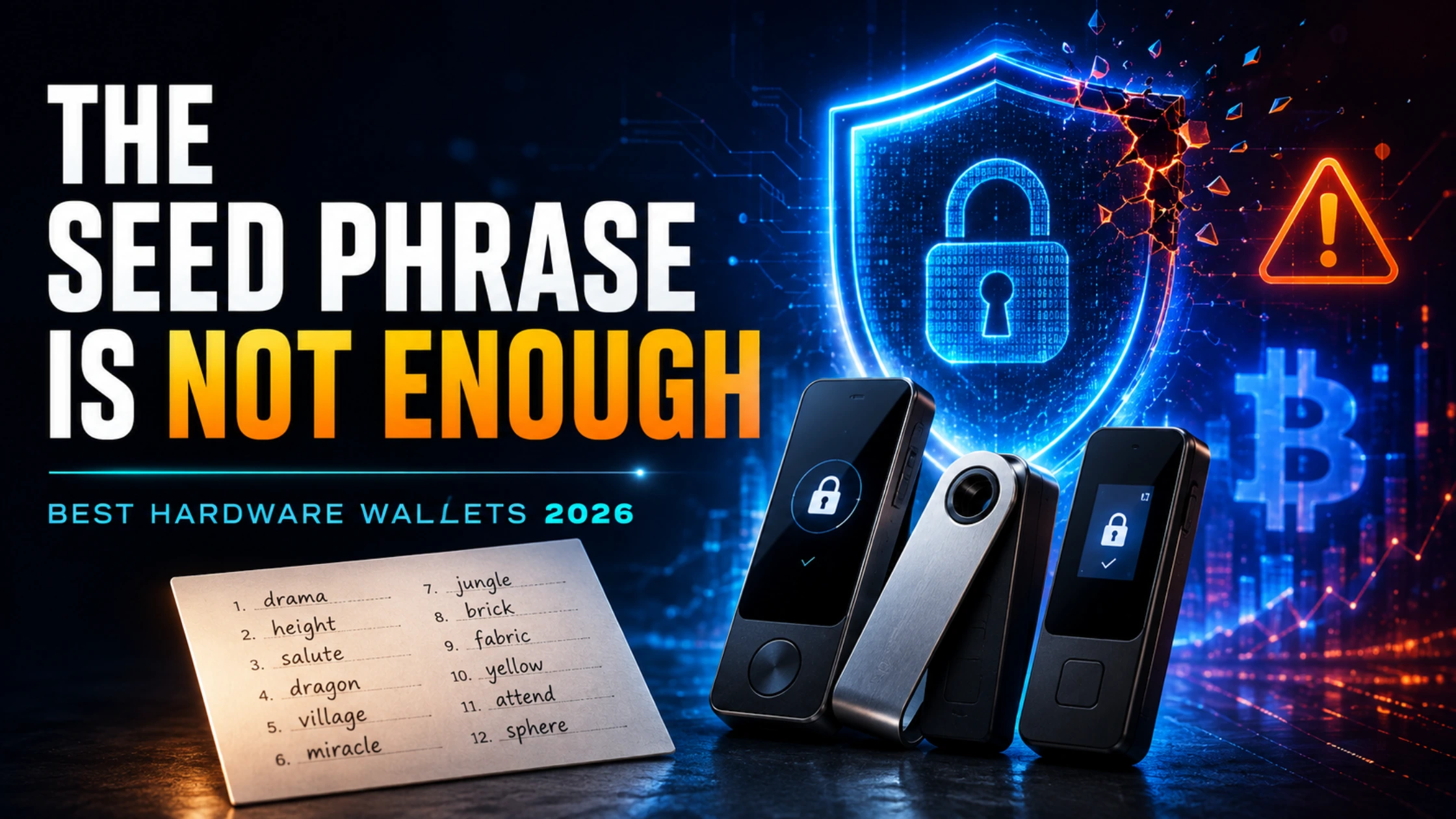
For most of the past decade, “move it to cold storage” has been the single piece of advice the crypto industry agreed on without argument. A hardware wallet keeps your private keys offline, away from exchange hacks, malware, and phishing. That advice just took its most serious hit in years, and the timing makes this ranking more relevant than it would have been a month ago.
Last updated: 5 August 2026
What just happened to Coldcard
Beginning July 30, 2026, an attacker began draining Bitcoin from Coldcard hardware wallets in three separate waves. The first wave alone pulled roughly 594 BTC, worth about $38 million, from nearly 500 addresses in just 25 minutes. By the time Galaxy Research had tracked the third wave, the total had climbed to approximately 1,367 BTC, worth close to $89 million, taken from more than 4,500 addresses, making it one of the largest self-custody failures on record.
What makes this incident genuinely different from a typical exchange hack or phishing scam is that the attacker never touched a physical device, never installed malware, and never tricked anyone into revealing a seed phrase. The root cause was a five-year-old firmware bug, present since a 2021 release, that weakened how affected Coldcard devices generated their recovery seed’s randomness. With roughly 40 bits of effective entropy instead of the full strength a seed should carry, the possible seed space shrank from astronomically large to something a well-resourced attacker could search offline, reconstructing private keys without ever needing access to the wallet itself.
Two details matter more than the headline number. First, wallets set up with a BIP-39 passphrase, the optional extra word or phrase added on top of the standard 12 or 24-word seed, were not affected. Second, multisignature setups were also untouched. Coinkite, the company behind Coldcard, has released patched firmware, but the patch cannot retroactively fix a seed that was already generated under the flawed randomness; anyone affected has to generate an entirely new seed on updated firmware and move funds to it.
Coldcard is not part of DN’s affiliate network, which makes it easier to say plainly: this is a serious, well-documented incident, and it is a useful stress test for the four hardware wallets covered in this ranking, none of which have reported anything comparable.
Why this is bigger than one product
The Coldcard incident lands inside a broader pattern. Blockchain security firm TRM Labs recorded 207 separate crypto hacking incidents in the first half of 2026, the most ever tracked in any six-month period, though total losses of roughly $972 million came in under half of the $2.3 billion stolen in the same period of 2025. Separately, blockchain security firm Blockaid has found that most 2026 losses came not from smart contract exploits but from compromised keys and operational security failures, exactly the category the Coldcard flaw falls into.
Security researchers have been careful to draw the right lesson from this. As one crypto-focused outlet put it, the Coldcard exploit is not evidence that self-custody is inherently riskier than exchange custody, it demonstrates that self-custody carries a different category of risk, firmware and supply-chain integrity, rather than counterparty or exchange-solvency risk. That distinction is exactly what the DN Cold Storage Risk Score is built to measure.
The DN Cold Storage Risk Score
DN scored four leading hardware wallets, Ledger, OneKey, CoolWallet, and KeepKey, across six weighted categories that map directly onto the failure modes that have actually caused fund losses in this device category: secure element hardware certification, firmware transparency, documented vulnerability track record, passphrase and advanced protection support, wireless attack surface, and supply chain or tamper-evidence design. The calculator below lets you reweight those categories to your own priorities and see the ranking recompute in real time, rather than accepting a single fixed score.
DN Cold Storage Risk Score Ranking
Adjust category weights to match your own priorities and see the ranking recalculate.
| Rank | Wallet | Cold Storage Risk Score |
|---|
Methodology: each wallet is scored 0 to 1 within six categories based on documented, publicly verifiable evidence, secure element certification level, open-source firmware status, disclosed and unpatched vulnerability history, passphrase and advanced anti-tamper support, wireless versus wired/air-gapped connectivity, and supply chain or tamper-evident packaging design. The default weights above reflect DN's own editorial judgment of relative importance; adjusting them recomputes each wallet's score as a weighted average, normalized to 100. This is a structural security assessment based on publicly documented evidence as of mid-2026, not a guarantee against future vulnerabilities in any device.
The four wallets, audited
OneKey, DN Cold Storage Risk Score: 93/100. OneKey’s flagship Pro model uses four EAL6+ certified secure elements, the highest certification tier represented in this ranking, and pairs that hardware with genuinely open-source firmware and reproducible builds, a combination competitors rarely offer together. It also layers in tamper-evident packaging, first-boot firmware attestation, and self-destruct safeguards against physical tampering. A publicly disclosed bug affecting the OneKey Mini was documented and patched by the OneKey security team; no unpatched or unpatchable hardware-level flaw has surfaced.
CoolWallet, DN Cold Storage Risk Score: 83/100. CoolWallet’s tamperproof, card-form design, using a CC EAL6+ secure element, has been in market since 2016 and cannot be physically opened, which meaningfully reduces supply-chain tampering risk. In 2023, CoolWallet open-sourced its secure element firmware directly in response to the Ledger Recover controversy, a rare instance of a closed-source-leaning brand moving toward transparency under community pressure. Its main structural tradeoff is connectivity: CoolWallet is Bluetooth-only with no wired or fully air-gapped option, which widens its wireless attack surface relative to a purely offline device, even though the Bluetooth channel itself is encrypted and never transmits key material.
Ledger, DN Cold Storage Risk Score: 72/100. Ledger remains the market’s dominant player by ecosystem breadth, and its ST33 secure element, CC EAL5+ certified, has never been remotely compromised to extract keys without a user-side mistake. What holds Ledger back in this ranking is transparency: the secure element driver remains closed-source for NDA reasons, and the 2023 Ledger Recover announcement, a feature offering to split and store encrypted seed fragments with third parties, drew sustained community criticism for working against the core promise that a seed should never leave the device, even though Ledger paused the rollout and committed to open-sourcing the relevant code. Ledger has also had two real, if non-catastrophic, security incidents: a 2020 email database leak that fueled a wave of phishing attempts, and a 2023 compromise of the Ledger Connect Kit npm package that cost users roughly $600,000, both software supply-chain issues rather than secure element failures.
KeepKey, DN Cold Storage Risk Score: 46/100. KeepKey is fully open-source and inexpensive, but it is the one wallet in this ranking with a documented, unpatchable hardware flaw. In 2020, Kraken Security Labs demonstrated a voltage-glitching attack against KeepKey’s microcontroller that extracts the encrypted seed in minutes using roughly $75 of equipment, at which point the seed is only protected by a 1 to 9 digit PIN that Kraken’s own researchers called trivial to brute force. Because KeepKey has no secure element, the flaw is inherent to the microcontroller itself and cannot be fixed with a firmware update, only a hardware redesign that has not shipped. As of 2026, KeepKey still lacks a secure element chip and still carries this exposure. The device also has no tamper-protection to alert an owner if it has been physically opened.
The one takeaway every hardware wallet owner should act on
If there is a single, brand-agnostic lesson from the Coldcard incident and from KeepKey’s known hardware flaw, it is this: a standard seed phrase alone is a single point of failure against exactly the kind of attack that just cost Coldcard users $89 million. A BIP-39 passphrase, an additional word or phrase you choose and never store anywhere digitally, effectively creates a hidden wallet that a weak-entropy seed attack, a stolen device, or a voltage-glitching attack cannot reach on its own, because the passphrase never lives on the device or in the seed’s own randomness. It is the specific mitigation that protected Coldcard users who had one enabled, and it is the specific fix Kraken recommended after finding KeepKey’s flaw back in 2019. It works the same way, for the same reason, regardless of which wallet in this ranking you use.
Where to buy, by priority
Highest certified hardware, most transparent firmware: OneKey combines EAL6+ secure elements with fully open-source, reproducible firmware.
Best for a compact, tamperproof form factor: CoolWallet offers a card-format design that cannot be physically opened.
Broadest ecosystem and asset support: Ledger remains the most widely integrated hardware wallet across exchanges, DApps, and staking platforms.
Frequently asked questions
What actually happened in the Coldcard hack? A five-year-old firmware bug, present since a 2021 release, weakened the randomness used to generate recovery seeds on affected devices. Attackers reconstructed private keys offline by narrowing the reduced entropy space, without ever needing physical or remote access to the device itself.
Am I at risk if I don’t own a Coldcard? Not from this specific vulnerability, but the underlying lesson applies to every hardware wallet: firmware and supply-chain integrity are the actual attack surface for cold storage in 2026, not just physical theft.
Does a BIP-39 passphrase really protect against this kind of attack? Yes. Wallets using a passphrase were not affected by the Coldcard vulnerability, because the passphrase is never stored on the device and is not derived from the same weakened randomness that generated the base seed.
Is KeepKey unsafe to use? KeepKey carries a real, unpatchable hardware vulnerability that requires physical possession of the device and specialized equipment to exploit. It is not remotely exploitable. Anyone using a KeepKey should treat physical security of the device as critical and strongly consider a BIP-39 passphrase.
Why does Ledger score lower than OneKey despite being the market leader? The score measures transparency and hardware certification, not market share or ecosystem size. Ledger’s secure element driver remains closed-source, and the 2023 Ledger Recover controversy drew sustained criticism for the same reason: it worked against the principle that a seed should never leave the device.
What is a secure element, and why does its certification level matter? A secure element is a dedicated, tamper-resistant chip that isolates private key storage and cryptographic operations from the device’s general-purpose processor. Certification levels like EAL5+ or EAL6+, under the Common Criteria standard, indicate independently tested resistance to physical and side-channel attacks; a device with no secure element at all, like KeepKey, relies entirely on its general-purpose microcontroller for this protection.
Is open-source firmware always safer than closed-source? Not automatically, but it allows independent researchers to audit the code rather than relying on the manufacturer’s own claims. OneKey and KeepKey are both fully open-source; KeepKey’s critical flaw shows that open-source transparency does not substitute for secure hardware, since the vulnerability was in the physical chip, not the code.
How often does DN update this ranking? Hardware wallet security postures change with real incidents, not on a fixed schedule. DN reviews and updates the scores behind this ranking whenever a new vulnerability, patch, or independent audit materially changes the picture, as this article does following the Coldcard incident.
This article is for informational purposes only and does not constitute financial or security advice. No hardware wallet eliminates all risk; verify current firmware versions and security advisories directly with each manufacturer before use. Decentralised News maintains commercial partnerships with some platforms referenced in this article. See our full affiliate disclosure for details.