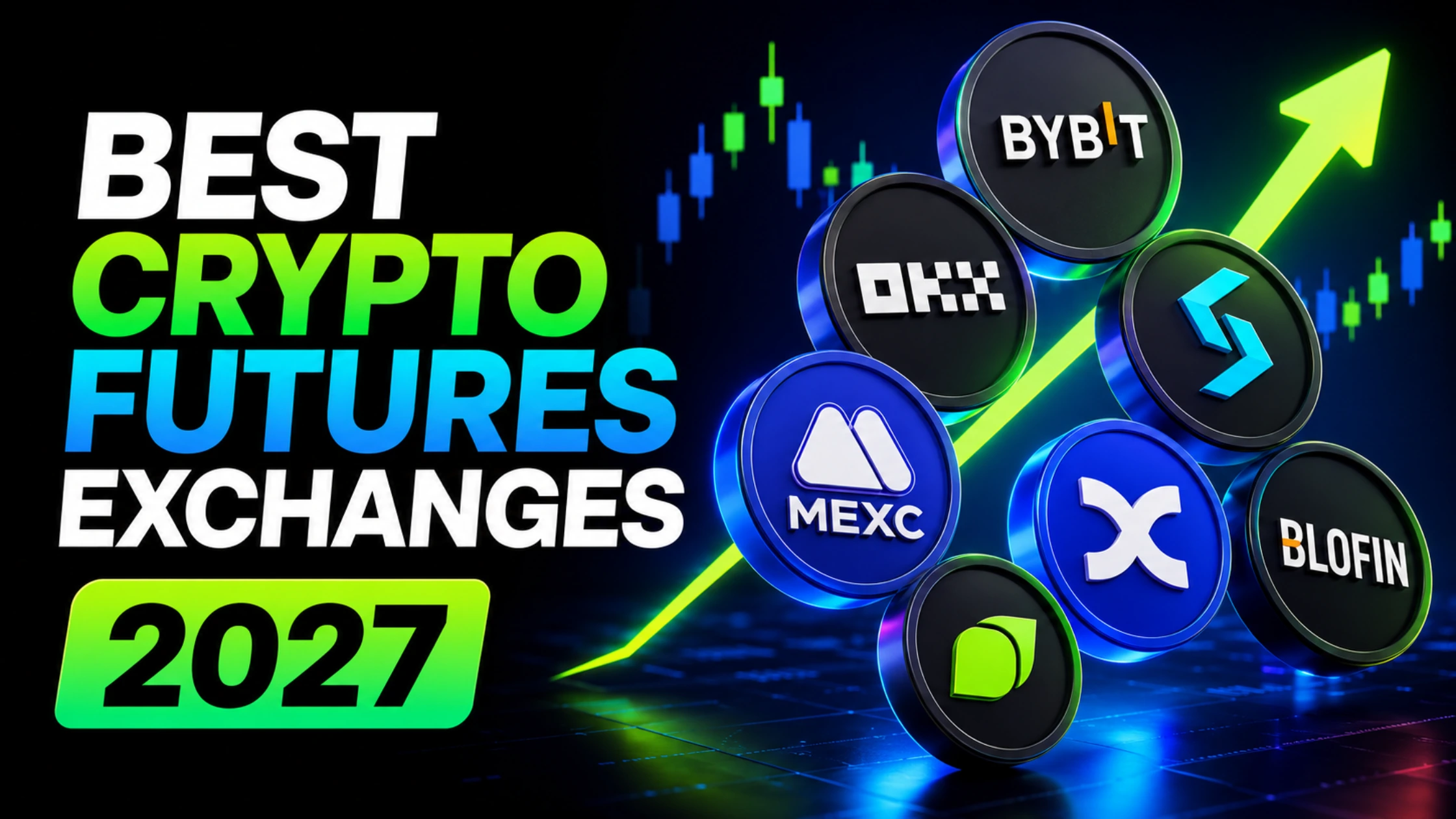
Compare the best crypto futures exchanges in 2027 using the DN Futures Venue Score. Analyse Bybit, OKX, Bitget, MEXC, BingX, BloFin, BTCC, Bitunix, KCEX, WEEX, Deribit and WOO X across fees, liquidity, margin, liquidation, APIs and mobile trading.
Edition: 2027 Early Edition
Last reviewed: July 2026
Summary
The strongest crypto futures exchange is not the venue offering the highest leverage.
Decentralised News ranks futures platforms according to the factors that determine whether a trading strategy can operate effectively:
- Execution quality
- Order-book depth
- Slippage
- Funding
- Contract design
- Margin flexibility
- Liquidation rules
- Insurance funds
- Auto-deleveraging
- Advanced orders
- API reliability
- Mobile performance
- Geographic availability
2027 category leaders
Category | Leading platform | Why it leads |
Best overall futures exchange | Strong interface, contract coverage, orders and risk controls | |
Best for portfolio margin and bots | Advanced margin modes, automation and API infrastructure | |
Best for copy trading | Integrated futures copy trading and trader analytics | |
Best for altcoin perpetuals | Broad emerging-market contract selection | |
Best for social and mobile trading | Mobile-first interface and copy-trading ecosystem | |
Best futures-focused alternative | USDT and coin-margined contracts with competitive fees | |
Best for demo and TradFi-linked futures | Demo account and broad market categories | |
Best combined spot and futures fee structure | Competitive entry rates and clear VIP progression | |
Lowest published futures fees | 0% maker and 0.01% taker reference rate | |
Best additional mobile-first venue | Mobile futures, copy tools and APIs | |
Best professional derivatives venue | Futures, options, spreads, volatility and portfolio margin | |
Best API and execution-focused venue | V3 APIs, professional liquidity and zero maker fees across tiers |
Overall verdict: Bybit is the most balanced futures exchange for active retail traders. OKX is the strongest multi-strategy platform. Deribit is the professional specialist. KCEX is the published fee leader.
All fee references are based on official information reviewed in July 2026 and must be updated before or during 2027.
The Maximum-Leverage Ranking Is the Wrong Ranking
Futures exchanges frequently promote leverage as if the largest number represents the best product.
It does not.
Maximum leverage tells the trader how little collateral may be required to open a position.
It says almost nothing about:
- Whether the order can be executed efficiently
- Whether the position can be closed during volatility
- Whether the mark price is robust
- Whether the funding mechanism is stable
- Whether the liquidation engine uses partial liquidation
- Whether the insurance fund is sufficient
- Whether the API remains available under stress
- Whether the contract is legally accessible to the user
The exchange offering the highest leverage can be the worst venue for a serious trader.
The correct ranking begins with execution and survival.
The DN Futures Venue Score
The DN Futures Venue Score evaluates each exchange according to eight factors.
Category | Weight | What is assessed |
Liquidity and depth | 20% | Spread, executable depth, open interest and resilience during volatility |
Execution quality | 20% | Slippage, order handling, mark pricing and platform responsiveness |
Liquidation and risk controls | 15% | Maintenance margin, partial liquidation, insurance fund and ADL |
Fees and funding | 15% | Maker, taker, funding, liquidation and contract-specific charges |
Contract coverage | 10% | Perpetuals, expiries, collateral types and asset availability |
APIs and advanced orders | 10% | REST, WebSocket, order types, subaccounts and automation |
Mobile and interface quality | 5% | Position monitoring, order entry and risk information |
Geographic usefulness | 5% | Availability and product access across supported regions |
The scores are editorial assessments, not guarantees of future performance or independently audited real-time liquidity measurements.
Best Crypto Futures Exchanges Compared
Rank | Exchange | Best for | DN Futures Venue Score | Current reference maker/taker | Main limitation |
1 | Overall active trading | 9.4/10 | 0.02% / 0.055% | Advanced products are highly visible to inexperienced users | |
2 | Portfolio margin, bots and APIs | 9.3/10 | 0.02% / 0.05% at Level 1 | Complex account and collateral modes | |
3 | Professional derivatives | 9.2/10 | 0% / 0.05% on many futures and perpetuals | Unsuitable for beginners | |
4 | Copy trading | 9.0/10 | 0.02% / 0.06% | Copied strategies can conceal leverage risk | |
5 | Altcoin futures | 8.9/10 | Pair and interface dependent | Liquidity varies widely between contracts | |
6 | APIs and execution | 8.9/10 | 0% maker across current futures tiers; taker varies | Geographic restrictions and dynamic fees | |
7 | Mobile and social trading | 8.7/10 | 0.02% / 0.05% | Social features can encourage performance chasing | |
8 | Futures-focused alternative | 8.6/10 | 0.02% / 0.06% | Smaller ecosystem than leading global venues | |
9 | Spot and futures balance | 8.5/10 | 0.02% / 0.06% | Market depth must be tested by pair | |
10 | Lowest fees | 8.5/10 | 0% / 0.01% | Low fees do not establish execution quality | |
11 | Demo and multi-market futures | 8.4/10 | 0.03% / 0.048% | Contract structure differs from conventional spot exchanges | |
12 | Mobile-first alternative | 8.3/10 | Common reference 0.02% / 0.06% | Product-specific fees can differ |
Official July 2026 references support the listed standard rates for Bybit, OKX, Bitget, BingX, BloFin, Bitunix, KCEX, BTCC, WEEX and Deribit. MEXC and WOO X use more dynamic or product-dependent structures.
Best Exchange by Futures Trader Profile
Trader profile | Best choice | Strong alternatives |
First-time learner using demo funds | BTCC | Bybit, OKX |
First live isolated-margin trader | Bybit | OKX, Bitunix |
Professional multi-asset trader | OKX | Deribit, WOO X |
Options and volatility trader | Deribit | OKX, Bybit |
Altcoin perpetual trader | MEXC | Bitget, BingX |
Copy trader | Bitget | BingX, Bybit |
Mobile trader | BingX | Bybit, WEEX |
Algorithmic trader | WOO X | OKX, Deribit |
High-turnover fee-sensitive trader | KCEX | MEXC, Bitunix |
Coin-margined futures trader | BloFin | Bybit, Deribit |
TradFi-linked futures trader | BTCC | BingX, WEEX |
Futures-focused secondary venue | BloFin | Bitunix, WEEX |
Current Futures Fee Reference
Exchange | Maker | Taker | Funding reference | Important qualification |
Bybit | 0.02% | 0.055% | Product dependent | Non-VIP reference rate |
OKX | 0.02% | 0.05% | Perpetual funding varies | Level 1 example |
Bitget | 0.02% | 0.06% | Commonly eight-hour settlement | Account level can reduce fees |
MEXC | Can be 0% on eligible contracts | Can be 0.01% on eligible contracts | Interval can change by contract | API rates can be 0.04% / 0.06% |
BingX | 0.02% | 0.05% | Commonly three settlements daily | VIP rates may be lower |
BloFin | 0.02% | 0.06% | Contract dependent | VIP maker rate can fall to 0% |
BTCC | 0.03% | 0.048% | Commonly eight hours | Higher VIP tiers can reduce fees |
Bitunix | 0.02% | 0.06% | Contract dependent | Balance or volume can reduce fees |
KCEX | 0% | 0.01% | Contract dependent | Confirm liquidity and live terms |
WEEX | 0.02% | 0.06% | Contract dependent | Some pairs use separate schedules |
Deribit | 0% | 0.05% on many contracts | Exchanged between traders | Additional delivery and liquidation fees |
WOO X | 0% across current futures tiers | Dynamic | Eight hours by default | Exact rate displayed in account |
Fees are not the total cost. A trader must also include spread, slippage, funding, liquidation charges, collateral conversion and withdrawals.
1. Bybit: Best Overall Futures Exchange
Join Bybit with referral code 46164
Bybit earns the highest overall score because it performs consistently across the factors that matter to an active futures trader.
Key strengths
- Mature derivatives interface
- Perpetual and expiry contracts
- USDT, USDC and crypto-settled structures
- Isolated and cross margin
- Hedge mode
- Risk-limit tiers
- Post-only, reduce-only and conditional orders
- Integrated stop-loss and take-profit tools
- Mobile trading
- REST and WebSocket connectivity
- Strong progression from retail to professional use
Risk architecture
Bybit’s dynamic risk-limit model increases initial and maintenance-margin requirements as position value rises.
This matters because a large position creates more liquidation and execution risk than a small position, even when both display the same chosen leverage.
Bybit also uses mark-price-based margin calculations in relevant modes and maintains an insurance fund for liquidation shortfalls.
Fee reference
Contract activity | Non-VIP reference |
Maker | 0.02% |
Taker | 0.055% |
Perpetual funding | Exchanged between longs and shorts |
Perpetual and futures liquidation fee | No separate liquidation fee in current general schedule |
Best strategy fit
- Intraday futures
- Swing trading
- Directional hedging
- Mobile execution
- Conditional-order strategies
- Multi-contract trading
- Retail systematic trading
DN verdict
Bybit is the most balanced choice for active retail futures traders.
2. OKX: Best for Portfolio Margin, Bots and Multi-Strategy Accounts
Join OKX with referral code 2136301
OKX is the strongest platform for users who view futures as one part of a broader trading portfolio.
Key strengths
- Perpetual swaps
- Expiry futures
- USDT and crypto-margined products
- Isolated margin
- Cross margin
- Multi-currency margin
- Portfolio margin
- Futures grid bots
- DCA strategies
- Subaccounts
- REST and WebSocket APIs
- Exchange and Web3 integration
Fee reference
Cost | Level 1 reference |
Maker | 0.02% |
Taker | 0.05% |
Liquidation fee | Current taker rate |
Maintenance-margin charge | Can apply during liquidation |
Funding | Contract dependent |
Why portfolio margin matters
A standard isolated position is assessed independently.
Portfolio margin evaluates the net risk of a group of positions.
This can be useful when combining:
- Long spot and short futures
- Calendar spreads
- Futures and options
- Several correlated assets
- Delta-neutral portfolios
The advantage is capital efficiency.
The danger is that risk becomes less intuitive. A correlation assumption can fail precisely when the market becomes most volatile.
API quality
OKX supports REST and WebSocket APIs for market data, execution and account functionality, including futures and cross-margin modes.
DN verdict
OKX is the leading exchange for advanced collateral management, bots and multi-strategy futures portfolios.
3. Deribit: Best Professional Futures, Options and Volatility Venue
Deribit is ranked third overall but first for professional derivatives.
Its platform should not be judged by the same criteria as a mobile-first retail exchange.
Key strengths
- BTC and ETH futures
- Linear USDC futures
- Perpetual contracts
- Crypto options
- Futures spreads
- Options combinations
- Portfolio and cross-portfolio margin
- Block trades
- RFQ trading
- Volatility futures
- Professional APIs
- Published insurance-fund information
Fee reference
Product | Maker | Taker |
BTC and ETH weekly futures | -0.01% rebate | 0.05% |
BTC and ETH futures and perpetuals | 0% | 0.05% |
USDC futures and perpetuals | 0% | 0.05% |
Futures block trades | 0.025% | 0.025% |
Expiry and liquidation charges can apply separately. BTC and USDC futures liquidations currently carry a 0.75% total fee, while ETH futures liquidations carry a 0.9% total fee.
Insurance fund
Deribit’s insurance fund is designed to cover negative equity left by bankrupt traders.
The exchange states that no socialised loss event has occurred to date, although future outcomes cannot be guaranteed.
Best strategy fit
- Options hedging
- Volatility trading
- Calendar spreads
- Futures basis
- Delta hedging
- Institutional block execution
- Professional algorithmic strategies
DN verdict
Deribit is the most complete specialist derivatives venue for professional futures and options traders.
4. Bitget: Best Futures Copy-Trading Exchange
Bitget’s differentiation comes from embedding social strategy discovery into the futures environment.
Key strengths
- Futures copy trading
- USDT and supported alternative collateral contracts
- Lead-trader statistics
- Copier allocation controls
- Mobile trading
- Hedge mode
- Insurance fund
- Futures APIs
- Direct manual futures trading
Current fees
Order role | Standard reference |
Maker | 0.02% |
Taker | 0.06% |
Funding | Usually eight-hour settlement, product dependent |
DN Copy Trader Due-Diligence Score
Metric | Weight |
Maximum drawdown | 25% |
Track-record length | 20% |
Average leverage | 15% |
Open unrealised loss | 15% |
Position concentration | 10% |
Completed-trade sample | 10% |
Profit sharing | 5% |
The trader with the highest return should not automatically rank first.
DN verdict
Bitget is the strongest platform for futures copy trading, but followers must analyse leverage and drawdown rather than headline return.
5. MEXC: Best for Broad Altcoin Perpetual Markets
Join MEXC with referral code 16yJL
MEXC’s advantage is breadth.
It frequently provides futures contracts for emerging tokens and narratives before they become widely available elsewhere.
Key strengths
- Extensive altcoin perpetual catalogue
- Frequent futures listings
- Aggressive fee programmes
- Insurance fund
- Auto-deleveraging
- Mobile and web trading
- Futures APIs
- Contract-specific funding schedules
The API fee distinction
MEXC demonstrates why traders must read product-specific terms.
Website or application rates can be as low as:
- 0% maker
- 0.01% taker
API orders may instead incur:
- 0.04% maker
- 0.06% taker
The API schedule can override zero-fee promotions.
Liquidity warning
An exchange can list hundreds of contracts without providing institutional-quality depth in every market.
Each altcoin contract must be evaluated independently.
DN verdict
MEXC is the leading altcoin perpetual venue, provided the trader treats liquidity as a contract-level question.
6. WOO X: Best API and Execution-Focused Futures Exchange
Join WOO X with referral code NCYDOFZF
WOO X is designed around liquidity aggregation, professional execution and API connectivity.
Key strengths
- V3 REST API
- V3 WebSocket API
- Unified spot and perpetual interface
- Advanced order instructions
- Subaccounts
- Real-time order-book depth
- Institutional connectivity
- Broker infrastructure
- Professional liquidity providers
- Zero maker fees across current futures tiers
WOO X states that its liquidity pool draws from major exchanges, institutions, market makers and Kronos Research. Its routing and crossing infrastructure is intended to improve fills and reduce slippage.
API order functionality
The API supports orders and workflows including:
- Market
- Limit
- Immediate-or-cancel
- Fill-or-kill
- Trailing stop
- Take profit
- Break-even logic
- Multi-pair automation
Fees
WOO X uses a dynamic structure based on volume and WOO holdings.
Its May 2026 update introduced 0% futures maker fees across tiers and reduced taker rates. Exact fees are displayed within the user’s account.
DN verdict
WOO X is the leading choice for API-driven and execution-focused traders who meet its geographic eligibility requirements.
7. BingX: Best Social and Mobile Futures Exchange
Join BingX with referral code F8XN1D
BingX offers a simplified mobile trading experience alongside copy trading and perpetual futures.
Key strengths
- Mobile-first interface
- Futures copy trading
- Futures grid tools
- Isolated and cross margin
- Broad contract selection
- Guaranteed-price functionality on eligible products
- Insurance fund and ADL framework
- Selected non-crypto market exposure
Fees and funding
Cost | Reference |
Maker | 0.02% |
Taker | 0.05% |
Funding | Commonly 00:00, 08:00 and 16:00 UTC+8 |
BingX states that liquidation is triggered when margin falls to the maintenance requirement plus the taker fee. Surplus liquidation margin enters the insurance fund, while the fund can absorb a shortfall.
DN verdict
BingX is the best social and mobile futures venue for users who want copy features and accessible position management.
8. BloFin: Best Futures-Specialist Alternative
Join BloFin with referral code Decentralised
BloFin has built a focused futures offering around competitive fees and multiple collateral structures.
Key strengths
- USDT-margined perpetuals
- Coin-margined perpetuals
- Copy trading
- Hedge mode
- APIs
- Tiered fees
- Insurance fund
- ADL
- Mobile and web trading
Fees
Tier | Maker | Taker |
Regular | 0.02% | 0.06% |
VIP 1 | 0.006% | 0.05% |
VIP 3 | 0.002% | 0.0425% |
VIP 5 | 0% | 0.035% |
Contract choice
USDT-margined contracts make profit, loss and collateral easier to measure in stablecoin terms.
Coin-margined contracts create collateral exposure to the underlying cryptocurrency.
A trader can be correct about the futures direction but still experience an undesirable collateral outcome.
DN verdict
BloFin is the strongest focused alternative for traders seeking competitive futures fees outside the largest exchanges.
9. Bitunix: Best Spot and Futures Balance
Join Bitunix with referral code 17hy
Bitunix provides a clean fee progression across spot and futures.
Futures fee tiers
Tier | Maker | Taker |
VIP 0 | 0.02% | 0.06% |
VIP 1 | 0.02% | 0.05% |
VIP 3 | 0.014% | 0.04% |
VIP 5 | 0.01% | 0.035% |
VIP 8 | 0% | 0.026% |
Key strengths
- Spot and futures trading
- Competitive entry-level fees
- Combined-margin features
- Multi-asset modes
- Chart trading
- APIs
- Balance-based VIP qualification
- Mobile access
DN verdict
Bitunix is a strong balanced choice for traders wanting spot and futures functionality in one account.
10. KCEX: Best for Low Futures Fees
Join KCEX with referral code 0MPMVM
KCEX wins the explicit fee category.
Published standard fees
Market | Maker | Taker |
Spot | 0% | 0% |
Futures | 0% | 0.01% |
Fee example
A trader opens a 25,000 USDT futures position as a taker.
25,000 × 0.01% = 2.50 USDT
Closing the full position as a taker at the same notional size creates another 2.50 USDT fee.
The approximate round-trip execution fee is 5 USDT before:
- Funding
- Slippage
- Spread
- Liquidation costs
- Withdrawal fees
DN verdict
KCEX is the lowest-fee futures platform in this comparison, but traders must independently verify depth, reliability and withdrawal performance.
11. BTCC: Best for Demo and TradFi-Linked Futures
Join BTCC with referral code 24EO07
BTCC combines crypto perpetuals, demo trading, copy trading and selected traditional-market-linked futures.
Key strengths
- USDT-margined contracts
- Coin-margined contracts
- Demo environment
- Copy trading
- TradingView charts
- Commodity, metal, stock and forex-linked futures
- Mobile applications
- VIP fee progression
Current reference fees
Level | Maker | Taker |
VIP 0 | 0.03% | 0.048% |
VIP 7 | 0.01% | 0.015% |
DN verdict
BTCC is the best platform in the ranking for demo practice and users wanting both crypto and broader market futures.
12. WEEX: Best Additional Mobile-First Futures Venue
Join WEEX with referral code 3whse
WEEX provides mobile trading, copy functionality, APIs and a broad contract catalogue.
Standard reference fees
Order role | Reference fee |
Maker | 0.02% |
Taker | 0.06% |
Some markets and programmes use different rates, including separate USDC-margined and promotional schedules.
Key strengths
- Mobile futures
- Copy trading
- Trigger orders
- APIs
- Broad contract range
- Insurance and protection-fund information
- Market-linked futures in supported regions
DN verdict
WEEX is a useful mobile-first secondary venue, but users must check the exact fee and margin rules for every contract.
The DN Liquidity, Depth and Slippage Test
Reported volume is not enough.
A serious futures comparison should use repeatable execution tests.
Test One: Spread
Record the midpoint:
Midpoint = best bid plus best ask, divided by two
Then calculate:
Spread percentage = best ask minus best bid, divided by midpoint
Repeat the calculation at least once per minute for 30 minutes.
Test Two: Order-Book Depth
Measure the total executable size available within:
Distance from midpoint | What it indicates |
0.05% | Immediate professional depth |
0.10% | Short-term active-trader depth |
0.25% | Medium position liquidity |
0.50% | Stress for larger positions |
1.00% | Severe market-impact zone |
Test Three: Simulated Market Orders
Estimate the average execution price for:
- 1,000 USDT
- 10,000 USDT
- 25,000 USDT
- 100,000 USDT
- 500,000 USDT
The exchange should be assessed at the position size the trader actually expects to use.
Test Four: Volatility Window
Repeat the test during:
- A normal Asian session
- European market hours
- US market hours
- A major inflation release
- A central-bank decision
- A sharp Bitcoin move
Test Five: Mark-Price Integrity
Compare:
- Last price
- Mark price
- Index price
- Major spot-exchange prices
- Perpetual price on competing venues
A mark price that frequently diverges from a robust external market deserves further investigation.
Test Six: Order Management
Measure:
- Time to place an order
- Time to cancel an order
- WebSocket update speed
- Partial fills
- Rejected orders
- Post-only reliability
- Performance during volatility
The DN Funding Burden Index
Funding can become more expensive than trading fees.
Formula
Funding payment = position notional × funding rate
A trader holding a 50,000 USDT long position through a +0.03% settlement pays:
50,000 × 0.03% = 15 USDT
If the position passes through three identical settlements, the total is 45 USDT.
Funding Burden Score
Annualised or repeated funding condition | Interpretation |
Near zero | Balanced positioning |
Persistently positive | Long positions are crowded |
Persistently negative | Short positions are crowded |
Rapidly changing | Unstable positioning or thin liquidity |
Extreme with short intervals | High holding-cost and liquidation risk |
Funding can reverse.
A funding-harvest strategy can become unprofitable if:
- The rate changes direction
- The spot and futures legs diverge
- One leg is liquidated
- Borrowing costs rise
- The exchange restricts withdrawals
- The contract is delisted
Isolated, Cross and Portfolio Margin Compared
Margin mode | Collateral scope | Main advantage | Main danger |
Isolated | Assigned to one position | Limits position-level damage | Position liquidates sooner if underfunded |
Cross | Shared within an account or collateral pool | Greater margin flexibility | One trade can consume wider account equity |
Portfolio | Risk assessed across positions | Capital efficiency for hedges | Complex correlations and nonlinear exposure |
Default recommendation
New futures traders should generally begin with isolated margin.
Cross and portfolio margin should be used only when the trader can explain how every position affects the complete account.
Liquidation Engines Compared Conceptually
A robust liquidation engine should:
- Use a reliable mark price.
- Cancel orders that consume margin.
- Attempt partial reduction before total closure.
- Use tiered maintenance-margin rules.
- Transfer positions to a dedicated liquidation engine.
- Use an insurance fund for bankruptcy shortfalls.
- Apply ADL only as a last resort.
- Publish relevant risk parameters.
Liquidation price vs bankruptcy price
The liquidation price is the level at which the exchange begins forced intervention.
The bankruptcy price is the level at which the position’s assigned equity is exhausted.
The difference between these prices can contribute to the insurance fund when the liquidation closes favourably.
Insurance Fund Due-Diligence Questions
Question | Why it matters |
Is the fund balance published? | Provides transparency |
Is the fund separated by contract or collateral? | Reveals how losses are pooled |
How is the fund financed? | Shows whether it depends on liquidation surplus or company capital |
Has the fund declined sharply? | May indicate stress |
When is ADL activated? | Defines counterparty risk to profitable traders |
Are socialised losses possible? | Determines extreme-event exposure |
Are liquidation fees added to the fund? | Explains fund replenishment |
Does the exchange use partial liquidation? | May reduce unnecessary full closures |
The DN Responsible Leverage Ladder
Level | Typical approach | DN risk classification |
1x | Unleveraged derivative exposure | Lower relative derivatives risk |
2x to 3x | Conservative hedge or directional trade | Moderate |
4x to 5x | Active trading with defined stops | Elevated |
6x to 10x | Short-term professional-style trading | High |
Above 10x | Narrow liquidation buffer | Very high |
Above 25x | Small adverse move can destroy margin | Extreme |
Maximum platform leverage | Marketing number, not a target | Unsuitable for responsible planning |
This ladder is educational and does not make low leverage safe.
Position Sizing Before Leverage
Assume:
- Account equity: £10,000
- Risk per trade: 0.5%
- Maximum planned loss: £50
- Stop distance: 2.5%
Position size
£50 ÷ 2.5% = £2,000
A £2,000 notional position matches the planned risk before slippage and fees.
Margin at different leverage
Leverage | Approximate required initial margin |
1x | £2,000 |
2x | £1,000 |
5x | £400 |
10x | £200 |
20x | £100 |
The planned loss remains approximately £50 only if:
- The stop executes
- Slippage remains limited
- Fees are included
- Liquidation does not occur first
- The platform remains operational
Higher leverage reduces the collateral buffer between the current price and liquidation.
It does not improve the trade’s expected return.
API and Algorithmic Futures Checklist
Before connecting a bot, confirm:
- REST and WebSocket documentation
- Testnet availability
- Authentication method
- Rate limits
- Order-placement limits
- Cancellation limits
- Batch-order support
- Post-only support
- Reduce-only support
- Hedge-mode compatibility
- Funding-rate endpoints
- Liquidation-price data
- Subaccount permissions
- IP allowlisting
- Withdrawal permission controls
- WebSocket reconnection logic
- Historical data availability
- Error-code documentation
- Maintenance announcements
- Kill-switch procedure
Never grant withdrawal access to a trading API unless it is operationally essential.
Geographic Availability
Futures access varies more than ordinary spot access.
A platform may:
- Accept account registrations but restrict derivatives
- Offer spot trading but not futures
- Limit leverage by country
- Require professional-investor classification
- Remove certain stablecoin-settled contracts
- Disable affiliate links in particular regions
- Require additional proof of address
- Close positions when a user travels to a restricted jurisdiction
WOO X explicitly excludes US residents and entities and applies additional restrictions to referral functionality in the EEA. Other exchanges also maintain product-specific regional rules.
Users must verify current eligibility directly with the platform.
Platform-Specific Quick-Start Routes
Exchange | Quick-start route |
Bybit | Register, secure, fund, choose USDT perpetual, select isolated margin, add stop |
OKX | Register, activate futures, select account mode, fund, test Level 1 contract |
Bitget | Register, choose direct or copy trading, set copier limits, monitor leverage |
MEXC | Register, inspect pair liquidity, check funding interval, confirm web or API fee |
BingX | Register, secure, choose isolated margin, review social-trading exposure |
BloFin | Register, select USDT or coin margin, check insurance and ADL rules |
BTCC | Register, use demo account, practise stops, move to small live position |
Bitunix | Register, fund futures wallet, review maintenance-margin tier |
KCEX | Register, test order-book depth, place small order, test withdrawal |
WEEX | Register, verify pair-specific rate, use isolated margin, test mobile controls |
Deribit | Register, use testnet, learn inverse vs linear products, maintain excess collateral |
WOO X | Register, create subaccount, generate restricted API key, test REST and WebSocket |
Frequently Asked Questions
What is the best crypto futures exchange in 2027?
Bybit is the leading overall choice in the DN Futures Venue Score.
OKX leads for advanced margin and bots, while Deribit is the professional specialist.
Which crypto futures exchange has the lowest fees?
KCEX currently publishes a 0% maker and 0.01% taker reference rate.
MEXC also offers highly competitive promotional rates, but API fees may be higher.
Which exchange has the best liquidity?
Liquidity varies by contract and time.
Bybit, OKX and Deribit are strong general candidates for major derivatives markets, while WOO X specifically targets execution-focused users.
Traders should perform their own order-book test.
Which platform is best for futures beginners?
No live futures platform is inherently beginner-safe.
BTCC’s demo account can help users practise. A first live trade should use isolated margin, low leverage and a very small position.
Which exchange is best for crypto options and futures?
Deribit is the leading specialist platform for futures, options, volatility and portfolio margin.
Which exchange is best for copy trading?
Bitget leads this category.
BingX, Bybit, BloFin, BTCC and WEEX provide additional copy or social-trading options.
Which exchange is best for bots?
OKX is strong for integrated bots.
WOO X is particularly attractive for professional API strategies.
Bybit, Deribit, Bitget, MEXC, Bitunix and WEEX also support automation.
Which exchange is best for altcoin futures?
MEXC offers one of the broadest altcoin perpetual selections.
Every contract must be evaluated for depth, spread, index quality and funding.
Is cross margin better than isolated margin?
Neither is universally better.
Isolated margin is generally clearer for defined-risk positions. Cross margin may be more capital-efficient for coordinated portfolios, but it can expose more account equity.
Can an insurance fund prevent my liquidation?
No.
The insurance fund protects the exchange system and counterparties from bankruptcy shortfalls. It does not protect your position from being liquidated.
Can a stop loss fail?
Yes.
Stops can execute with slippage, be rejected during system disruption or trigger after the liquidation threshold during a rapid market move.
How much leverage should I use?
Position size should be calculated from account risk and stop distance first.
Leverage should only determine how much collateral is committed.
Final 2027 Rankings
Award | Winner |
Best overall futures exchange | |
Best for advanced margin and bots | |
Best professional derivatives venue | |
Best for copy trading | |
Best for altcoin futures | |
Best for APIs and execution | |
Best social and mobile platform | |
Best futures-focused alternative | |
Best spot and futures fee balance | |
Lowest published futures fees | |
Best for demo and broader markets | |
Best additional mobile-first venue |
The Decentralised News Verdict
The best futures exchange is not the one willing to lend a trader the largest notional position.
It is the venue that allows the trader to execute, manage and close a properly sized position with the least unnecessary risk.
For most active retail traders, Bybit offers the strongest overall balance.
OKX is better suited to users who need bots, portfolio margin and multi-strategy accounts.
Deribit is the professional choice for futures, options and volatility.
Bitget leads for copy trading.
MEXC provides broad altcoin futures access.
WOO X is compelling for API and execution-focused traders.
BingX and WEEX serve mobile and social futures users.
BloFin and Bitunix are credible futures-focused alternatives.
KCEX offers the lowest published standard futures fees in the comparison.
BTCC stands out for demo trading and broader market-linked contracts.
The correct decision sequence is:
- Verify geographic eligibility.
- Select the contract type.
- Test liquidity at the intended position size.
- Understand the mark and index prices.
- Compare complete fees and funding.
- Choose isolated, cross or portfolio margin deliberately.
- Calculate risk before selecting leverage.
- Enter the stop-loss and exit plan.
- Test deposits and withdrawals.
- Maintain a backup venue and operational plan.
Leverage is not the product.
Execution, risk control and survival are the product.
Affiliate Disclosure
Some links in this article are affiliate or referral links. Decentralised News may receive compensation when eligible readers register or trade through a featured platform.
Affiliate relationships do not guarantee inclusion, a positive review or a category award. Rankings are based on platform functionality, costs, execution considerations, risk controls and suitability for different trader profiles.
Risk Disclaimer
This publication is for educational and informational purposes only. It does not constitute financial, investment, legal, accounting or tax advice.
Cryptocurrency futures, perpetual contracts, margin, copy trading and automated strategies involve substantial risk. Leverage can cause rapid liquidation and complete loss of assigned collateral.
Fees, funding, leverage limits, platform products and geographic availability can change without notice.
Readers must be at least 18 years old, verify legal eligibility and conduct independent due diligence before depositing or trading.