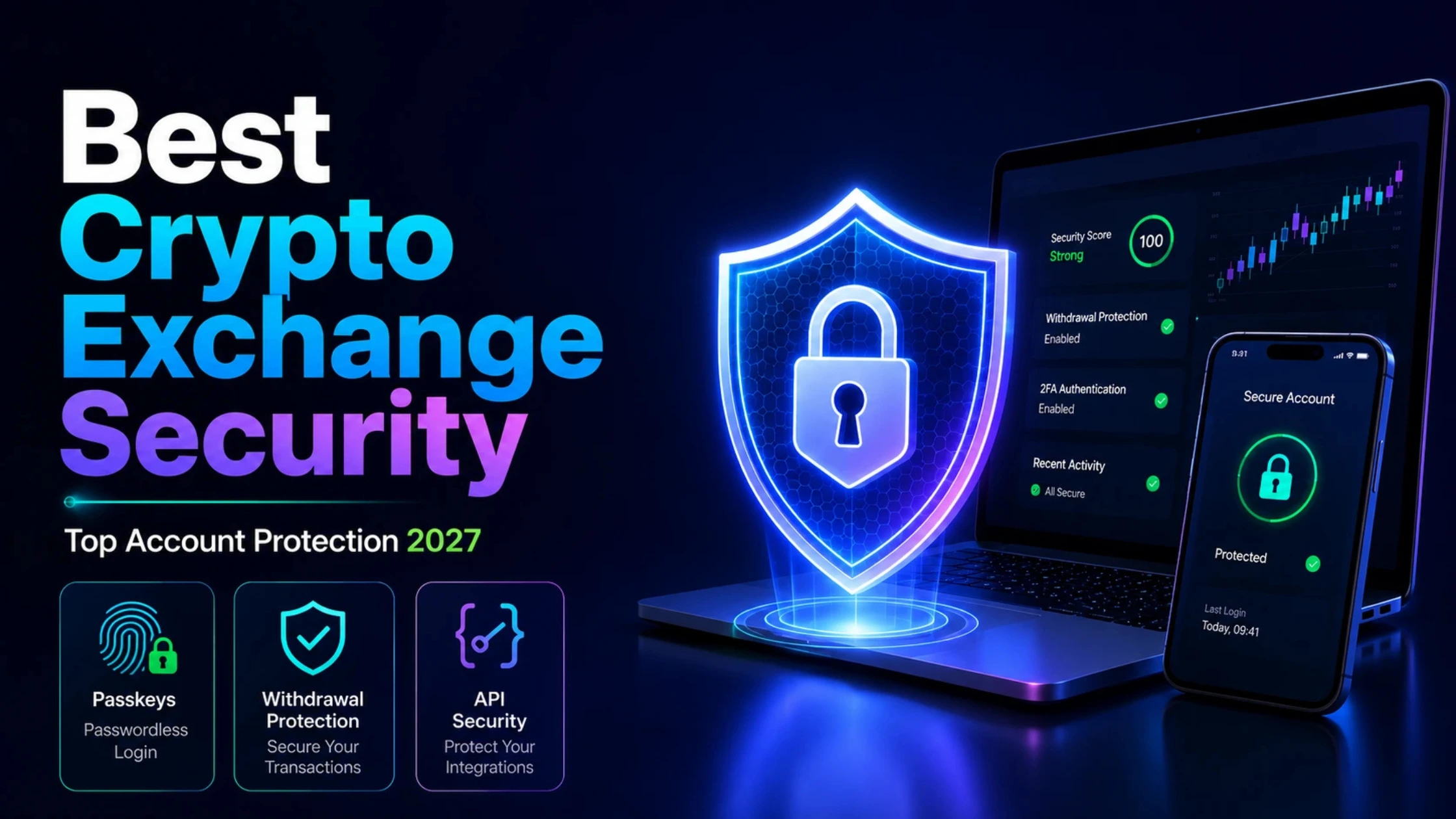
Which crypto exchange offers the strongest account security in 2027? We rank Bybit, Kraken, OKX, Bitget, Binance, Coinbase, VALR, Luno and CEX.IO by passkeys, hardware keys, 2FA, withdrawal allowlists, security delays, device controls, API permissions and recovery safeguards.
Data checked: 26 August 2026. Security features can change by account type, product and jurisdiction.
Summary
The safest crypto exchange account is not necessarily held at the exchange with the strongest balance sheet.
These are two different risks.
Platform risk
Can the exchange itself remain solvent, safeguard customer assets and process withdrawals?
Account-takeover risk
What happens if an attacker obtains:
- your password
- your email
- your phone number
- an authenticated browser session
- a compromised device
- an API key
Most crypto exchange comparisons mix these questions together.
Decentralised News does not.
The proprietary DN Exchange Account Security Score evaluates the controls users can activate to prevent an account compromise from becoming an asset loss.
Our current findings:
- Bybit: Best overall user-level withdrawal security controls.
- Kraken: Best lockdown architecture for high-value accounts.
- OKX: Best combination of modern authentication and adaptive withdrawal protection.
- Bitget: Best cross-device withdrawal verification and cancellation controls.
- Binance: Best mature all-round account-security stack.
- Coinbase: Best phishing-resistant authentication and simple consumer allowlisting.
- VALR: Best South African exchange for restrictive withdrawal controls and team permissions.
- Luno: Best simplified retail security architecture.
- CEX.IO: Solid conventional security but fewer advanced account-containment controls.
This is not a solvency ranking, Proof-of-Reserves ranking or custody-risk ranking.
It measures one specific question:
If someone gets into my exchange account, how difficult is it for them to actually steal the assets?
Quick Verdict
A password plus SMS code is no longer enough for a high-value crypto exchange account.
The strongest security stacks now combine several independent layers:
Phishing-resistant login
→ Passkey or hardware security key
Withdrawal containment
→ Allowlisted addresses
Time
→ New-address or withdrawal delay
Device controls
→ Session and trusted-device management
API containment
→ Minimum permissions and IP restrictions
Emergency response
→ Account lock or withdrawal disable
That layering matters.
Imagine an attacker has already stolen your exchange password.
A weak account might permit:
Password → SMS code → withdrawal
A well-configured account could force the attacker through:
Passkey → trusted device → withdrawal allowlist → new-address delay → withdrawal-specific authentication → account-change cooldown
That is a radically different threat model.
Under the current DN methodology, Bybit narrowly leads the user-control ranking because its 2026 withdrawal-security suite goes beyond conventional allowlisting.
Users can configure protections including:
- withdrawal-address allowlists
- address-book-only withdrawals
- new-address locks
- configurable withdrawal delays
- daily withdrawal limits
- app-only withdrawals
- additional geographic verification for withdrawals from unfamiliar locations
Kraken follows extremely closely because its Global Settings Lock, separate withdrawal 2FA, passkeys and Master Key architecture can make a high-value account extraordinarily difficult to alter after compromise.
DN Exchange Account Security Ranking 2027
Rank | Exchange | DN Account Security Score | Best For | Standout Control |
1 | 96/100 | Maximum withdrawal containment | Configurable withdrawal protection | |
2 | 95/100 | High-value long-term accounts | Global Settings Lock + Master Key | |
3 | 93/100 | Modern adaptive security | Passkeys + withdrawal protection stack | |
4 | 91/100 | Withdrawal verification | Cross-device verification + cancellation | |
5 | 90/100 | Mature all-round security | Hardware keys + allowlists + anti-phishing | |
6 | 89/100 | Phishing-resistant retail security | Passkeys/security keys + 48-hour allowlist | |
7 | 88/100 | South African users and teams | Support-gated withdrawal restriction | |
8 | 87/100 | Simplified retail security | Passkeys + disable sends + 7-day lock | |
9 | 77/100 | Conventional account protection | Mandatory withdrawal 2FA + session controls |
Important: Scores represent currently documented user-access controls, not an assessment of the financial health of the company operating the exchange.
The DN Exchange Account Security Score
The score is weighted toward one outcome:
Preventing unauthorized removal of assets.
A feature therefore receives more weight if it can still protect the customer after credentials have already been compromised.
1. Phishing-Resistant Authentication: 20 Points
Measures:
- passkeys
- FIDO2
- physical security keys
- authenticator-app 2FA
- step-up authentication
Hardware-backed or cryptographic authentication receives more credit than SMS.
2. Withdrawal Containment: 25 Points
Measures:
- address allowlist
- address-book-only withdrawals
- new-address delays
- withdrawal delays
- configurable withdrawal limits
- separate withdrawal authentication
This is the largest individual category.
Why?
Because an attacker making unauthorized trades is damaging.
An attacker successfully withdrawing everything is potentially catastrophic.
3. Account-Change Protection: 10 Points
Measures what happens after sensitive changes such as:
- password reset
- email change
- 2FA change
- new device
- withdrawal-setting modification
Strong exchanges automatically impose cooldown periods after high-risk account changes.
4. Device and Session Controls: 10 Points
Measures:
- device history
- trusted devices
- active sessions
- IP information
- ability to revoke devices
- terminate sessions
5. API Security: 10 Points
Measures:
- read-only permissions
- trading permissions
- withdrawal permissions
- IP allowlisting
- API deletion
- subaccount isolation
- expiry or risk controls
6. Phishing Protection: 5 Points
Measures:
- anti-phishing code
- official-channel verification
- domain-bound passkeys
- suspicious-login warnings
7. Emergency Lock and Recovery: 10 Points
Measures:
- immediate account disable
- withdrawal suspension
- recovery protections
- delayed unlock
- specialist security support
8. Mobile Security: 5 Points
Measures:
- biometric unlock
- passkeys
- trusted-device approval
- transaction confirmation
9. Subaccounts and Team Permissions: 5 Points
Measures whether users can segregate:
- trading
- withdrawals
- APIs
- teams
- strategies
without sharing unrestricted credentials.
DN Exchange Account Security Calculator
Score the protections you have actually enabled on your crypto exchange account. The result focuses on account-takeover and unauthorized-withdrawal risk, not exchange solvency or Proof of Reserves.
Your Security Configuration
API Exposure
Your Result
Priority Security Actions
The tool scores the security configuration the user has actually enabled.
That distinction is important.
An exchange might score:
95/100
for available security controls.
But a customer using:
- password
- SMS 2FA
- no withdrawal allowlist
- no API IP restriction
might personally operate that account at:
45/100.
The calculator therefore answers:
How secure is my exchange setup right now?
rather than simply:
How secure could this exchange theoretically be?
Account Security Is Not Exchange Solvency
Before ranking platforms, this distinction needs to be explicit.
Account Security
Protects against:
- phishing
- password theft
- SIM swapping
- stolen phones
- session theft
- malicious browser extensions
- compromised API keys
- unauthorized withdrawals
Platform Solvency and Custody Risk
Concerns:
- asset reserves
- liabilities
- custody segregation
- bankruptcy structure
- operational controls
- exchange wallet compromise
- insurance
- regulatory capital
- governance
An exchange could score extremely well on account security and still carry financial or counterparty risk.
Conversely, a financially strong company could offer relatively basic retail account controls.
DN therefore does not use:
- Proof of Reserves
- exchange reserves
- insurance funds
- company profitability
inside the Account Security Score.
Those belong in separate benchmarks.
1. Bybit: Best Overall User-Level Account Security
Referral code: 46164
Bybit has developed one of the most extensive user-configurable withdrawal-security suites currently available on a major exchange.
Its general security architecture includes:
- authenticator-app 2FA
- passkeys
- anti-phishing code
- account deactivation
- secure transaction approval
- withdrawal controls
But the withdrawal architecture is where Bybit separates itself.
Bybit Withdrawal Address Allowlist
Users can restrict withdrawals to approved addresses.
Bybit also supports a stricter mode:
Withdraw via Address Book
Once enabled, users cannot manually type an entirely new destination during the withdrawal flow.
That removes an important attack path.
A compromised session cannot simply paste the attacker’s wallet into the withdrawal screen.
New Address Withdrawal Lock
Bybit can impose a:
24-hour withdrawal restriction
on newly added wallet addresses.
That creates something extremely valuable:
time.
An attacker might compromise an account at 14:00.
They add their wallet address.
But rather than immediately withdrawing the balance, they must wait.
During that period, the genuine owner can potentially receive:
- email alerts
- app notifications
- suspicious-login warnings
and secure the account.
Configurable Withdrawal Protection
This is one of the strongest controls in the entire benchmark.
Bybit now allows users to intentionally add a delay before on-chain withdrawals are processed.
A withdrawal does not leave immediately.
It waits for the user-configured protection period.
This turns irreversible crypto transactions into a two-stage process.
That can be extremely valuable for larger balances.
App-Only Withdrawals
Bybit also allows users to restrict on-chain withdrawals so that they can only be initiated through the mobile application.
This reduces the attack surface created by a compromised browser session.
It is not a perfect defence.
But it forces the attacker to compromise another environment.
Withdrawal Limits
Users can configure their own:
- daily crypto withdrawal limit
- monthly crypto withdrawal limit
below the platform’s maximum limits.
This is another underrated control.
If your normal activity never requires withdrawing $500,000 in one day, there is little reason to leave that level of withdrawal capacity permanently available.
On the Move Protection
Bybit also offers a location-aware protection layer.
If an on-chain withdrawal is initiated from an unfamiliar or suspicious location, additional security verification can be required.
That applies even where the destination is already allowlisted.
Bybit Anti-Phishing Code
A user-defined security code can appear in genuine Bybit communications.
This makes email impersonation more difficult.
DN Verdict
Best overall user-configurable withdrawal security in the 2027 benchmark.
Bybit’s advantage is not one revolutionary feature.
It is the number of independent obstacles that can be placed between account compromise and asset withdrawal.
2. Kraken: Best Lockdown Architecture for High-Value Accounts
Kraken takes a slightly different approach.
Rather than concentrating only on withdrawal controls, it creates a hierarchy of security keys and account locks.
The most important components are:
- passkeys
- FIDO2 security devices
- sign-in 2FA
- withdrawal 2FA
- Master Key
- Global Settings Lock
- device management
- API permissions
Kraken Passkeys
Kraken recommends passkeys as its preferred sign-in protection.
Passkeys are substantially more resistant to traditional phishing because authentication is cryptographically tied to the legitimate service.
An attacker cannot simply create a convincing fake Kraken page and collect a reusable password plus TOTP code.
Separate Withdrawal 2FA
Kraken supports a dedicated authentication layer for funding and withdrawals.
This means gaining sign-in access does not necessarily grant the attacker permission to move assets.
That separation is excellent security architecture.
Kraken Master Key
The Master Key is distinct from ordinary sign-in authentication.
Among other protections, it can help prevent unauthorized password resets where the user’s email has been compromised.
Kraken recommends using a different authentication method for the Master Key from the primary sign-in factor.
For example:
Login: Hardware security key
Master Key: Separate passkey on another device
That creates genuine factor separation.
Kraken Global Settings Lock
The Global Settings Lock, or GSL, is arguably Kraken’s strongest user-level feature.
When enabled, it can prevent account-setting and withdrawal-address changes.
Users can configure an unlock waiting period of:
one to 30 days.
Imagine an attacker gets:
- password
- email access
- active session
but cannot alter the withdrawal destination because the GSL is locked for seven days.
The attack becomes materially harder.
Kraken also emails the customer when an unlock is attempted.
For high-value accounts that rarely change security settings, a long GSL delay is extremely powerful.
Important GSL Trade-Off
Security creates inconvenience.
If you lose the Master Key and have configured a long GSL delay, Kraken support cannot simply bypass the protection because you ask.
That is exactly why it is secure.
But users need to understand the trade-off before enabling a 30-day lock.
Device Management
Kraken allows customers to review and revoke device-level access.
New devices can also trigger additional approval.
Kraken API Permissions
API keys can be restricted according to required functionality.
A portfolio tracker should not receive the same permissions as a trading bot.
A trading bot should not automatically receive withdrawal rights.
DN Verdict
Best security architecture for users willing to deliberately lock down a high-value account.
Bybit offers more granular withdrawal options.
Kraken’s Master Key + withdrawal 2FA + GSL combination is arguably harder to defeat when properly configured.
3. OKX: Best Modern Authentication and Adaptive Security
Referral code: 2136301
OKX has substantially expanded its account-security architecture.
Current user-level controls include:
- passkeys
- physical FIDO security keys
- authenticator app
- mobile verification
- face verification
- anti-phishing code
- device management
- withdrawal allowlisting
- new-address protection
- API permissions
- API IP allowlisting
- account security holds
OKX Passkeys
OKX currently supports FIDO passkeys using:
- device biometrics
- mobile devices
- USB FIDO2 security keys
This offers phishing-resistant authentication.
Physical Security Keys
Users can specifically protect accounts with compatible physical FIDO hardware.
For high-value accounts this is preferable to relying only on SMS.
OKX Anti-Phishing Code
OKX supports a user-defined anti-phishing code for official communications.
This helps identify fake exchange emails.
Withdrawal Allowlist
Customers can restrict withdrawals to addresses stored in their address book.
That means compromising the account does not necessarily allow an attacker to send funds to an arbitrary destination.
New Address Protection
OKX also offers a new-address withdrawal lock in applicable withdrawal settings.
Combined with allowlisting, this substantially reduces instant theft risk.
Automatic Security Holds
Certain account-security changes automatically trigger withdrawal restrictions.
For example, changing a login password currently generates a:
24-hour withdrawal restriction.
This prevents one common takeover pattern:
- attacker gets account access
- attacker changes password
- attacker locks real owner out
- attacker immediately withdraws assets
The delay breaks that sequence.
Device Management
Users can inspect and remove unrecognized devices through OKX Security Center.
API Security
OKX allows API keys to receive distinct:
- Read
- Trade
- Withdraw
permissions.
Keys can be bound to up to 20 IP addresses.
OKX also applies additional protection to API keys with powerful permissions that are not bound to IP addresses.
DN Verdict
One of the most complete modern account-security stacks reviewed.
OKX performs particularly well for users who combine passkeys, allowlisting and IP-restricted APIs.
4. Bitget: Best Cross-Device Withdrawal Security
Referral code: nqef
Bitget’s strongest security differentiator is not its standard 2FA.
It is its increasingly sophisticated transaction-verification layer.
Current features include:
- passkeys
- authenticator 2FA
- anti-phishing code
- device management
- withdrawal allowlisting
- withdrawal cancellation
- cross-device verification
- account disable
- API permissions
- API IP allowlisting
Bitget Passkeys
Bitget supports passwordless passkey authentication.
Passkeys can rely on:
- fingerprint
- facial recognition
- device PIN
- compatible security hardware such as YubiKey
They are domain-specific, making them significantly more resistant to phishing sites than ordinary passwords.
Cross-Device Withdrawal Verification
This is one of Bitget’s most interesting controls.
A withdrawal address entered through the website can be separately verified through the mobile application.
That helps counter threats such as:
- browser malware
- clipboard replacement
- compromised desktop sessions
The attacker now needs to defeat another device.
Cancel Withdrawal Window
Bitget also provides an option allowing certain withdrawal requests to be cancelled within a short window after submission.
Crypto transactions are normally irreversible.
Creating even a brief pre-broadcast cancellation period gives the genuine account owner a chance to stop a suspicious request.
Withdrawal Allowlisting
Users can restrict withdrawals to pre-approved addresses.
Anti-Phishing Code
Bitget can include the customer’s personal anti-phishing code in official communications.
Device Management
Customers can view logged-in devices and immediately remove devices they do not recognize.
Emergency Account Disable
Bitget’s self-service disable function can:
- terminate active devices
- stop login
- stop trading
- stop other asset activity
and applies protection across linked subaccounts.
API Security
Bitget allows:
- multiple API keys
- different permission scopes
- IP address allowlisting
- RSA-based authentication options
Bitget specifically recommends least-privilege API design.
DN Verdict
Best cross-device withdrawal-verification architecture in the benchmark.
Particularly strong for users concerned about browser compromise or malicious extensions.
5. Binance: Best Mature All-Round Security Stack
Referral code: CPA_00SXKU7IO9
Binance has one of the most mature consumer account-security systems in the industry.
Current controls include:
- authenticator 2FA
- hardware security keys
- withdrawal allowlisting
- withdrawal-address delays
- anti-phishing code
- device management
- activity logs
- account disable
- API permissions
- API IP restrictions
Hardware Security Keys
Binance supports physical security keys such as compatible YubiKey-style devices.
This provides stronger phishing resistance than SMS.
Withdrawal Address Allowlisting
Once enabled, withdrawals can only go to approved wallet addresses.
New addresses can be subject to a:
24-to-48-hour security waiting period.
This makes withdrawal allowlisting much more useful than a simple address book.
Anti-Phishing Code
Binance supports one of the industry’s better-known anti-phishing code systems.
The user creates a private code.
Official Binance communications contain that code.
A convincing fake email without it becomes easier to identify.
Device Management
Users can inspect authorized devices and IP activity.
Unrecognized devices can be removed.
Password-Change Delay
Changing the Binance password results in a:
24-hour withdrawal suspension.
Again, this creates time to respond if an attacker changes account credentials.
Binance API Security
API users can restrict access using:
- permission controls
- IP allowlisting
- RSA signing
For algorithmic traders, that is extremely important.
An exchange account with excellent login security can still be compromised through a badly configured API key.
DN Verdict
One of the strongest mature all-round security stacks.
It does not currently lead our user-control ranking because Bybit, Kraken and some competitors provide more aggressive configurable withdrawal-containment tools.
6. Coinbase: Best Phishing-Resistant Retail Authentication
Coinbase has made significant progress in moving retail users away from weaker authentication.
Its current security architecture supports:
- passkeys
- physical security keys
- authenticator 2FA
- device and session management
- withdrawal-address allowlisting
- allowlist activation delays
- API permissions
- required API IP restrictions on Coinbase Exchange
Coinbase is included even where no DN affiliate relationship is available because excluding a major security benchmark would weaken the comparison.
Coinbase Security Keys
Coinbase supports compatible WebAuthn/FIDO2 security keys.
Users can register multiple keys, giving a backup in case one is lost.
Coinbase Passkeys
Coinbase recommends security keys or passkeys for stronger two-step verification.
This substantially reduces traditional credential-phishing risk.
Coinbase Address Allowlisting
Coinbase.com now supports an address-book allowlist.
When enabled, sends can be limited to pre-approved destinations.
New addresses generally require:
48 hours
before becoming available.
Disabling allowlisting also normally requires a:
48-hour security delay.
This is exactly the kind of asymmetric protection DN rewards.
Turning protection off should be harder than turning it on.
Device and Session Revocation
Users can inspect active sessions, mobile applications and confirmed devices.
Unauthorized sessions or devices can be revoked.
Coinbase Exchange API Controls
Coinbase Exchange API keys support distinct:
- View
- Trade
- Transfer
- Manage
permissions.
IP allowlisting is required when creating these API keys.
That is particularly good practice.
DN Verdict
Excellent phishing-resistant retail security with strong allowlisting.
The main reason Coinbase ranks below the leaders is that its consumer user-level withdrawal controls are somewhat less granular than Bybit’s or Kraken’s.
7. VALR: Best Account Security for South African Power Users
Referral code: VAZP2TAW
VALR has quietly developed a surprisingly strong security architecture.
Current functionality includes:
- authenticator 2FA
- biometric mobile authentication
- device and session management
- withdrawal-address book
- crypto withdrawal restriction
- 24-hour new-address cooldown
- automatic withdrawal holds after security changes
- detailed API permissions
- multi-user permissioning
- transaction approvals
VALR Crypto Withdrawal Restriction
VALR users can activate a particularly strict option:
Restrict Crypto Withdrawals
Once enabled, crypto can only be sent to addresses already saved in the wallet address book.
New addresses added after activation receive a:
24-hour cooldown.
But the strongest part is what happens when the user wants to disable the feature.
It cannot simply be turned off inside the account.
The user must contact VALR Support.
That can take up to approximately:
24 hours.
This creates significant resistance to a compromised session.
Security-Change Withdrawal Holds
VALR automatically imposes withdrawal restrictions after high-risk account changes.
Current examples include:
- 2FA reset: 24 hours
- support-assisted mobile change: three days
- support-assisted 2FA removal: three days
- support-assisted email change: three days
New-device registration also triggers a shorter security window.
Device and Session Controls
VALR users can review connected devices and revoke any unwanted device.
Revoking it removes its access completely until re-authorized.
Biometric Mobile Security
VALR supports biometric account access such as Face ID where available.
API Permissions
VALR’s API permissions can separately authorize:
- View
- Trade
- Withdraw
- Internal Transfer
- Link Bank Account
This allows integrations to receive only the permissions they actually need.
Shared Account Security
VALR also performs exceptionally well for team accounts.
Shared Account Access can grant different permissions to different users.
Companies can require approval before:
- crypto withdrawals
- fiat withdrawals
- bank-account linking
- internal transfers
Guest actions are recorded in an audit trail.
DN Verdict
One of the strongest exchanges for South African users and business teams.
VALR’s support-gated withdrawal restriction is an especially effective account-takeover defence.
8. Luno: Best Simplified Security Architecture
Luno’s account-security architecture is less complex than Bybit’s or Kraken’s.
But several of its controls are unusually practical.
Current features include:
- passkeys
- authenticator 2FA
- trusted devices
- high-risk action approvals
- device removal
- disable-send control
- emergency account lock
Luno Passkeys
Luno supports passwordless passkey sign-in using:
- face
- fingerprint
- device lock/PIN
In several markets including South Africa, Malaysia and Nigeria, Luno also requires a:
passkey or 2FA
when enabling crypto sends and when completing a crypto send.
That makes passkeys more than just a login convenience.
Disable Crypto Sends
Luno explicitly recommends disabling cryptocurrency sends when they are not needed.
This is an extremely simple but powerful control.
A long-term holder does not need outbound cryptocurrency capability permanently enabled.
Turning the function off reduces attack surface.
Trusted Devices
High-risk actions can be approved through a trusted mobile device.
Actions can include:
- sign-in
- mobile-number changes
- first crypto send from a new device
- API creation
- enabling sends
Emergency Seven-Day Lock
Users who believe their account has been compromised can temporarily lock it.
The lock disables:
- buying
- selling
- crypto sends
- fiat deposits/withdrawals
- Exchange trading
- API activity
for:
seven days.
Even Luno Support cannot simply remove the self-imposed lock during that period.
That is strong emergency containment.
Device Management
Users can review trusted devices and remove them.
DN Verdict
Excellent simplified security for mainstream users.
Luno lacks some of the sophisticated withdrawal-address and API tools available on trading-heavy exchanges, but its passkeys, send-disable function and hard seven-day emergency lock are excellent retail controls.
9. CEX.IO: Strong Conventional Security, Fewer Advanced Controls
CEX.IO provides a solid conventional account-security stack.
Current features include:
- authenticator-app 2FA
- SMS 2FA
- mandatory 2FA for withdrawals
- connected-device management
- session termination
- withdrawal security holds
- trusted withdrawal destinations
- API permissions
- optional API IP allowlisting
Mandatory Withdrawal 2FA
CEX.IO requires 2FA before users can make withdrawals.
That is preferable to treating 2FA as an optional login-only setting.
48-Hour Security Holds
CEX.IO applies withdrawal restrictions after sensitive events.
For example:
- new account
- restoring/changing 2FA
- changing email
can trigger:
48-hour withdrawal restrictions.
Session Manager
Users can see connected devices including:
- last activity
- location
- IP address
They can terminate:
- individual sessions
- all sessions except the current one
API Controls
CEX.IO API keys can receive separate permissions for:
- Read
- Trade
- Internal fund transfers
- Wallet transfers
IP allowlisting is available.
However, it is optional rather than mandatory.
Why CEX.IO Scores Lower
We found fewer documented advanced consumer controls such as:
- passkeys
- dedicated anti-phishing codes
- configurable withdrawal delays
- strong new-address allowlisting delays
- multiple independent account-lock layers
than on the highest-ranking exchanges.
DN Verdict
Solid conventional security, but less configurable than the 2027 leaders.
Feature Matrix
Security Control | Bybit | Kraken | OKX | Bitget | Binance | Coinbase | VALR | Luno | CEX.IO |
Passkey / FIDO | ✓ | ✓ | ✓ | ✓ | Hardware | ✓ | Partial | ✓ | Basic 2FA |
Hardware security key | ✓/FIDO | ✓ | ✓ | ✓/FIDO | ✓ | ✓ | No clear dedicated support | Device passkey | No clear support |
Authenticator 2FA | ✓ | ✓ | ✓ | ✓ | ✓ | ✓ | ✓ | ✓ | ✓ |
Anti-phishing code | ✓ | No dedicated code | ✓ | ✓ | ✓ | No dedicated code | No dedicated code | No dedicated code | No dedicated code |
Withdrawal allowlist | ✓ | GSL protects addresses | ✓ | ✓ | ✓ | ✓ | ✓ | Different model | Trusted addresses |
New-address delay | ✓ | GSL-defined lock | ✓ | Security holds | ✓ | 48h | 24h | Send enable controls | Limited |
Configurable withdrawal delay | ✓ | GSL waiting period | Advanced controls | Limited | Limited | Fixed | Fixed security holds | 7-day emergency lock | Fixed holds |
Device/session management | ✓ | ✓ | ✓ | ✓ | ✓ | ✓ | ✓ | ✓ | ✓ |
API permission controls | ✓ | ✓ | ✓ | ✓ | ✓ | ✓ | ✓ | ✓ | ✓ |
API IP restriction | ✓ | ✓ | ✓ | ✓ | ✓ | Required on Exchange | Depends on implementation | API security | Optional |
Emergency account lock | ✓ | ✓ | ✓ | ✓ | ✓ | ✓ | ✓ | ✓ | Support/security process |
Feature availability can vary by jurisdiction, interface and account type.
Best Exchange for Passkey Security
Our shortlist:
Kraken
Excellent passkey architecture combined with Master Key protection.
OKX
Passkeys plus physical FIDO2 hardware support.
Coinbase
Strong consumer passkey and physical security-key integration.
Bitget
Passkeys support biometrics and compatible FIDO hardware.
Luno
Excellent simplified passkey implementation and transaction authorization in selected markets.
Best Exchange for Withdrawal Security
1. Bybit
The strongest set of user-configurable withdrawal barriers.
2. Kraken
Withdrawal 2FA plus GSL makes security-setting and address modification extremely difficult.
3. Bitget
Excellent cross-device verification, allowlisting and cancellation controls.
4. OKX
Strong allowlisting and security-change holds.
5. VALR
Support-gated disablement of withdrawal restrictions is a particularly strong feature.
Best Exchange for Hardware Security Keys
Physical security keys are attractive because they require possession of a cryptographic device.
Strong implementations include:
- Kraken
- OKX
- Coinbase
- Binance
Bitget and Bybit also support modern passkey/FIDO-based security approaches.
For high-value accounts, a physical security key can materially reduce:
- phishing
- credential stuffing
- SIM-swap exposure
Best Anti-Phishing Code
The strongest documented dedicated anti-phishing-code implementations in this comparison include:
- Binance
- OKX
- Bybit
- Bitget
Once enabled, genuine platform communications contain a secret code selected by the user.
A fake email might perfectly reproduce:
- exchange logo
- colours
- typography
- sender name
but it will not know the user’s private anti-phishing code.
Best Security for API Traders
An API key can be more dangerous than the exchange login itself.
Consider a user with:
- hardware-key login
- withdrawal allowlist
- passkeys
but a third-party bot holds an unrestricted API key.
The strongest API security model is:
Read only where possible
or:
Read + Trade
with:
No Withdraw
plus:
IP Allowlist
For algorithmic traders, strong API environments include:
- OKX
- Binance
- Coinbase Exchange
- Bitget
- Kraken
- VALR
- Bybit
Why API Withdrawal Permissions Are Dangerous
Suppose a portfolio tracker asks for:
View + Trade + Withdraw.
That should immediately raise questions.
A portfolio tracker normally requires:
View.
A trading bot may require:
View + Trade.
A withdrawal permission should only exist where the application genuinely needs to move assets.
Least privilege should be the default.
Best Exchange for Account Lockdown
Kraken
Best deliberate long-term lockdown through GSL.
Luno
Excellent emergency seven-day hard lock.
Bitget
Strong account-disable function.
Coinbase
Good self-service security lock.
Bybit
Account deactivation plus numerous transaction protections.
The Attack Paths This Index Is Designed Around
Attack 1: Password Leak
Attacker obtains password from:
- malware
- data breach
- reused credentials
Best defence
Passkey or hardware-backed 2FA.
Attack 2: SIM Swap
Attacker convinces telecom provider to transfer your number.
Weak security
SMS authentication.
Better security
- authenticator app
- passkey
- hardware key
Attack 3: Email Compromise
The attacker accesses your email and attempts:
- password reset
- withdrawal confirmation
- device authorization
Strong defence
Independent security factor.
Kraken’s separate Master Key is particularly relevant here.
Attack 4: Session Theft
Malware steals an authenticated browser session.
The attacker may not need the password.
Strong defence
- device/session revocation
- withdrawal-specific authentication
- allowlist
- withdrawal delay
Attack 5: Stolen Phone
An attacker obtains the user’s unlocked or weakly protected phone.
Strong defence
- device biometrics
- passkeys
- app PIN
- transaction approval
- ability to revoke device remotely
Attack 6: Malicious API Key
An API credential leaks from:
- GitHub
- cloud storage
- third-party trading software
- malware
Strong defence
- least-privilege permissions
- no withdrawal right
- IP restriction
- subaccount isolation
- rapid API revocation
Attack 7: Social Engineering
The attacker persuades the user to authorize the transaction personally.
This is harder.
Technical controls cannot solve every scam.
But mechanisms such as:
- withdrawal delay
- transaction verification
- location-based protection
- high-risk-address detection
can still introduce friction.
The Most Secure Exchange Setup for a Long-Term Holder
A strong configuration could look like:
Login
Physical FIDO security key or passkey.
Backup
Second physical key stored separately.
Withdrawal
Allowlisted addresses only.
New addresses
24–48-hour delay.
Account settings
Maximum practical security lock.
API
None.
Mobile
Biometrics enabled.
Sessions
Regularly reviewed.
Withdrawals
Low user-defined daily limit.
This is substantially safer than leaving every feature at its convenience-focused default.
The Most Secure Setup for an Active Trader
Active traders have different needs.
A practical structure:
Main account
Holds only operational capital.
Long-term holdings
Moved to separate custody.
Login
Passkey or physical security key.
API
Trade-only.
IP
Strictly allowlisted.
Withdrawals
Disabled or restricted on trading subaccount.
Treasury
Separate account/subaccount with additional approvals.
This limits how much a compromised trading system can lose.
Self-Custody Still Changes the Security Model
Even the strongest exchange security does not eliminate custodial risk.
On an exchange:
Exchange controls the underlying private keys.
In self-custody:
You control the keys.
That replaces:
Exchange counterparty risk
with:
personal key-management risk.
Neither model is automatically safe.
A hardware wallet protected by a seed phrase photographed and stored in cloud storage may be less secure than a well-configured exchange account.
Security depends on implementation.
Should You Leave Long-Term Crypto on an Exchange?
There is no universal answer.
Factors include:
- amount
- trading frequency
- technical ability
- estate planning
- custody knowledge
- exchange risk
- self-custody risk
A useful middle ground is:
Operating capital on exchange
Long-term holdings in separate custody
This limits the impact of either one failure mode.
Security Features Users Should Enable Immediately
For most exchange accounts:
1. Passkey or Hardware Security Key
Prefer phishing-resistant authentication.
2. Authenticator-Based 2FA
Where passkeys are unavailable.
Avoid SMS as the only second factor for high-value accounts.
3. Withdrawal Allowlist
Restrict where money can leave.
4. New-Address Delay
Turn it on where offered.
5. Anti-Phishing Code
Where supported.
6. Device Review
Remove old and unknown devices.
7. API Review
Delete keys you no longer use.
8. IP-Restrict APIs
Where available.
9. Reduce Withdrawal Limits
Do not keep unnecessary capacity available.
10. Secure Your Email
The exchange account is only as strong as the recovery channel behind it.
Security Settings Most Users Forget
Several high-value controls remain surprisingly underused.
Withdrawal allowlists
Potentially one of the strongest anti-theft tools.
API IP restrictions
Critical for automated trading.
Session cleanup
Old trusted devices remain an unnecessary risk.
Emergency account lock
Learn how it works before an incident.
Backup security keys
A user relying on one physical key can create a recovery problem.
Recovery Security Matters Too
Security cannot simply maximize difficulty.
Users sometimes legitimately lose:
- phone
- hardware security key
- authenticator
- email access
Recovery must therefore balance:
Availability
with:
Resistance to social engineering.
An account that can be recovered instantly through a weak support interaction can undermine all the security controls protecting it.
This is why delayed recovery is sometimes a feature, not a flaw.
Kraken’s GSL and Luno’s seven-day lock illustrate this philosophy particularly well.
Best Crypto Exchange Security by User Type
User Type | DN Starting Choice | Why |
High-value long-term holder | Kraken | GSL + Master Key |
Active derivatives trader | Bybit | Extensive withdrawal controls |
Algorithmic trader | OKX / Binance | Strong API security |
User worried about desktop malware | Bitget | Cross-device verification |
Mainstream US investor | Coinbase | Passkeys + allowlisting |
South African power user | VALR | Restrictive withdrawal controls |
South African beginner | Luno | Passkeys + simple send-disable controls |
Business team | VALR / Kraken | Permissions and governance |
Frequently Asked Questions
Which crypto exchange has the best account security?
Bybit currently receives the highest DN Account Security Score for available user-level controls, particularly its configurable withdrawal-protection system.
Kraken is extremely close and may be preferable for high-value users who want to deliberately lock account settings for long periods.
Which exchange has the strongest withdrawal security?
Bybit currently offers the broadest set of withdrawal-specific controls reviewed, including allowlisting, new-address locks, configurable delays, app-only withdrawals and user-defined limits.
Which exchange is best for long-term holders?
Kraken’s combination of passkeys, withdrawal 2FA, Master Key and Global Settings Lock is particularly attractive for accounts that rarely need security-setting changes.
Which exchanges support passkeys?
Current documented implementations include Kraken, Coinbase, OKX, Bybit, Bitget and Luno.
Availability can depend on device, account and jurisdiction.
Are hardware security keys better than SMS 2FA?
Generally yes.
Hardware/FIDO authentication is much more resistant to SIM swapping and conventional phishing.
What is a withdrawal allowlist?
It restricts withdrawals to wallet addresses approved in advance.
If an attacker compromises the account, they cannot simply add their own destination and instantly transfer funds where strong cooldown rules apply.
Which exchanges have withdrawal delays?
Several exchanges impose automatic delays after security changes.
Bybit additionally allows users to configure withdrawal protection directly.
Kraken users can configure long account-setting locks using GSL.
What is an anti-phishing code?
It is a private code chosen by the user that appears in genuine exchange communications.
A fake email impersonating the exchange should not know the code.
Which exchanges have anti-phishing codes?
Prominent implementations include Binance, OKX, Bybit and Bitget.
Are passkeys safer than passwords?
Passkeys are generally far more resistant to phishing because authentication uses public-key cryptography and is tied to the legitimate service.
Should I use SMS 2FA?
SMS is better than using only a password.
For high-value financial accounts, an authenticator application, passkey or physical security key is generally preferable because SMS is vulnerable to SIM-swap attacks.
Should an API key have withdrawal permissions?
Only if absolutely necessary.
Most portfolio applications need only read access.
Most trading bots require read and trade access, not withdrawal rights.
Does Proof of Reserves mean my account is secure?
No.
Proof of Reserves relates to exchange asset backing.
It does not prevent an attacker from compromising your personal account.
Can an exchange with strong account security still fail?
Yes.
User-account security and company solvency are separate risks.
Is self-custody always safer than an exchange?
No.
Self-custody removes exchange counterparty risk but places private-key and recovery responsibility entirely on the user.
Poor self-custody practices can be extremely dangerous.
Final Verdict
The crypto industry has historically asked:
Is this exchange safe?
That question is too broad.
A better analysis separates:
Is the exchange financially and operationally resilient?
from:
Can an attacker steal money from my individual account?
This article addresses the second question.
Under the current DN Exchange Account Security Score, Bybit ranks first because its withdrawal controls create the largest number of configurable barriers between account compromise and asset loss.
Kraken is an exceptionally close second and arguably offers the strongest deliberate lockdown architecture through passkeys, withdrawal 2FA, its Master Key and the Global Settings Lock.
OKX combines modern FIDO authentication with strong withdrawal, device and API controls.
Bitget is particularly innovative around cross-device withdrawal verification and short cancellation windows.
Binance retains one of the industry’s most mature all-round consumer security stacks.
Coinbase performs exceptionally well for phishing-resistant authentication and delayed withdrawal allowlisting.
For South Africans, VALR provides unusually strong restrictive withdrawal controls and team permissions, while Luno offers a remarkably practical retail model combining passkeys, trusted devices, send-disable functionality and a hard emergency lock.
CEX.IO remains well protected by conventional standards but currently exposes fewer of the advanced user-configurable controls found at the top of the ranking.
The most important conclusion is not which exchange wins by two points.
It is this:
Security features only protect you if you turn them on.
A customer using the highest-ranked exchange with weak authentication and unrestricted withdrawals can still be less secure than a customer using a lower-ranked platform configured with:
Passkey + Allowlist + Withdrawal Delay + Device Controls + Restricted APIs.
The strongest account is therefore not simply the one opened at the strongest exchange.
It is the one designed to remain secure even after something else has already gone wrong.
Affiliate Disclosure
Some links in this article are affiliate links. Decentralised News may receive compensation if an eligible reader opens an account through one of these links. Affiliate relationships do not influence security scoring, rankings, methodology or editorial conclusions.
Disclaimer
This article is for educational and informational purposes only and is intended for readers aged 18 and over. Security features, product availability and account protections vary by jurisdiction and can change. No exchange, wallet or security control can eliminate all risk. Cryptocurrency can result in significant or total financial loss. Confirm current security functionality directly with the platform and consider self-custody or professional custody where appropriate.