
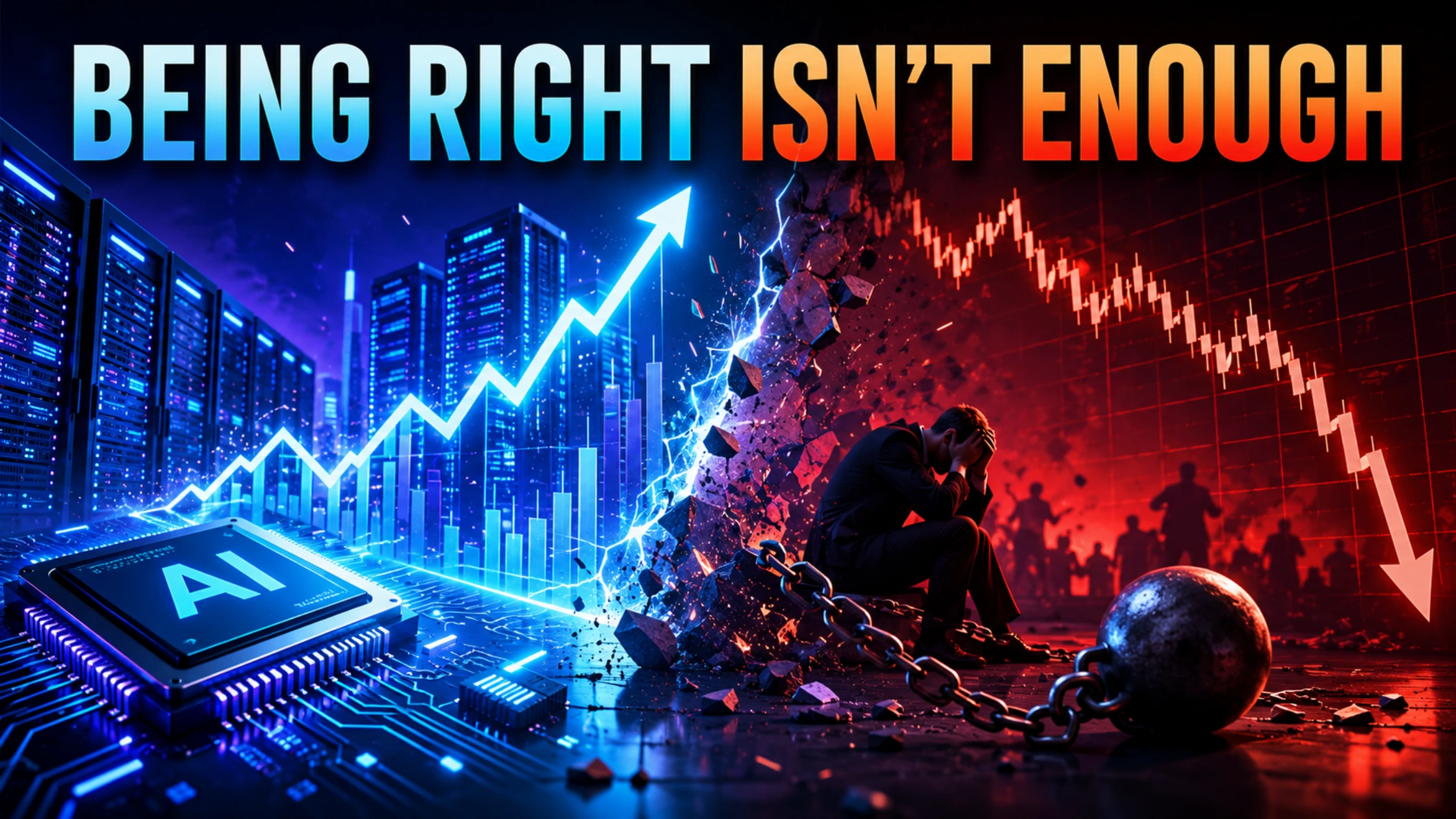
Right about the future, wrong about the size: what Leopold Aschenbrenner and Sam Bankman-Fried actually teach about surviving an AI conviction bet in 2026
- Leopold Aschenbrenner, a 25-year-old former OpenAI researcher, grew his hedge fund Situational Awareness LP from $225 million to as much as $45 billion in under two years on an AI infrastructure thesis, before a July 2026 AI stock rout forced a liquidation of its public equity book to Citadel.
- The fund ran roughly 4x leverage; the Philadelphia Semiconductor Index fell 28.6% from its June 22, 2026 peak and the Morgan Stanley Momentum TMT Index dropped 53.5% during the same window, triggering margin calls from Goldman Sachs, JPMorgan Chase and Bank of America.
- Aschenbrenner retains a roughly $5 billion private stake in Anthropic and will continue operating the fund as a private vehicle; assets fell to around $10 billion after the forced sale.
- Four years earlier, Sam Bankman-Fried's FTX and Alameda Research identified Anthropic before almost anyone else, investing $500 million for an 8 percent stake in 2021, plus early stakes in what became SpaceX-acquired Cursor and other since-transformative companies.
- FTX's bankruptcy, caused by commingling customer funds rather than any failure of investment judgment, forced its estate to sell that Anthropic stake for $1.3 billion in 2024, a position now worth an estimated $30 billion, and its 5 percent Cursor stake for the $200,000 Alameda originally paid, a position that would be worth roughly $3 billion at SpaceX's 2026 acquisition price.
- Both men correctly identified genuinely transformative companies years ahead of consensus. Neither survived to hold the position through to the payoff, for two different but related reasons: uncontrolled leverage in one case, and a structural fraud that had nothing to do with the investment thesis in the other.
- The DN Kelly Ruin Simulator, embedded below, models exactly how much leverage a genuinely correct edge can survive before the position, not the thesis, becomes the risk.
There is a specific, recurring shape to these stories, and it is not the one most coverage reaches for. The easy version says a young genius got too confident and blew up, or that a convicted fraudster's early bets do not count because the money was never really his to invest. Both readings miss the more useful and more uncomfortable pattern underneath: two people, four years and one AI cycle apart, independently identified the same company, Anthropic, before institutional consensus caught up, and both lost access to the position before the thesis finished paying off. Being early and being right turned out to be necessary but nowhere near sufficient. What determined the outcome was something almost entirely separate from the investment call itself: how the position was sized, structured and financed.
The fund that grew 200x on a thesis nobody wanted to believe
Leopold Aschenbrenner's path to Wall Street ran through OpenAI, not a trading desk. German-born, a valedictorian at Columbia University at 19 after enrolling at 15, he joined OpenAI's Superalignment team in 2023 under Ilya Sutskever and Jan Leike, and was dismissed the following year over what the company described as an improper disclosure of internal information, a characterization Aschenbrenner has disputed, saying he shared a largely non-confidential planning document for outside feedback and that the dismissal followed tensions over security concerns he had raised. Later in 2024 he published a series of essays, titled Situational Awareness, arguing that the path to advanced AI would require an enormous, underappreciated build-out of compute, semiconductors, memory and energy infrastructure. He then built a hedge fund, also named Situational Awareness, to put real capital behind that exact argument.
The results were extraordinary by any historical standard. The fund reportedly grew from $225 million to as much as $45 billion in under two years, up roughly 270 percent after fees through May 2026 according to the Wall Street Journal, backed by early investors including Stripe's Patrick and John Collison, Daniel Gross and Nat Friedman, with Jane Street later becoming an investor as well. The portfolio leaned heavily into the physical infrastructure layer of the AI trade, positions in companies like CoreWeave, Bloom Energy, memory makers, and Bitcoin miners repositioned as AI data centre operators, treating them as leveraged proxies on the same thesis his essays had laid out.
What actually happened in July 2026
The fund ran its book at roughly four times leverage. That works exactly as intended when the underlying positions are rising, and works against you with brutal, mechanical certainty the moment they are not. In July 2026, the AI infrastructure trade cracked: the Philadelphia Semiconductor Index fell 28.6 percent from its June 22 peak, while the Morgan Stanley Momentum TMT Index, a rough proxy for the most crowded, highest-momentum AI-adjacent names, fell 53.5 percent over the same window. At four times leverage, a decline of that magnitude does not erode a portfolio's equity. It threatens to erase it, since losses on a levered book compound against a shrinking equity base far faster than they would unlevered.
Reporting from Bloomberg, CNBC and the Wall Street Journal converged on the same sequence: as losses mounted, the fund's three prime brokers, Goldman Sachs, JPMorgan Chase and Bank of America, issued margin calls, and Situational Awareness began working with them to either raise fresh capital or unwind positions in an orderly fashion. Fresh capital did not arrive in time. On July 30, 2026, the fund sold the bulk of its public equity portfolio to Ken Griffin's Citadel. Assets fell from a reported $20 to 24 billion to roughly $10 billion in the aftermath. What remains, notably, is the fund's private holdings, including a stake in Anthropic reported at roughly $5 billion, positions that a public equity margin call cannot force a sale of in the same way, because there is no public market price triggering a broker's risk system in real time.
It is worth being precise about what this sequence does and does not demonstrate. It does not demonstrate that Aschenbrenner's underlying thesis, that AI progress requires a historic infrastructure build-out, was wrong. Every company in his portfolio remains part of a real, ongoing capital cycle covered extensively elsewhere in this publication. What it demonstrates is that a genuinely correct multi-year thesis, expressed through a four-times-levered public equity book, cannot survive a sharp enough short-term drawdown regardless of whether the thesis is eventually vindicated, because the prime broker's margin call operates on today's price and today's leverage, not on next year's fundamentals.
The earlier version of this story: FTX and the stake nobody else wanted
Four years before Situational Awareness existed, Sam Bankman-Fried's FTX and its trading arm Alameda Research made a strikingly similar kind of early, correct call. In 2021, before the generative AI boom had entered public consciousness, FTX invested $500 million for roughly an 8 percent stake in Anthropic, a company then barely known outside AI research circles. Alameda separately put $200,000 into a tiny, unknown startup called Anysphere in April 2022, buying 5 percent of what would eventually become Cursor, the AI coding tool that grew into the fastest-growing business software company ever measured by revenue milestones, reaching a $29.3 billion valuation by November 2025 before SpaceX agreed in 2026 to acquire it for $60 billion.
Neither position survived to realize that outcome for FTX's investors, for a reason entirely disconnected from the investment thesis. FTX collapsed in November 2022 because Bankman-Fried had directed customer deposits into Alameda's trading operations, a structural fraud that had nothing to do with whether Anthropic or Cursor were good investments; they plainly were. Bankman-Fried was convicted and sentenced to 25 years in prison, with $11 billion in forfeiture ordered. The court-appointed bankruptcy estate, tasked with maximizing recovery for defrauded customers as quickly and reliably as possible rather than holding for maximum long-term value, sold the Anthropic stake for $1.3 billion in 2024 and the Cursor stake back to its founders for the original $200,000 in 2023. By 2026, independent analysts estimated the same Anthropic stake would have been worth roughly $30 billion had it been held, and the Cursor stake roughly $3 billion, a combined gap of tens of billions of dollars in value that never reached a single defrauded FTX customer, because the position had to be liquidated on the estate's timeline, not the market's.
Two different failure modes, one identical outcome
Put side by side, these are not the same story with the same moral. Aschenbrenner's fund failed because of a financing structure, leverage, that he chose and controlled. Bankman-Fried's estate failed to realize its early conviction because of a fraud that had already destroyed the entity holding the position before the investment thesis had time to play out; the liquidation that followed was a consequence of that fraud, executed by a court-appointed trustee with a legal obligation to prioritize creditor recovery over optimal exit timing, not a decision anyone made about the merit of Anthropic or Cursor as investments.
What connects them is narrower and more useful than "leverage bad" or "fraud bad." In both cases, the entity holding a genuinely prescient position was forced to exit it on a timeline set by someone else, a margin desk in one case, a bankruptcy court in the other, entirely disconnected from the timeline on which the underlying thesis was proven correct. The market for being early rewards patience above almost everything else, and both structures removed the ability to be patient before the reward arrived.
DN Kelly Ruin Simulator
A correct thesis and an oversized position are two different bets. See what leverage does to a genuine edge.
The mechanics of what actually happens when a position this size has to move
It is worth understanding, in general terms, why unwinding a position at this scale is so much harder than it looks from outside. A hedge fund holding a large, illiquid stake in a thinly traded stock cannot simply place a market sell order the way a retail investor closes a small position; doing so would crater the price before the order finished filling. Prime brokers instead work such orders discreetly through direct calls to other institutions, testing interest without revealing the true size of the seller, because the moment the market suspects a large forced seller exists, other participants have a rational incentive to sell first or short into the disclosed weakness, accelerating exactly the price decline the broker is trying to manage around. This dynamic, sometimes called shooting against a fund in industry slang, is a well-documented feature of prior large liquidations and is part of why funds facing margin pressure often prefer a single negotiated block sale, of the kind Situational Awareness executed with Citadel, over attempting to sell into public markets directly. A single buyer large enough to hold the position for years without needing to justify short-term price moves, which is roughly the role Citadel and similar multi-strategy firms have played in several prior fund liquidations, can absorb a book that the original owner no longer has the balance sheet or the time to hold.
What this means for spotting the next Anthropic before consensus does
Both men's genuine skill was pattern recognition years ahead of the market: Aschenbrenner's insight that AI's bottleneck would shift from algorithms to physical infrastructure, and Bankman-Fried's early willingness to fund an unproven AI safety spinout and a barely-launched coding tool when almost no one else would. That skill is worth isolating from the outcome, because the framework underneath it generalizes.
A few patterns recur across the early, correct calls in this space, regardless of who made them. First, structural bottleneck ownership: the companies that turned into generational outcomes, Anthropic, Cursor, CoreWeave in its early days, controlled something scarce and hard to replicate, a research team, a workflow habit among engineers, or physical compute capacity, rather than a feature that could be copied by a well-funded competitor within a product cycle. Second, contrarian entry timing: in every case cited here, the investment was made when institutional consensus considered the company unproven, illiquid, or simply too early to underwrite, which is precisely the window in which price does not yet reflect the eventual outcome. Third, and this is the lesson both stories converge on hardest, position durability mattered as much as position selection: the size and structure of the bet had to be survivable through the multi-year gap between being early and being proven right, a gap that swallowed both of these portfolios before it closed.
The evaluative discipline this suggests is straightforward to state and hard to execute: identify the scarce, hard-to-replicate asset before consensus prices it in, then size the position so that a drawdown which does not invalidate the thesis also cannot force you out of the position before the thesis resolves. The Kelly criterion, a century-old piece of mathematics originally developed for information theory and adopted widely by professional gamblers and traders, formalizes exactly this second half of the discipline: for any given edge, there is a bet size that maximizes long-run compounding, and sizing meaningfully above it does not increase long-run returns, it decreases them, because the mathematics of compounding is geometric, not additive, and a large enough single loss cannot be earned back from a shrunken base no matter how many correct calls follow it.
What this means for DN's readers
The temptation in crypto and AI-adjacent markets alike is to treat conviction as a substitute for position sizing, reasoning that if the thesis is strong enough, leverage simply accelerates a correct outcome. Both stories above are direct evidence against that reasoning. A four-times-levered correct thesis and an unlevered correct thesis are not the same bet with a bigger number attached; they are different bets with different survival odds, and only one of them reliably gets to collect the payoff years later when the thesis matures. The same discipline applies directly to DePIN and AI-infrastructure token positions: identifying the right protocol early is necessary, but sizing that position so a 50 percent drawdown, which crypto markets produce routinely and which does not by itself invalidate a multi-year thesis, cannot force a liquidation before the thesis has time to resolve.
For readers looking to build exposure to the AI infrastructure and DePIN theme discussed throughout this piece, spot and derivatives markets are available through most major exchanges, including Bybit, OKX and MEXC. As always, this is not financial advice. Identifying a correct thesis early is a real and rare skill. Surviving long enough to be paid for it is a separate discipline, and the data above suggests it is the harder one.
Frequently asked questions
Who is Leopold Aschenbrenner and what happened to his hedge fund?
Leopold Aschenbrenner is a former OpenAI researcher who founded the hedge fund Situational Awareness in 2024 based on his essays arguing AI progress requires a massive infrastructure build-out. The fund grew to as much as $45 billion before a July 2026 AI stock rout, combined with roughly 4x leverage, forced margin calls from its prime brokers and a sale of its public equity portfolio to Citadel on July 30, 2026.
Why did Situational Awareness have to sell its portfolio?
The fund's public equity positions were leveraged approximately four times. When the Philadelphia Semiconductor Index fell 28.6 percent and the Morgan Stanley Momentum TMT Index fell 53.5 percent in July 2026, the resulting losses triggered margin calls from Goldman Sachs, JPMorgan Chase and Bank of America that the fund could not meet with fresh capital in time, forcing a negotiated sale of the public book.
Does Leopold Aschenbrenner still have any AI investments?
Yes. Reporting indicates the fund retains a private stake in Anthropic valued at roughly $5 billion and will continue operating as a private investment vehicle, since private holdings are not subject to the same public-market margin call mechanics that forced the sale of the fund's public equities.
How did FTX and Sam Bankman-Fried identify Anthropic and Cursor so early?
FTX and Alameda Research invested $500 million for an 8 percent stake in Anthropic in 2021 and $200,000 for a 5 percent stake in Anysphere, the company behind Cursor, in April 2022, both well before either company was widely known, reflecting early conviction in AI research talent and developer tooling ahead of the broader generative AI boom.
Why didn't FTX's estate keep the Anthropic and Cursor stakes?
FTX's bankruptcy, caused by Sam Bankman-Fried directing customer deposits into Alameda Research's trading operations, required a court-appointed estate to prioritize timely, reliable creditor recovery over holding for maximum long-term value. The estate sold the Anthropic stake for $1.3 billion in 2024 and the Cursor stake for its original $200,000 cost in 2023, both years before either position reached its eventual, far higher valuation.
What is the Kelly criterion and why does it matter for AI investing?
The Kelly criterion is a formula for the bet size that maximizes long-run compound growth given a stated edge and payout. Betting above the Kelly-optimal fraction, as with high leverage on a correct thesis, can turn a genuinely positive edge into a negative long-run growth rate, because losses compound geometrically against a shrinking capital base regardless of how sound the underlying investment thesis is.
Was Leopold Aschenbrenner's AI infrastructure thesis wrong?
The forced sale of his fund's public portfolio does not, by itself, demonstrate the thesis was incorrect. It demonstrates that a four-times-leveraged public equity expression of that thesis could not survive a sharp short-term drawdown, independent of whether the underlying companies and infrastructure build-out continue to develop as the thesis predicted.
How does a hedge fund actually sell a large, illiquid stock position?
Rather than placing public market orders that would crash the price, prime brokers typically work large positions through discreet calls to other institutions, testing buyer interest without revealing the full size of the sale. Because other market participants have an incentive to sell or short ahead of a suspected large forced seller, funds facing this situation often prefer a single negotiated block sale to a large buyer capable of holding the position long-term, rather than attempting to sell into public markets directly.
What is the practical lesson for evaluating early-stage AI companies?
Both cases suggest identifying a company controlling a genuinely scarce, hard-to-replicate asset ahead of institutional consensus is necessary but not sufficient. The position also needs to be sized and structured so that a drawdown which does not invalidate the underlying thesis cannot force an exit before the thesis has time to resolve, since both funds examined here lost their positions for reasons unrelated to whether their investment judgment was correct.





