Is It Cheaper to Hold Spot or Perp? The DN Basis & Cost-of-Carry Calculator for 2026
The true cost of holding a position over time — funding, basis and carry — and a clear verdict on whether spot or a perpetual is the cheaper way in.
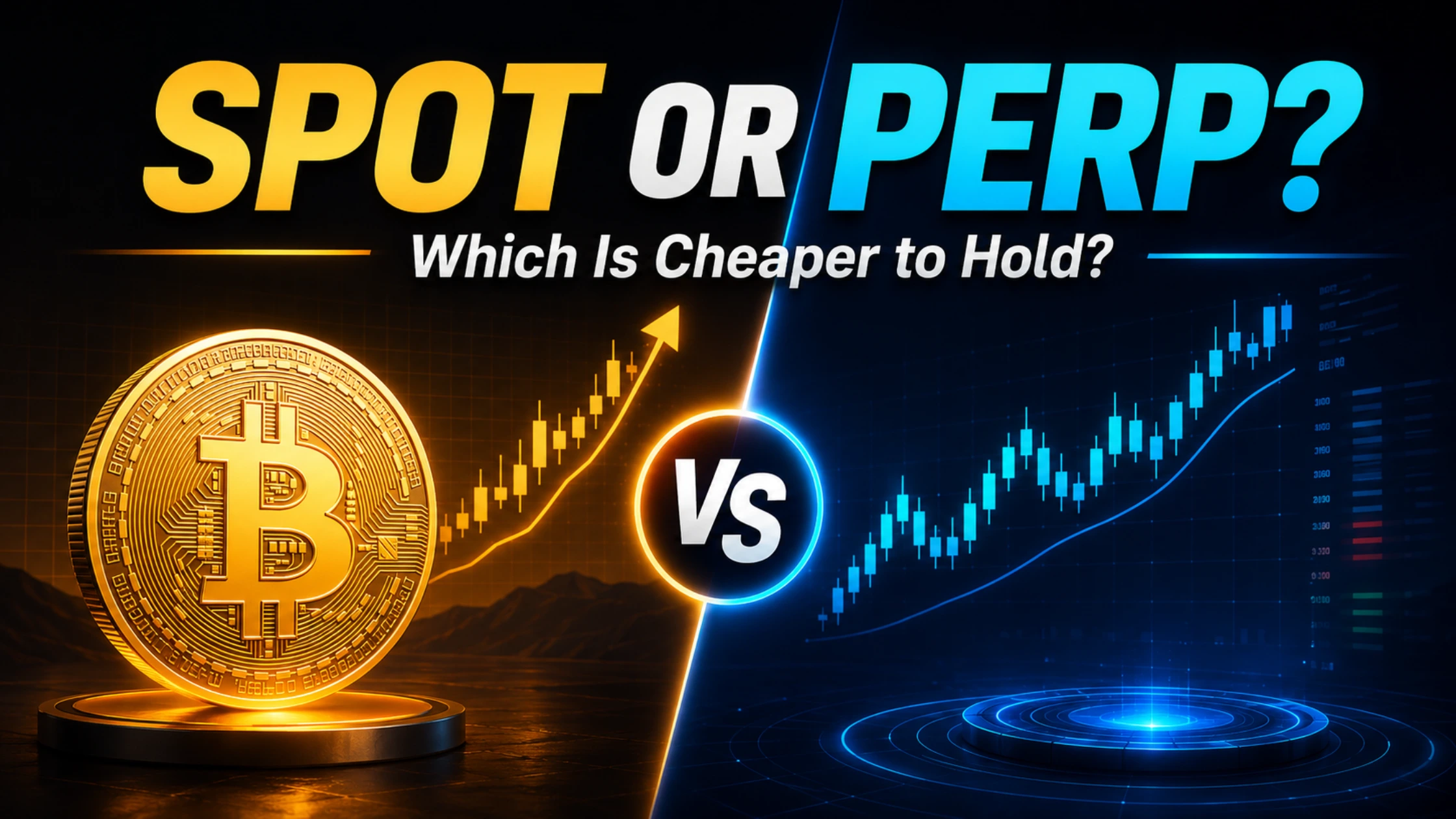
The cost of holding a leveraged crypto position is its cost of carry — for a perpetual, the funding you pay or receive each eight hours; for a dated future, the basis that decays as it converges to spot at expiry. Whether spot or perp is cheaper for long exposure depends mainly on funding: when funding is low, zero or negative, a perp is cheaper and more capital-efficient because it frees up cash to earn yield; when funding runs hot and positive, holding spot avoids that drain. The calculator below computes your annualised carry, the funding cost amplified by leverage, and a direct spot-versus-perp verdict.
Most crypto traders obsess over entry price and ignore the meter running the entire time they hold. That meter is the cost of carry — the quiet, continuous price of keeping a position open — and in the world of perpetual futures it can turn a correct directional call into a losing trade. Traditional finance has understood carry for a century; crypto is only now learning that a position is not free to hold, and that the cheapest way to express a view is a question with a real, calculable answer.
This calculator answers it. It computes the basis and the annualised carry on both perpetual and dated futures, shows you how leverage amplifies the funding bill relative to your actual capital, and then settles the perennial argument directly: for the exposure you want, over the time you intend to hold it, is spot or perp the cheaper vehicle?
Advanced — fees & cash yield
—
Basis, explained
Basis is the gap between a derivative's price and the spot price of the asset it tracks. In dated futures — contracts that expire on a set date — the basis is simply the futures price minus spot, and it exists because of the time value of money and the cost of holding the underlying. When futures trade above spot the market is in contango, the normal state for a healthy bull market; when they trade below spot it is in backwardation, often a sign of stress or a rush for immediate delivery. As expiry approaches, the futures price converges to spot, and the basis shrinks to zero. That convergence is where the money in basis trading is made.
Perpetual futures, which dominate crypto volume, never expire, so they cannot rely on convergence to stay tethered to spot. Instead they use the funding rate — a small payment exchanged between longs and shorts every eight hours that pulls the perp price back toward spot. When the perp trades above spot, funding is positive and longs pay shorts; when it trades below, funding is negative and shorts pay longs. Funding is therefore the perpetual's basis, expressed as a recurring cost rather than a price gap. It is the meter running on your position.
Annualised futures basis = (futures − spot) ÷ spot × (365 ÷ days to expiry)
Carry trade mechanics
A carry trade harvests the basis directly while staying neutral to price. The classic version is cash-and-carry: buy the asset on spot and simultaneously sell an equal amount of a dated future trading at a premium. You are perfectly hedged — every dollar the spot gains, the short future loses, and vice versa — but you have locked in the basis, which converges to zero by expiry and lands in your pocket as yield. In a healthy contango, this is a market-neutral return that can comfortably beat what cash earns, which is exactly why it is a staple of institutional crypto desks.
The perpetual equivalent is the funding harvest: hold spot and short the perp when funding is richly positive, collecting the funding payments while remaining price-neutral. Both trades convert the market's structural demand for leverage into a steady yield. The calculator's annualised basis and cash-and-carry figures show you, in plain percentage terms, whether that yield is worth the capital and execution effort — and how it compares to simply parking the money in a yield-bearing stablecoin.
The holding-cost trap
Here is where directional traders quietly bleed out. You buy a perpetual long, you are right about the direction, price grinds up over three weeks — and you still finish with less than you expected, because funding was eating your position the entire time. At a tenth of a percent of funding a day, a position held a month surrenders roughly three percent of its notional to the funding meter. That sounds small until you remember leverage: at ten times leverage, that three percent of notional is thirty percent of your actual margin, gone to carry alone, before price has done anything.
This is why the calculator shows funding both as a percentage of notional and, more importantly, as a percentage of your margin. The leverage that makes a position capital-efficient also amplifies its carry cost relative to the capital you put up. A high-leverage long in a high-funding regime is a position racing against its own holding cost, and many traders lose that race without ever understanding why a winning chart produced a losing trade.
When perp beats spot — and when it does not
The spot-versus-perp decision comes down to a single trade-off. Spot ties up your full capital but pays no funding; a perp ties up only the margin, freeing the rest of your cash to earn a yield elsewhere, but charges you funding for the privilege. The verdict therefore swings on the funding rate:
- Funding negative or near zero: the perp wins decisively. You get the same exposure for a fraction of the capital, your freed cash earns yield, and you may even be paid funding to hold.
- Funding modestly positive: it is a genuine contest. The funding cost competes against the yield you earn on freed capital — the calculator settles it in dollars over your specific holding period.
- Funding richly positive: spot wins for a long-term holder. Paying steep funding month after month to hold a leveraged long is a slow bleed that owning the asset outright avoids entirely.
The deeper lesson is that holding period matters as much as funding level. A perp is almost always the right tool for a short-term tactical position, where carry has little time to accumulate. Spot increasingly wins the longer you intend to hold, because funding compounds against you while the convenience of leverage stops mattering. Decide your horizon first, then let the numbers choose the vehicle.
Where to trade basis and carry
Carry and basis trades demand venues with deep futures liquidity, reliable funding mechanics and the instruments to build a clean hedge. These are the venues we use and rate for it:
Frequently asked questions
Is it cheaper to hold spot or perp?
It depends mainly on the funding rate and your holding period. When funding is negative, zero or modestly positive, a perpetual is usually cheaper and more capital-efficient because it frees cash to earn yield. When funding is richly positive or you intend to hold for a long time, spot is cheaper because it pays no funding. The calculator settles it in dollars for your exact inputs.
What is basis in crypto futures?
Basis is the difference between a futures price and the spot price. For dated futures it is the price gap that converges to zero at expiry; for perpetuals it is expressed through the funding rate. Positive basis (futures above spot) is contango; negative basis (futures below spot) is backwardation.
How is annualised funding calculated?
Crypto funding is typically paid every eight hours, so there are three payments a day and 1,095 a year. The compounded annualised rate is (1 + funding per 8h) raised to the power of 1,095, minus one. A funding rate of 0.01% per 8h compounds to roughly 11.5% annualised.
What is the cash-and-carry trade?
It is a market-neutral trade that buys the asset on spot and simultaneously sells an equal-sized dated future trading at a premium. The position is hedged against price, but locks in the basis, which converges to zero by expiry and is collected as yield. In contango it can earn more than holding cash.
What is contango and backwardation?
Contango is when futures trade above spot, the normal state in a healthy market, reflecting positive cost of carry. Backwardation is when futures trade below spot, often signalling stress or strong demand for immediate delivery. Basis traders earn yield from contango and pay it in backwardation.
Does crypto funding compound?
Effectively yes, because it is charged repeatedly — three times a day — on your position value, and the costs accumulate. Over months this compounding turns a small per-payment rate into a substantial annualised drag, which is why the calculator reports the compounded annualised figure rather than a simple multiple.
This tool and article are for educational and informational purposes only and do not constitute financial, investment or trading advice. Derivatives and leveraged trading carry significant risk, including the total loss of capital, and carry trades involve execution, liquidation and counterparty risks. All calculations are estimates that assume static funding and linear basis convergence; real markets move continuously. Always verify against your exchange and consider consulting a licensed financial professional. Decentralised News may earn a commission from exchanges linked in this article at no additional cost to you.