
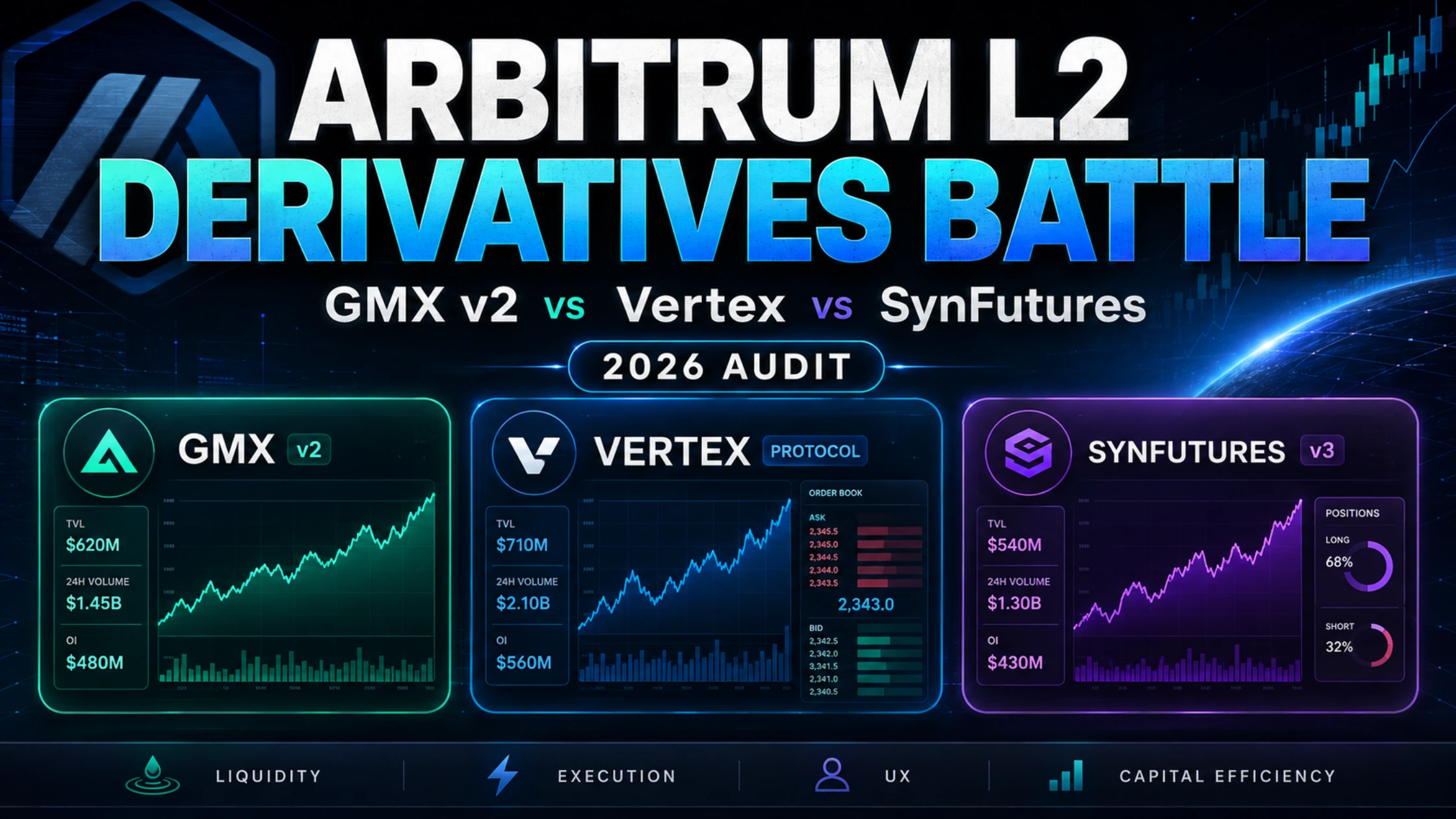
Arbitrum L2 Derivatives Battle: GMX v2 vs. Vertex Protocol vs. SynFutures v3 (2026 Audit)
Key Takeaways (DN Arbitrum Benchmarks)
- Arbitrum's DeFi Moat: Arbitrum remains the primary Layer-2 venue for decentralized derivatives, processing billions in weekly perpetual volume due to its deep liquidity pools, established developer ecosystem, and low-latency Optimistic Rollup infrastructure.
- GMX v2 leads pooled synthetic execution with its GM Isolated Pools, offering zero-slippage oracle execution, fixed borrow rates, and isolated risk parameters for liquidity providers.
- Vertex Protocol delivers CEX-like speed via Vertex Edge—a hybrid off-chain order book matching engine with onchain settlement that enables cross-margin trading across spot, perpetuals, and money markets with sub-30ms latency.
- SynFutures v3 provides permissionless market creation via its Oyster AMM, combining concentrated liquidity with onchain order books to support long-tail altcoin perps.
Featured Arbitrum Execution Outlets & VIP Discount Portals
Access trading fee discounts, liquidity provider yield multipliers, and priority routing using our verified partner portals:
- 🔹 GMX v2 (GM Isolated Pools): Trade Perps on GMX v2 — Referral Code:
decentralised - 🔹 Vertex Protocol (Sub-30ms Order Book): Launch Vertex Edge Exchange — Promo Code:
decentralised - 🔹 SynFutures v3 (Oyster AMM Engine): Trade SynFutures v3 Perps — Team Code:
decentnews - 🔹 deBridge (Cross-Chain Arbitrum Router): Bridge Capital to Arbitrum via deBridge — Partner Link:
20473
1. Arbitrum’s Sustained Supremacy in Onchain Derivatives
Despite fierce competition from newer Layer-2 rollups and non-EVM app-chains, Arbitrum continues to hold the largest concentration of decentralized derivatives Total Value Locked (TVL).
The platform’s dominance is anchored by two fundamental design approaches:
- Pooled Synthetic Vault Engines (GMX v2): Traders execute directly against multi-asset liquidity pools at exact Chainlink and Pyth oracle index prices, completely eliminating order book price impact for large whale positions.
- Hybrid Central Limit Order Books (Vertex Protocol & SynFutures v3): Ultra-fast matching engines that match limit orders off-chain or via concentrated liquidity, providing institutional speed for high-frequency day traders and automated market makers.
To determine which platform delivers the best execution for traders and maximum risk-adjusted APY for liquidity providers, Decentralised News audited GMX v2, Vertex Protocol, and SynFutures v3.
2. DN Arbitrum Liquidity & Latency Metric (DN-ALLM) Framework
Our research team evaluates Arbitrum derivatives venues using five quantitative criteria:
- Order Matching Latency: Round-trip timestamp delay from local wallet execution to fill confirmation on Arbitrum One.
- Oracle Price Precision & Deviation Guards: Protocols' resilience against single-feed oracle manipulation and flash-crash liquidations.
- Borrow Spread & Funding Fee Efficiency: Net holding cost for long and short positions over 8-hour, 24-hour, and 7-day intervals.
- Cross-Margin Collateral Utilization: Ability to offset margin risk across spot assets, options, and perpetual futures.
- Liquidity Pool Impermanent Loss Mitigation: Historical risk-adjusted yield for GM, Vertex, and Oyster liquidity providers relative to trader PnL drawdowns.
3. Arbitrum Perpetual DEX Comparison Matrix
Below are the empirical benchmarks from our 30-day continuous execution test on Arbitrum:
| Platform | Core Architecture | Max Leverage | Order Matching Model | Standout Advantage | Verified Partner Portal |
|---|---|---|---|---|---|
| GMX v2 | GM Isolated Synthetic Pools | 100x | Chainlink / Pyth Oracle Execution | Zero price impact on $500k+ market trades | GMX v2 Portal (decentralised) |
| Vertex Protocol | Vertex Edge Hybrid CLOB + AMM | 100x | Off-Chain Matcher / Onchain Settlement | Sub-30ms execution & universal cross-margin | Vertex Exchange (decentralised) |
| SynFutures v3 | Oyster AMM (CLMM + Order Book) | 100x | Concentrated Liquidity Order Book | Permissionless market creation for any ERC-20 | SynFutures Hub (decentnews) |
4. Platform Deep Dives: Top Arbitrum Derivatives Outlets
1. GMX v2 — Zero-Slippage Oracle Execution & Isolated GM Pools
GMX v2 represents the evolution of pooled synthetic derivatives on Arbitrum. Building upon the legacy GLP pool, GMX v2 introduced GM (GMX Market) Pools, segmenting liquidity into isolated asset pairs (e.g., BTC/USD, ETH/USD, SOL/USD).
Key Highlights: Risk is isolated strictly to individual pools. Trades execute against exact Chainlink/Pyth oracle index prices with zero price impact, while dynamic borrow fees incentivize balanced long/short open interest.
💡 Trader Pro Tip: Open futures positions on GMX v2 via Code decentralised to ensure optimal swap routing and priority execution.
2. Vertex Protocol — Sub-30ms Order Book & Universal Cross-Margin
Vertex Protocol brings centralized exchange speed to Arbitrum through its Vertex Edge matching engine.
Key Highlights: Hybrid CLOB + AMM matching engine delivering sub-30ms execution speeds, paired with universal cross-margin support that backs perps, spot, and money markets with shared collateral.
💡 Trader Pro Tip: Launch the Vertex Protocol Exchange (Code decentralised) to unlock fee rebates and low-latency API access.
3. SynFutures v3 — Concentrated Liquidity & Permissionless Pairs
SynFutures v3 introduces concentrated liquidity to the perpetual futures market through its Oyster AMM.
Key Highlights: Combines concentrated liquidity range bound orders with an order book, enabling permissionless listing of perpetual futures for any ERC-20 token on Arbitrum within minutes.
💡 Trader Pro Tip: Join the official SynFutures v3 Team (Code decentnews) to receive yield boosts and fee rebates.
Frequently Asked Questions (FAQ)
Why is GMX v2 safer for liquidity providers than GMX v1?
GMX v2 introduced isolated GM (GMX Market) pools, restricting asset exposure to specific pairs (e.g., ETH/USD). If a single token suffers a flash-crash or exploit, the loss is isolated to that specific pool, shielding the rest of the protocol's liquidity.
How does Vertex Protocol achieve sub-30ms order execution on Arbitrum?
Vertex utilizes an off-chain sequencer engine (Vertex Edge) to match order book limit and market trades off-chain in milliseconds, while batching trade settlements onchain to preserve self-custodial security.
How do I bridge USDC to Arbitrum with minimal fees?
You can use intent-based cross-chain routers like deBridge to bridge native USDC from Ethereum, Base, or Solana to Arbitrum in under 25 seconds with zero MEV sandwich risk.