AI Will Not Kill Inflation. It Will Change Who Owns the Future
The next crypto cycle may not be driven by memes, halvings or another retail mania.
It may be driven by something far larger: the collision between artificial intelligence and a debt-based monetary system.
The mainstream story says AI is deflationary. It will make software cheaper, automate services, reduce labour costs and increase productivity. That is partly true. But it misses the more important point. In a financial system built on debt, too much deflation is not a gift. It is a threat.
When prices fall, the real value of debt rises. Loans become harder to repay. Companies with shrinking revenues struggle to refinance. Banks tighten credit. Governments face weaker tax receipts at the same time their interest bills remain fixed.
That is why AI is not simply a technology story. It is a monetary story.
And Bitcoin may be one of the few assets built for it.

The End of the Software Moat
For 15 years, investors treated software as the perfect business model. High margins. Recurring revenue. Low distribution costs. Global scalability. The market rewarded anything that looked like cloud software with premium valuations.
AI is now challenging that assumption.
Reuters reported in February that a selloff had wiped nearly $1 trillion from global software and media stocks as investors began reassessing AI disruption risk. Bain has also argued that the reset in SaaS valuations reflects AI-driven disruption, slowing retention and a growing divide between winners and losers.
That does not mean every software company dies. Some will adapt. Some will own critical workflows. Some will become AI infrastructure winners.
But the old belief that software moats automatically compound forever is broken.
If intelligence becomes cheap, many businesses built on selling access to human knowledge become vulnerable. Research, design, coding, legal drafts, customer support, analytics and content production all face margin pressure.
This is not a normal sector rotation. It is a repricing of human output.

The Market Is Too Concentrated to Ignore
The risk is not only in software. It is in index concentration.
The Magnificent Seven represented about 33.7% of the S&P 500 in April 2026, up from 12.5% in 2016. Visual Capitalist also noted that just 13 companies now make up more than 40% of the index.
This concentration has been profitable, but it is also fragile.
If AI turns out to be a winner-takes-most revolution, the largest firms may justify their dominance. If AI compresses margins faster than it creates new defensible revenue, capital will begin looking elsewhere.
The market is already asking the question: what still has scarcity when intelligence becomes abundant?
That question leads directly to Bitcoin.

The Fed’s AI Problem
AI gives central bankers a seductive argument.
If productivity rises, the economy can grow faster without generating the same inflation. Kevin Warsh, nominated to lead the Federal Reserve, has argued that AI could allow a more nuanced interpretation of inflation and interest rates. Reuters Breakingviews called the argument convenient but not entirely wrong. Invesco also noted that Warsh appeared open to interpreting inflation differently in a world shaped by AI productivity, tariffs and oil shocks.
This is where the danger lies.
AI may reduce prices in digital services, but it also increases demand for energy, chips, data centres and physical infrastructure. It can make code cheaper while making electricity more valuable. It can reduce labour costs while intensifying capital expenditure.
That means AI may create deflation in the virtual economy and inflation in the physical economy at the same time.
For the Fed, this is a nightmare wrapped in an opportunity. It can justify easier policy by pointing to future productivity gains, even while households still face high costs in food, fuel, housing and insurance.
That is not a clean disinflationary boom. It is a split economy.

Why Bitcoin Is Different
Bitcoin does not depend on labour productivity. It does not have margins to compress. It does not need a software moat. It has no earnings call, no CEO and no central bank.
Its core property is scarcity.
AI can produce more code, more images, more documents, more agents and more synthetic content. It cannot produce more than 21 million Bitcoin.
That difference matters.
In an age where intelligence becomes abundant, scarce monetary assets become more important. Gold has already benefited from this instinct, with central banks continuing to accumulate it as geopolitical and reserve risks rise. Bitcoin is the younger, more volatile, more networked version of the same desire for monetary insulation.
The bullish case is not that Bitcoin replaces every asset. It is that Bitcoin becomes a portfolio answer to a world where labour is repriced, software is disrupted and monetary policy becomes more reactive.

The Crypto Market Outlook
The next phase of crypto will likely separate Bitcoin from the rest of the market.
Bitcoin benefits from three forces: fixed supply, institutional ETF access and macro sensitivity to liquidity. Altcoins need more. They need risk appetite, retail participation, developer traction and real token demand.
If liquidity expands, the broader crypto market can recover sharply. But if AI continues compressing speculative software valuations and long-term yields stay high, capital may first concentrate in Bitcoin before moving down the risk curve.
That sequence matters.
First comes Bitcoin as macro collateral. Then large-cap crypto. Then, if liquidity truly returns, the speculative layer.

The Bottom Line
AI is not just making things cheaper. It is changing the hierarchy of value.
Human capital faces repricing. Software moats face compression. Index concentration faces scrutiny. Central banks face a new excuse to ease and a new reason to worry.
Bitcoin sits outside that storm.
It is not immune to volatility. It is not guaranteed to rise in a straight line. But it is structurally different from the assets AI is disrupting.
The next wealth transfer may not come from owning the best AI app.
It may come from owning the scarce asset that survives when intelligence becomes cheap and money becomes political.
That is the Bitcoin thesis for the AI decade.
Recommended reading:
Bitcoin Is Reflecting a Shift the Fed Hasn’t Confirmed
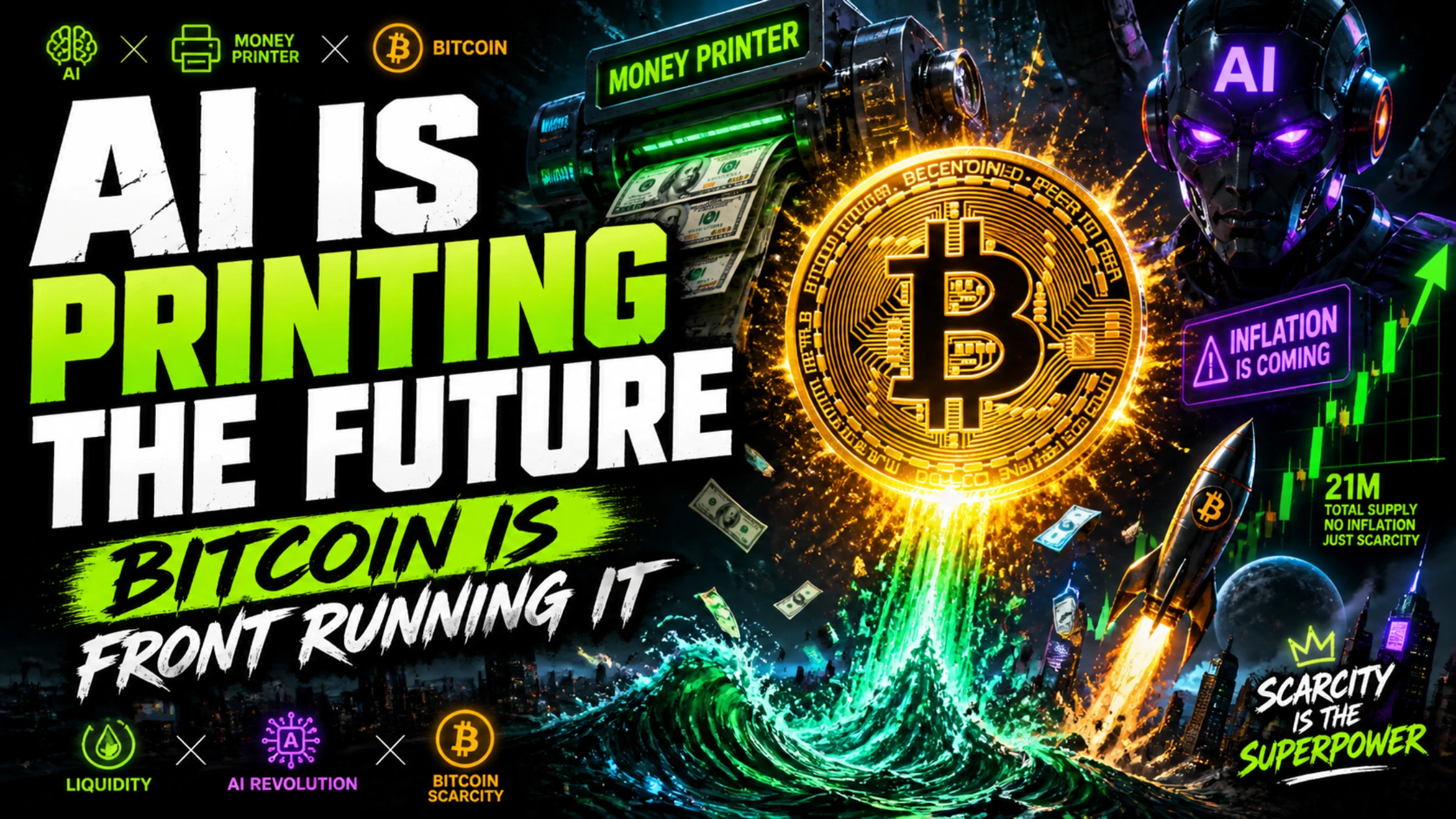
Bitcoin Is Front-Running the Next Money Printing Cycle
The Post-Powell World: How a Warsh-Led Fed Could Reset Markets, Bitcoin, and the Dollar System
Inside the Fed’s Decision to End Balance Sheet Runoff
The Fed’s Crypto Playbook: How Central Bank Actions Create Trading Opportunities
Financial Literacy in 2026: The Skills That Protect You in an AI Economy
AI For Blue-Collar, Trade, and Service Workers: The Opportunity Nobody Talks About
AI Agents Need App Stores — These 8 Crypto Marketplaces Are Building Them