
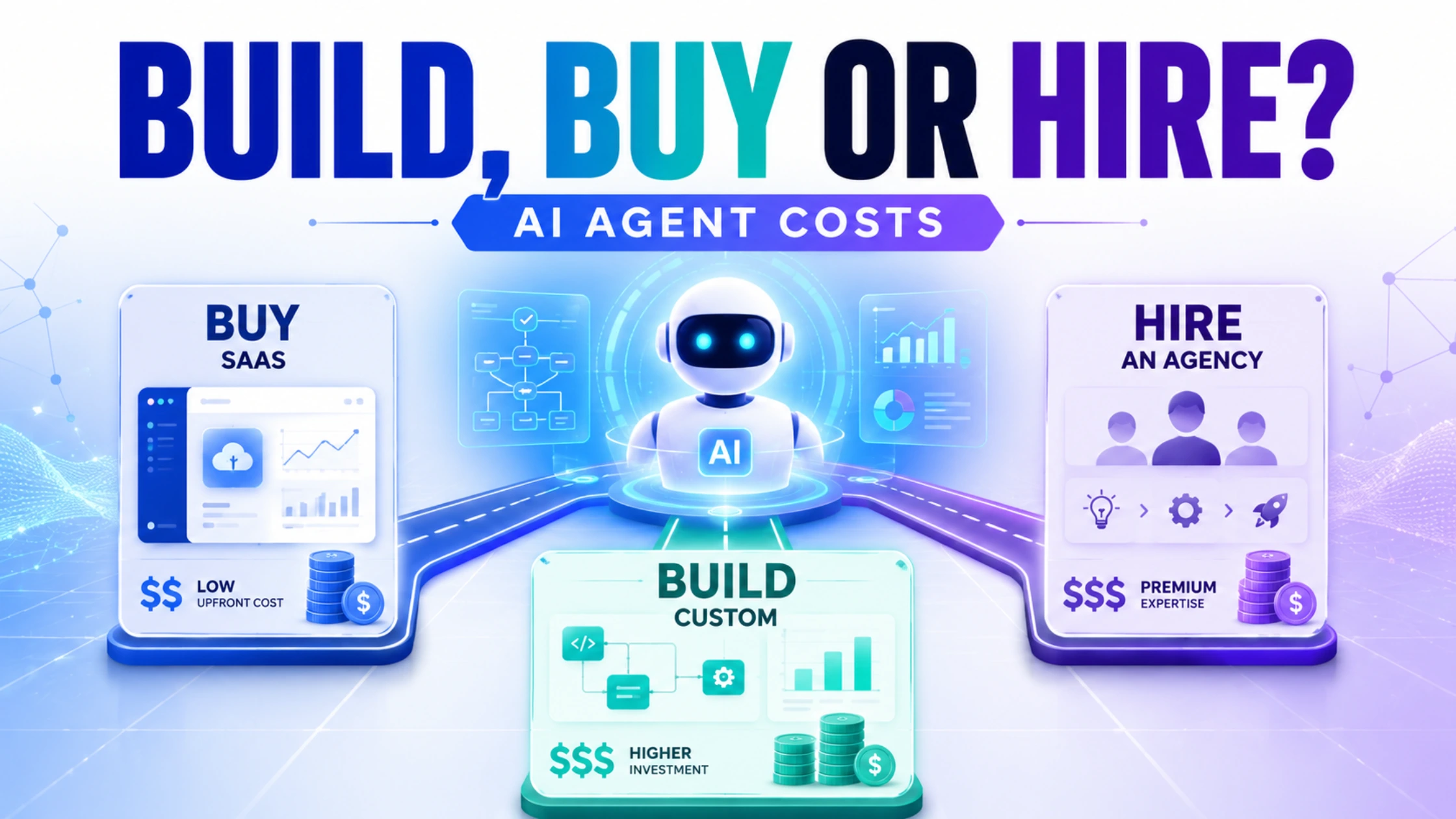
Calculate the real cost of deploying an AI agent in 2027. Compare SaaS platforms, custom development and managed agency implementation across first-year cost, three-year ownership, ROI, risk and payback.
Summary
The sticker price of an AI agent is rarely its true cost.
An advertised $20 subscription can become a multi-thousand-dollar annual system after seats, usage, integrations, administration and human review.
A custom agent with a modest API bill can require a six-figure development programme.
An agency engagement with a higher initial fee may produce the fastest payback when internal execution capacity is weak.
The correct decision depends on five variables:
- Workflow differentiation
- Required launch speed
- Integration complexity
- Data and regulatory sensitivity
- Internal technical capacity
Our central finding is that most organisations should adopt a staged hybrid strategy:
Buy the commodity infrastructure, hire expertise where execution is difficult and build only the components that create proprietary value.
Build vs Buy vs Agency: Comparison at a Glance
Factor | Buy SaaS | Build Custom | Hire an Agency |
Initial cost | Usually lowest | Usually highest | Moderate to high |
Launch speed | Fast | Slowest | Fast to moderate |
Customisation | Limited to moderate | Highest | Moderate to high |
Internal technical burden | Low to moderate | Highest | Low to moderate |
Vendor dependency | Highest | Lower at the application layer | Depends on architecture |
Intellectual-property ownership | Limited | Strongest | Contract dependent |
Integration flexibility | Platform dependent | Highest | High with the right partner |
Maintenance responsibility | Primarily vendor | Primarily business | Shared or managed |
Best use case | Common workflows | Strategic systems | Complex projects without internal capacity |
Primary risk | Lock-in and usage pricing | Cost and delivery failure | Dependency and unclear scope |
2027 Cost Planning Ranges
These are DN scenario ranges, not universal market averages or quotations.
Agent type | Buy SaaS: first year | Build custom: initial plus year one | Agency: implementation plus year one |
Internal knowledge assistant | $1,000 to $15,000 | $15,000 to $75,000 | $10,000 to $50,000 |
Department workflow agent | $10,000 to $75,000 | $75,000 to $350,000 | $40,000 to $250,000 |
Customer-facing support agent | $15,000 to $150,000 | $100,000 to $500,000 | $75,000 to $350,000 |
Multi-system revenue agent | $25,000 to $250,000 | $150,000 to $750,000 | $100,000 to $500,000 |
Regulated enterprise agent | $100,000 to $750,000+ | $500,000 to $2 million+ | $300,000 to $1.5 million+ |
The range expands rapidly when the system needs:
- real-time actions
- regulated data
- multiple integrations
- identity verification
- audit trails
- payment authority
- near-continuous availability
- multilingual support
- formal service levels
- ongoing model evaluation
Why AI Agent Pricing Is So Difficult to Compare
AI-agent vendors charge according to several incompatible units.
Pricing model | Typical unit |
Seat based | User per month |
Usage based | Tokens, messages, credits, tasks or runs |
Outcome based | Successful resolution or qualified lead |
Conversation based | Customer interaction |
Platform based | Workspace or tenant |
Infrastructure based | Compute, storage and runtime |
Service based | Implementation project and monthly retainer |
Hybrid | Subscription plus usage plus services |
Current examples illustrate the problem.
ChatGPT Business is listed at $20 per user per month on annual billing. Intercom Fin charges $0.99 per qualifying outcome. Microsoft Copilot Studio sells 25,000-credit packs at $200 per month. Salesforce offers Agentforce pricing based on credits, actions or conversations.
These prices cannot be compared directly without modelling the expected workload.
A seat may create unlimited perceived access but still operate under usage restrictions.
An outcome charge may appear expensive but remain attractive when it replaces a more expensive human interaction.
A custom API may be cheap per request but expensive to design, secure and maintain.
Route 1: Buy an AI Agent Platform
The economic case
Buying transfers much of the underlying product burden to the vendor.
The subscription may cover:
- agent interface
- model access
- authentication
- connectors
- workflow tooling
- analytics
- permissions
- hosting
- security functions
- product updates
Make currently offers AI Agents across its plan structure and allows users to work with Make’s provider or connect their own model key. The platform is particularly relevant when an agent must operate across several applications through visible, configurable workflows.
Taskade combines agents, projects, automations and AI applications within a collaborative workspace. Its current pricing begins at relatively low annual subscription levels, making it suitable for validating internal and small-team use cases before committing to custom development.
The full SaaS cost formula
Initial cost
- solution design
- configuration
- data preparation
- integrations
- testing
- training
Recurring cost
- subscription
- user seats
- model usage
- workflow credits
- outcome charges
- storage
- support tier
- internal administration
- overages
Long-term cost
- annual price increases
- integration maintenance
- migration
- duplicated subscriptions
- vendor switching
Buy score
Buying should receive the highest score when:
- workflow uniqueness is low
- required launch speed is high
- technical capacity is limited
- integration count is manageable
- the business is still validating demand
- data sensitivity is moderate
- the platform can cover at least 70% to 80% of the workflow
Where buying fails
Buying becomes less attractive when:
- the product cannot express critical business rules
- the agent must use proprietary data structures
- pricing rises sharply with usage
- the platform does not support required permissions
- the workflow depends on unsupported systems
- the agent is central to the company’s competitive advantage
Route 2: Build a Custom AI Agent
The economic case
Custom development converts a recurring vendor limitation into an owned technical asset.
The organisation can determine:
- interface
- models
- orchestration
- tools
- memory
- permissions
- data retrieval
- evaluation
- monitoring
- escalation
- deployment environment
OpenAI and Anthropic both provide usage-based model APIs. The direct model cost is governed by the chosen model, prompt length, output, caching, tools and runtime. Anthropic also publishes managed-agent runtime billing of $0.08 per active session hour in addition to tokens, while its API web-search tool is priced at $10 per 1,000 searches.
Direct model costs can therefore be modest compared with labour.
The full custom-build cost formula
Initial product cost
- discovery
- workflow mapping
- architecture
- data engineering
- interface development
- integration
- agent logic
- evaluation framework
- testing
- security review
- deployment
- employee training
Recurring operating cost
- model APIs
- cloud infrastructure
- vector databases
- observability
- backups
- incident response
- technical support
- quality evaluation
- model migration
- maintenance
- new features
Labour is the dominant custom-build variable
Custom deployment rarely involves one developer working alone.
The US Bureau of Labor Statistics reported 2024 median annual wages of $131,450 for software developers, $103,790 for systems analysts, $124,910 for information-security analysts and $100,750 for project-management specialists. These figures exclude many employer costs and do not represent consultancy rates.
A production agent may also require:
- product management
- subject-matter expertise
- data engineering
- user-experience design
- quality assurance
- DevOps
- compliance review
Build score
Custom development should receive the highest score when:
- the workflow is strategically unique
- internal engineering capability is strong
- proprietary data creates an advantage
- integration complexity is high
- volumes may make usage-based SaaS expensive
- ownership is commercially important
- the organisation can maintain the system after launch
Where building fails
Custom projects fail when organisations underestimate:
- process ambiguity
- exception cases
- poor data quality
- evaluation
- employee adoption
- security
- maintenance
- changing model behaviour
- ongoing product ownership
Building an impressive prototype is easier than operating a dependable agent.
Route 3: Hire a Managed AI Implementation Agency
The economic case
An agency converts a capability shortage into a contracted delivery programme.
The client buys access to:
- architecture
- vendor selection
- automation expertise
- integration
- testing
- training
- governance
- deployment
- ongoing management
The agency may build custom infrastructure, configure SaaS or combine both.
The full agency cost formula
Initial engagement
- discovery
- workflow audit
- implementation
- custom connectors
- data preparation
- testing
- training
- launch
Recurring cost
- software and API pass-through
- management retainer
- monitoring
- support
- optimisation
- change requests
- reporting
Agency score
A managed implementation should receive the highest score when:
- urgency is high
- internal engineering capacity is weak
- the workflow crosses several departments
- data sensitivity requires specialist controls
- internal stakeholders need process design support
- the business wants an accountable delivery partner
- implementation risk is more important than minimising direct cost
Where agency engagements fail
Common failure points include:
- unclear scope
- weak documentation
- vendor accounts controlled by the agency
- missing intellectual-property clauses
- limited knowledge transfer
- excessive change charges
- reliance on one contractor
- untested performance claims
- lack of post-launch support
The client should retain ownership of critical accounts, data and operational documentation wherever possible.
DN Scenario Comparison
Scenario 1: Internal Knowledge Assistant
Requirement: Search approved company documents and answer employee questions.
Likely winner: Buy SaaS
A platform can often satisfy this requirement without a large development programme. The business should focus on permissions, document quality, citations and information ownership.
Scenario 2: Customer-Support Agent
Requirement: Answer routine customer questions and escalate complex cases.
Likely winner: SaaS or hybrid
An outcome-priced support product may be more economical than building the service layer from zero. Intercom Fin currently charges $0.99 per qualifying outcome and can be deployed with supported helpdesk environments.
Custom work may still be required for:
- authentication
- account actions
- refunds
- regulated disclosures
- specialist escalation
- proprietary systems
Scenario 3: Sales and Revenue Agent
Requirement: Research accounts, enrich leads, update CRM records and trigger follow-up.
Likely winner: Hybrid
Existing CRM, enrichment and workflow products can provide most infrastructure. Specialist implementation may be needed to create:
- qualification logic
- approval gates
- routing
- data-quality rules
- personalised sequences
- reporting
Scenario 4: Proprietary Research Agent
Requirement: Combine company data, external information and specialised analysis.
Likely winner: Custom or hybrid
The research interface may use existing model and automation providers while proprietary data, scoring and workflow logic remain owned.
Crypto-focused businesses may validate specialist workflows using ASCN before deciding which research capabilities justify internal development.
Scenario 5: Regulated Enterprise Agent
Requirement: Work with sensitive information and execute controlled actions.
Likely winner: Custom or enterprise platform with managed implementation
The deciding factors are likely to include:
- identity
- permissions
- data residency
- auditability
- evaluation
- explainability
- human approval
- vendor agreements
- incident management
The DN AI Agent Cost and Value Model
The calculator separates cost from value.
Monthly theoretical value
Employee hours saved × fully loaded hourly value
Plus:
- gross-profit contribution
- avoided external costs
- reduced error cost
- faster processing
- improved customer resolution
Risk-adjusted value
Theoretical value is reduced by an adoption factor.
For example:
- theoretical monthly value: $20,000
- expected realisation: 65%
- risk-adjusted monthly value: $13,000
This is more defensible than assuming every saved minute becomes productive economic output.
Ramp adjustment
Most implementations do not create full value in month one.
The calculator therefore allows the user to include a ramp-up period for:
- testing
- training
- data correction
- adoption
- workflow refinement
ROI
ROI equals:
Total risk-adjusted value minus total cost
divided by total cost
multiplied by 100
Payback
Payback equals:
Initial implementation cost
divided by monthly value after recurring costs
A route with lower initial cost usually achieves payback sooner, but may have a higher long-term run rate.
How the DN Recommendation Engine Works
The calculator assigns route-fit scores using:
Decision factor | Favours buying | Favours custom build | Favours agency |
Standard workflow | High | Low | Moderate |
Unique workflow | Low | High | High |
Urgent launch | High | Low | High |
Strong internal engineering | Moderate | High | Low |
Weak internal engineering | High | Low | High |
High data sensitivity | Moderate | High | High |
Many integrations | Low | High | High |
Frequent workflow changes | Moderate | Moderate | High |
Lowest total cost | Route-specific | Route-specific | Route-specific |
The recommendation is a decision aid, not a substitute for technical discovery or vendor quotations.
The Minimum Viable Agent Strategy
A company should not begin with a large autonomous system.
Phase 1: Assist
The AI retrieves information, produces recommendations and requires human action.
Phase 2: Draft
The AI prepares the output or transaction, but an employee approves it.
Phase 3: Execute Low-Risk Actions
The AI performs reversible actions within strict limits.
Phase 4: Execute High-Value Workflows
The AI receives broader permissions only after reliability is demonstrated.
This staged approach generates evidence before the organisation accepts greater cost and risk.
The Strongest Commercial Strategy
For most businesses, the highest-return sequence is:
Step 1: Buy to validate
Use Taskade, Make or another appropriate platform to prove the workflow.
Step 2: Hire expertise to operationalise
Use specialist support for integrations, governance, evaluation and rollout.
Step 3: Build the differentiating layer
Develop only the components that create proprietary value or reduce unacceptable vendor constraints.
Step 4: Retain optionality
Avoid architectures that make model, vendor or agency replacement unnecessarily difficult.
DN AI Agent Cost Calculator
The calculator provides:
- USD, ZAR, GBP, EUR, AUD and CAD presentation
- editable SaaS costs
- editable custom-development assumptions
- editable agency costs
- one, three and five-year horizons
- employee-time savings
- revenue and cost-saving benefits
- adoption adjustments
- implementation ramp assumptions
- first-year cost
- total ownership cost
- net value
- ROI
- payback
- strategic route scores
- decision risks
- scenario presets
Available presets include:
- internal knowledge assistant
- customer-support agent
- sales and operations agent
- regulated enterprise agent
- crypto research agent
AI Agent Cost Calculator: Build, Buy or Hire an Agency?
Compare first-year cost, three-year total cost, expected ROI, payback and implementation fit. All assumptions are editable, because vendor pricing, project scope and workflow risk vary widely.
1. Business case and value
2. Strategic fit
Buy SaaS
Fastest pathBuild Custom
Maximum controlHire a Managed Implementation Agency
Speed plus expertise3. Calculate and compare
| Metric | Buy SaaS | Build Custom | Hire Agency |
|---|---|---|---|
| Initial implementation | |||
| Steady monthly run rate | |||
| First-year cost | |||
| 3-year total cost | |||
| Net value over horizon | |||
| ROI over horizon | |||
| Estimated payback |
DN recommendation
Relevant implementation platforms
Taskade
Useful for agentic workspaces, internal apps, team projects and faster low-code validation.
Explore Taskade →Make
Useful for visual automation, multi-application workflows, AI agents and human approval steps.
Explore Make →ASCN
A crypto-native option for AI research and agent workflows where digital-asset data is central.
Explore ASCN →Affiliate disclosure: Decentralised News may earn a commission from selected partner links at no additional cost to the user. Partner status does not determine the calculator result.
Due-Diligence Checklist
Product and cost
- What is included in the base price?
- Which usage triggers additional charges?
- Are API costs passed through?
- Are annual increases capped?
- Can usage limits be configured?
- What happens when credits are exhausted?
Technology
- Can the agent use different models?
- Can the customer use its own API account?
- Are actions logged?
- Can sensitive actions require approval?
- Can data and workflow logic be exported?
- What happens if an integration fails?
Governance
- How is access controlled?
- Where is data processed and stored?
- Is customer information used for training?
- Which retention controls are available?
- Can the agent’s decisions be audited?
- How are incidents handled?
Implementation partner
- Who owns the code?
- Who owns the accounts?
- Is documentation included?
- Is training included?
- What is covered by support?
- What qualifies as a change request?
- Can another supplier maintain the system?
Frequently Asked Questions
Is it cheaper to build or buy an AI agent?
Buying is usually cheaper initially. Building may become more economical at high volume or when the agent performs a distinctive and commercially important workflow.
What is a reasonable AI agent budget?
A small internal pilot may require hundreds or several thousand dollars. A cross-system operational deployment may require tens or hundreds of thousands. A regulated enterprise programme can exceed $1 million.
Why are agency prices higher than SaaS prices?
An agency price may include workflow design, implementation, integration, testing, training and support. A SaaS subscription normally does not include all those services.
Are token costs the largest custom-agent expense?
Usually not. Development, integration, data, testing, governance and maintenance can exceed model usage costs substantially.
Can no-code platforms replace custom development?
They can replace or delay custom development for many common workflows. They become less suitable when the business needs highly specialised logic, proprietary interfaces, unusual integrations or strict infrastructure control.
Is hiring an agency risky?
It can be when ownership, scope and ongoing support are unclear. The contract should define deliverables, accounts, intellectual property, security, documentation, service levels and exit arrangements.
What is the best option for a small business?
A small business should normally begin with a SaaS or low-code pilot. Taskade and Make are relevant starting points for agentic workspaces and application-connected automation.
What is the best option for a large enterprise?
The answer depends on the existing technology ecosystem. An enterprise may use a platform such as Microsoft Copilot Studio or Salesforce Agentforce, supported by internal development and a specialist implementation partner.
What is the best option for a crypto company?
A crypto business may combine a general model, automation infrastructure and specialist services such as ASCN. Custom development becomes more defensible when proprietary market data, risk controls or trading infrastructure are central to the product.
Final Verdict
The decision is not simply build versus buy.
It is a capital-allocation decision about where the business should own technology and where it should rent capability.
Buy when the function is becoming standard.
Build when the function creates differentiation.
Hire an agency when specialist execution is more valuable than internal ownership during the implementation period.
Combine the three when commodity infrastructure, proprietary logic and managed delivery each have a legitimate role.
The strongest AI-agent programme is not the one with the most advanced demonstration.
It is the one that produces repeatable business outcomes, survives operational failure and creates more risk-adjusted value than it costs.





