The Agent Payment Protocol Race: x402 vs AP2 vs MPP
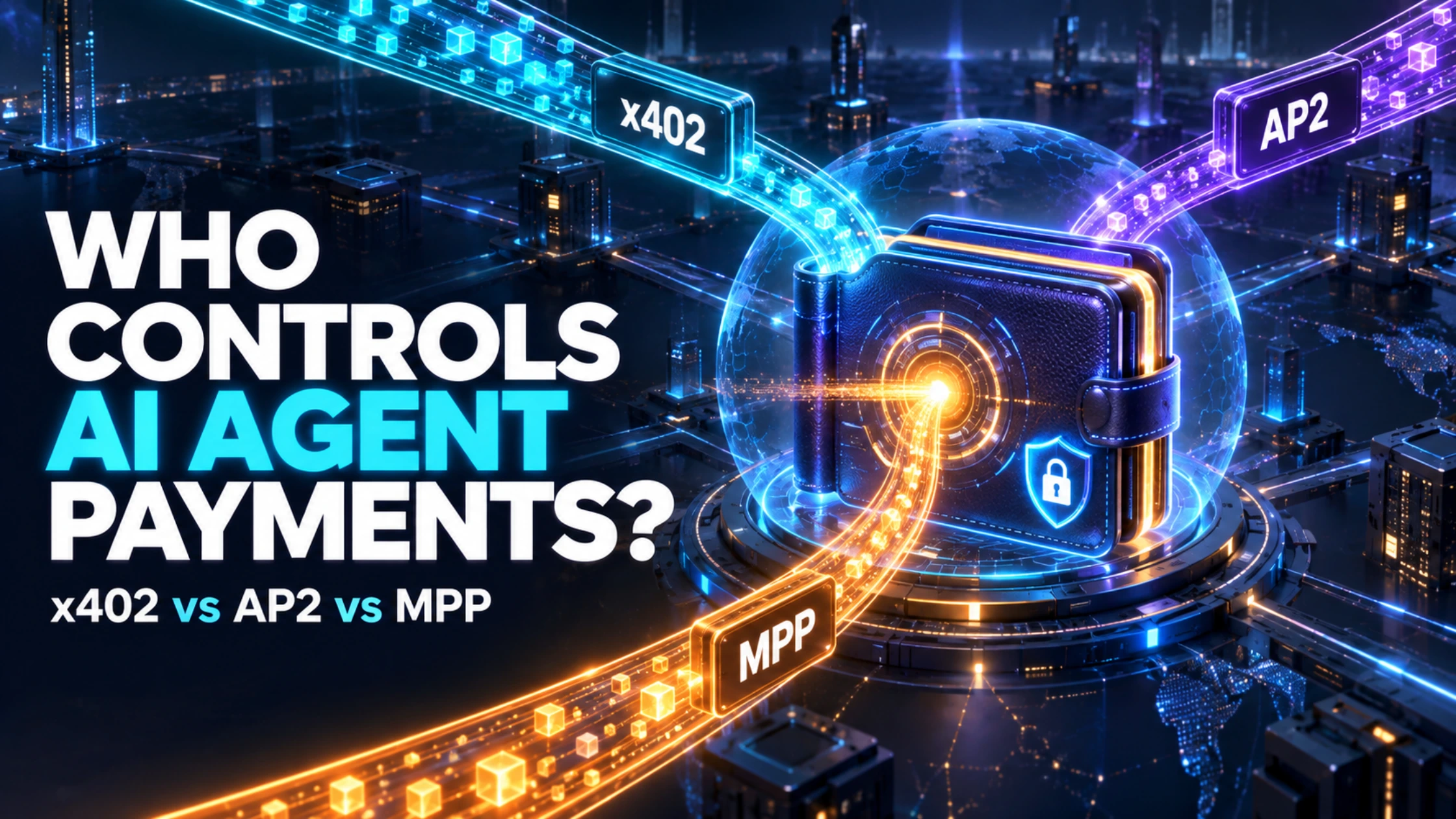
AI agents are beginning to buy data, tools, compute and physical services without navigating a human checkout. The decisive battle is not simply which rail moves money fastest. It is which stack can prove intent, constrain authority, settle value and verify that the paid service was actually delivered.
Updated September 21, 2026 | 18-minute read | Original DN framework and interactive tool
What Matters
These are not equivalent protocols
x402 and MPP operate most directly at the HTTP payment layer. AP2 provides verifiable mandates for agent authorization and accountability. Paid MCP endpoints are resources sold through these mechanisms, not a separate payment protocol.
APIs become products at the moment of use
An agent can discover a tool, receive a machine-readable price, pay and continue its task without a subscription signup, sales call or pre-shared API key.
Payment does not prove fulfillment
A valid authorization and successful settlement do not establish that the data was accurate, the tool completed its task or the purchase reflected unmanipulated user intent.
The Category Error: Rail, Mandate and Resource
The agent-payment market is being described as a single protocol race. That framing is useful for headlines but technically incomplete. Four separate functions are being compressed into one category:
- Intent: What did the user authorize the agent to buy, under which conditions?
- Negotiation: How does a service communicate its price and accepted payment methods?
- Settlement: How does value move and how is payment verified?
- Fulfillment: Did the buyer receive the promised data, computation, tool result or physical product?
x402 and MPP focus heavily on negotiation and settlement through HTTP. AP2 creates cryptographically verifiable records of delegated intent and transaction accountability. MCP can expose a paid tool, but MCP itself does not become the money rail merely because payment gates a tool call.
This distinction leads to the article's central thesis: the most valuable agent-payment infrastructure will bind user intent to price, settlement and verifiable fulfillment across the entire transaction lifecycle.
x402 vs MPP vs AP2 at a Glance
| System | Primary role | Payment methods | Authorization model | Billing models | Strongest fit | Important limitation |
|---|---|---|---|---|---|---|
| x402 | HTTP-native payment negotiation and settlement | Crypto-native, prominently stablecoins across supported networks | Wallet signature plus application policy; optional human approval in clients | Strongest for pay-per-request and metered resources | APIs, data, inference and MCP tools needing rapid stablecoin settlement | Settlement success alone does not prove delegated intent or service quality |
| MPP | Payment-method-agnostic machine payment framework | Stablecoins, cards through Stripe and extensible custom methods | Payment challenge and credential flow, with controls implemented by the client and payment system | One-time charge, measured session and subscription | Businesses needing fiat and crypto options with flexible billing | Broader abstraction increases integration and trust-surface complexity |
| AP2 | Delegated authorization, verifiable intent and accountability | Designed to work across card, bank, wallet and digital-currency rails | Signed checkout and payment mandates using verifiable digital credentials | Human-present and autonomous human-not-present commerce | Retail and higher-stakes purchases where user intent and disputes matter | It is not a universal settlement rail and cannot prevent every upstream manipulation |
| Paid MCP endpoint | Monetized tool or capability | Depends on the payment integration | Depends on client, wallet, mandate and policy layer | Per call, usage session, subscription or contract | Turning specialist tools and data into agent-consumable products | Payment gating does not automatically provide discovery, security or outcome verification |
1. x402: The Crypto-Native Paywall Inside an HTTP Request
x402 revives the HTTP 402 Payment Required status code as a machine-readable payment flow. A client requests a resource. The service responds with payment requirements. The client signs or fulfills payment, retries with a payment credential, and receives the resource plus a response describing settlement.
The commercial breakthrough is removal of conventional onboarding. An agent does not necessarily need to open an account, choose a SaaS tier, store a card or request an API key before purchasing one unit of data or one tool call. Coinbase's current documentation says its CDP stack has processed more than 100 million x402 payments across Base and Solana. That figure demonstrates real transaction volume, although transaction count should not be confused with unique users, revenue or successful downstream outcomes.
x402 is especially natural for stablecoin-denominated digital goods. An inference endpoint, premium article, market-data query or remote MCP tool can quote a price at the point of request. Facilitators can verify and settle payments so sellers do not need to run direct blockchain infrastructure.
Where x402 is strongest
- Small, frequent purchases for digital resources
- Stablecoin-native businesses and global machine customers
- Pay-per-call APIs and MCP tools
- Services that want payment without account creation
The hidden risk
Facilitators can become concentrated trust points. A July 2026 research study examining 15 major facilitators reported rule violations across all evaluated facilitators and described risks including unauthorized free access, asset theft, service denial and gas abuse. A later fix can mitigate a disclosed implementation flaw, but it does not remove the structural need to audit facilitator behavior, idempotency, replay protection and settlement assumptions.
2. MPP: One Machine Interface for Stablecoins, Cards and Recurring Billing
The Machine Payments Protocol was introduced by Stripe and Tempo in March 2026 as an open, internet-native way for machines to coordinate payments. Cloudflare's implementation describes MPP as a formal payment authentication scheme built around HTTP 402. A service returns a challenge, the client fulfills it, retries with a payment credential and receives a receipt.
MPP's strategic difference is payment-method neutrality. It supports stablecoins, cards through Stripe and custom methods. It also defines three commercial intents: a one-time charge, a metered session and a recurring subscription. That makes it applicable to more than atomic micropayments.
The protocol is also designed to be backward-compatible with existing x402 services. An MPP-aware client can consume an x402 endpoint without requiring that service to change. If this compatibility holds across production implementations, MPP can compete at the client layer while absorbing rather than displacing some x402 supply.
Where MPP is strongest
- Businesses that cannot require every customer to hold stablecoins
- Usage sessions such as browsers, compute or long-running services
- Recurring machine subscriptions
- Merchants already using conventional payment processors
The hidden risk
Payment-method breadth does not eliminate payment-method differences. Cards, stablecoins and custom rails have different finality, dispute, fraud, fee and identity properties. A unified interface can simplify integration while leaving materially different risk beneath the abstraction.
3. AP2: Proving What the Human Actually Authorized
Google introduced the Agent Payments Protocol in September 2025 and released version 0.2 in April 2026 while donating the project to the FIDO Alliance. AP2 is an open protocol for secure and interoperable agent commerce. It operates as an extension for A2A and the Universal Commerce Protocol, with additional integrations developing.
AP2's core innovation is the mandate. Verifiable digital credentials record the user's constraints and the final transaction. A checkout mandate captures what is being purchased. A payment mandate authorizes the payment instrument and amount. Open mandates can define budgets and conditions for autonomous execution; closed mandates bind authorization to a finalized checkout.
This directly addresses a question that a payment signature alone cannot answer: did the agent have authority to make this particular purchase on these terms? The resulting audit trail can support accountability and disputes across the user, agent, merchant, credential provider and payment processor.
Where AP2 is strongest
- Higher-value purchases and physical commerce
- Human-not-present transactions governed by pre-authorized rules
- Situations where merchants and issuers need evidence of intent
- Cross-platform agent commerce using existing payment rails
The hidden risk
Cryptographic mandates can protect transaction data after authorization, but they cannot guarantee that the context producing that authorization was truthful. An August 2026 security analysis of AP2 v0.2 identified high-risk threats across several deployment architectures and concluded that valid signatures alone do not ensure a transaction reflects user intent when pre-authorization context has been manipulated. Prompt injection, compromised tools and deceptive merchant data therefore remain lifecycle risks.
4. Paid MCP Endpoints: The Business Model Hiding Inside the Protocol Debate
MCP makes external tools available to AI applications. When a tool call encounters a payment requirement, an x402- or MPP-aware client can pay and retry the call. Cloudflare documents paid MCP tools for both protocols, and x402 provides an implementation guide for bridging an MCP client to a paid API.
This turns a specialist capability into a machine-purchasable product. A provider can sell one credit-score lookup, one geospatial calculation, one compliance check, one database query or one minute of browser automation without forcing the agent into a conventional SaaS funnel.
The revenue opportunity is large, but pricing design matters. Per-call pricing is simple and can become expensive during retries or multi-step reasoning. Session pricing suits sustained compute. Subscriptions work for predictable repeat use but reintroduce commitments and account state. Outcome-based pricing aligns incentives but requires a trusted definition of success.
| Model | Best for | Agent advantage | Provider risk | Buyer risk |
|---|---|---|---|---|
| Per call | Data queries and atomic tools | Exact consumption, no commitment | Revenue volatility | Retry loops and fragmented charges |
| Metered session | Compute, browsing and streaming workflows | Continuous access during a task | Measurement disputes | Runaway sessions |
| Subscription | Repeat, predictable workloads | Stable access and budgeting | Underused capacity | Zombie renewals and lock-in |
| Outcome based | Leads, settlement and completed workflows | Pay for value rather than attempts | Attribution disputes | Manipulated success criteria |
The DN Agent Payment Readiness Index
The DN Agent Payment Readiness Index, or DN-APRI, is a 100-point framework for evaluating whether an agent-payment implementation is ready for controlled production use. It scores the full lifecycle rather than rewarding settlement speed alone.
| Dimension | Weight | Evidence required | Failure it addresses |
|---|---|---|---|
| Verifiable intent | 15 | Signed or auditable purchase constraints bound to the transaction | The agent buys something the user did not mean to authorize |
| Delegated authority | 15 | Agent identity, permitted instruments, limits and expiry | A compromised agent exceeds its mandate |
| Price negotiation | 10 | Machine-readable amount, currency, recipient, expiry and resource | Ambiguous or substituted payment terms |
| Settlement integrity | 10 | Idempotency, replay resistance, receipt and finality handling | Duplicate, forged or inconsistent payment |
| Spending controls | 15 | Per-call, daily, merchant, category and cumulative limits | Runaway loops or budget exhaustion |
| Security architecture | 15 | Key isolation, facilitator controls, dependency review and incident process | Credential theft or shared-infrastructure compromise |
| Fulfillment binding | 10 | Payment linked to the correct response, tool result or delivery evidence | Payment succeeds but the service fails or changes |
| Recovery | 5 | Refund, dispute, cancellation and human escalation paths | Irreversible loss after error or fraud |
| Commercial transparency | 5 | Total price, network fees, facilitator fees, recurring terms and tax treatment | Agents optimize headline price while ignoring total cost |
Hard gates
- Delegated: requires explicit authority and expiry, not possession of a funded wallet alone.
- Budget-Safe: requires enforceable transaction and cumulative spending limits.
- Production-Ready: requires replay protection, idempotency, receipts and a failure-recovery process.
DN Agent Payment Rail Selector
Describe the transaction. The selector identifies the strongest starting architecture and the control that matters most.
Required control:
Illustrative exposure:
This is an architectural screening tool, not payment, legal, security or financial advice. Confirm protocol and processor support in the intended jurisdiction.
The Architecture DN Expects to Win
The durable agent-payment stack will be modular:
- Discovery: the agent finds a capability and its commercial terms.
- Intent: a mandate or policy establishes what the user authorizes.
- Negotiation: HTTP or MCP communicates price and accepted methods.
- Settlement: x402, MPP or another compatible rail moves value.
- Fulfillment: the service response is bound to the payment and tested.
- Reconciliation: receipts, refunds, tax records and disputes remain available.
AP2 can therefore complement x402 or MPP. Indeed, AP2 documentation includes an autonomous x402 example. The meaningful competition is at each layer: which mandate standard, negotiation format, settlement method, facilitator, wallet-policy engine and verification provider becomes the default.
DN Alpha Thesis: The Wallet Policy Engine Becomes the Agent's CFO
The visible protocols will attract attention, but the defensible control point may be the policy engine between an agent and its money. This layer decides whether a payment is permitted, whether human approval is needed, which rail to use and whether the expected value justifies the cost.
A sophisticated policy engine can enforce:
- Maximum cost per tool call and per completed task
- Daily, weekly and lifetime budgets
- Merchant and category allowlists
- Dynamic approval thresholds
- Retry and duplicate-payment limits
- Maximum network and facilitator fees
- Proof-of-delivery requirements
- Emergency pause and key rotation
This creates a major DN data opportunity: a public Agent Payment Cost and Reliability Observatory comparing quoted price, total settled cost, latency, failure rate, duplicate prevention, refund availability and fulfillment quality across paid tools. The dataset can support editorial rankings, an API, enterprise research, verified provider profiles and benchmark sponsorships without selling favorable scores.
Commercial Opportunities for Builders and Publishers
| Opportunity | Customer | Revenue model | Defensible data |
|---|---|---|---|
| Paid specialist MCP tools | Agents and workflow developers | Per call, session or subscription | Task completion, latency and cost history |
| Agent payment policy engine | Enterprises and wallet providers | SaaS plus transaction fee | Risk rules and anomalous-spend patterns |
| Payment facilitator intelligence | Merchants and auditors | Monitoring subscription or API | Availability, settlement and incident history |
| Fulfillment oracle | Outcome-priced services | Verification fee | Independent evidence of completed work |
| Agent expense management | Businesses operating agent fleets | Seat, wallet or spend-based pricing | Budget, attribution and reconciliation graph |
| DN payment benchmark | Buyers, providers and researchers | Research, API, sponsorship and leads | Independent longitudinal transaction tests |
What Would Prove This Thesis Wrong?
The modular-stack thesis would weaken if one network or platform bundled discovery, authorization, payment, fulfillment and dispute handling so effectively that developers abandoned open interoperability. It would also weaken if most agent transactions remained low-risk internal accounting events rather than purchases across organizational boundaries.
DN will monitor four falsification signals: concentration of paid agent traffic in one closed ecosystem, failure of HTTP 402 protocols to move beyond demonstrations, merchants rejecting autonomous purchases because liability remains unclear, and persistent user preference for human checkout. Until then, open and composable agent-payment infrastructure remains the stronger trajectory.
DN-APRI Methodology
Version 1.0: published September 21, 2026. DN-APRI evaluates an implementation, not a protocol name in isolation. Scores should reflect the actual client, wallet, facilitator, processor, merchant and recovery path used in production.
Testing: record price challenge contents, authorization policy, settlement result, latency, fees, receipt, idempotency behavior, response integrity and recovery outcome. Repeat testing across ordinary failures, retries and adversarial inputs.
Evidence boundary: documentation proves stated design. Code review helps assess implementation. Controlled transactions provide operational evidence. None alone proves safety under every environment.
Update policy: rescore after material specification, SDK, facilitator, payment-method, security or governance changes and at least quarterly for active implementations.
Primary Sources and Research
- Coinbase Developer Documentation: x402 Overview, accessed September 21, 2026.
- x402 Foundation and protocol resources.
- Agent Payments Protocol Documentation, including mandates and version 0.2 resources.
- Google: AP2 donation to the FIDO Alliance and version 0.2 release, April 28, 2026.
- Stripe: Introducing the Machine Payments Protocol, March 18, 2026.
- Cloudflare Agents: MPP documentation, updated August 5, 2026.
- Cloudflare Agents: Agentic Payments, updated August 5, 2026.
- x402 Documentation: MCP Server with x402.
- Beyond the Mandate: A Systematic Security Analysis of AP2, August 2026.
- When HTTP 402 Meets the Blockchain: Risks on Emerging x402 Payments, July 2026.
Frequently Asked Questions
What is x402?
x402 is an open HTTP payment protocol that allows a service to return machine-readable payment requirements and a client to pay and retry the request. It is strongly associated with stablecoin payments for APIs, content and tools.
What is the Machine Payments Protocol?
MPP is an open, payment-method-agnostic protocol for machine payments using HTTP 402 and payment authentication headers. It supports stablecoins, cards and extensible payment methods, plus charge, session and subscription intents.
What is AP2?
The Agent Payments Protocol is an open framework for verifiable agent authorization and transaction accountability. It uses signed checkout and payment mandates to record user intent and payment authority.
Does AP2 compete directly with x402?
Only partly. AP2 primarily addresses intent, authorization and accountability, while x402 primarily handles payment negotiation and settlement. AP2 can use x402 as a payment method.
Can MPP clients use x402 services?
Cloudflare's current documentation states that MPP is backward-compatible with x402 and that MPP clients can consume existing x402 services without changes to those services.
What is a paid MCP endpoint?
It is an MCP tool or server capability that requires payment before or during access. The payment can be handled by x402, MPP or another integrated payment system.
Are agent payments safe?
They can be controlled, but no protocol eliminates every risk. Safe deployment requires explicit authority, spending limits, key isolation, replay protection, idempotency, receipts, fulfillment checks and recovery procedures.
Can an agent pay without a human approving every transaction?
Yes, when the agent operates under pre-authorized constraints. The safer design limits amount, merchant, category, duration, frequency and permitted payment instruments.
Which protocol is best for micropayments?
x402 is a strong fit for stablecoin-native atomic digital purchases. MPP may be preferable when multiple payment methods or session and subscription billing are required.
What does the DN Agent Payment Readiness Index measure?
DN-APRI scores verifiable intent, delegated authority, price negotiation, settlement integrity, spending controls, security, fulfillment, recovery and commercial transparency.